Pediatric Dental Marketing: A Complete Guide
Posted on 2/19/2026 by WEO Media |
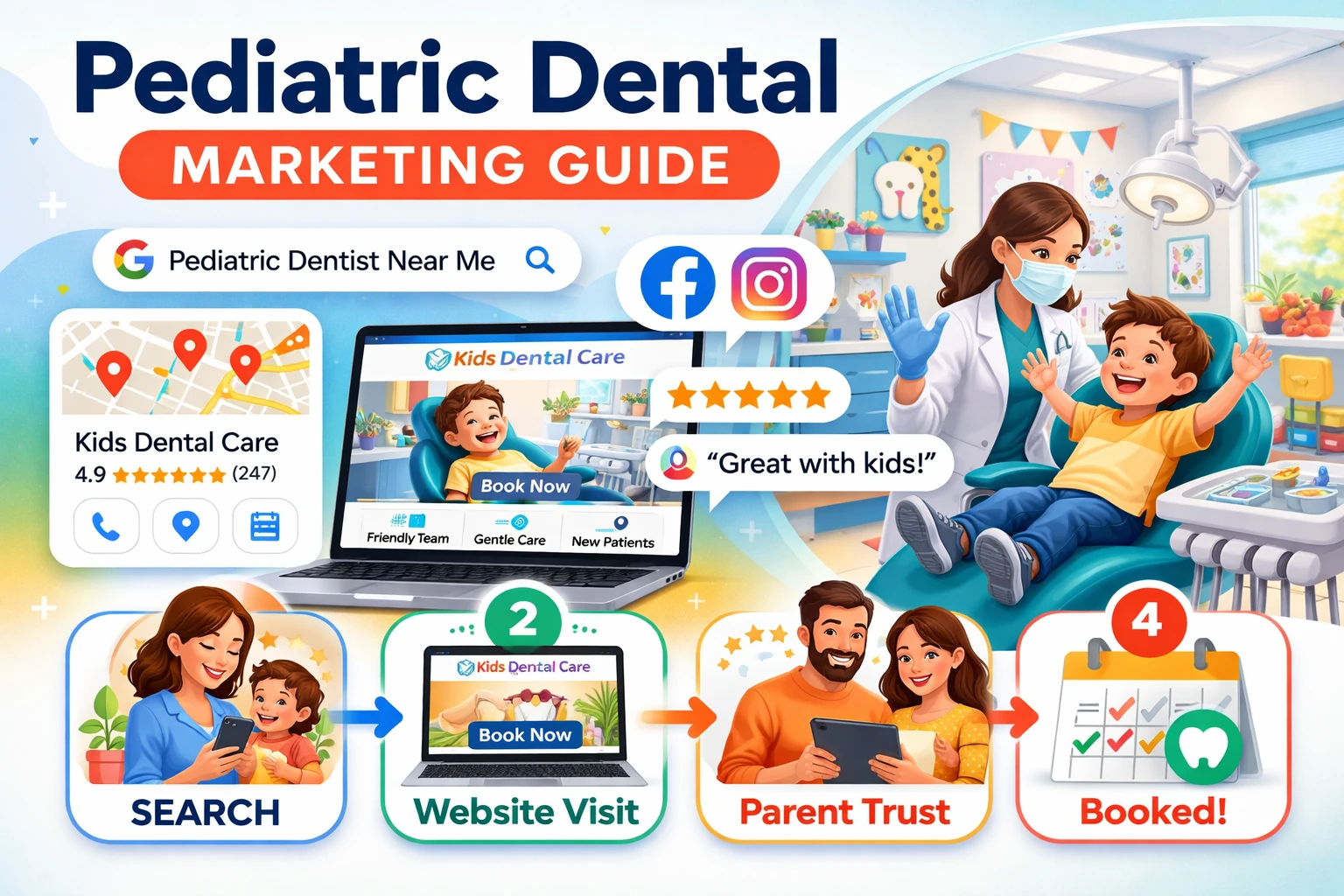 Pediatric dental marketing is the multi-channel strategy children’s dental practices use to attract more families—covering SEO, paid advertising, website optimization, reputation management, social media, and community outreach—all built around the core challenge that makes it fundamentally different from general dental marketing: your patients are children, but your marketing audience is parents. Unlike marketing directly to adult patients, pediatric dental marketing requires dual-audience messaging: you need to reassure parents about safety, credentials, and comfort while simultaneously signaling to children that your office is a place they don’t need to fear. Pediatric dental marketing is the multi-channel strategy children’s dental practices use to attract more families—covering SEO, paid advertising, website optimization, reputation management, social media, and community outreach—all built around the core challenge that makes it fundamentally different from general dental marketing: your patients are children, but your marketing audience is parents. Unlike marketing directly to adult patients, pediatric dental marketing requires dual-audience messaging: you need to reassure parents about safety, credentials, and comfort while simultaneously signaling to children that your office is a place they don’t need to fear.
Parents research pediatric dentists while juggling school pickups, work schedules, and bedtime routines—usually from their phones. They’re comparing 3–5 local practices through Google listings, websites, and reviews before making contact. Your website, your online reputation, and your local search presence must immediately communicate pediatric expertise, convenience, and warmth, or parents move on to the next result.
Already have a marketing foundation in place? Use the table of contents to jump to the channel or strategy that needs attention. Starting from scratch? Read straight through—this guide builds from foundational elements to advanced tactics.
Start here: brand and website foundation, SEO and local search, Google Business Profile, paid advertising, reputation management, KPIs and reporting
This complete guide to pediatric dental marketing covers every channel and tactic specific to children’s dental practices. You’ll find actionable frameworks, real-world benchmarks, and the operational details that separate practices generating 30+ new child patients per month from those wondering why the phone isn’t ringing.
Written for: pediatric dental practice owners, office managers, and marketing teams who want a structured, channel-by-channel system for attracting more families and converting parent interest into kept appointments.
TL;DR
If you focus on seven things, prioritize these:
| • |
Optimize your Google Business Profile for pediatric-specific searches - complete every field, choose “Pediatric Dentist” as your primary category, and post weekly with parent-focused content
|
| • |
Build a website that speaks to parents first - mobile-first design, sub-2-second load times, clear service pages for each age group, and online scheduling that takes fewer than 3 clicks
|
| • |
Earn and manage Google reviews consistently - aim for 5+ new reviews per month with a system that makes leaving feedback easy for busy parents
|
| • |
Run pediatric-specific paid campaigns - target high-intent keywords like “pediatric dentist near me” and “children’s dentist [city]” with ad copy that speaks directly to parent concerns
|
| • |
Create content that answers what parents actually search - first dental visit guides, teething timelines, cavity prevention tips, and dental anxiety resources
|
| • |
Build community presence beyond digital - school partnerships, pediatrician referral relationships, and local event sponsorships create trust that online-only marketing cannot
|
| • |
Track the metrics that matter - new patient calls by source, cost per new family, website conversion rate, and review velocity tell you what’s working and what’s leaking |
Table of Contents
Why pediatric dental marketing requires its own strategy
A pediatric dental practice cannot simply copy a general dentist’s marketing playbook and expect results. The differences run deeper than swapping stock photos of adults for photos of children. Three structural factors make pediatric marketing fundamentally different.
You’re marketing to one audience while serving another. Parents choose the dentist; children receive the care. This means your messaging, ad copy, website content, and even your visual branding must simultaneously address two sets of emotional needs. Parents need to see credentials, safety protocols, and evidence that your team handles anxious kids well. Children need visual cues that your office feels safe and even fun. Getting this balance wrong—too clinical for parents, too cartoonish for credibility—is the most common branding mistake in pediatric dentistry.
The decision timeline is different. Parents don’t search for a pediatric dentist on a whim. They’re usually triggered by a specific event: a child’s first birthday approaching, a school dental notice, a toddler’s complaint about tooth pain, or a move to a new area. This means your marketing needs to be visible at the moment of need—which is why local search visibility and Google Business Profile completeness matter so much for pediatric practices. Understanding the patient journey from awareness to acceptance helps you place the right message at each stage.
Lifetime value is measured in families, not individuals. A single child patient often leads to siblings, parents seeking their own dentist nearby, and a referral network within the family’s school community. A practice that acquires one family effectively may gain 3–5 patients over time. This changes how you should think about acquisition cost—and why the patient experience itself is a marketing channel.
> Back to Table of Contents
Building your marketing foundation: brand, website, and messaging
Before investing in any paid channel, your practice needs three foundational elements in place. Without these, every dollar spent on PPC or SEO drives traffic to an experience that doesn’t convert.
Pediatric-specific branding
Your brand should communicate pediatric expertise within the first two seconds of any touchpoint—website, business card, office signage, or social media profile. This doesn’t mean your logo needs cartoon characters. It means your visual identity, color palette, and messaging tone should be warm, approachable, and clearly oriented toward families.
What strong pediatric branding includes:
| • |
A name that signals your audience - practice names that include words like “kids,” “children’s,” “pediatric,” or “family” immediately tell parents they’re in the right place
|
| • |
Consistent visual identity across every channel - your website, social profiles, Google Business Profile photos, and printed materials should all feel like the same practice
|
| • |
Messaging that leads with parent concerns - “gentle care for growing smiles” resonates more than “comprehensive pediatric dental services”
|
| • |
Photography that shows your actual office and team - professional practice photography with real team members and your actual space builds far more trust than stock images of smiling children |
A website built for parents on mobile
Your website is the most important conversion tool in your marketing stack. For pediatric practices, the design and content must be structured for both users and search engines with a specific understanding: parents are the visitors, and they’re overwhelmingly visiting from phones.
Critical website elements for pediatric dental practices:
| • |
Mobile-first, fast-loading design - page load speed directly impacts patient conversion; pages should load in under 2 seconds; mobile now accounts for more than 60% of global web traffic, and parents searching “pediatric dentist near me” are almost always on their phones
|
| • |
Clear service pages organized by patient need - separate pages for first dental visits, preventive care, sealants, orthodontic evaluations, sedation dentistry, and emergency care; each page should answer the parent’s core question in plain language
|
| • |
Online scheduling with minimal friction - the booking process should take fewer than 3 clicks from any page; requiring a phone call during business hours loses parents who are researching at 10 PM
|
| • |
Visible trust signals above the fold - board certification, years in practice, Google review rating, and parent testimonials should be immediately visible without scrolling; live chat widgets also give parents an instant way to ask questions without committing to a phone call
|
| • |
A dedicated “first visit” page - this is the highest-intent page for new patient parents; it should cover what to bring, what to expect, how long it takes, and how your team handles nervous children; your homepage layout and CTAs should make this page easy to find within one click |
A common mistake we see in dental website messaging is writing for other dentists instead of for parents. Avoid clinical jargon. A parent doesn’t search for “prophylaxis”—they search for “teeth cleaning for kids.”
Messaging that converts parent interest into action
Every piece of content on your website and in your marketing should answer three unspoken parent questions: Is my child safe here? Will my child be comfortable? Is this practice convenient for our family? Applying the principles of website copy that converts visitors into patients to your pediatric-specific messaging makes the difference between a site that informs and one that books.
High-converting messaging patterns for pediatric practices:
| • |
Lead with empathy, not credentials - “We know a dental visit can feel scary for little ones—our team is trained to make every child feel safe” outperforms “Our board-certified pediatric dentists provide comprehensive oral care”
|
| • |
Address anxiety directly - parents whose children have dental fear need to see that you understand and have protocols for it, not just that you offer sedation as a line item
|
| • |
Show the experience, not just the services - describe what a first visit looks like minute by minute; this reduces the unknown and builds confidence
|
| • |
Use parent language - “cavity prevention for kids” instead of “pediatric caries management”; “braces for teens” instead of “adolescent orthodontic intervention” |
> Back to Table of Contents
SEO and local search for pediatric dentists
For most pediatric dental practices, search engine optimization is the highest-ROI marketing channel over time. Parents searching “pediatric dentist near me” or “children’s dentist [city]” have high intent—they’re actively looking for a provider, not casually browsing. Ranking well for these searches puts your practice in front of families at the exact moment they’re ready to book.
Keyword strategy for pediatric practices
Your keyword strategy should be organized around three intent levels:
| • |
High-intent, appointment-ready keywords - “pediatric dentist near me,” “children’s dentist [city],” “kids dentist accepting new patients,” “pediatric dentist open Saturday”; these drive direct bookings and should be your top SEO and PPC priority
|
| • |
Service-specific keywords - “dental sealants for kids,” “baby’s first dental visit,” “pediatric dental sedation,” “children’s emergency dentist”; each of these should map to a dedicated service page on your site
|
| • |
Informational and trust-building keywords - “when should a child first see a dentist,” “how to help a child with dental anxiety,” “are dental x-rays safe for kids”; these attract parents earlier in the research phase and are ideal for blog content |
A pattern we see consistently: practices that build separate, keyword-optimized pages for each service—rather than listing everything on one “services” page—rank for significantly more searches. Each page becomes a potential entry point from Google.
Local SEO fundamentals
Pediatric dental searches are inherently local. Parents aren’t looking for a children’s dentist three towns away. This makes local SEO ranking factors especially important for your practice.
Core local SEO actions:
| • |
NAP consistency - your practice name, address, and phone number must be identical across your website, Google Business Profile, Yelp, Healthgrades, and every directory where you appear; even small variations (“Street” vs. “St.”) can dilute your local rankings
|
| • |
Location-specific content - create content that references your community, local schools, neighborhood events, and area-specific oral health topics; this helps Google understand your geographic relevance
|
| • |
Service area pages
- if you draw patients from surrounding towns, build dedicated pages targeting those areas with content specific to each location
|
| • |
“Near me” search optimization
- ensure your site’s technical SEO supports proximity-based searches, which dominate how parents find pediatric dentists on mobile |
Content that builds topical authority
Google increasingly rewards sites that demonstrate comprehensive expertise in a specific area. For a pediatric dental practice, this means building a content cluster strategy that covers the full scope of children’s oral health—not just publishing a blog post whenever inspiration strikes.
A sustainable content approach: publish 1–2 well-researched articles per month targeting specific parent questions. Over 12 months, that builds a library of 12–24 pages, each ranking for its own set of keywords and collectively signaling to Google that your site is an authority on pediatric dental topics. Building strong E-E-A-T signals through this content—experience, expertise, authoritativeness, and trustworthiness—is what separates sites that rank from those that don’t. Topics like “teething timeline for babies,” “how to prevent cavities in toddlers,” and “what to do if your child chips a tooth” attract consistent search volume and build trust with parents before they ever call.
> Back to Table of Contents
Google Business Profile optimization
Your Google Business Profile is often the first thing parents see when they search for a pediatric dentist. In many cases, parents make their decision based on your GBP listing alone—without ever visiting your website. A complete, optimized profile is not optional.
Category and attribute setup
Set “Pediatric Dentist” as your primary business category. This is the single most important GBP setting for ensuring you appear in relevant pediatric searches. Add secondary categories only for services you actively provide, such as “Orthodontist” if you offer orthodontic treatment.
Complete every available attribute: wheelchair accessibility, appointment-required status, accepted insurance types, and amenities. These attributes help Google match your listing to specific search queries and help parents pre-qualify your practice before calling.
Photos, posts, and profile completeness
Profile completeness directly influences how often and where your listing appears. Upload high-quality photos of your waiting room, treatment areas, and team members. Parents want to see what their child’s experience will look like before they arrive.
GBP posting for pediatric practices: post at least weekly with content that serves parent needs. Effective posts include seasonal oral health tips (back-to-school dental checkup reminders, Halloween candy guidance), first visit preparation advice, and behind-the-scenes glimpses of your child-friendly office. Avoid purely promotional posts—parent-focused Google Business Profile posts that educate and reassure consistently outperform discount announcements.
Q&A section management
Google’s Q&A feature on your Business Profile allows anyone to ask and answer questions about your practice. Proactively seed this section with the questions parents most commonly ask: “Do you accept new patients?” “What ages do you treat?” “Do you offer sedation for anxious children?” “Do you accept [insurance name]?”
Answer each question yourself with clear, helpful responses. Unmanaged Q&A sections often accumulate incorrect answers from random users—and those answers influence whether parents call.
> Back to Table of Contents
Paid advertising for pediatric dental practices
While SEO builds long-term visibility, paid advertising delivers families now. For pediatric practices, the key is targeting the right searches with messaging that speaks directly to parent priorities—not running generic dental ads and hoping families respond.
Google Ads for pediatric dentists
Google Ads puts your practice at the top of search results for high-intent queries. For pediatric dental campaigns, the most effective approach structures campaigns around specific keyword groups with dedicated ad copy and landing pages.
High-performing keyword groups:
| • |
Core appointment keywords - “pediatric dentist near me,” “children’s dentist [city],” “kids dentist near me”; these have the highest conversion rates because intent is clear
|
| • |
Service-specific keywords - “pediatric dental sedation [city],” “baby first dental visit [city],” “emergency pediatric dentist”; these often have lower competition and cost less per click
|
| • |
Insurance and affordability keywords - “pediatric dentist that accepts Medicaid,” “kids dentist [insurance name]”; if your practice accepts specific plans, targeting these queries captures a high-intent segment that competitors may ignore |
Ad copy that converts parents: your ads should immediately communicate three things: you specialize in children, you’re nearby, and you make dental visits comfortable. Headlines like “Gentle Pediatric Dentist in [City]” and descriptions that mention “kid-friendly office,” “same-week appointments,” and “accepting new patients” consistently outperform generic dental ad copy. Each ad group should point to a dedicated landing page tailored to the specific search intent—not your homepage.
Google Local Services Ads
Local Services Ads (LSAs) appear above traditional search ads and operate on a pay-per-lead model rather than pay-per-click. For pediatric dental practices, LSAs are particularly effective because they display your Google review rating, years in business, and a “Google Verified” badge that builds immediate trust.
The pay-per-lead model means you only pay when a parent actually contacts your practice—not when they simply see or click your ad. For practices with strong review profiles, LSAs often deliver the lowest cost per new patient of any paid channel.
Social media advertising
Facebook and Instagram ads are valuable for pediatric practices because they allow precise targeting: parents in your geographic area with children in specific age ranges. Unlike search ads, social ads reach parents before they actively search—making them ideal for building awareness and staying top of mind. Retargeting ads can also re-engage parents who visited your website but didn’t schedule.
Effective social media ad formats for pediatric practices include short video tours of your office, parent testimonial clips, and educational content about children’s dental milestones (first visit, losing baby teeth, orthodontic evaluations). Image and video ads that show real team members interacting with children consistently outperform stock photo ads.
> Back to Table of Contents
Reputation management and parent reviews
For pediatric dental practices, online reviews carry more weight than in almost any other dental specialty. Parents choosing a healthcare provider for their child rely heavily on what other parents say. Your reputation management strategy must be systematic, not occasional. Building a comprehensive dental reputation strategy is one of the highest-ROI investments a pediatric practice can make.
Building a review generation system
The most effective approach to generating Google reviews is making the process as easy as possible for busy parents. A text message with a direct link to your Google review page, sent within 1–2 hours of the appointment, consistently produces the highest response rates.
What works for pediatric practices:
| • |
Ask at the right moment - the ideal time is when the parent is watching their child happily receive a sticker or prize after the visit; that emotional high translates into more detailed, positive reviews
|
| • |
Make it one-tap easy - a direct link in a text message eliminates friction; asking parents to “find us on Google and leave a review” produces far fewer responses
|
| • |
Set a volume target - aim for 5+ new reviews per month; practices with 100+ Google reviews and a 4.8+ rating dominate local search results for pediatric dental queries
|
| • |
Respond to every review - thank positive reviewers by name, and address concerns in negative reviews professionally and empathetically; how you respond to a complaint tells prospective parents as much as the complaint itself |
Managing negative reviews
Negative reviews happen to every practice. What matters is how you handle them. A professional, empathetic review response that acknowledges the parent’s experience and offers to resolve the issue offline demonstrates exactly the kind of care parents want to see.
Critical rules for pediatric practices: never disclose patient information in a review response—even confirming that a child was a patient violates HIPAA compliance requirements. Keep responses focused on your commitment to every family’s experience, and invite the parent to contact your office directly to discuss their concerns.
> Back to Table of Contents
Social media strategy for pediatric practices
Social media serves a different role for pediatric dentists than for general practices. Parents don’t follow a children’s dentist expecting promotional content—they follow because they want to feel connected to the practice that cares for their child and to get useful tips for managing their child’s dental health at home.
Platform priorities
Focus your efforts where your audience actually spends time:
| • |
Facebook - remains the primary platform for parent communities and local discussions; ideal for community engagement, event promotion, and longer-form educational content
|
| • |
Instagram
- effective for visual storytelling; behind-the-scenes content, office environment showcases, and team introductions perform well
|
| • |
YouTube
- video content like office tours, “what to expect at your first visit” walkthroughs, and brushing technique demonstrations build trust and support SEO through video search results
|
| • |
TikTok - short-form video content can reach younger parents effectively; behind-the-scenes clips, dental myth-busting, and kid-friendly educational content perform well on this platform; if considering paid promotion, explore whether TikTok ads fit your audience |
A common mistake is trying to maintain a strong presence on every platform. Pick two and do them well before expanding. Consistency beats breadth.
Content that works for pediatric dental social media
The content mix that sustains engagement:
| • |
Educational tips parents can use at home - brushing technique for toddlers, when to switch from training toothpaste to fluoride, snack choices that protect teeth; these provide genuine value and get shared
|
| • |
Behind-the-scenes team content - introduce dental assistants, show how your team prepares the room for a nervous child, highlight continuing education and certifications; this humanizes your practice
|
| • |
Patient milestones (with permission) - “first visit” celebrations, lost tooth photos, braces-off reveals; parents love seeing their child featured, and this content generates organic engagement
|
| • |
Community involvement - school visits, local event sponsorships, dental health month activities; this demonstrates your investment in the community beyond the treatment room
|
| • |
Seasonal and timely content - back-to-school dental checkup reminders, Halloween candy buyback promotions, sports mouthguard awareness during sports seasons |
Post consistently—3–5 times per week is a sustainable target for most practices. A content calendar planned monthly prevents the “what should we post today?” scramble that leads to inconsistent publishing.
> Back to Table of Contents
Content marketing that attracts families
Content marketing for pediatric dental practices serves two purposes: it brings parents to your website through search (SEO) and it builds trust once they arrive. The most effective pediatric dental content answers questions parents are actively asking—and answers them better than the generic health sites competing for the same searches.
High-value content topics for pediatric practices
These topics consistently drive traffic and build parent trust:
| • |
First dental visit guides - “When should my child first see a dentist?” and “What to expect at your child’s first dental visit” are among the most-searched pediatric dental queries; a comprehensive guide on your site can rank well and serve as a first touchpoint for new families
|
| • |
Age-based dental care timelines - content organized by developmental stage (infant, toddler, school-age, teen) helps parents find exactly what’s relevant to their child right now
|
| • |
Dental anxiety management - articles and videos about how your practice helps anxious children are among the highest-converting content types for pediatric dentists; parents searching for help with dental fear are highly motivated to find a practice that gets it
|
| • |
Preventive care education - sealants, fluoride treatments, proper brushing techniques, diet and cavity prevention; this content positions your practice as an authority while naturally leading parents toward booking preventive visits
|
| • |
Orthodontic readiness - “When does my child need braces?” and “Signs your child may need an orthodontic evaluation” capture parents at a high-value decision point, especially if your practice offers orthodontic services; see also orthodontic marketing strategies for attracting these families
|
| • |
Emergency guidance - “What to do if your child knocks out a tooth” and “Is this a dental emergency?” content serves parents in crisis moments and can drive urgent appointments |
Content format and distribution
Blog posts are the foundation, but effective content marketing for pediatric practices extends beyond written articles. Short-form video (60–90 seconds) explaining common parent questions performs well on social media and YouTube. Patient education videos covering topics like brushing technique and first-visit preparation build trust while parents are still in research mode. Downloadable resources like a “First Visit Preparation Checklist” or “Age-by-Age Dental Care Guide” can serve as patient acquisition tools and email list builders.
Distribution cadence that works: publish one blog post per month, share it across social media channels, repurpose key points into 2–3 social media posts, and send it to your email newsletter list. This approach extracts maximum value from each piece of content without requiring a full-time content team.
> Back to Table of Contents
Community outreach and referral partnerships
Digital marketing drives the majority of new patient volume for most pediatric dental practices, but community-based strategies create the kind of trust and brand recognition that online channels alone cannot replicate. Practices that combine strong digital presence with active community involvement consistently outperform those relying on a single approach.
Pediatrician and physician referral relationships
Pediatricians are the most natural referral source for children’s dentists. Many parents ask their child’s doctor for a dental recommendation before searching online. Building a relationship with local pediatric offices—providing them with referral cards, offering to give a brief lunch-and-learn on children’s oral health, and making it easy for them to recommend you—can produce a steady stream of high-trust new families.
What makes physician referrals work: make the referral easy. Provide a simple card with your practice name, phone number, and a QR code linking to your online scheduling page. Follow up with a thank-you note when a referred family books. The practices that maintain these relationships with small, consistent gestures generate more referrals than those that make one outreach attempt and forget.
School and daycare partnerships
Schools and daycares give you direct access to the families you want to reach. Effective school-based outreach includes:
| • |
Dental health presentations - short, fun presentations for students with take-home materials for parents; these position your practice as a community resource and put your name in front of families
|
| • |
School supply or event sponsorships - sponsoring a school fun run, back-to-school night, or PTA event puts your brand in front of engaged local parents
|
| • |
Dental screening events - offering free dental screenings at schools or community health fairs demonstrates commitment to children’s health while creating opportunities for parents to schedule follow-up appointments
|
| • |
Supply toothbrush kits - branded toothbrush kits sent home with students create a tangible touchpoint that parents see and associate with your practice |
Local event and sponsorship strategy
Sponsoring local youth sports teams, community festivals, and family-oriented events keeps your practice visible in the community. The key is choosing sponsorships that align with your target audience—families with children—rather than broad community events that reach everyone. A youth soccer league sponsorship puts your logo on jerseys that parents see every weekend. A float in the local holiday parade puts your team in front of thousands of families. These touchpoints compound over time and create the kind of brand familiarity that makes parents think of you first when they need a children’s dentist.
> Back to Table of Contents
Measuring what matters: KPIs and reporting
A pediatric dental marketing strategy without measurement is just activity. The difference between practices that grow predictably and those that wonder whether marketing is “working” comes down to tracking the right numbers and reviewing them consistently.
Essential KPIs for pediatric dental practices
| • |
New patient calls and forms by source - track whether new families find you through Google organic search, paid ads, Google Business Profile, social media, or referrals; this tells you where to invest more and where to cut spending
|
| • |
Cost per new family - divide your total marketing spend by the number of new patient families acquired; for pediatric practices, tracking this metric by channel reveals which investments deliver the best return
|
| • |
Website conversion rate - the percentage of website visitors who take action (call, submit a form, book online); if your site gets traffic but few conversions, the issue is your calls to action, messaging, or user experience—not your SEO
|
| • |
Google review velocity and rating - track new reviews per month and your overall rating; declining velocity often signals a process issue at the front desk, not a satisfaction problem
|
| • |
Phone answer rate - a metric most practices don’t track but should; if marketing generates calls that go unanswered, every dollar spent on visibility is partially wasted; intake processes matter as much as lead generation
|
| • |
Kept appointment rate - the percentage of booked appointments that patients actually attend; high no-show rates in pediatric dentistry often point to scheduling friction or insufficient pre-visit communication; strong recall systems and appointment text reminders significantly reduce missed appointments |
Reporting cadence and accountability
Review your marketing KPIs monthly at minimum. A simple monthly dashboard showing new patients by source, cost per acquisition, and review count gives you the information needed to make smart decisions. Setting up Google Analytics 4 properly ensures you have accurate data to work with. Quarterly, look at trends: is organic traffic growing? Are paid campaigns improving or plateauing? Has review velocity changed?
The most important principle: marketing accountability should be based on outcomes (new patients, revenue) rather than activity metrics (impressions, clicks, followers). A practice that generates 40 new patient families per month from a well-measured marketing budget is in a stronger position than one spending more but unable to attribute results to specific channels.
> Back to Table of Contents
Common pediatric marketing mistakes to avoid
In our work with dental practices, these are the errors we see most often in pediatric marketing—and each one is fixable.
| • |
Treating pediatric marketing like general dental marketing - reusing general dental ad copy, website templates, and keyword strategies misses the dual-audience dynamic that defines pediatric dentistry; your marketing must speak to parents as decision-makers and children as patients
|
| • |
Ignoring or neglecting Google reviews - a practice with 12 Google reviews competing against one with 200+ reviews will lose nearly every time, regardless of clinical quality; review generation must be a system, not an afterthought
|
| • |
Running ads without proper tracking - spending on Google Ads or Facebook Ads without call tracking, conversion attribution, and clear ROI measurement means you’re guessing where your money goes; many of the most common Google Ads mistakes dentists make stem from this exact issue
|
| • |
Publishing inconsistently - starting a blog, posting twice, then going silent for six months signals to Google and parents that your practice isn’t actively engaged; a modest but consistent publishing schedule outperforms sporadic bursts every time
|
| • |
Relying on a single channel - practices that depend entirely on Google Ads or entirely on referrals are vulnerable to disruption; a balanced strategy across search, paid, reputation, social, and community creates stability
|
| • |
Using stock photos instead of real images - parents can spot stock photography immediately; it undermines the trust you’re trying to build; invest in professional photography of your actual team and office
|
| • |
Neglecting the phone experience - marketing drives the call, but the front desk experience determines whether that call becomes an appointment; your intake process is the final step in your marketing funnel
|
> Back to Table of Contents
Get help building a pediatric dental marketing strategy that works
Building a pediatric dental marketing strategy that produces predictable new patient growth requires coordinated effort across multiple channels—and the expertise to know which channels matter most for your specific practice, location, and goals. WEO Media - Dental Marketing has helped hundreds of dental practices build the websites, SEO programs, paid campaigns, and reputation systems that drive measurable growth.
If your pediatric practice is ready to attract more families, convert more parent interest into kept appointments, and build the kind of marketing foundation that compounds over time, schedule a consultation with our team or call us at 888-246-6906.
FAQs
How is marketing for a pediatric dentist different from marketing for a general dentist?
Pediatric dental marketing targets parents as the primary audience while creating a brand that appeals to children. This requires dual-audience messaging, kid-friendly visual branding, and content that addresses parent-specific concerns like child comfort, safety, dental anxiety, and age-appropriate care. General dental marketing typically communicates directly to the patient, which simplifies the messaging strategy. Pediatric marketing also tends to rely more heavily on community relationships, school partnerships, and physician referrals than general dental marketing.
What is the best marketing channel for a pediatric dental practice?
No single channel works best in isolation. For most pediatric practices, the highest-impact combination is a well-optimized Google Business Profile, strong local SEO, consistent Google review generation, and targeted Google Ads for high-intent searches. Social media and community outreach serve as important supporting channels that build brand awareness and trust over time. The right mix depends on your market, competition, and current patient volume.
How many Google reviews does a pediatric dental practice need?
There is no universal threshold, but practices with 100+ Google reviews and a rating of 4.8 or higher tend to dominate local search results and convert a higher percentage of profile views into phone calls. More important than reaching a specific number is maintaining consistent review velocity—adding 5 or more new reviews per month signals to Google and to parents that your practice is active and well-regarded.
When should a child first see a dentist, and how does this affect marketing?
The American Academy of Pediatric Dentistry recommends a child’s first dental visit by age 1 or within 6 months of the first tooth erupting. From a marketing perspective, this creates opportunities to reach new parents early through content about first dental visits, partnerships with pediatricians, and targeted advertising to parents of infants and toddlers. Practices that educate parents about early dental visits often acquire families at a younger age and retain them longer.
How much should a pediatric dental practice spend on marketing?
Marketing budgets vary based on practice maturity, location, and growth goals. Newer practices or those in competitive markets typically invest a higher percentage of revenue in marketing compared to established practices with strong referral networks. Regardless of the specific amount, the more important factor is tracking return on investment by channel so you can allocate budget toward what produces measurable new patient results and reduce spend on what does not.
What kind of website does a pediatric dental practice need?
A pediatric dental website should be mobile-first with fast load times, since parents overwhelmingly search from phones. It needs dedicated service pages for each treatment type, a prominent first-visit page, online appointment scheduling, visible trust signals like review ratings and board certifications, and professional photography of your actual office and team. The design should be warm and approachable without sacrificing the professionalism that builds parent confidence.
How can a pediatric dental practice stand out on social media?
Focus on content that provides genuine value to parents rather than purely promotional posts. Educational tips parents can use at home, behind-the-scenes team content, patient milestone celebrations with permission, and community involvement updates perform consistently well. Posting 3 to 5 times per week on one or two platforms where your audience is active produces better results than inconsistently posting across every available platform.
Are Google Local Services Ads worth it for pediatric dentists?
Google Local Services Ads can be highly effective for pediatric dental practices because they appear above traditional search ads, display your Google review rating, and operate on a pay-per-lead model instead of pay-per-click. This means you only pay when a parent actually contacts your practice. Practices with strong review profiles and a Google Verified badge often see lower cost-per-lead from LSAs compared to standard Google Ads campaigns. |
|