Content Clusters for Dental SEO: How to Build a Scalable Strategy
Posted on 2/14/2026 by WEO Media |
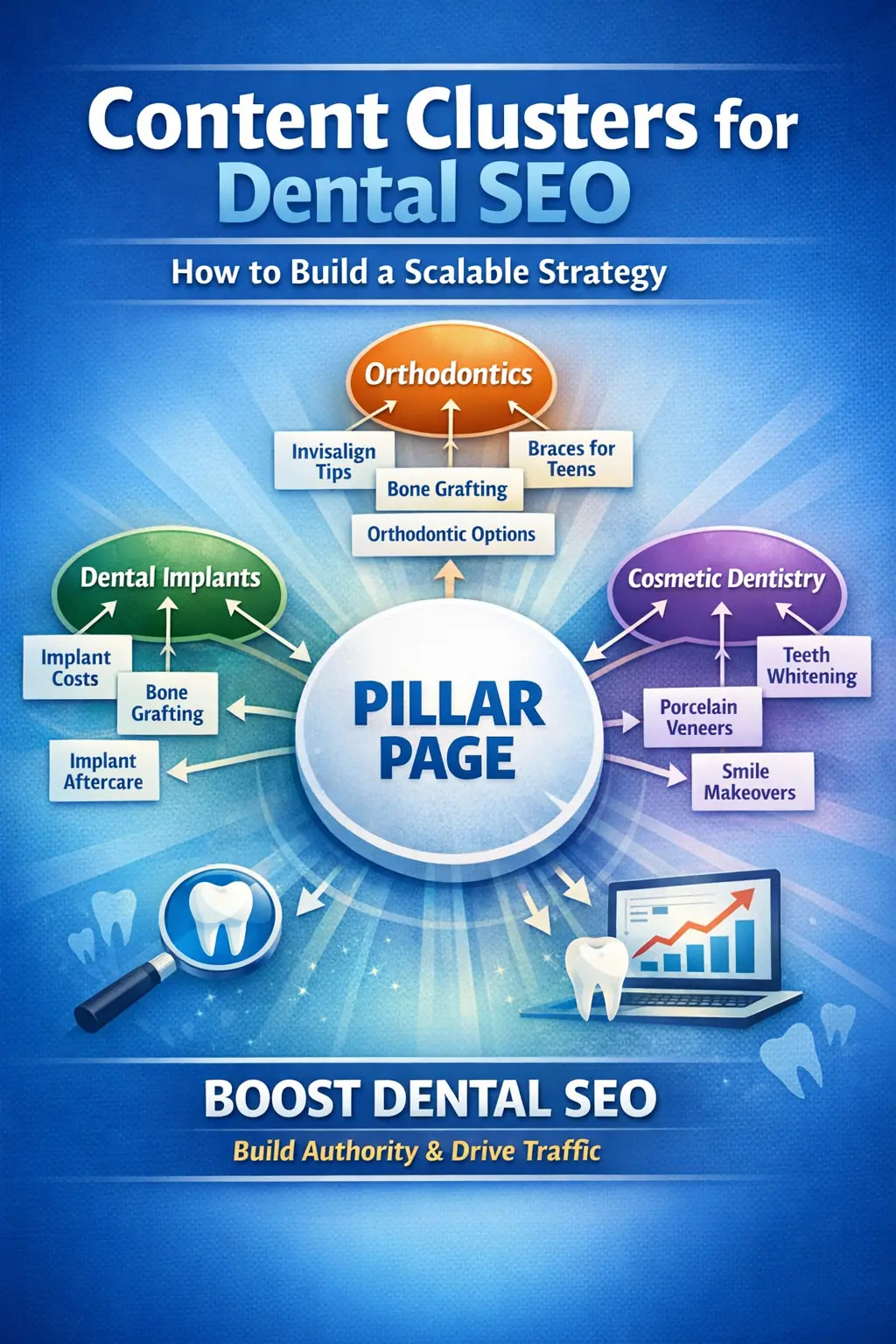 Building content clusters for dental SEO is one of the most scalable ways to grow your practice’s organic visibility—turning a scattered blog into a structured system where every page strengthens the others. Instead of publishing one-off articles and hoping they rank, a content cluster strategy organizes your content around core service topics, connecting pillar pages to supporting articles through internal linking, shared relevance, and topical depth that search engines reward. Building content clusters for dental SEO is one of the most scalable ways to grow your practice’s organic visibility—turning a scattered blog into a structured system where every page strengthens the others. Instead of publishing one-off articles and hoping they rank, a content cluster strategy organizes your content around core service topics, connecting pillar pages to supporting articles through internal linking, shared relevance, and topical depth that search engines reward.
The difference is compounding visibility. A single blog post competes alone. A well-built cluster—one pillar page supported by 8–15 related articles all linking to each other—signals to Google that your site has genuine authority on that topic. In our work with dental practices, we consistently see cluster-based content strategies outperform random publishing schedules within 4–6 months, often doubling organic traffic to the pillar topic.
If your site already has dozens of blog posts but traffic has plateaued, this guide will help you reorganize what you have. If you’re starting from scratch, it gives you a roadmap to build the right way from day one.
Below, you’ll learn what content clusters are, how to choose pillar topics for your practice, how to map and prioritize cluster pages, how to build the internal linking structure, and how to measure whether your clusters are actually working—with examples specific to dental practices.
Written for: dental practice owners, marketing coordinators, and agency teams who want a repeatable content system that compounds SEO results instead of producing isolated posts.
TL;DR
If you only remember five things, remember these:
| • |
Organize content around pillar topics, not random keywords - choose 3–5 core service areas your practice wants to be known for and build depth around each one
|
| • |
Every cluster needs a pillar page - one comprehensive, linkable page (1,500–2,500+ words) that covers the broad topic and links out to every supporting article
|
| • |
Cluster pages answer specific questions - each supporting article targets a long-tail keyword or subtopic and links back to the pillar, creating a two-way authority loop
|
| • |
Internal linking is the mechanism - without intentional links connecting pillar and cluster pages, Google can’t see the relationship and the strategy doesn’t work
|
| • |
Audit before you create - most dental sites already have content that can be reorganized into clusters, saving months of writing and avoiding duplicate-topic cannibalization |
Table of Contents
What is a content cluster and why does it matter for dental SEO?
A content cluster is a group of related pages organized around one central topic. At the center is a pillar page—a comprehensive resource that covers a broad topic like “dental implants” or “orthodontic treatment options.” Around it are cluster pages—individual articles that go deep on specific subtopics, like “how long do dental implants last,” “implant-supported dentures vs. traditional dentures,” or “bone grafting before dental implants.” Every cluster page links back to the pillar, and the pillar links out to each cluster page.
This structure matters for dental SEO because Google’s ranking systems increasingly evaluate topical authority—how thoroughly a site covers a subject—rather than just matching individual keywords on individual pages. A dental practice with one blog post about Invisalign competes against every other single page on the topic. A practice with a pillar page on orthodontics plus 10 supporting articles covering aligners, traditional braces, treatment timelines, cost considerations, teen orthodontics, retainers, and candidacy questions demonstrates depth that a single page cannot. This depth is also a core component of E-E-A-T for dental practices—the experience, expertise, authoritativeness, and trustworthiness signals Google uses to evaluate content quality.
What we typically see in dental website audits: practices with 30–50 blog posts published over several years, but no intentional structure connecting them. Posts cover overlapping topics, compete with each other for the same keywords (called keyword cannibalization), and none of them rank well because Google can’t determine which page is the authoritative one. A thorough dental SEO audit will reveal these overlaps. Content clusters solve this by making the relationship between pages explicit.
The practical benefit is compounding returns. Each new cluster page you publish doesn’t just compete on its own—it strengthens the pillar page and every other page in the cluster. Over time, the entire cluster rises together, which is why practices that adopt this approach often see organic traffic accelerate after the first 3–4 months of consistent publishing.
> Back to Table of Contents
How to identify your pillar topics
Choosing the right pillar topics is the most important strategic decision in your cluster plan. Get this wrong and you’ll build depth around topics that either don’t drive patient inquiries or are too narrow to support a full cluster.
Start with your services, not your keywords. The best pillar topics for dental practices map directly to the services you want to grow. If your practice is investing in implant cases, implants should be a pillar. If you’re expanding pediatric services, pediatric dentistry is a pillar. Keywords come later—the pillar is the strategic commitment. Your overall dental marketing strategy should inform which pillars you prioritize.
The pillar topic selection framework
A strong pillar topic meets three criteria:
| 1. |
Revenue relevance - the topic connects to a service line that drives meaningful production; general topics like “oral health tips” rarely convert to patient inquiries
|
| 2. |
Search depth - the topic has enough subtopics to support 8–15 cluster pages; if you can’t brainstorm at least 8 distinct questions or angles, the topic may be too narrow for a pillar
|
| 3. |
Competitive opportunity - you can realistically build more depth than what currently ranks; check the top 5 results for your target keyword and evaluate whether your combined cluster would be more comprehensive |
A pattern we commonly see: practices want to build a pillar around something ultra-specific like “CEREC same-day crowns.” While that’s a great cluster page, it’s usually too narrow for a pillar. The pillar might be “dental crowns” or “restorative dentistry,” with CEREC as one of several supporting articles.
Example pillar topics for dental practices
| • |
Dental implants - supports clusters on single implants, implant-supported dentures, All-on-4, bone grafting, implant cost, implant recovery, implant candidacy, implant longevity, implants vs. bridges; practices running dental implant marketing campaigns benefit most from building this pillar first
|
| • |
Cosmetic dentistry - supports clusters on veneers, teeth whitening, bonding, smile makeovers, gummy smile correction, cosmetic vs. restorative, before-and-after expectations
|
| • |
Orthodontics - supports clusters on Invisalign, traditional braces, clear aligners, teen orthodontics, adult orthodontics, retainers, treatment timeline, orthodontic emergencies; orthodontist marketing programs can use this cluster to strengthen paid and organic channels simultaneously
|
| • |
Periodontal health - supports clusters on gum disease stages, scaling and root planing, gum recession, laser gum treatment, periodontal maintenance, gum disease and systemic health
|
| • |
Pediatric dentistry - supports clusters on first dental visit, sealants, fluoride, cavity prevention for kids, dental anxiety in children, sports mouthguards, thumb sucking |
Most practices should start with 3–5 pillar topics. Trying to build more than that simultaneously spreads your publishing capacity too thin and delays the compounding effect.
> Back to Table of Contents
How to map cluster pages around each pillar
Once you’ve selected your pillar topics, the next step is mapping out the specific cluster pages each one needs. This is where keyword research meets content planning—and where most dental practices either skip steps or overcomplicate things.
Step 1: Audit your existing content
Before writing anything new, inventory what you already have. In our experience, most dental sites with 20+ blog posts already have raw material for at least one or two clusters—it just isn’t organized. If you haven’t done a full content inventory recently, our guide on refreshing old dental content to improve SEO rankings walks through the process.
Pull a list of every published page and blog post. For each one, note the primary topic it covers and whether it could logically support one of your pillar topics. You’ll typically find three categories:
| • |
Cluster-ready pages - existing posts that clearly support a pillar topic and just need updated linking and possibly a content refresh
|
| • |
Consolidation candidates - two or three thin posts covering overlapping subtopics that should be merged into one stronger cluster page
|
| • |
Orphan content - posts that don’t fit any pillar topic; these either need to be redirected, updated to fit, or left as standalone pages |
Step 2: Identify subtopic gaps with keyword research
For each pillar, brainstorm every question a patient might ask about that topic. Then validate and expand your list with keyword research. You’re looking for long-tail keywords and question-based queries that represent distinct subtopics—a process we cover in depth in our dental content gaps guide.
Practical approach: search your pillar keyword in Google and look at the “People Also Ask” section, related searches at the bottom, and autocomplete suggestions. These reflect real patient search behavior. Tools like Google Search Console (for queries your site already gets impressions on) and free keyword tools can fill additional gaps. For a deeper look at the most important dental keywords by specialty and intent, start with high-volume terms and work outward.
Each distinct subtopic becomes a potential cluster page. For a “dental implants” pillar, your gap analysis might reveal:
| • |
Already covered - implant cost, implant recovery timeline, implant candidacy
|
| • |
Gaps to fill - implant-supported dentures, mini implants vs. traditional implants, bone grafting requirements, implant failure rates and causes, dental implant maintenance, implants for seniors
|
| • |
Consolidation needed - three separate posts about implant aftercare that should become one comprehensive recovery guide |
Step 3: Define each cluster page before writing
For every cluster page, document three things before you start writing: the primary keyword it targets, the specific question it answers, and how it connects to the pillar. This prevents scope creep and ensures each page has a distinct purpose.
A common mistake is planning cluster pages that are too similar. “How much do dental implants cost?” and “Are dental implants worth the investment?” might seem like two pages, but they answer essentially the same user intent. Combine them into one stronger page rather than splitting the topic thin.
> Back to Table of Contents
Building the internal linking structure
Internal linking is what makes a content cluster function as a cluster. Without deliberate links, you just have a collection of topically related pages that Google treats as independent. The linking structure is the mechanism that transfers authority, establishes hierarchy, and tells search engines how your content relates. This is also a core element of technical SEO for dentists—your site’s crawlability and link architecture directly affect how Google indexes and ranks your pages.
The two-way linking rule
Every content cluster follows one core linking principle:
| • |
Pillar → Cluster - the pillar page links to every cluster page in the group, using descriptive anchor text that reflects the cluster page’s target keyword
|
| • |
Cluster → Pillar - every cluster page links back to the pillar page at least once, ideally within the first few paragraphs and again near the end where contextually natural
|
| • |
Cluster → Cluster - where relevant, cluster pages within the same group link to each other; a post about “bone grafting before implants” naturally references the “implant candidacy” post |
Anchor text matters. Don’t link with generic phrases like “click here” or “learn more.” Use descriptive, keyword-relevant anchor text: “learn about dental implant recovery timelines” tells both readers and search engines what they’ll find on the linked page. How you structure your dental website also plays a role here—clean URL hierarchies and logical navigation reinforce the cluster relationships you’re building through content.
How to update your pillar page as you publish cluster content
Your pillar page isn’t static. Each time you publish a new cluster page, update the pillar to include a contextual link to the new article. Over time, your pillar page becomes a comprehensive hub that naturally integrates references to every subtopic in the cluster.
A practical way to manage this: include a section near the bottom of your pillar page (something like “Related Topics” or “Explore [Topic] in Depth”) where you add links as cluster pages publish. This ensures no cluster page goes un-linked from the pillar, even if the body text doesn’t naturally reference every subtopic.
Cross-cluster linking
Clusters don’t exist in isolation. Some topics naturally span multiple pillars. A post about “dental implants for seniors” might belong to your implant cluster but also deserve a link from your “senior dental care” content if you have one. These cross-cluster links add another layer of authority, but keep them secondary—the primary linking relationship should always be within the cluster. Backlinks from external sites amplify this further, but the internal structure must be solid first.
> Back to Table of Contents
How to prioritize and schedule cluster content
Building multiple content clusters simultaneously is a common ambition and a common mistake. Without a publishing cadence that matches your actual capacity, clusters stall halfway through and never reach the critical mass needed to compound. Treating your content calendar as part of your broader dental marketing SOPs helps ensure consistency.
Start with one cluster and build momentum
Pick the pillar topic with the highest combination of revenue relevance and existing content. If you already have 4–5 posts that could support a dental implants cluster, start there—you’re closer to a complete cluster than you think.
A realistic publishing schedule for most dental practices: 2–4 new cluster pages per month. At that pace, you can build a complete 10–12 page cluster in roughly 3 months. Once the first cluster is substantially built (8+ pages published and linked), shift some capacity to starting the second cluster while maintaining the first.
Prioritize cluster pages by impact
Not all cluster pages are equal. Prioritize based on:
| 1. |
Search volume and intent alignment - pages targeting keywords with clear patient intent (“how long do dental implants last”) before informational-only queries (“history of dental implants”)
|
| 2. |
Conversion proximity - pages closer to a booking decision rank higher in priority; “am I a candidate for dental implants” converts better than “types of implant materials”; understanding how content fits your dental marketing funnel helps you sequence pages for maximum impact
|
| 3. |
Existing content leverage - pages where you can refresh and restructure an existing post get published faster than net-new writing
|
| 4. |
Competitive gaps - subtopics where top-ranking competitors have thin or outdated content represent faster ranking opportunities; look for quick wins to jump competitors in Google rankings
|
The 90-day cluster launch plan
For practices working with an agency or a dedicated marketing coordinator, here’s what a realistic first-cluster build looks like:
Month 1: Publish or refresh the pillar page. Audit existing content and assign pages to the cluster. Publish 2–3 high-priority cluster pages. Establish all initial internal links.
Month 2: Publish 3–4 additional cluster pages. Update the pillar page with new links after each publish. Begin tracking keyword rankings for pillar and cluster page targets.
Month 3: Publish remaining cluster pages to reach 8–12 total. Conduct a full internal link audit to ensure all two-way links are in place. Establish baseline traffic and ranking metrics for the cluster. Begin planning the second pillar topic.
Results typically begin appearing in months 3–4, with meaningful traffic gains by month 5–6 as the cluster matures and Google recognizes the topical depth.
> Back to Table of Contents
Measuring content cluster performance
One of the most valuable aspects of a cluster strategy is measurability. Because the content is organized around a defined topic, you can track performance at the cluster level rather than evaluating individual posts in isolation. If you’re not already tracking results across channels, our guide on how to track dental marketing ROI by channel and source provides the framework.
Metrics that matter for dental content clusters
| • |
Cluster organic traffic - total organic sessions across all pages in the cluster (pillar + all cluster pages); this is your primary growth metric and should trend upward monthly
|
| • |
Pillar page keyword rankings - track position changes for the pillar page’s primary keyword and top 5–10 secondary keywords; as cluster pages publish, the pillar should climb; keep an eye on the local SEO ranking factors that also affect visibility in your market
|
| • |
Cluster page keyword coverage - how many of your target long-tail keywords have a page ranking in the top 20; this tells you whether your cluster is capturing the subtopic landscape
|
| • |
Internal link click-through - in Google Analytics, look at navigation paths between cluster pages; healthy clusters show visitors moving between related pages
|
| • |
Conversion events from cluster pages - appointment requests, phone calls, or form submissions that originate from any page in the cluster; this ties content directly to patient acquisition
|
Review cadence: check rankings weekly for the first 3 months after launching a cluster. Review traffic and conversion metrics monthly. Conduct a full cluster audit quarterly—looking for pages that need refreshing, new subtopics to add, and links that may have broken.
When to refresh vs. when to add new pages
A common question we hear is whether to keep adding cluster pages or to improve existing ones. The answer depends on where you are in the cluster lifecycle:
| • |
Under 8 cluster pages - prioritize adding new content to reach critical mass; the cluster doesn’t have enough depth yet to compound
|
| • |
8–15 cluster pages with ranking growth - balance new pages with refreshing underperformers; update thin pages with more depth, better formatting, and stronger internal links
|
| • |
15+ cluster pages with stalled rankings - focus on quality over quantity; refresh the pillar page first, consolidate any overlapping cluster pages, and improve the internal linking structure before adding more |
> Back to Table of Contents
Common content cluster mistakes and how to avoid them
In our work with dental practices across the country, we see the same cluster-building mistakes repeatedly. Most are fixable once you recognize the pattern.
Mistake 1: Building clusters around topics that don’t convert
A cluster about “oral health facts” or “dental history” might attract traffic, but it rarely drives appointments. Every pillar topic should connect to a service your practice actively wants to grow. Traffic without intent alignment is a vanity metric.
The fix: before committing to a pillar, ask: “If this cluster ranked #1 for every keyword in it, would we get more patient inquiries?” If the answer isn’t clearly yes, choose a different pillar.
Mistake 2: Neglecting the internal linking structure
We’ve audited dental sites with excellent cluster content that performed poorly because the pages weren’t linked to each other. Publishing 12 related articles means nothing to Google if there’s no link structure telling the algorithm these pages are connected.
The fix: make internal linking part of your publishing workflow, not a separate task. Every time a new cluster page goes live, immediately add a link from the pillar page and from at least 1–2 existing cluster pages. Add the link to the pillar on the new page before it publishes.
Mistake 3: Keyword cannibalization between cluster pages
This happens when two or more pages target the same keyword or answer the same user intent. Google gets confused about which page to rank, so it may rank neither well. The most common version in dental: separate pages for “dental implant cost” and “how much are dental implants”—these serve the same intent and should be one page.
The fix: during the mapping phase, group keywords by intent rather than by exact match. If two keywords would produce essentially the same article, combine them into one cluster page targeting both.
Mistake 4: Publishing thin cluster pages
A 300-word blog post that barely scratches the surface of “bone grafting for dental implants” doesn’t add authority to your cluster—it dilutes it. Every cluster page should be substantial enough to genuinely answer the question it targets, which usually means 800–1,500 words minimum depending on the subtopic’s complexity. Google evaluates whether your content demonstrates real expertise, and thin pages undermine the SEO signals that matter in Google’s current era.
The fix: if a subtopic can’t support at least 800 words of genuinely useful content, it may not deserve its own page. Consider combining it with a closely related subtopic.
Mistake 5: Abandoning the strategy after 60 days
Content clusters are a compounding strategy, not an immediate-result tactic. Practices that publish 4–5 cluster pages and then stop because they haven’t seen dramatic ranking changes are abandoning the approach right before it would start working. In our experience, meaningful results typically appear between month 3 and month 6.
The fix: commit to completing at least one full cluster (8–12 pages) before evaluating results. Set expectations with your team or agency that this is a 90-day build with a 6-month evaluation window.
> Back to Table of Contents
Build your content cluster strategy
A content cluster strategy gives your dental website the structure, depth, and internal authority to compete for the keywords that drive patient inquiries—not just traffic. If you’re ready to stop publishing disconnected blog posts and start building a content system that compounds, schedule a consultation to map out your first cluster or call us at 888-246-6906.
> Back to Table of Contents
FAQs
What is a content cluster in dental SEO?
A content cluster is a group of related web pages organized around one central topic. It consists of a comprehensive pillar page covering a broad subject like dental implants or orthodontics, surrounded by supporting cluster pages that address specific subtopics in depth. All pages are connected through intentional internal links, which signals to search engines that your site has genuine authority on the topic.
How many cluster pages does a dental content cluster need?
Most dental content clusters perform well with 8 to 15 supporting cluster pages, though the right number depends on the topic’s depth and competitive landscape. Clusters with fewer than 8 pages often lack the topical coverage needed to signal authority to search engines. Going beyond 15 pages is fine if the subtopics are genuinely distinct, but adding thin or overlapping pages dilutes quality rather than building it.
How long does it take for content clusters to improve dental SEO rankings?
Most dental practices begin seeing measurable ranking improvements between month 3 and month 6 after starting a content cluster, assuming consistent publishing of 2 to 4 quality pages per month. Initial movement in keyword rankings often appears around months 3 to 4, with meaningful traffic gains following as Google recognizes the topical depth and internal linking structure.
What is the difference between a pillar page and a cluster page?
A pillar page is a comprehensive, broad-topic resource (typically 1,500 to 2,500 or more words) that covers a subject like dental implants at a high level and links to all supporting content. A cluster page is a focused article that goes deep on one specific subtopic, such as implant recovery timelines or bone grafting requirements. The pillar provides breadth while cluster pages provide depth, and internal links connect them into a unified authority signal.
Can I build a content cluster from blog posts I already have?
Yes, and in most cases you should start by auditing your existing content. Many dental websites already have blog posts that can be reorganized into clusters with updated internal links and some content refreshing. The key steps are grouping existing posts under pillar topics, identifying gaps that need new pages, consolidating overlapping posts into stronger single pages, and establishing the two-way linking structure between pillar and cluster pages.
What is keyword cannibalization and how does it affect content clusters?
Keyword cannibalization happens when two or more pages on your site target the same keyword or search intent, causing them to compete against each other in search results. In content clusters, this most commonly occurs when cluster pages cover subtopics that are too similar. The result is that Google may not rank either page well. Preventing cannibalization means grouping keywords by user intent during the planning phase and combining closely related topics into single, stronger pages.
How many content clusters should a dental practice build?
Most dental practices benefit from 3 to 5 content clusters, each aligned with a core service line they want to grow. However, building all of them simultaneously is not recommended. Start with one cluster, build it to completion (8 to 12 pages with full internal linking), and then begin the next. Trying to build multiple clusters at once spreads publishing capacity too thin and delays the compounding effect that makes the strategy work.
Do content clusters work for single-location dental practices?
Content clusters are effective for dental practices of any size, including single-location offices. In fact, single-location practices often benefit more because they are competing for local and regional search visibility where topical authority can be a strong differentiator. A solo practice with a well-built implant cluster can outrank a larger group practice that has scattered, unorganized content on the same topic. |
|