Quick Wins for Dentists to Jump Competitors in Google Rankings
Posted on 1/30/2026 by WEO Media |
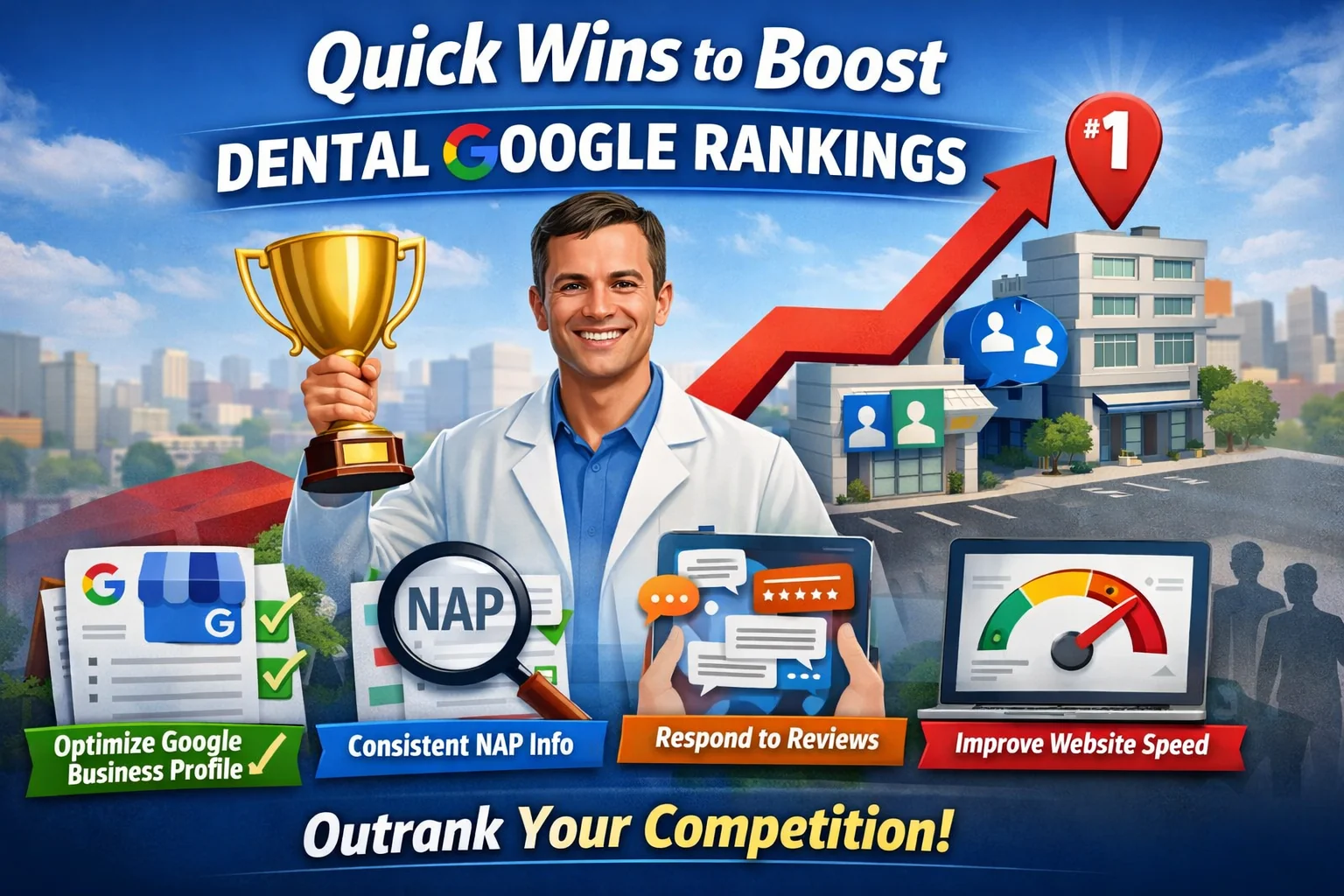 The fastest way to jump competitors in Google rankings is to fix what they’re ignoring: an incomplete Google Business Profile, inconsistent business information across directories, unanswered reviews, and slow website speeds. These foundational gaps create ranking drag that content and ad spend can’t overcome—and most practices leave them broken for years. The fastest way to jump competitors in Google rankings is to fix what they’re ignoring: an incomplete Google Business Profile, inconsistent business information across directories, unanswered reviews, and slow website speeds. These foundational gaps create ranking drag that content and ad spend can’t overcome—and most practices leave them broken for years.
The pattern we see constantly: a practice invests in dental SEO or paid ads, generates traffic, but stays stuck on page two because the basics are leaking authority. Meanwhile, a competitor with a complete GBP, fast site, and steady review responses sits in the local pack—not because they’re spending more, but because they fixed what you haven’t.
This guide covers tactical fixes you can implement in hours, not months. If you need a full marketing strategy, start with how to find a dental marketing agency you can trust first.
Below, you’ll learn how to audit your current gaps, prioritize fixes by your specific situation, and measure whether changes are working—with time estimates, realistic benchmarks, and a change log template so you can connect improvements to results.
Written for: dental practice owners, office managers, and marketing leads who want to stop watching competitors rank above them and start converting the visibility they’ve earned.
TL;DR
If you only do five things, do these:
| • |
Complete your Google Business Profile - fill every field, add services with descriptions, upload 3–5 photos monthly, and verify your primary category matches your highest-value service
|
| • |
Fix NAP inconsistencies - audit your name, address, and phone across the top 15 directories; mismatches confuse Google and dilute local authority
|
| • |
Respond to every review within 24 hours - response rate and speed are ranking signals; personalized responses also improve click-through
|
| • |
Speed up your website - compress images, enable caching, remove unused plugins; most dental websites load 3–5x slower than they should
|
| • |
Track changes with a simple log - date, what changed, expected impact, observed result; without this, you can’t connect fixes to outcomes |
Table of Contents
Who This Guide Is For
| • |
Practice owners watching competitors rank above them - you know your care is better, but patients find them first
|
| • |
Office managers handling marketing tasks - you need a prioritized list, not another 50-page SEO guide
|
| • |
Practices stuck on page two for months - you’re close but not converting because you’re not visible in the local map pack
|
| • |
Anyone skeptical of SEO promises - these are verifiable fixes with measurable outcomes, not vague “optimization” |
This guide assumes you have a website and a Google Business Profile. If you’re missing these basics, start there.
Time investment: implementing all quick wins requires roughly 8–15 hours spread across 2–4 weeks. Most practices can handle this internally. The prioritization framework below helps you focus on highest-impact items first if time is limited.
> Back to Table of Contents
Where to Start (Prioritization Framework)
Not all quick wins are equal for every practice. Use this framework to identify your highest-priority fixes based on where you currently stand.
If you’re not appearing in the local map pack at all
Start here: Google Business Profile completeness, NAP consistency, review velocity
These three factors have the most direct impact on local pack visibility. In our experience, practices missing from the map pack almost always have incomplete GBP profiles or significant NAP inconsistencies across directories.
If you appear in the map pack but rank 4th or lower
Start here: Review response strategy, GBP photo uploads, GBP posts
You have the foundation; now you need activity signals that show Google your profile is actively managed. Competitors in positions 1–3 typically have more recent reviews, more photos, and faster response times.
If you rank in the map pack but get few clicks
Start here: Review quality and quantity, GBP photos, website speed
Visibility without clicks suggests your listing isn’t compelling compared to competitors. Better reviews, professional photos, and a fast-loading site increase click-through rates even at the same ranking position.
If you rank well in maps but poorly in organic results below
Start here: Content refresh, internal linking, schema markup
Organic rankings below the map depend more on website factors than GBP factors. Your site content, structure, and technical foundation need attention.
A real pattern we see repeatedly
A practice came to us ranking 7th on Google Maps for their primary keyword. Their GBP was ~60% complete, they hadn’t uploaded photos in two years, and they responded to roughly one in five reviews. Within six weeks of completing their profile, uploading 20 new photos, and responding to every review within 24 hours, they moved to position 3. No website changes, no new content, no paid ads—just fixing what was already broken.
Results vary by market competition and starting position; this illustrates the pattern, not a guarantee.
> Back to Table of Contents
Why Quick Wins Work (and What They Won’t Fix)
Google ranks dental practices on three local factors: relevance (does your profile match the search), distance (how close you are), and prominence (how established and trusted you appear online).
Quick wins target relevance and prominence—the factors you can directly influence. Distance is fixed by your address, but strengthening the other two factors can expand your effective ranking radius.
What quick wins improve
| • |
Local pack visibility - the map results for “dentist near me” and similar near me searches
|
| • |
Click-through rates - better profiles earn more clicks even at the same ranking position
|
| • |
Conversion rates - faster sites with working mobile paths turn more visitors into calls and form submissions |
What quick wins won’t overcome
| • |
Major authority gaps - if competitors have hundreds of quality backlinks and you have few, quick wins narrow the gap but don’t close it
|
| • |
Brand recognition differences - a new practice competing against a 20-year established name needs time and sustained visibility
|
| • |
Saturated metro markets - dense areas with dozens of optimized competitors require strategy beyond quick wins
|
| • |
Fundamental website problems - major technical issues, poor architecture, or thin content everywhere can’t be fixed with tactical tweaks |
The realistic goal: quick wins get you into contention. Long-term strategy keeps you there.
> Back to Table of Contents
Google Business Profile Optimization
Your Google Business Profile is the single highest-impact asset for local rankings. Most practices complete the basics during setup and never return—which is exactly why this is a quick win opportunity.
Profile completeness audit (30–60 minutes)
Log into your GBP and verify every field:
| • |
Primary category - match your highest-value service; “Cosmetic Dentist” or “Pediatric Dentist” may outperform generic “Dentist” depending on your focus (see our guide on optimizing GBP categories)
|
| • |
Secondary categories - add all that legitimately apply; don’t add categories for services you don’t actually offer
|
| • |
Services - add each service with a description; Google uses these to match search queries
|
| • |
Business description - use all 750 characters; describe what makes your practice different, not just what you do
|
| • |
Attributes - mark accessibility features, payment options, languages spoken accurately
|
| • |
Hours and special hours - verify regular hours; add holiday hours before holidays occur
|
| • |
Appointment link - must go directly to booking, not your homepage |
Photo strategy (ongoing, 30 minutes monthly)
Profiles with recent photos perform measurably better. Google tracks upload dates and favors active profiles.
| • |
Baseline requirements - logo, cover photo, exterior with visible signage, reception area, treatment room, team photo
|
| • |
Monthly additions - 3–5 new photos: before/after cases (with patient consent), new equipment, team events, office updates
|
| • |
Quality standards - well-lit and in-focus only; blurry or dark photos signal low effort |
Posts and updates (15 minutes weekly)
GBP posts appear in your listing and signal activity. Posts tend to lose prominence after about 7 days, so weekly cadence helps.
| • |
Frequency - one post minimum per week
|
| • |
Content - service highlights, community involvement, team announcements, seasonal topics
|
| • |
What to avoid - stock images, posts with no clear value, excessive promotional language |
Common mistake we see: practices spend hours crafting the perfect post but haven’t uploaded a photo in 18 months. Photo freshness has more ranking impact than post content. Prioritize accordingly.
> Back to Table of Contents
NAP Consistency and Local Citations
NAP stands for Name, Address, and Phone. Inconsistent NAP across directories and citations confuses Google about your practice identity and reduces your local authority.
Why inconsistency happens
| • |
Office moves - old addresses persist on directories that were never updated
|
| • |
Phone changes - tracking numbers, old lines, or acquisitions create mismatches
|
| • |
Name variations - “Smith Dental” vs “Smith Dental Care” vs “Dr. Smith DDS” appear as different businesses to algorithms
|
| • |
Auto-generated listings - data aggregators create listings from public records that may be outdated or incorrect |
Audit process (2–3 hours)
| 1. |
Search your practice name, phone number, and address separately in Google to find existing listings
|
| 2. |
Check these directories manually: Google, Bing Places, Apple Maps, Yelp, Healthgrades, Zocdoc, Facebook, Vitals, WebMD, Yellow Pages
|
| 3. |
Document every variation in a spreadsheet with source URLs
|
| 4. |
Claim or update each listing to match your GBP exactly—same name format, same address format, same phone number
|
| 5. |
For listings you can’t edit, submit correction requests to the directory |
Priority tiers
| • |
Fix immediately - Google Business Profile, Bing Places, Apple Maps, Yelp, Facebook
|
| • |
Fix within 30 days - Healthgrades, Zocdoc, Vitals, WebMD
|
| • |
Fix as time allows - Yellow Pages, Superpages, local chamber directories, dental society listings |
What we typically find: the average practice has NAP inconsistencies on 30–50% of their listings. Practices that recently moved or changed phone systems often have inconsistencies on 70% or more.
> Back to Table of Contents
Review Velocity and Response Strategy
Reviews influence rankings directly and click-through rates indirectly. Recent review activity matters more than total count—a practice with steady new reviews will often outrank one with a larger but stale review base.
What Google measures
| • |
Review velocity - steady flow of recent reviews signals ongoing patient activity
|
| • |
Average rating - higher is better, though 4.7–4.9 often performs comparably to 5.0 and appears more authentic
|
| • |
Review content - keywords in reviews (“great implant experience”) can reinforce service relevance
|
| • |
Response rate and speed - responding signals engagement; faster responses signal attentiveness |
Increasing review velocity ethically
| • |
Ask consistently - train staff to ask every satisfied patient at checkout; the best moment is immediately after a positive comment
|
| • |
Make it frictionless - provide a direct link to your Google review page via text, email, or QR code; every extra click loses patients
|
| • |
One follow-up maximum - a single reminder 24–48 hours later is appropriate; more feels pushy and risks complaints
|
| • |
Never incentivize - offering anything for reviews violates Google guidelines and risks profile suspension |
Response strategy
Respond to every review within 24 hours. This is non-negotiable for practices serious about rankings and reputation management.
| • |
Positive reviews - thank by name, reference something specific they mentioned, keep it brief (2–3 sentences)
|
| • |
Negative reviews - acknowledge without defensiveness, never discuss health information publicly, offer to continue the conversation offline
|
| • |
Fake or spam reviews - flag for removal through Google but respond professionally in case removal is denied |
Strong positive response example: “Thank you, Sarah! We’re glad the crown process was smoother than expected. See you at your next cleaning!”
Strong negative response example: “We’re sorry your visit didn’t meet expectations. Please call us at [phone] so we can discuss this directly and make it right.”
For more templates and a complete SOP, see our guide on dental patient review responses.
> Back to Table of Contents
Website Speed Fixes
Page speed is a confirmed ranking factor. Slow websites also lose visitors—research consistently shows that each additional second of load time increases bounce rates and reduces conversions.
How to check your speed (5 minutes)
| • |
Google PageSpeed Insights - pagespeed.web.dev provides scores and specific recommendations for both mobile and desktop
|
| • |
Google Search Console - Core Web Vitals report shows site-wide performance issues affecting rankings
|
| • |
Real device testing - load your site on your phone over cellular data; this is what patients actually experience |
Common fixes (1–4 hours depending on site complexity)
| • |
Image compression - most dental sites serve images 5–10x larger than needed; compress to web-optimized formats without visible quality loss
|
| • |
Browser caching - enable caching so returning visitors load faster; your hosting provider or a caching plugin can handle this
|
| • |
Remove unused plugins - every plugin adds load time; audit your site and remove anything you don’t actively use
|
| • |
Lazy loading - load images only as they scroll into view rather than all at once on initial page load
|
| • |
Hosting upgrade - budget shared hosting is often the bottleneck; mid-tier hosting can dramatically improve server response times |
Priority pages to fix first
| 1. |
Homepage (see our guide on dental homepage design that converts)
|
| 2. |
Top service pages (implants, Invisalign, emergency—whatever drives your highest-value appointments)
|
| 3. |
Contact page
|
| 4. |
Location pages (if you have multiple offices) |
What we commonly find: the average dental website we audit loads in 6–8 seconds on mobile. After basic optimization, most can reach 2–3 seconds. That difference affects both rankings and conversions measurably.
> Back to Table of Contents
Content Refresh Strategy
Updating existing content often improves rankings faster than creating new pages. Google values freshness, especially for topics where information changes or where searchers expect current answers.
How to identify pages to refresh
| • |
Pages ranking positions 5–15 - close to page one; small improvements can push them up
|
| • |
Pages with declining traffic - check Google Analytics for pages performing worse than 6–12 months ago
|
| • |
High impressions, low clicks - Google Search Console shows this; your title or meta description may not be compelling
|
| • |
Outdated information - statistics, guidelines, or technology references that have changed since publication |
What to update
| • |
Strengthen the introduction - make sure the first paragraph directly answers the primary search intent
|
| • |
Expand thin sections - add depth where you currently give surface-level answers
|
| • |
Add recent information - update statistics, reference current guidelines or technology
|
| • |
Include FAQ sections - answer related questions people commonly ask
|
| • |
Update internal links - link to newer relevant content on your site
|
| • |
Refresh the publication date - only after making substantive changes; don’t update dates for cosmetic edits |
After making substantive updates, request reindexing through Google Search Console to prompt faster recrawling.
> Back to Table of Contents
Schema Markup Basics
Schema markup is structured data that helps Google understand your content. It can enable rich results—enhanced search listings with ratings, FAQs, or service details that stand out from plain results.
Essential schema types for dental practices
| • |
LocalBusiness (Dentist) - practice name, address, phone, hours, services offered
|
| • |
FAQPage - marks up FAQ sections for potential rich results in search
|
| • |
Service - defines specific services with descriptions
|
| • |
Review/AggregateRating - helps understanding and can enable rich results when eligible; local business star snippets are limited and self-serving review markup usually won’t show stars |
Implementation options
| • |
WordPress plugins - Yoast, Rank Math, or Schema Pro can generate schema without coding knowledge
|
| • |
Manual JSON-LD - add structured data directly to page templates for cleaner, more controlled implementation
|
| • |
Google Tag Manager - inject schema through GTM if you can’t edit site templates directly |
Validate your schema using Google’s Rich Results Test or Schema.org's Validator Tool before expecting enhanced results to appear.
Caution: only add schema for content that actually exists on the page. Marking up fake reviews, services you don’t offer, or inflated ratings violates Google guidelines and risks manual penalties. For more detail, see the importance of schema markup for dental marketing.
> Back to Table of Contents
Internal Linking Audit
Internal links help Google discover pages and understand relationships between them. They also distribute ranking authority from stronger pages to weaker ones.
Common problems
| • |
Orphan pages - pages with no internal links pointing to them; Google may not find or value these
|
| • |
Generic anchor text - “click here” or “learn more” tells Google nothing about the target page
|
| • |
Broken internal links - links to pages that no longer exist waste crawl budget and frustrate users |
Quick fixes (1–2 hours)
| 1. |
Identify your most important service pages (the ones that drive revenue)
|
| 2. |
Search your blog for mentions of those services without links
|
| 3. |
Add links with descriptive anchor text (“our dental implant marketing approach” rather than “click here”)
|
| 4. |
Add “Related Services” sections linking between complementary service pages
|
| 5. |
Ensure priority pages are linked from your homepage if they aren’t already |
> Back to Table of Contents
Mobile Usability Check
More than half of dental searches happen on mobile devices. Google uses mobile-first indexing, meaning it evaluates the mobile version of your site for rankings—not the desktop version.
Critical elements to test
| • |
Click-to-call - phone numbers must be tappable and initiate calls immediately
|
| • |
Booking flow - complete your own appointment request process on a phone; identify every friction point
|
| • |
Form usability - forms must work without zooming, pinching, or horizontal scrolling
|
| • |
Button spacing - tap targets must be large enough that users don’t accidentally click the wrong element
|
| • |
Pop-ups - intrusive mobile pop-ups that block content can trigger Google ranking penalties |
Test on real devices. Use your phone, your staff’s phones, different screen sizes. Browser emulators miss real-world issues that patients encounter.
> Back to Table of Contents
Tracking and Measuring Results
Quick wins only matter if you can verify they worked. Without tracking, you can’t distinguish real improvement from normal fluctuation—or know which changes to repeat.
What to track
| • |
Ranking positions - track target keywords weekly; daily fluctuations are noise, weekly trends show real movement
|
| • |
Local pack appearances - are you showing in map results for your priority searches?
|
| • |
Click-through rate - Google Search Console shows impressions vs clicks; improving CTR means your listings are more compelling
|
| • |
Conversions - calls, form submissions, appointment requests; connect traffic increases to actual patient inquiries |
For a deeper dive into connecting marketing efforts to outcomes, see how to track dental marketing ROI by channel and source.
Change log template (copy/paste)
| • |
Date - when you made the change
|
| • |
What changed - specific action (“Added 15 GBP photos,” “Fixed NAP on Healthgrades”)
|
| • |
Expected impact - what you hope to improve
|
| • |
Result - fill in 4–6 weeks later with observed outcome |
This log helps you identify what works for your practice, avoid repeating ineffective tactics, and build institutional knowledge even if staff changes.
> Back to Table of Contents
What If Rankings Drop?
Sometimes rankings temporarily decline after making changes. This causes understandable anxiety, but it’s often not cause for alarm.
Normal fluctuations vs real problems
| • |
Normal - positions shifting 1–3 spots day-to-day; temporary drops during Google algorithm updates; brief dips after making changes as Google reprocesses your site
|
| • |
Concerning - sustained drops of 10+ positions over 2+ weeks; disappearing from results entirely; manual action notices in Google Search Console |
If rankings drop after changes
| 1. |
Wait 2 weeks before reacting—many drops self-correct as Google finishes reprocessing
|
| 2. |
Check Google Search Console for manual actions, security issues, or crawl errors
|
| 3. |
Review your change log to identify what might have caused the drop
|
| 4. |
If a specific change correlates with the drop, consider reverting it
|
| 5. |
If drops persist beyond 4 weeks with no clear cause, seek professional diagnosis |
Important context: in our experience, ranking drops after legitimate quick wins are uncommon. When they happen, they usually resolve within 2–3 weeks as Google finishes reprocessing the changes.
> Back to Table of Contents
Tactics That Backfire
Some “quick wins” promoted online are actually shortcuts that risk penalties. Google actively detects and punishes manipulative tactics—and recovery takes months.
| • |
Buying reviews - violates Google guidelines; risks profile suspension and permanent reputation damage
|
| • |
Review gating - filtering who you ask based on expected sentiment is against Google policy
|
| • |
Keyword stuffing - overloading your business name or description with keywords triggers spam filters
|
| • |
Fake locations - adding GBP profiles for addresses without physical presence; Google actively removes these
|
| • |
Link schemes - buying links, participating in link exchanges, or using private blog networks
|
| • |
Duplicate location pages - copy-pasting the same content with only city names changed creates thin, low-value pages that can drag down your entire site |
If you’ve been penalized: identify the specific violation, fix it completely, document your changes, and submit a reconsideration request if applicable. Recovery takes weeks to months depending on severity.
> Back to Table of Contents
Realistic Timeline Expectations
| • |
GBP changes - profile updates appear within hours to days; ranking impact typically visible in 2–4 weeks
|
| • |
NAP fixes - directory updates take 2–8 weeks to propagate depending on the directory
|
| • |
Review responses - appear immediately; ranking impact from consistent response builds over weeks
|
| • |
Website speed improvements - technical changes are instant; ranking impact appears in 2–6 weeks as Google recrawls
|
| • |
Content updates - ranking changes typically appear in 2–8 weeks after reindexing |
Factors that affect timeline
| • |
Competition level - dense markets with many optimized competitors move slower
|
| • |
Starting position - moving from position 50 to 20 is faster than moving from position 5 to 1
|
| • |
Domain authority - established sites with strong backlink profiles see faster results from on-page changes
|
| • |
Crawl frequency - more active sites get crawled more often; changes propagate faster |
> Back to Table of Contents
Maintaining Momentum
Quick wins create an initial boost, but rankings erode without ongoing maintenance. Competitors don’t stop optimizing just because you caught up.
Minimum monthly maintenance
| • |
GBP - upload 3–5 photos, post weekly, respond to all reviews within 24 hours
|
| • |
Reviews - maintain consistent ask process at checkout; velocity matters more than occasional big pushes
|
| • |
Content - refresh one existing page per month; update seasonal content ahead of the season
|
| • |
Tracking - review rankings and conversions weekly; update your change log with observations |
Time investment
After initial implementation, maintaining quick wins requires roughly 2–4 hours per month. This can be delegated to trained staff with clear checklists and accountability.
> Back to Table of Contents
When Quick Wins Aren’t Enough
Quick wins have limits. If you’ve implemented everything in this guide and still aren’t ranking where you want, the issue is likely deeper than tactical fixes can address.
Signs you need more than quick wins
| • |
Competitors have significantly more backlinks - authority gaps require link building, not just on-page optimization
|
| • |
Fundamental technical problems - indexing issues, poor site architecture, or security problems require technical SEO expertise
|
| • |
Saturated market - dozens of well-optimized competitors in your area require differentiation strategy
|
| • |
Thin content across all pages - surface-level content everywhere signals low E-E-A-T to Google and users |
What comes after quick wins
| • |
Comprehensive SEO audit - technical, content, and backlink analysis to identify all ranking barriers
|
| • |
Content strategy - ongoing creation of helpful content that builds organic traffic over time
|
| • |
Link building - earning quality backlinks through outreach, PR, and community involvement
|
| • |
Paid search
- Google Ads can supplement organic visibility while longer-term strategies mature |
> Back to Table of Contents
Get Help With Your Dental SEO
If you want expert guidance implementing these strategies—or need to diagnose why rankings aren’t improving despite your efforts—WEO Media - Dental Marketing can help. We specialize in dental SEO and practice marketing with a focus on measurable, sustainable results.
Call 888-246-6906 to discuss your practice’s situation and learn what a realistic improvement plan looks like for your market.
FAQs
How long does it take to see results from dental SEO quick wins?
Most practices see measurable local pack movement within 2 to 6 weeks and organic ranking changes within 4 to 12 weeks. Timelines vary based on competition level, starting position, and how significant your changes are. Track weekly trends rather than daily fluctuations to see real progress.
Can I implement these SEO fixes myself or do I need to hire someone?
Most quick wins in this guide can be implemented without professional help if you have 8 to 15 hours over a few weeks and basic technical comfort. More complex issues like technical SEO problems, link building, or competitive strategy typically benefit from professional expertise. The decision depends on your available time and how competitive your market is.
What is the single most important thing I can do right now to improve rankings?
Complete your Google Business Profile. Fill every field, upload recent photos, and start responding to every review within 24 hours. For most practices, GBP optimization has the largest and fastest impact on local pack visibility. It takes about an hour for the initial audit and costs nothing.
How many Google reviews do I need to rank well?
There is no magic number because it depends on your competitors. The goal is to have more recent reviews than the practices ranking above you. A practice with 50 reviews adding 5 new ones monthly will often outperform a practice with 200 reviews but no recent activity. Velocity matters more than total count.
What if my competitor is doing all of these SEO tactics too?
If competitors are also optimizing well, quick wins become table stakes rather than differentiators. You will need to move beyond quick wins into content strategy, link building, and conversion optimization. The good news is that most practices do not maintain consistent effort over time, so sustained execution often wins even against initially stronger competitors.
What if I make changes and my Google rankings get worse?
Temporary fluctuations after changes are normal as Google reprocesses your site. Wait 2 weeks before reacting. If drops persist beyond 4 weeks, review your change log to identify potential causes and consider reverting recent changes. Sustained ranking drops from legitimate quick wins are uncommon in our experience.
Is it worth paying for SEO tools to track my dental practice rankings?
Free tools like Google Search Console, Google Analytics, and PageSpeed Insights cover most basic needs for a single practice. Paid tools like Semrush, Ahrefs, or BrightLocal become valuable when you need competitive analysis, comprehensive site audits, or automated rank tracking across many keywords. For most practices doing occasional optimization, free tools are sufficient to start.
Will these SEO strategies work for a brand new dental practice?
Yes, but with adjusted expectations. New practices lack domain authority and review history, so quick wins help establish a foundation rather than achieve immediate top rankings. Focus on building a complete Google Business Profile, accumulating reviews consistently from day one, and creating quality website content. Expect a longer timeline to reach competitive positions compared to established practices. |
|