Top Local SEO Ranking Factors for Dentists to Outrank Competitors in 2026
Posted on 1/15/2026 by WEO Media |
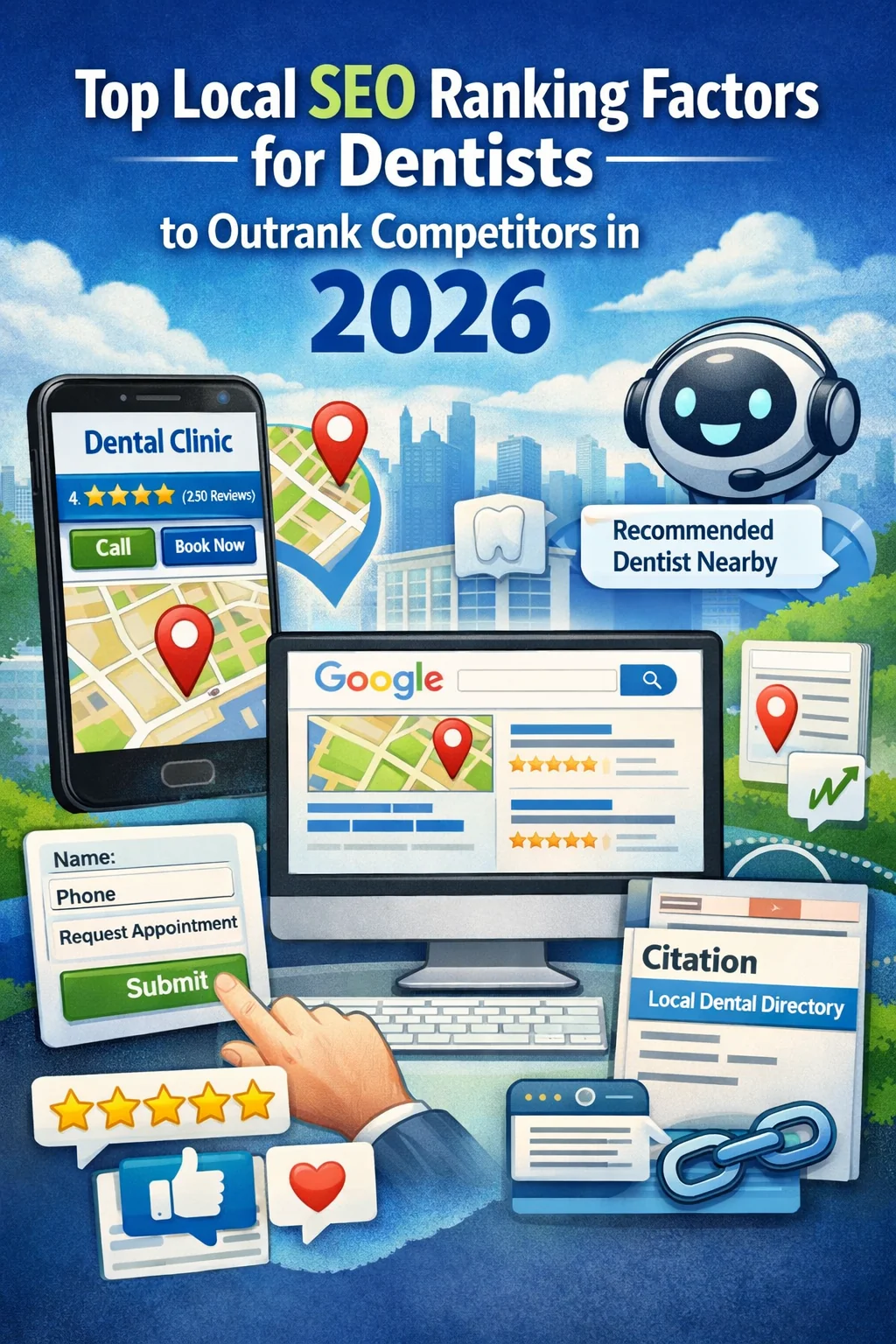 In 2026, local SEO for dentists is shaped by signals that affect both rankings and real patient decisions: reviews, consistent business information, and how easy it is to request an appointment on a phone. AI-generated local recommendations are also increasing the value of credible third-party visibility and corroborated mentions across the web. In 2026, local SEO for dentists is shaped by signals that affect both rankings and real patient decisions: reviews, consistent business information, and how easy it is to request an appointment on a phone. AI-generated local recommendations are also increasing the value of credible third-party visibility and corroborated mentions across the web.
This guide focuses on four connected outcomes: Google Maps/Local Pack visibility
, local organic visibility, appointment requests (calls and forms), and a fourth layer that matters more each year: AI visibility (being recommended or referenced by assistants and AI summaries). This content is for marketing and education and is not medical advice.
Table of Contents:
Start Here — The 60-Second Answer
Local rankings are commonly explained through relevance, distance, and prominence. For dental practices, consistent wins usually come from accurate Google Business Profile (GBP) setup, clean business facts (name, address, phone, hours, map pin), a review profile that looks current and trustworthy, service pages that match what patients search, and a scheduling path that is frictionless on mobile.
If you only do three things this quarter:
| 1. |
Confirm your primary GBP category matches the practice’s real identity and link GBP to the page that best fits the query. |
| 2. |
Build 3–5 dedicated pages for your highest-value and highest-urgency services, then connect them with internal links. |
| 3. |
Create a steady review process that improves recency and increases useful written review text. |
1 KPI per outcome:
Track one metric per goal so you can tell what’s improving without overcomplicating reporting.
| • |
Google Maps/Local Pack: calls and direction requests from GBP. |
| • |
Local organic: Search Console clicks to priority service pages. |
| • |
Appointment requests: total calls and form submissions from mobile visitors. |
| • |
AI visibility: growth in credible third-party mentions and review diversity across reputable sources. |
> Back to Table of Contents
How Local Rankings Work (Only What You Need)
Local results are commonly framed with three concepts: relevance, distance, and prominence. These definitions help you choose what to fix first, especially when you’re trying to earn more appointment requests rather than chase vanity rankings.
| • |
Relevance - How well the listing and page fit the searched service and need, often influenced by categories, services, and landing-page alignment. |
| • |
Distance - How close the searcher is to the business location, which affects eligibility and ordering and is not directly controllable. |
| • |
Prominence - How established and trusted the business appears, often associated with reviews, credible mentions, authoritative links, and consistent business information. |
Local Pack vs Local Organic (Why You Need Both)
Google Maps/Local Pack is optimized for immediate actions like calls and directions. Local organic supports deeper research like candidacy, timelines, comfort concerns, and cost factors.
| • |
Google Maps/Local Pack example - "Emergency dentist near me" is often decided quickly based on proximity, hours, reviews, and the ability to call fast.
|
| • |
Local organic example - "Invisalign cost in [city]" often leads to service-page comparisons before a patient requests an appointment. |
Paid Ads and Local Rankings (Important Clarification)
Paid ads can appear separately, but they don’t directly improve organic Google Maps/Local Pack rankings or organic local results. If ads are part of your mix, treat them as a separate channel that can increase demand while local SEO strengthens long-term visibility.
> Back to Table of Contents
Google Maps Ranking Factors for Dentists in 2026
If the goal is more appointment requests from Google Maps/Local Pack, focus on what improves clarity and trust at the moment of choice. Competitive markets usually reward accurate categories, clean business facts, review strength, and a website link that routes people to the right next step.
Tier 1 — Biggest Drivers You Can Control
| • |
Primary GBP category accuracy - Categories influence relevance, and the primary category is often one of the strongest controllable levers in competitive markets. |
| • |
Proximity - Distance affects eligibility and ordering, so competing against closer offices requires stronger fundamentals elsewhere. |
| • |
Business name compliance - Use the real-world name that matches signage and documentation, since stuffing increases policy and suspension risk. |
| • |
Address accuracy - Correct suite formatting and consistent address details reduce confusion and arrival problems. |
| • |
Pin placement - A pin placed at the building entrance reduces routing errors and missed arrivals. |
| • |
Hours and special hours - Accurate hours support open now visibility and prevent trust-killing mismatches. |
| • |
GBP website link alignment - The link should route patients to the page that best matches the query with clear scheduling options. |
Tier 2 — Reviews (Visibility and Appointment Requests)
Reviews reduce uncertainty. Patients use review text to infer comfort, communication, and responsiveness before they call.
| • |
Star rating - Helps patients filter options quickly and lowers hesitation. |
| • |
Written review volume - Adds context that supports faster decisions. |
| • |
Recency - Signals that the experience is current. |
| • |
Steady velocity
- Consistent monthly reviews typically outperform short bursts. |
Tier 3 — Profile Completeness (Supports Relevance and Choice)
| • |
Services and attributes - Accurate details reduce confusion and support better matching for common searches. |
| • |
Description - Factual, non-promissory language supports trust and clarity. |
| • |
Photos - A credible baseline reduces anxiety and improves arrival confidence. |
| • |
Scheduling path - Fewer steps from need to appointment request improves outcomes. |
| • |
Messaging - Enable only if response time will be reliable and consistent. |
Tier 4 — Website Alignment That Supports Google Maps/Local Pack
| • |
NAP match - Ensure name, address, and phone are consistent between website and GBP. |
| • |
Landing-page fit - The linked page should answer the searched service and location need, not a generic homepage. |
| • |
Clear service architecture
- Dedicated service pages reduce drop-offs and make meaning easier to interpret for both users and systems. |
Tier 5 — Engagement as Outcomes (Not a Lever to Game)
Clicks and interactions are best treated as outcomes of being the clearest, most trusted option rather than tactics to manipulate.
| • |
Engagement and CTR - Often rise when the listing is accurate, trusted, and aligned to what the searcher is trying to do. |
| • |
Best use of effort - Improve clarity, reviews, photos, and scheduling flow so engagement follows naturally. |
> Back to Table of Contents
Dentist Google Business Profile Optimization Checklist (Do This in Order)
This checklist covers common implementation questions practice managers search for: category selection, adding services, updating hours, choosing the right website link, and fixing duplicates. The goal is accuracy first, then routing searchers to the right next step.
Step 1 — Ownership, Access, and Verification Basics
| • |
Confirm access - Ensure the right stakeholders have manager-level access and know who can approve changes. |
| • |
Secure recovery - Keep account recovery methods current to reduce lockout risk. |
| • |
Use one source of truth - Standardize business details so updates do not conflict. |
Step 2 — Categories (How to Choose and What to Avoid)
| • |
Choose the closest true primary category
- The primary category should reflect the practice’s real-world identity. |
| • |
Use accurate secondary categories - Add only if services are truly offered and supported on-site. |
| • |
Avoid category spam - Inaccurate categories can weaken relevance alignment and patient trust. |
Quick category examples (choose what matches your real practice identity)
| • |
General dentistry - Use a general dentistry identity when the practice is primarily general care. |
| • |
Specialty practices - Specialty identities should reflect what patients search for and what the practice truly provides. |
| • |
Multi-service offices - Use secondary categories only when services are a real, supported offering with matching on-site pages. |
Step 3 — NAP, Pin, and Address Display (Accuracy First)
| • |
Correct suite formatting - Match real-world formatting consistently across website and key listings. |
| • |
Pin placement - Place the pin at the building entrance to reduce routing errors. |
| • |
Storefront clarity - Most dental offices are storefronts, and clear address details reduce confusion and missed arrivals. |
| • |
Service-area exception - If the business is service-area based, address visibility settings may differ, so follow the applicable guidelines. |
Step 4 — Hours and Special Hours (Open Now Eligibility)
| • |
Regular hours - Keep hours accurate and consistent with the website contact page. |
| • |
Holiday and special hours - Add special hours ahead of time to prevent open now mismatches. |
| • |
After-hours routing - If emergency steps differ after hours, reflect this clearly on the emergency page and scheduling flow. |
Step 5 — Services and Website Link Choice (Match Patient Need)
| • |
Use patient language - List services patients search for rather than internal terminology. |
| • |
Support key services on the website - Priority services should have dedicated pages that address candidacy, timeline, and cost factors. |
| • |
Choose the right GBP website link - The best link depends on the highest-intent demand you want to convert. |
| • |
Keep it truthful - Avoid listing services that are not truly offered. |
Simple rule for the GBP website link (homepage vs service page vs location page)
| • |
Emergency-heavy demand - Link to an emergency landing page with immediate call options and urgent routing. |
| • |
Single-location general dentistry - Link to the primary location page that includes services, directions, and scheduling options. |
| • |
One priority growth service - Link to that high-intent service page when it is the main conversion goal. |
Step 6 — Photos (Minimum Viable Set and Cadence)
| • |
Minimum viable set - Exterior signage, reception, operatories, and team presence. |
| • |
Decision support - Photos reduce anxiety and set expectations for first-time patients. |
| • |
Keep current - Update regularly so the profile reflects the real office experience. |
Step 7 — Description and Opening Date (Often Overlooked)
| • |
Description - Factual language about services and what patients can expect. |
| • |
Opening date - Use an accurate date that reflects real-world history. |
Step 8 — Messaging and Attributes (Only If You Can Support It)
| • |
Messaging - Enable only if response time will be reliable and consistent. |
| • |
Attributes - Add only accurate attributes that help patients make decisions quickly. |
Step 9 — Posts (Optional, but Useful)
| • |
Announcements - Holiday hours, availability, and operational updates. |
| • |
Education - Plain-language explanations of common services and what to expect. |
| • |
Process clarity - How scheduling works and what a new patient visit looks like. |
Step 10 — Patient Questions and Answer Coverage (2026-Safe)
GBP features evolve and question-based interfaces vary by market. The durable approach is making sure GBP fields and visible on-site FAQs answer the questions that block appointment requests.
| • |
Cover top questions in GBP fields - Use services, description, attributes, and hours to reduce uncertainty. |
| • |
Use visible FAQs on service pages - Answer candidacy, timeline, comfort, cost factors, and scheduling expectations. |
| • |
If an ask feature is visible - Monitor it, correct inaccuracies where possible, and treat it as supplemental rather than foundational. |
GBP data and policy don’ts (small mistakes that create big problems)
| • |
Do not stuff keywords into the business name - Use the real-world name that matches signage and documentation. |
| • |
Do not use tracking numbers as the primary public phone - Keep canonical NAP consistent across GBP and citations. |
| • |
Do not use misleading addresses - Avoid virtual offices and non-eligible locations. |
| • |
Do not offer incentives for reviews - Incentives and manipulation create policy risk and trust issues. |
| • |
Do not gate reviews - Avoid selectively routing unhappy patients away from review platforms. |
GBP 30-Minute Tune-Up (Fast Action List)
| 1. |
Confirm the primary category matches the core identity and remove inaccurate secondary categories. |
| 2. |
Verify address formatting and place the map pin at the building entrance. |
| 3. |
Update regular hours and add special and holiday hours for the next 60–90 days. |
| 4. |
Refine top services using patient language and ensure each priority service has a matching website page. |
| 5. |
Upload a baseline photo set: signage, reception, operatory, and team. |
| 6. |
Set the GBP website link to the page that best matches your highest-intent demand. |
| 7. |
Confirm the website contact page and footer match GBP NAP exactly. |
Suspensions and Reinstatement (High-Level, Safe)
| • |
Compliance first - Use the real business name and real address and keep hours accurate. |
| • |
Fix root causes - Correct policy issues before attempting reinstatement steps. |
| • |
Document operations - Keep evidence of signage, address, and operations available if requested. |
> Back to Table of Contents
Why Your Dental Practice Isn’t Showing on Google Maps (Troubleshooting Flow)
This is an ordered diagnostic flow designed to reduce wasted time. Check items in order so simple issues are not missed. Local results vary by searcher location and device, so evaluate trends rather than relying on a single test.
Troubleshooting Step-by-Step (Check These in Order)
| 1. |
Confirm eligibility basics: profile access, verification status, and any policy flags that limit edits. |
| 2. |
Confirm the primary category matches the search you want to compete for. |
| 3. |
Validate address details, suite formatting, and pin placement. |
| 4. |
Fix hours and special hours so open now visibility and trust are not broken. |
| 5. |
Look for duplicates and filtering conflicts and pursue cleanup before adding new content. |
| 6. |
Evaluate reviews for recency, sentiment themes, and enough written detail to reduce uncertainty. |
| 7. |
Confirm the GBP landing page fits the query and the scheduling flow works on mobile. |
| 8. |
Audit NAP consistency across the web and correct high-visibility conflicts first. |
| 9. |
Assess proximity reality and set expectations by neighborhood and radius. |
| 10. |
If market spam is present, document issues and report through platform reporting and support mechanisms. |
| 11. |
Check technical and UX friction: slow mobile pages, unclear phone visibility, and confusing scheduling steps. |
> Back to Table of Contents
The Most Important Local Organic Ranking Factors for Dentists in 2026
Local organic visibility captures both urgent service searches and high-value research queries. The largest gains usually come from building a clear service architecture and writing pages that match patient needs.
Because dental topics affect health and finances, higher trust, clear credentials, and conservative claims matter most when discussing outcomes, risks, or treatment suitability.
| • |
Tier 1: Architecture - Dedicated pages for each priority service plus a visit-ready location page that supports local searches. |
| • |
Tier 2: Authority - Credible links and mentions from relevant and local sources that demonstrate trust. |
| • |
Tier 3: On-page and technical trust - Clear titles and headings, mobile usability, and fast-enough performance for real patients. |
How long does local SEO take for dentists?
Early indicators often show up first once accuracy issues and scheduling friction are removed, such as higher GBP actions and better conversion rate on key pages. More durable visibility changes typically build over weeks as reviews, consistent citations, and authoritative mentions compound.
> Back to Table of Contents
Service Page Blueprint (Copy-Ready Template)
A high-intent service page should match search intent clearly and remove hesitation by answering the questions that typically block appointment requests. For most practices, publishing 3–5 strong service pages is more effective than publishing many thin pages.
What Every High-Intent Service Page Must Include
| • |
Above the fold - Service name with location context, phone visibility, and a clear appointment-request option. |
| • |
Who it is for - Candidacy and common reasons people seek the service. |
| • |
Process and timeline - What happens and how long it typically takes in general terms. |
| • |
Comfort considerations - Anxiety cues and sedation options where relevant, explained plainly. |
| • |
Cost factors - What influences cost, without promises or misleading pricing claims. |
| • |
Visible FAQs - Answers to the questions people ask before scheduling. |
| • |
Trust elements - Credentials, office photos, and review themes without patient-identifying details. |
| • |
Internal links - Link to the location page, related services, and one supporting blog post. |
Example H1 and Section Headings (Implants, Invisalign, Emergency)
| • |
Dental implants: H1 example — “Dental Implants in [City]” with sections for candidacy, steps, timeline, cost factors, and FAQs. |
| • |
Invisalign: H1 example — “Invisalign in [City]" with sections for who it’s for, timeline, comfort, and FAQs. |
| • |
Emergency dentistry: H1 example — “Emergency Dentist in [City]" with sections for what counts as an emergency, what to do now, and scheduling steps. |
Minimum Viable Service Page in 60 Minutes
| 1. |
Write a clear H1 that matches the core query and location context. |
| 2. |
Add a short summary that explains who the service is for and what happens next. |
| 3. |
Add a process and timeline section with plain language and a few bullets. |
| 4. |
Add five visible FAQs based on calls and consultations: comfort, timeline, cost factors, candidacy, scheduling expectations. |
| 5. |
Add trust elements: office photo set, credentials overview, and review themes. |
| 6. |
Add clear scheduling options and link to the location page and related services. |
> Back to Table of Contents
Location Page Blueprint (Visit-Ready and Trust-Ready)
A strong location page reduces friction from Google Maps/Local Pack to arrival and supports local organic visibility. It also prevents drop-offs caused by parking confusion, entrance uncertainty, and unclear scheduling steps.
| • |
Visit-ready essentials - NAP, embedded map, parking guidance, entrance instructions, and accessibility notes. |
| • |
Service summary with links - A short list of core services linked to dedicated pages. |
| • |
Natural neighborhood references - Nearby landmarks and common routes without creating thin doorway pages. |
| • |
Trust elements - Office photos and review themes that reflect real experience without patient-identifying details. |
Multi-Location Duplication Traps (Avoid Doorway Signals)
| • |
Avoid copy-and-paste city swaps - Each location should have unique details and proof. |
| • |
Use location-specific photos and directions - Show the actual office and arrival experience. |
| • |
Differentiate service emphasis - Highlight what is true for that office rather than repeating generic text everywhere. |
| • |
Phone consistency - Avoid shared public numbers across locations where possible, or handle tracking so canonical NAP remains consistent. |
> Back to Table of Contents
Internal Linking Plan (Simple System)
Internal linking helps search engines understand hierarchy and helps patients move from research to scheduling without dead ends.
| • |
Homepage - Link to top services and the primary location page using clear anchors. |
| • |
Service pages - Link to related services, the location page, and the scheduling flow. |
| • |
Blogs - Link back to the most relevant service page using descriptive anchors that match what the post answers. |
| • |
GBP landing page - Ensure the linked page points to the next step: related services, location details, and scheduling. |
> Back to Table of Contents
Citations and NAP Cleanup for Dentists
Citations are third-party listings that repeat business facts such as name, address, and phone. They support corroboration and reduce patient confusion. Citations are different from links and PR mentions: citations confirm business details, while links and editorial mentions often represent stronger authority signals.
Where to Start (Non-Exhaustive, Market-Dependent)
| • |
Start with platforms patients use - Mapping apps, major review platforms, and major healthcare directories in your market. |
| • |
Prioritize visibility - Fix listings that drive calls and directions first. |
| • |
Watch for duplicates - Old addresses and duplicate entries often reduce appointment requests. |
Safe Cleanup Process (In Order)
| 1. |
Set one canonical NAP format and use it everywhere as the standard. |
| 2. |
Update the website contact page and footer first. |
| 3. |
Confirm the same details inside GBP fields. |
| 4. |
Audit major consumer platforms and fix mismatches. |
| 5. |
Find duplicates and old addresses and pursue merges or removals where possible. |
| 6. |
Re-check after changes so old data does not reappear through other sources. |
What to Avoid
| • |
Bulk low-quality directory blasts - They can introduce inconsistent data and low-trust signals. |
| • |
Multiple public phone numbers - They can confuse patients and weaken consistency. |
| • |
Address variations - Small formatting differences can create duplicates over time. |
> Back to Table of Contents
Authority Building for Dentists (Links and Local PR That Make Sense)
Authority is built through credible coverage and real relationships. The goal is quality and relevance rather than volume, especially for local markets where trust drives appointment requests.
| • |
Local credibility - Chambers of commerce, community sponsorships, school or charity partnerships, and local publications with editorial standards. |
| • |
Professional credibility - Dental associations, continuing education involvement, and reputable partnerships that reflect real-world expertise. |
| • |
Service-based credibility - Scholarship pages, community initiatives, and educational resources that earn citations naturally. |
| • |
Avoid shortcuts - Paid link schemes and low-quality directory spam can create long-term risk and data inconsistency. |
> Back to Table of Contents
Review Strategy That Improves Rankings and Real Appointments
Reviews matter because they remove doubt. Patients use review text to answer questions they often won’t ask on the phone, such as comfort, staff attitude, wait times, and responsiveness.
What to Do Consistently
| • |
Ask at the right moment - Request feedback when satisfaction is expressed. |
| • |
Make it mobile-easy - Reduce steps from request to completion. |
| • |
Keep the ask neutral - Encourage honest feedback without filtering or steering. |
| • |
Avoid incentives and gating - Incentives and selective solicitation create policy risk and trust issues. |
Copy-Paste Review Request Scripts
| • |
Text message - "Thank you for visiting today. If you have a moment, would you share your experience in a review? Your feedback helps others choose the right dental office." |
| • |
Email - "Thanks for coming in. If you are willing, please leave a review about your visit. We read every message and use feedback to improve." |
| • |
In-person - "If you feel comfortable sharing feedback, a review helps other patients choose a dentist. We appreciate honest comments about your experience." |
Negative Review Response Framework (Privacy-First)
| • |
Acknowledge - Thank the reviewer and acknowledge the concern without arguing. |
| • |
Protect privacy - Do not confirm a patient relationship or treatment details. |
| • |
Offer resolution - Invite offline contact for next steps. |
| • |
Keep it brief - Calm, short responses often help future readers. |
> Back to Table of Contents
AI Visibility in 2026 (How Dentists Get Mentioned)
AI-generated local recommendations change quickly. They vary by product and cannot be optimized directly in a reliable one-to-one way. A durable strategy is improving corroboration: consistent business facts, clear service pages, and credible third-party signals that support trust.
What Sources AI Systems Tend to Trust (General Tendencies)
AI systems often draw from sources with editorial control, recognized platforms, and corroborated facts across multiple places. This is a general tendency, not a guaranteed lever.
AI Visibility Checklist
| • |
Align facts - Keep NAP, hours, and services consistent across GBP, website, and major platforms. |
| • |
Earn credible mentions - Focus on relationships and coverage that reflect real-world reputation. |
| • |
Build selective review diversity - Strengthen trust across a small set of reputable sources beyond Google. |
| • |
Improve extraction clarity - Use scannable service pages with visible FAQs that match patient questions. |
> Back to Table of Contents
Conversion Factors That Turn Rankings Into Appointments
Rankings create visibility, but appointment requests create outcomes. Dental patients often compare options quickly on mobile, so trust and friction reduction matter.
Highest-Impact Conversion Drivers
| • |
High rating and positive sentiment - Lowers hesitation at the decision point. |
| • |
Written review quantity and recency - Helps patients evaluate experience today. |
| • |
Hours match urgent demand - Open now visibility often matters most for emergency-driven searches. |
| • |
Mobile-friendly pages - Reduces drop-offs during fast comparisons. |
| • |
Clear service pages - Patients should instantly find what they searched for. |
| • |
Easy scheduling path - Fewer steps from need to appointment request improves conversion. |
Dentist Conversion UX Checklist
| • |
Prominent phone number - Tap-to-call visibility across key pages. |
| • |
Clear scheduling prompt - Appointment request options above the fold on high-intent pages. |
| • |
Insurance and financing clarity - Straightforward options and next steps reduce uncertainty. |
| • |
Short forms - Minimal fields: name, phone, reason for visit. |
| • |
Confirmation - Clear next steps and expected response time after submission. |
| • |
After-hours routing - Clear guidance for emergencies versus next-day scheduling. |
> Back to Table of Contents
How to Measure Local SEO for Dentists (Maps, Organic, Appointment Requests)
Measurement connects visibility to appointment requests and prevents wasted effort. A simple setup tracks each surface with a few KPIs and reviews them on a consistent cadence.
Track by Surface
| • |
Google Maps/Local Pack - GBP calls, direction requests, and website clicks. |
| • |
Local organic - Search Console clicks to priority service pages and the queries driving those clicks. |
| • |
Appointment requests - Total calls and form submissions, plus conversion rate by landing page. |
| • |
AI indicators - Growth in credible mentions and review diversity across reputable sources. |
Tracking Setup Checklist
Call Tracking Best Practice
| • |
Use dynamic number insertion on-site - Attribute website channels while keeping canonical NAP consistent across GBP and citations. |
| • |
Avoid public number conflicts - Changing numbers across platforms can confuse patients and weaken consistency. |
| • |
Expect blended journeys - Patients may click Google Maps/Local Pack, return via local organic, and call later, so trend measurement matters. |
Weekly vs Monthly Cadence
| • |
Weekly - Review recency, GBP actions, service page conversions, duplicate listing checks. |
| • |
Monthly - Search Console service page clicks, stability for priority queries, conversion rate by landing page, third-party mention trends. |
> Back to Table of Contents
Spam Fighting and Competitive Cleanup (Safe Workflow)
Spam and duplicates can distort local results in some markets. A safe approach is documentation, reporting through platform mechanisms, and continuing to strengthen fundamentals.
| • |
What to document - Screenshots of misleading names, duplicates, wrong addresses, and search examples where the issue appears. |
| • |
Where to report - Use built-in edit suggestions for obvious inaccuracies and rely on platform support and reporting mechanisms for repeated policy problems. |
| • |
What not to do - Avoid creating extra listings and avoid review manipulation, incentives, or gating. |
> Back to Table of Contents
What to Avoid in 2026 (Filtering, Drops, Suspension Risk)
Stability is a competitive advantage. Many visibility drops are caused by preventable inconsistencies or high-risk shortcuts.
| • |
Common visibility killers - Wrong primary category, inaccurate hours, duplicate listings, inconsistent NAP, persistent negative sentiment. |
| • |
High-risk GBP practices - Name stuffing, fake or virtual addresses, misleading content, improper multiple listings. |
| • |
Address visibility nuance - Storefront dental offices usually benefit operationally from clear address details, while service-area businesses may need different settings per guidelines. |
> Back to Table of Contents
Local SEO Myths Dentists Can Ignore
| • |
Geo-tagging photos as the main strategy - Photo credibility and patient usefulness matter more than metadata. |
| • |
Paid ads raising organic rankings - Paid placements can appear separately, but they don’t directly improve organic Google Maps/Local Pack rankings or organic local results. |
| • |
Title tag length obsession - Clarity and query-fit usually matter more than strict character targets. |
> Back to Table of Contents
Quick Wins for Busy Practice Managers (30 Minutes)
This section is intentionally a condensed repeat of earlier checklist actions for teams that want the fastest, highest-leverage changes in one place.
| 1. |
Confirm the primary category and remove inaccurate secondary categories. |
| 2. |
Add special and holiday hours for the next 60–90 days. |
| 3. |
Verify address formatting and place the map pin at the building entrance. |
| 4. |
Set the GBP website link to the page that best matches your highest-intent demand. |
| 5. |
Upload a baseline photo set: signage, reception, operatory, team. |
| 6. |
Refine top services using patient language and match them to dedicated website pages. |
| 7. |
Confirm the website contact page NAP matches GBP exactly. |
| 8. |
Fix one high-visibility citation conflict such as an old address or wrong phone number. |
| 9. |
Add internal links from one related blog to a priority service page and the location page. |
> Back to Table of Contents
Self-Audit Scorecard
□ Primary category is correct - Matches the real identity of the practice.
□ Hours are accurate - Includes special and holiday hours.
□ Address and pin are correct - Suite formatting matches and pin is at the entrance.
□ Services are accurate - Listed services match real offerings and dedicated pages.
□ Photos build trust - Baseline set exists and reflects the real office.
□ Reviews are healthy - Recency, sentiment, and written detail support confidence.
□ NAP is consistent - Website and high-visibility citations match GBP.
□ Service pages exist - Priority services have dedicated pages with visible FAQs.
□ Internal linking is clear - Services, location, and supporting content connect logically.
□ Tracking is functional - UTMs and conversion events are in place and reviewed regularly.
> Back to Table of Contents
Dentist-Specific 90-Day Execution Plan for 2026
Phase 1: Weeks 1–2 (Fundamentals)
| • |
Focus - Categories, hours, pin placement, core GBP completeness, NAP consistency, and scheduling flow clarity. |
| • |
Expected outcomes - Fewer operational errors and stronger GBP actions such as calls and directions. |
Phase 2: Weeks 3–6 (Website Build)
| • |
Focus - Dedicated service pages, location page improvements, internal linking, and mobile usability. |
| • |
Expected outcomes - Better Search Console performance for service queries and higher conversion rates on high-intent pages. |
Phase 3: Weeks 7–12 (Trust Signals and AI Overlay)
| • |
Focus - Steady review acquisition, citations cleanup, credible mentions, and selective review diversity. |
| • |
Expected outcomes - Stronger corroboration across the web and more stable competitiveness in Google Maps/Local Pack and local organic results. |
> Back to Table of Contents
Pre-Publish Quality Checklist
| • |
Accuracy - Categories, hours, services, and NAP match across GBP, website, and key citations. |
| • |
Mobile - Tap-to-call works and appointment request options are visible above the fold on priority pages. |
| • |
Schema mapping
- Homepage uses Organization or LocalBusiness, location pages use Dentist or LocalBusiness, provider pages use Person where appropriate. |
| • |
FAQ visibility - Use FAQ schema only where FAQs are visible on the page itself. |
| • |
Links - Internal links point to the right service and location pages with descriptive anchors. |
| • |
Tracking - UTMs and conversion events are live and validated. |
> Back to Table of Contents
Conclusion
Outranking competitors in 2026 is less about one lever and more about alignment. Google Maps/Local Pack visibility strengthens when categories, hours, address details, and the GBP website link route people to the right next step. Local organic visibility improves when each priority service has a dedicated page with clear answers and a frictionless scheduling path. AI visibility tends to improve when the practice is easy to corroborate across reputable sources through consistent facts, credible mentions, and strong review signals.
This framework reflects how WEO Media - Dental Marketing evaluates local visibility across dental markets: accuracy first, clarity second, then trust signals that compound over time.
> Back to Table of Contents
FAQs
What are the most important Google Maps ranking factors for dentists in 2026?
A durable framework is relevance, distance, and prominence. In practice, dentists often see the biggest gains from accurate GBP categories, correct hours and special hours, correct address and pin placement, a GBP website link that routes people to the right next step, and a review profile with strong recency and useful written detail.
What should my GBP website link be: homepage, location page, or service page?
Choose the link that best matches your highest-intent demand. Emergency-heavy practices often benefit from linking to an emergency page. Single-location general dentistry often fits best with a primary location page that includes services, directions, and scheduling options. If one service is the main growth goal, linking to that high-intent service page can fit the query more precisely.
Why is my dental practice not showing on Google Maps?
Common causes include category mismatch, incorrect address or pin placement, inaccurate hours or missing special hours, duplicates and filtering conflicts, weak review recency, a landing page that does not fit the query, and NAP inconsistencies across citations. A faster approach is checking these items in order and fixing accuracy issues first.
Do reviews affect visibility for dentists in Google Maps/Local Pack?
Reviews strongly affect appointment requests because they reduce uncertainty at the decision point. Review strength is also commonly associated with competitiveness in local results, especially when recency and written detail are strong.
What are citations in local SEO for dentists, and why do they matter?
Citations are third-party listings that repeat business facts such as name, address, and phone. They matter because they help corroborate business details and reduce patient confusion. The safest approach is a cleanup process that starts with a single canonical NAP, then aligns the website, GBP, and high-visibility platforms patients use.
How long does local SEO take for dentists?
Many practices see early indicators first, such as improved GBP actions and higher conversion rate on key pages, once accuracy issues and scheduling friction are addressed. More durable visibility changes typically build over weeks as reviews, consistent citations, and authoritative mentions compound and as priority service pages earn stronger organic visibility.
Do paid ads improve Google Maps or local organic rankings?
Paid placements can appear separately, but they don’t directly improve organic Google Maps/Local Pack rankings or organic local results. Organic local visibility is primarily influenced by relevance, distance, and prominence signals, along with consistent information and strong pages that match patient needs.
How can dentists improve AI visibility in local recommendations?
AI visibility varies by product and changes frequently, so it cannot be optimized directly in a one-to-one way. A durable strategy is corroboration: consistent facts across GBP and major platforms, clear service pages with scannable headings and visible FAQs, credible mentions from reputable sources, and strong review signals across a small set of trusted platforms. |
|