How to Balance DSO Brand Consistency With Local Dental Marketing
Posted on 3/26/2026 by WEO Media |
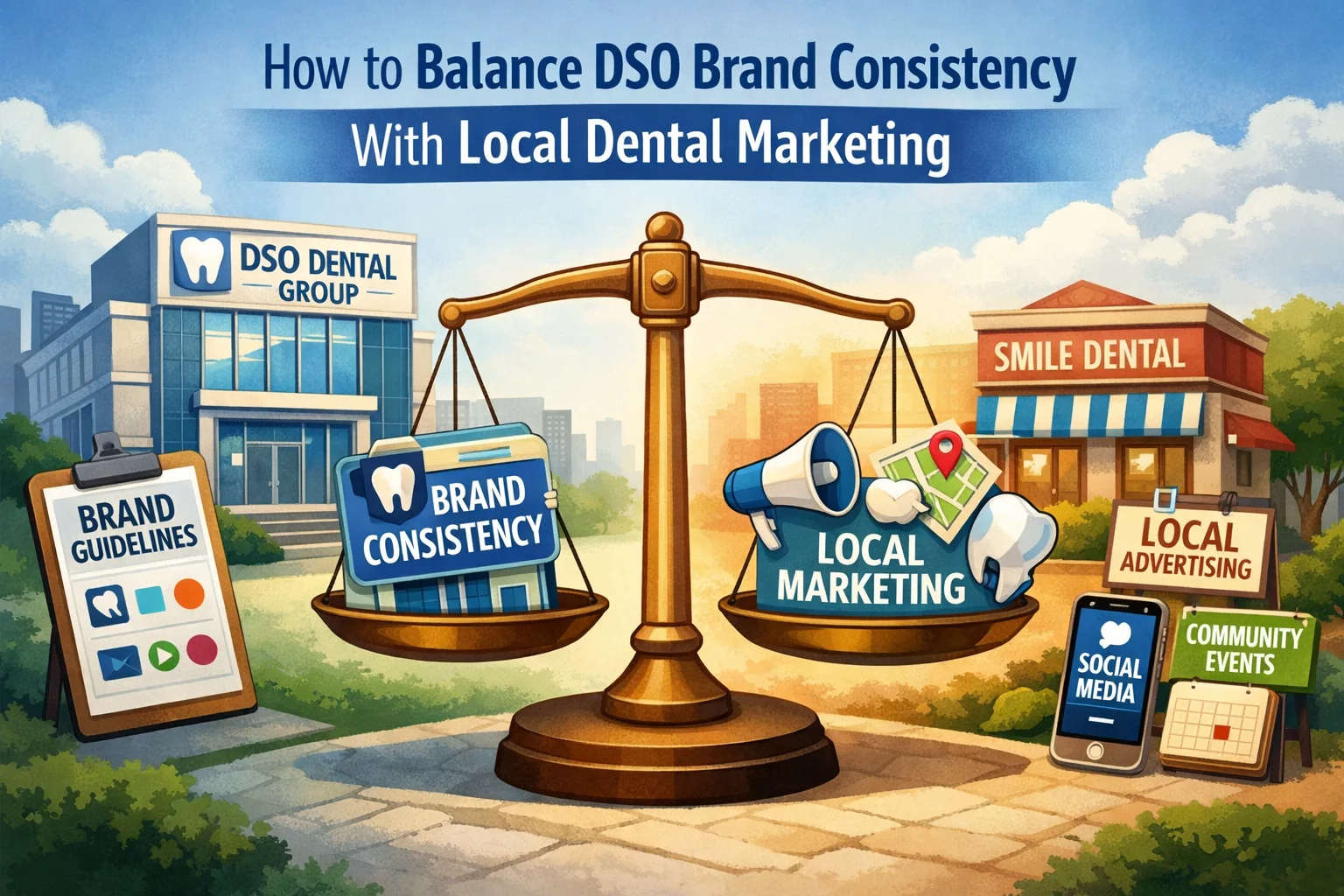 Balancing DSO brand consistency with local dental marketing is one of the biggest challenges multi-location dental organizations face—and this guide breaks down exactly how to do it. Corporate wants a unified brand, but local offices need the freedom to connect with their own patient base in multi-location dentistry. When either side wins completely, marketing performance suffers—either because the brand fragments and trust erodes, or because rigid top-down control stifles the local relevance that drives patient acquisition. Balancing DSO brand consistency with local dental marketing is one of the biggest challenges multi-location dental organizations face—and this guide breaks down exactly how to do it. Corporate wants a unified brand, but local offices need the freedom to connect with their own patient base in multi-location dentistry. When either side wins completely, marketing performance suffers—either because the brand fragments and trust erodes, or because rigid top-down control stifles the local relevance that drives patient acquisition.
The underlying challenge is structural, not creative. DSOs that treat brand governance as a one-time memo inevitably watch their locations drift. Logos change. Messaging shifts. Patient experiences diverge. Meanwhile, DSOs that lock everything down from headquarters often find their local SEO rankings stagnate because every location sounds identical and none sound local. The organizations that scale marketing successfully build a system—brand guidelines that flex without breaking, content workflows that localize without fragmenting, and reporting that tracks both brand health and local performance.
Below, you’ll learn how to build a brand governance framework that scales, create local marketing strategies that stay on-brand, manage multi-location Google Business Profiles without conflict, and measure results at both the network and practice level.
Written for: DSO marketing directors, regional managers, group practice owners, and corporate brand teams managing multi-location dental organizations.
TL;DR
If you only do five things, do these:
| • |
Build a tiered brand governance framework — define what is locked (logo, colors, compliance language), what is flexible (local photos, community events, team bios), and what needs approval before publishing
|
| • |
Create location-specific Google Business Profiles — each practice needs its own fully optimized GBP with unique photos, descriptions, and review management rather than a copy-paste template
|
| • |
Develop modular content templates — give local teams pre-approved frameworks they can customize with local details instead of requiring every post to go through corporate review
|
| • |
Separate local SEO from corporate SEO — corporate owns the main domain strategy while each location targets its own geo-modified keywords and community content so offices don’t cannibalize each other
|
| • |
Track brand consistency and local performance together — measure brand compliance scores alongside cost per new patient by location so you can see where governance helps and where it hurts |
Table of Contents
Why brand consistency matters for DSO growth
Brand consistency isn’t about aesthetics—it’s about trust at scale. When a patient visits one location and has a positive new patient experience, that experience becomes associated with the brand. If they move, travel, or refer a friend to a different location, they expect the same standard. When the second location looks, sounds, and feels different, the referral chain breaks.
The compounding effect works both ways. Consistent branding across locations builds cumulative recognition that no single office could achieve alone. Every billboard, every paid ad, every social media post reinforces the same identity. But inconsistency compounds negatively too—one location’s outdated logo or off-brand messaging can create doubt about the entire network, especially when patients search online and encounter conflicting visual identities across locations. (For more on leveraging this advantage, see our guide to multi-location marketing advantages.)
A pattern we commonly see with growing DSOs: the first 5–10 locations maintain strong brand alignment because the founding team is directly involved. Somewhere between 15 and 30 locations, governance loosens. Local managers start making independent decisions about signage, social media tone, and promotional offers. By the time the network reaches 50+ locations, the brand has quietly fragmented into a collection of loosely related practices rather than a cohesive organization.
Brand consistency directly affects three growth levers:
| • |
Patient acquisition cost — consistent branding improves ad performance because creative assets work harder when they reinforce a recognizable identity; DSOs with strong brand alignment typically see lower cost-per-click and higher conversion rates across their PPC campaigns, improving every stage of the dental marketing funnel
|
| • |
Referral volume — patients refer more confidently when they know the experience will be consistent at another location; inconsistency creates hesitation
|
| • |
Recruitment and retention — dentists and hygienists evaluating DSO opportunities pay attention to brand quality as a proxy for operational quality; a fragmented brand signals fragmented management (for a deeper look at this dynamic, see recruitment and retention strategies for DSOs) |
> Back to Table of Contents
Where DSO brand and local marketing typically conflict
Understanding where tensions surface helps you design governance that prevents them rather than reacting after the damage is done. In our work with multi-location dental groups, the friction points fall into predictable categories. (If you’re still deciding how to organize marketing responsibilities, start with our breakdown of DSO marketing structures: consolidated vs. location-specific vs. hybrid.)
Corporate messaging vs. local voice
Corporate teams write polished, brand-safe copy. Local teams know their community—they know that the office near the university campus speaks differently than the suburban family practice. When corporate mandates identical messaging across all locations, local relevance drops and engagement falls. When local teams write freely, brand voice fractures.
The fix isn’t choosing one side. It’s creating a voice spectrum: a defined brand voice with documented acceptable variations for different practice types (family, cosmetic, pediatric, specialty) and community demographics. Getting this right starts with how your DSO structures its marketing team.
Centralized content vs. local SEO needs
A single blog published on the corporate domain may rank well nationally but does nothing for local search visibility in individual markets. Meanwhile, if every location publishes its own content independently, you risk keyword cannibalization—where two DSO locations compete against each other for the same search terms and both lose.
This is especially common with high-value dental service pages. If Location A and Location B both publish nearly identical content about dental implants targeting the same metro area, Google has to choose which one to surface, and it may choose neither.
Visual identity drift
Local offices inevitably customize. A new office manager orders business cards with a slightly different shade of blue. A location creates a social media graphic using a non-approved font. A practice hangs signage from before the acquisition that was never updated. Individually, these seem minor. Collectively, they erode the visual cohesion that makes a multi-location brand recognizable.
Review management inconsistency
How locations respond to online reviews varies wildly without governance. One office responds to every Google review within 24 hours with a warm, professional tone. Another ignores reviews entirely. A third responds defensively to negative feedback. Since patients often check reviews across multiple locations before choosing, inconsistent reputation management creates an uneven trust signal.
> Back to Table of Contents
How to build a DSO brand governance framework
Effective brand governance isn’t a 200-page manual that nobody reads. It’s a clear system with three tiers: locked elements that never change, flexible elements that adapt within guidelines, and approval-required elements that need corporate sign-off before going live. (If your DSO hasn’t formalized its visual identity yet, start with logo design and branding and our guide to building a dental brand patients remember and refer.)
Tier 1 — Locked elements (non-negotiable)
These are the foundations that create instant brand recognition across all locations:
| • |
Logo usage — exact files, minimum size, clear space requirements, and prohibited modifications (no stretching, no color changes, no adding taglines to the logo itself)
|
| • |
Primary brand colors — hex codes, CMYK values, and Pantone references with specific rules for digital vs. print applications
|
| • |
Typography — approved font families for headings, body copy, and digital use, with fallback fonts specified for web and email
|
| • |
Legal and compliance language — HIPAA-compliant disclaimers, required disclosures, and any state-specific regulatory language that must appear on patient-facing materials
|
| • |
Core brand messaging — the mission statement, value proposition, and brand promise that define who you are across every location |
Tier 2 — Flexible elements (localize within guidelines)
These are the elements where local adaptation is expected and encouraged:
| • |
Team photography — each location should feature its own team, office, and community rather than stock photos; professional dental photography should follow brand style guidelines for lighting, composition, and tone
|
| • |
Community involvement content — local sponsorships, school partnerships, charity events, and neighborhood activities are uniquely valuable and should be promoted using brand-approved templates
|
| • |
Service emphasis — a location known for orthodontics can lead with that specialty in local marketing while still referencing the full service menu; a location near a retirement community can emphasize implants and restorative care
|
| • |
Patient testimonials and reviews — each location collects and shares its own patient stories following brand guidelines for format and HIPAA compliance; patient testimonial videos are especially effective when filmed on-site at each location
|
| • |
Google Business Profile details — descriptions, GBP posts, photos, and Q&A content should be unique to each location while maintaining brand voice standards |
Tier 3 — Approval-required elements
These need corporate review before publishing because they carry brand or compliance risk:
| • |
Promotional offers and discounts — pricing consistency across markets protects brand positioning; a location offering steep discounts can undermine perceived quality at neighboring offices
|
| • |
New service announcements — if one location begins offering a new treatment, the messaging should align with how (or whether) other locations will eventually offer it
|
| • |
Press and media interactions — any media appearances, interviews, or press releases should be coordinated through corporate communications
|
| • |
Paid advertising creative — ad copy and imagery for PPC and paid social should be reviewed to ensure brand alignment and compliance before launching |
Make governance accessible. Store all brand assets, templates, and guidelines in a shared digital asset management system (DAM) that every location can access. If local teams have to email corporate to request a logo file, they’ll use whatever they have on hand—and that’s how drift starts.
> Back to Table of Contents
Local marketing tactics that stay on brand
The goal of local dental marketing isn’t to override the brand—it’s to express the brand through a local lens. Here are the tactics that consistently work for DSO locations without creating governance headaches.
Localized content that builds authority
Each practice location should produce content that connects the brand’s expertise to local context. This means going beyond generic dental education and creating content that a specific community would find valuable.
Effective local content types include:
| • |
Geo-specific service pages — location-targeted pages like “Invisalign in [City Name]” that reference local landmarks, community details, and location-specific information while following website design standards
|
| • |
Community event recaps — posts about local health fairs, school visits, or charity partnerships that show the practice as an active community member
|
| • |
Local team spotlights — profiles of dentists, hygienists, and staff that humanize the location and build the personal connections patients want from their dental provider
|
| • |
Neighborhood guides — content that connects the practice to its surrounding area, especially useful for new patient acquisition in competitive markets |
The key is providing local teams with content templates rather than finished content. A template might include the headline structure, required brand elements, suggested word count, and SEO guidelines—but leave the local details for the team that knows the community. Documenting these workflows in marketing SOPs ensures every new location onboards consistently.
Social media at the local level
Social media is where the tension between brand consistency and local authenticity is most visible. Patients follow local practice accounts expecting to see their dentist, their team, and their community—not corporate stock imagery. Building a content pillar framework helps local teams plan posts that stay on-brand without stifling creativity.
A workable social media governance model:
| • |
Corporate provides — branded templates, monthly content calendars with suggested post themes, pre-approved educational graphics, and hashtag guidelines
|
| • |
Local teams create — behind-the-scenes content, team celebration posts, patient milestone photos (with HIPAA-compliant consent), and community event coverage
|
| • |
Approval workflow — promotional posts and anything involving pricing, clinical claims, or before-and-after images require corporate approval; day-to-day community and team content can be posted within template guidelines |
Local paid advertising
Pay-per-click advertising is one area where local customization directly impacts performance. An ad for a family practice in a suburban community should look and read differently from an ad for a cosmetic-focused practice in an urban market—even within the same DSO.
Geo-targeting is essential for multi-location DSOs. Each location’s ad campaigns should target its specific service area without overlapping with neighboring DSO locations. When two offices in the same DSO bid on the same PPC keywords in the same market, they drive up each other’s cost per click and split their own budget against themselves. A clear DSO marketing budget allocation framework prevents this waste.
Reputation management across locations
Online reviews are among the most powerful local marketing assets a DSO has, and they require a consistent approach without sounding robotic. Our dental patient review response SOP provides a detailed template for building this consistency.
Build a review response framework:
| • |
Positive reviews — acknowledge the specific compliment, thank the patient by name (first name only), and reference the location; avoid copy-paste responses that make the practice look automated
|
| • |
Negative reviews — follow a consistent protocol: acknowledge the concern, express empathy, invite the patient to discuss privately, and never disclose protected health information in a public response
|
| • |
Response time standard — set a network-wide goal (e.g., all reviews receive a response within 24–48 hours) and track compliance by location
|
| • |
Review generation — provide every location with the same systematic process for generating five-star Google reviews post-appointment so volume grows consistently rather than depending on individual initiative |
> Back to Table of Contents
Managing multi-location Google Business Profiles
Google Business Profile management is where brand consistency and local marketing either come together or fall apart for DSOs. Each location needs its own GBP, and each profile needs to feel both uniquely local and unmistakably part of the same organization.
Setting up GBP for DSO locations
Google’s guidelines for multi-location businesses require that each physical location maintains its own separate profile. For DSOs, this means:
| • |
Business name consistency — use the exact legal business name as it appears on signage at each location; Google’s guidelines allow sub-brand variations (e.g., “Bright Dental — Westside” and “Bright Dental — Downtown”) as long as the naming convention is consistent
|
| • |
Unique phone numbers and addresses — every location must have its own phone number and physical address; shared numbers create tracking problems and can trigger Google’s duplicate detection
|
| • |
Location-specific categories — while all locations share the primary category (e.g., “Dentist”), secondary categories should reflect each location’s actual services; optimizing GBP categories correctly means if one location offers orthodontics and another doesn’t, their categories should differ accordingly
|
| • |
Individual verification — each location must be verified separately, though bulk verification is available for businesses with 10+ locations |
Optimizing each profile for local search
A common DSO mistake is creating GBP profiles that are technically correct but locally generic. Optimizing for local SEO ranking factors requires location-level attention. Each profile should include:
| • |
A unique business description — reference the specific neighborhood, community, and services emphasized at that location rather than copying the corporate description across all profiles
|
| • |
Location-specific photos — exterior shots (so patients recognize the building), interior photos, team photos, and before-and-after work (with consent); Google’s algorithm favors profiles with regularly updated, unique images
|
| • |
Consistent hours and service information — keep hours current, especially during holidays, and ensure listed services match what the location actually offers
|
| • |
Regular GBP posts — each location should publish posts highlighting local events, promotions, and updates; corporate can provide a content calendar while local teams add community-specific details |
Avoiding internal competition
When multiple DSO locations serve overlapping markets, GBP management requires coordination to avoid cannibalization:
| • |
Define service area boundaries — map each location’s primary and secondary service areas, ensure GBP service area settings don’t overlap unnecessarily, and verify that directory citations are accurate for every office
|
| • |
Differentiate by specialty or emphasis — if two locations are close together, lean into what makes each one distinct (one emphasizes pediatric, the other cosmetic) rather than marketing both identically
|
| • |
Coordinate review generation — make sure efforts to collect reviews don’t create an imbalance where one location has hundreds of reviews and a neighboring office has a handful |
> Back to Table of Contents
How to measure brand consistency and local performance
You can’t manage what you don’t measure, and DSOs need visibility into both brand health and local marketing results. A well-built marketing dashboard that surfaces both sets of metrics is essential. In our experience, the organizations that track both outperform those that focus on only one.
Brand consistency metrics
| • |
Brand audit scores — conduct quarterly audits of each location’s patient-facing materials (website, signage, social media, print materials) against the brand guidelines; score compliance on a scale and track trends over time
|
| • |
Visual identity compliance rate — the percentage of locations using current, approved logos, colors, fonts, and imagery across all channels
|
| • |
Review response compliance — the percentage of online reviews that receive a response within the network-wide time standard, plus qualitative evaluation of response tone and adherence to the response framework
|
| • |
Content governance adherence — the percentage of published content (blog posts, social media, ads) that followed the appropriate approval workflow |
Local marketing performance metrics
| • |
Cost per new patient by location — the most important metric for evaluating local marketing ROI; track ROI by channel and source (organic, paid, referral) and compare across locations
|
| • |
Local search visibility — track rankings for geo-modified keywords (e.g., “dentist in [city]”) and GBP insights (views, searches, actions) for each location
|
| • |
Review volume and rating by location — monitor the total number of reviews, average rating, and month-over-month growth for every office
|
| • |
Website traffic by location page — if you use location-specific landing pages on the corporate domain, track traffic, bounce rate, and conversion rate for each
|
| • |
Patient acquisition source by location — understand where each office’s new patients actually come from using tools like call tracking so you can allocate local budgets effectively |
Connecting the two: brand health vs. local results
The most revealing analysis compares brand compliance scores with local marketing performance. What you typically find:
Locations with high brand compliance and strong local customization tend to outperform on both patient acquisition and retention. They benefit from brand recognition while connecting with their community. Locations with low brand compliance may show strong short-term results from aggressive local tactics but typically underperform on referral volume and long-term patient retention because they lack the trust signals that consistent branding creates. Locations with rigid brand adherence but no local customization often struggle with local search visibility and community engagement because they sound corporate rather than personal.
The sweet spot is high compliance on locked elements combined with active, creative use of flexible elements. That’s what governance should enable.
> Back to Table of Contents
Let WEO Media build your DSO marketing system
WEO Media specializes in dental SEO, paid advertising, reputation management, and multi-location marketing strategy built specifically for DSOs and group dental practices. We help organizations build the governance frameworks, content systems, and local marketing playbooks that keep brands strong while every location thrives. See our DSO and multi-location case studies or contact us today at 888-246-6906 to discuss your DSO’s marketing goals.
> Back to Table of Contents
FAQs
What is brand consistency in dental marketing?
Brand consistency in dental marketing means every patient-facing touchpoint—websites, social media, signage, ads, review responses, and in-office materials—uses the same logo, colors, messaging tone, and visual identity. For DSOs, this extends across all locations so patients experience a recognizable, trustworthy brand regardless of which office they visit or encounter online.
How do DSOs balance brand standards with local marketing needs?
The most effective approach is a tiered governance framework. Locked elements like logos, brand colors, and compliance language remain identical across all locations. Flexible elements like team photos, community content, and service emphasis are customized locally within brand guidelines. Approval-required elements like promotional offers and paid ad creative go through corporate review before publishing.
Should each DSO location have its own Google Business Profile?
Yes. Google requires each physical business location to maintain its own separate Google Business Profile. For DSOs, this means creating and individually verifying a profile for every office, each with a unique phone number, address, business description, photos, and locally relevant content. Bulk verification is available for organizations with ten or more locations.
How do you prevent keyword cannibalization between DSO locations?
Define each location’s target keywords using geo-modifiers specific to its service area. Avoid publishing identical service-page content across location pages. Instead, create unique content for each market that references local details. For paid search, set geographic targeting boundaries so two DSO offices are not bidding on the same terms in the same area and driving up costs.
What metrics should DSOs track for brand consistency?
Key metrics include brand audit scores from quarterly reviews of patient-facing materials, visual identity compliance rates across all channels, review response compliance rates against the network time standard, and content governance adherence showing the percentage of published content that followed the proper approval workflow. Tracking these alongside local performance metrics reveals how governance impacts results.
How should DSOs handle online reviews across multiple locations?
Build a review response framework that sets a network-wide response time standard, provides tone and format guidelines, and includes protocols for handling negative feedback without disclosing protected health information. Each location should use the same systematic process for requesting patient reviews post-appointment so volume grows consistently rather than depending on individual staff initiative.
Can DSO locations run their own social media accounts?
Yes, and they should. Patients want to see their specific team, office, and community on social media rather than corporate stock imagery. The best model has corporate providing branded templates, monthly content calendars, and pre-approved educational graphics while local teams create community and team content within those guidelines. Promotional posts and clinical claims should require corporate approval before publishing.
What is a digital asset management system and why do DSOs need one?
A digital asset management system is a centralized platform where all brand assets—logos, templates, photography guidelines, fonts, and approved marketing materials—are stored and accessible to every location. DSOs need one because brand drift often starts when local teams cannot easily access current approved assets and improvise with outdated or off-brand materials instead. |
|