Best DSO Marketing Structure: Consolidated vs Location-Specific vs Hybrid
Posted on 1/6/2026 by WEO Media |
 Marketing structure is one of the most consequential decisions a DSO (dental service organization)
can make. It shapes how consistently patients experience the brand, how quickly information can be updated across locations, how reliably performance can be measured, and how effectively compliance risk is managed at scale. Marketing structure is one of the most consequential decisions a DSO (dental service organization)
can make. It shapes how consistently patients experience the brand, how quickly information can be updated across locations, how reliably performance can be measured, and how effectively compliance risk is managed at scale.
This guide helps DSOs evaluate, select, and govern the right marketing structure without sacrificing local relevance, staff alignment, or reporting integrity. By the end, readers should be able to choose a model and understand the governance components required to execute it sustainably.
Who This Guide Is For
| • |
DSO CMOs and Marketing Leaders - Determine the right balance of central control and local flexibility while protecting brand, compliance, and measurement standards.
|
| • |
Regional and Operations Leadership - Understand how updates flow, where validation authority lives, and how to prevent bottlenecks without losing oversight.
|
| • |
Practice-Level Leaders - Contribute meaningful local inputs through structured workflows rather than ad hoc control. |
Why it matters: Structure determines whether marketing friction shows up as patient confusion, staff frustration, or unreliable data.
TL;DR
| • |
Consolidated marketing prioritizes consistency, risk control, and reporting clarity, but can limit local relevance if updates move too slowly.
|
| • |
Location-specific marketing improves local trust and intent alignment, but increases brand drift, legal exposure, and maintenance complexity without guardrails.
|
| • |
Hybrid marketing is typically the most durable model for DSOs, combining centralized systems with governed local inputs.
|
| • |
Search engines and patients reward consistency paired with usefulness, not generic templating or unchecked localization.
|
| • |
Execution quality depends on role clarity, approval tiers, and shared KPIs—not the model alone. |
Plain-language takeaway: Consistency builds confidence, and structured local input builds credibility.
Quick Definitions
Consolidated marketing
centralizes brand standards, messaging rules, analytics definitions, and publishing authority at the corporate level, with limited structured input from locations.
Location-specific marketing
allows individual practices greater autonomy to tailor messaging, content, and campaigns to their local market conditions.
Hybrid marketing
centralizes infrastructure and governance while enabling controlled localization through defined inputs, validation lanes, and escalation paths.
How to Choose a Model in Under a Minute
| • |
High compliance sensitivity - Lean toward consolidated or a hybrid approach with strict claims and promotions governance.
|
| • |
Frequent urgent updates - Hybrid models with defined fast lanes reduce operational friction.
|
| • |
Significant market variation - A hybrid approach lets language, access, and service emphasis adapt by location within guardrails.
|
| • |
Uneven local execution - Greater centralization reduces risk until training and feedback loops mature.
|
| • |
Fragmented CMS or analytics - Consolidation is often required before safe localization can scale. |
The most effective structure is the simplest one the organization can operate consistently across every location.
Why Structure Matters to Patients and Staff
Patients often use consistency as a trust signal, especially in healthcare. If a website, a listing, and a front desk deliver different expectations, patients may interpret the mismatch as instability or uncertainty about what to expect. This is amplified during transitions like rebrands, acquisitions, or platform migrations.
Trust signals vary by market type, so DSOs rarely succeed with a single messaging layer everywhere.
| • |
Urban competitive markets - Patients compare options quickly, so local proof (recent reviews, access details, service clarity) helps reduce hesitation.
|
| • |
Rural or access-limited markets - Availability and logistics (hours, emergency guidance, insurance fit) often matter more than polished positioning.
|
| • |
Multilingual markets - Comprehension drives confidence; bilingual appointment instructions and clearly stated language availability reduce drop-off and miscommunication. |
Staff perception matters because operational follow-through becomes a marketing input. When local teams feel disconnected from marketing decisions, participation can decline in areas that require consistent repetition, such as review workflows or timely content updates.
Plain-language takeaway: When the message changes from channel to channel, patients hesitate and staff end up doing damage control.
Consolidated Marketing
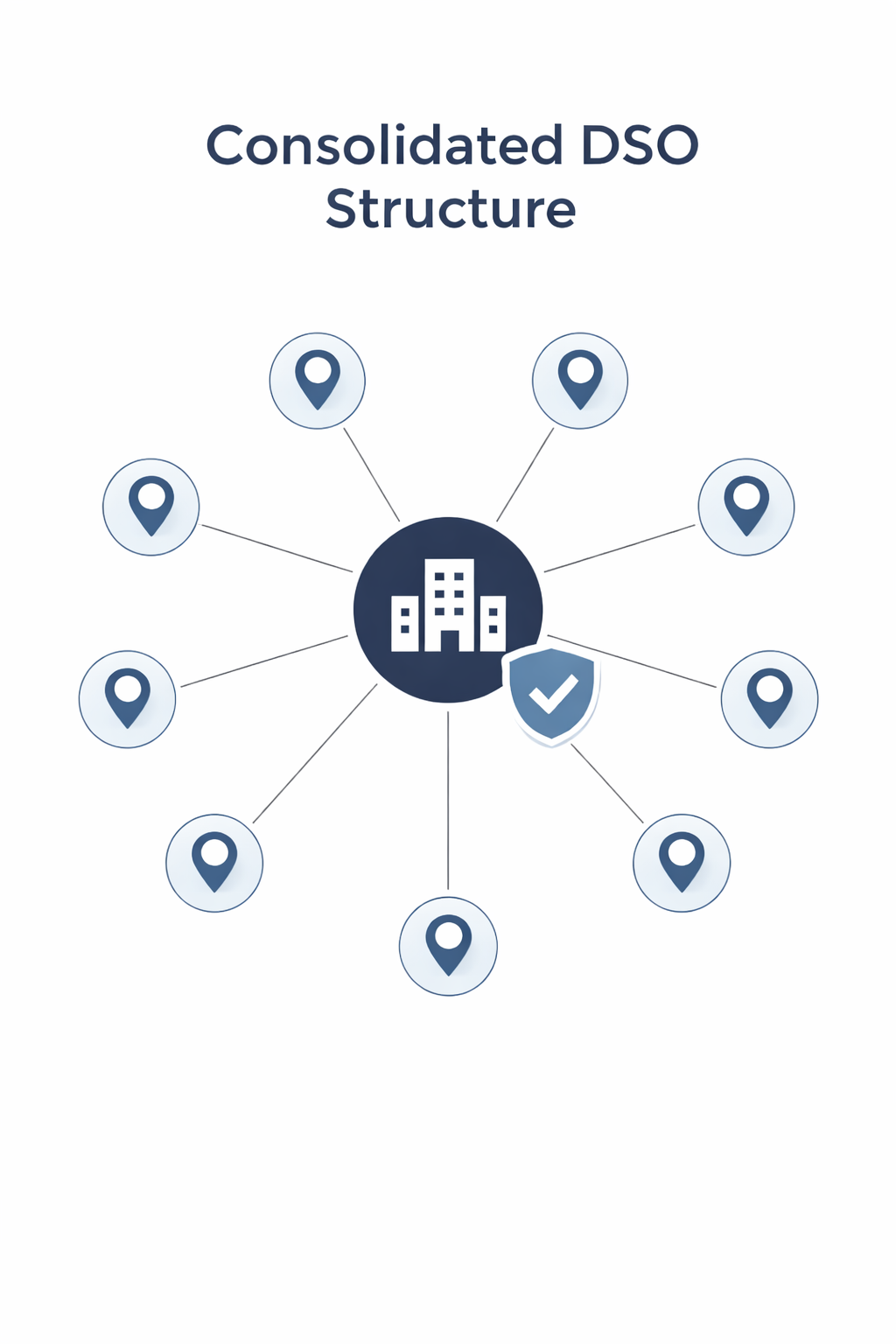 Best for: DSOs with complex compliance requirements, multi-state operations, or a strong need for uniform reporting and brand control. Best for: DSOs with complex compliance requirements, multi-state operations, or a strong need for uniform reporting and brand control.
Least effective for: Organizations that require frequent local pivots or rapid operational updates.
Strengths
- Uniform patient experience – Fewer discrepancies across channels and touchpoints.
- Comparable reporting – Standardized tracking enables system-wide performance analysis.
- Reduced compliance risk – Claims, disclosures, and promotions are easier to govern centrally.
- Efficient system-wide updates – Template and accessibility fixes can be deployed broadly.
Common pitfall: Centralized queues become bottlenecks, delaying time-sensitive updates such as hours, closures, or appointment instructions.
Common Pitfalls Checklist
- Slow operational updates – Patients see outdated hours or instructions, increasing cancellations and front-desk friction.
- Generic local pages – Pages feel interchangeable, reducing local intent match and engagement.
- Field disengagement – Locations feel marketing is “done to them,” reducing participation in reviews and local proof collection.
Why it matters: If a location changes Saturday hours but updates lag online, patients arrive with mismatched expectations and the front desk absorbs the fallout.
Location-Specific Marketing
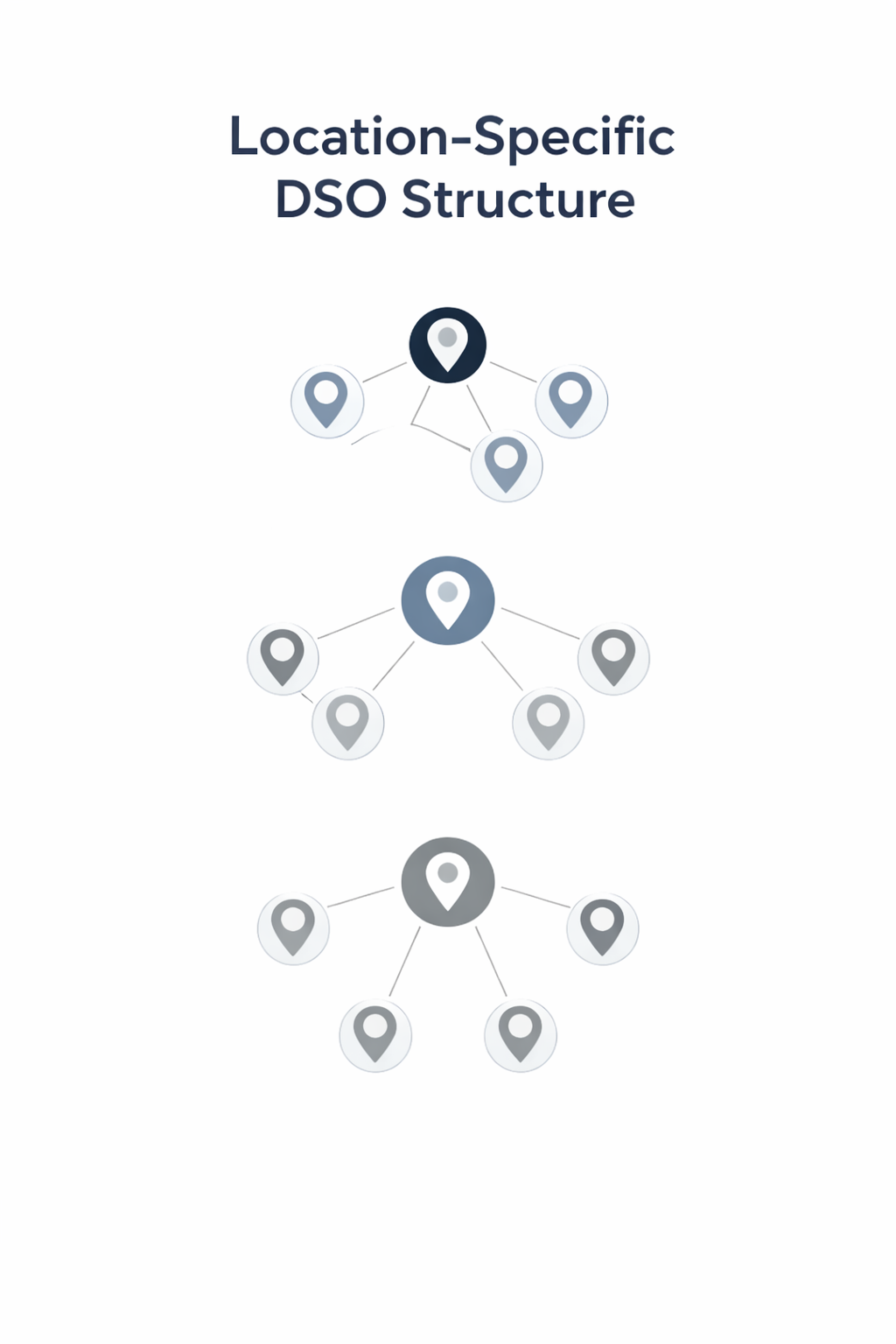 Best for: Smaller groups with strong local leadership and limited compliance complexity. Best for: Smaller groups with strong local leadership and limited compliance complexity.
Least effective for: Larger DSOs where drift and inconsistency undermine trust and measurement.
Strengths
- High local relevance – Content aligns closely with patient intent and community context.
- Faster local response – Teams can adapt quickly to competitive or seasonal shifts.
- Stronger community connection – Authentic local content can increase trust.
Common pitfall: Unmanaged variation in claims, offers, and tracking leads to risk and unreliable data.
Common Pitfalls Checklist
- Brand drift – Tone, claims, and offers vary across locations, weakening patient trust in the system as a whole.
- Compliance exposure – Promotions and promises become uneven, especially across state lines or after acquisitions.
- Maintenance overload – Hundreds of pages become difficult to keep current without automation and standards.
- Measurement fragmentation – Dashboards become incomparable because tracking and definitions differ by market.
Plain-language translation: When every market measures “leads” differently, leadership can’t tell whether results changed—or the tracking did.
Hybrid Marketing
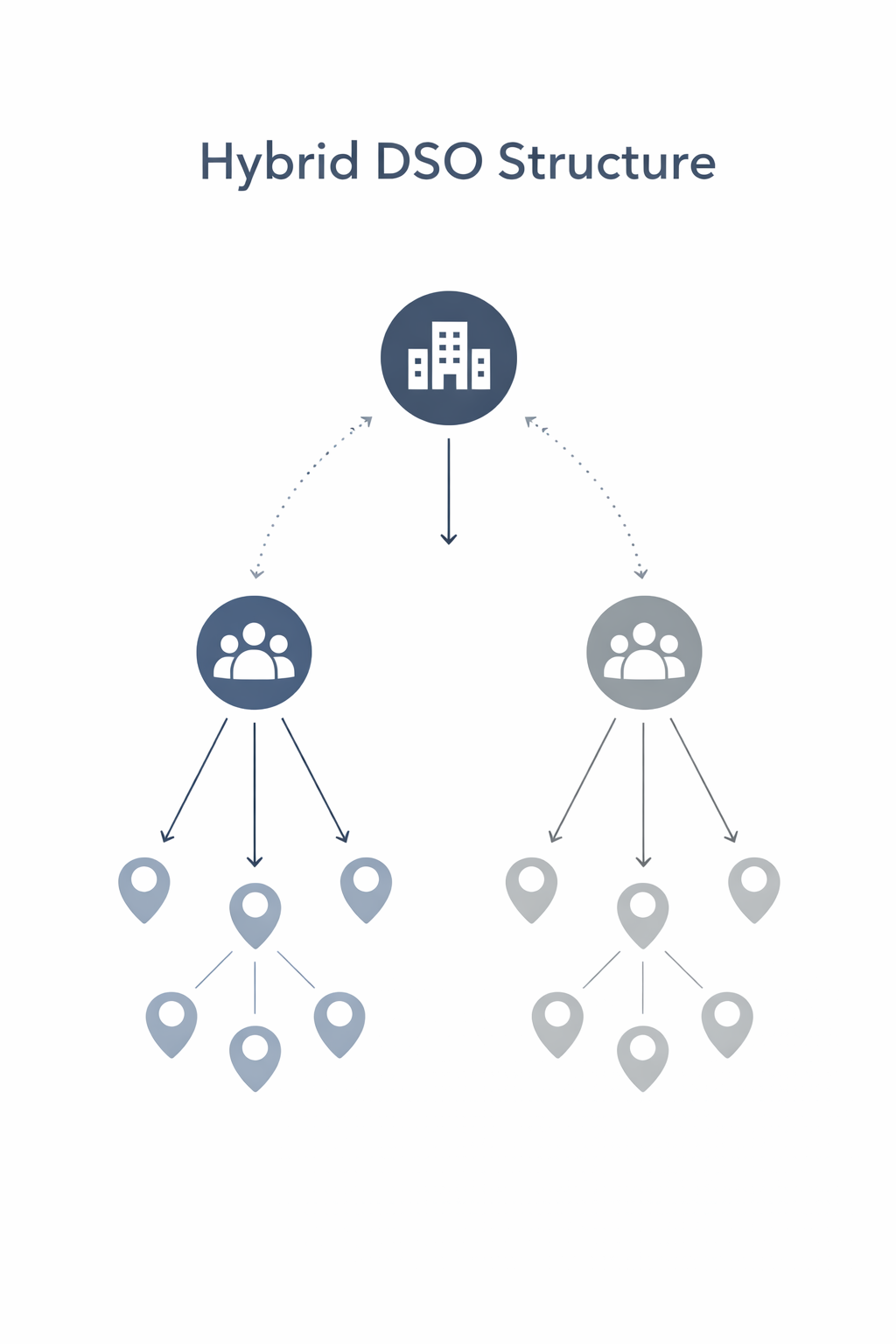 Best for: Most DSOs operating across diverse markets who need consistent systems and reporting while preserving local relevance. Best for: Most DSOs operating across diverse markets who need consistent systems and reporting while preserving local relevance.
Least effective for: Organizations without defined roles, approval tiers, or a scalable update system.
What Hybrid Centralizes and Localizes
- Centralized elements – Templates, disclosures, analytics definitions, tracking configuration, accessibility standards, vendor governance.
- Localized elements – Photos, local FAQs, access details, language availability, and market-specific service emphasis within approved phrasing.
Hybrid succeeds when local relevance is a governed process, not a loophole.
Common Pitfalls Checklist
- “Half-hybrid” bottlenecks – Local inputs exist, but everything still waits on corporate publishing without a fast lane.
- Role confusion – Regions are expected to oversee outcomes without dashboards or training, or practices expect full control over claims and offers.
- Thin templating – Location pages exist but don’t help patients decide for that location, reducing organic value.
Why it matters: If the workflow isn’t designed first, hybrid becomes centralized with extra steps.
The DSO Governance Fit Score
The DSO Governance Fit Score is a readiness rubric that turns “which model” into a repeatable decision. Score each dimension from 1 to 5, then total your score.
Scoring Anchors 1–5
| • |
1 - Inconsistent or undefined; decisions vary by person; drift is common.
|
| • |
3 - Partially defined; some standardization exists; execution varies by region or location.
|
| • |
5 - Well-defined and followed; clear accountability; consistent execution with auditability. |
Score These Five Dimensions
| 1. |
Governance clarity - Roles, approvals, escalation paths, and update SLAs are documented and used in practice.
|
| 2. |
Compliance sensitivity - Claims and promotions carry meaningful risk across jurisdictions, brands, or service lines.
|
| 3. |
CMS maturity - Permissions, modular templates, bulk updates, and audit logs are available and actively used.
|
| 4. |
Local execution reliability - Locations reliably follow review, photo, and update workflows without drifting from standards.
|
| 5. |
Measurement integrity - KPI definitions and tracking are consistent across locations and acquisitions. |
Interpret your total:
| • |
5–11 - Lean consolidated first; stabilize governance, CMS controls, and measurement before expanding localization.
|
| • |
12–19 - Hybrid is typically the best fit; implement approval tiers, role lanes, and shared KPIs before scaling local modules.
|
| • |
20–25 - You can support a more flexible hybrid with stronger regional validation and richer local modules. |
Plain-language translation: If you can’t govern it, don’t distribute it.
DSO Marketing Governance Workflow Template
Governance determines whether a chosen model remains functional over time. A scalable workflow makes updates fast, accurate, and auditable.
Local Update Intake Form Outline
| • |
Operational updates - Hours, closures, scheduling instructions, accessibility notes, parking directions.
|
| • |
Service emphasis - Top services for the location, seasonal shifts, payer mix considerations where approved.
|
| • |
Local proof assets - New photos, community partnerships, location-specific FAQs based on real patient questions.
|
| • |
Language and inclusion - Languages spoken, translation needs for appointment instructions, culturally responsive wording requests within brand rules. |
Why it matters: Structured intake reduces ad hoc requests and makes approvals faster.
Tiered Approval Workflow
| 1. |
Low-risk updates - Operational details validated and published quickly using standard checks.
|
| 2. |
Medium-risk updates - Localized content reviewed by regional validators for accuracy and fit.
|
| 3. |
High-risk updates - Claims, promotions, and pricing language reviewed by compliance and legal before publishing. |
Why it matters: When everything is treated as high risk, everything becomes slow.
Escalation and Conflict Resolution
When local market needs conflict with central standards, resolution works best when criteria are defined in advance.
| • |
Regional leadership - Owns urgency triage and local accuracy validation without needing to manage channels directly.
|
| • |
Corporate marketing - Owns templates, measurement standards, and cross-market consistency.
|
| • |
Compliance and legal - Owns final decisions for claims, offers, disclosures, and privacy-sensitive content. |
Plain-language takeaway: You’re not debating opinions; you’re applying a decision rule.
KPIs and Reporting
Effective reporting separates system health from local execution and keeps dashboards comparable across acquisitions.
Define “Qualified Lead” in a Way Your Team Can Use
A “qualified lead” should be defined consistently, then refined as the organization learns. Common examples include a call above a minimum duration, a completed form with new-patient intent, or a booked appointment outcome when integrations allow.
Plain-language translation: If every location defines a lead differently, the dashboard stops being a decision tool.
Central KPIs
| • |
Qualified leads
- Calls and forms filtered by agreed criteria so reporting reflects meaningful demand.
|
| • |
Conversion stability - Sudden drops often indicate tracking, page, or listings issues rather than immediate demand changes.
|
| • |
Technical health
- Indexing coverage, crawl errors, and template performance trends. |
Local KPIs
| • |
Local visibility
- Performance for high-intent, geo-modified searches by market type.
|
| • |
Listings interactions - Calls, directions, and clicks interpreted with seasonality and staffing realities.
|
| • |
Review velocity
- A leading indicator that often reflects operational follow-through more than creative changes. |
Equity Metrics
| • |
Peer-tier visibility - Compare locations to similar markets rather than flagship offices (tier by competition level and population served).
|
| • |
Language and accessibility coverage - Ensure inclusive information appears where patients decide (pages, listings, appointment instructions). |
Why it matters: Equity metrics reduce the risk of always allocating attention to the loudest markets instead of the most underserved ones.
Diagnostics to check first when performance dips:
| • |
Tracking - Confirm call tracking numbers, form events, and attribution rules didn’t break during updates.
|
| • |
Indexing - Confirm key location pages remain indexed after template or CMS changes.
|
| • |
Listings integrity - Confirm categories, duplicates, hours, and attributes didn’t drift across Google Business Profiles. |
Multi-Location Dental SEO Architecture
Hybrid execution requires platforms that separate templates from local data so you can scale updates without creating drift.
Required CMS Capabilities
| • |
Role-based permissions - Locations update approved fields without altering templates.
|
| • |
Modular page structure - Controlled slots for unique local content without redesigning the whole page.
|
| • |
Bulk propagation - Central fixes deploy across many pages quickly and consistently.
|
| • |
Approval states and audit logs - Changes are reviewable, traceable, and reversible.
|
| • |
Single source of truth - Governed location data feeds pages and key fields to reduce mismatches over time. |
Plain-language translation: The CMS should make the right changes easy and the risky ones hard.
Schema and Duplicate Content, Explained Simply
Schema is most sustainable when it is generated from accurate location data rather than manually edited across hundreds of pages. Duplicate content risk increases when location pages are templated but don’t add local value.
| • |
Reduce thin templating - Add authentic photos, localized FAQs, language availability, and access details that help patients decide.
|
| • |
Avoid city-name swaps - Replacing only a city name rarely improves usefulness or rankings.
|
| • |
Keep non-negotiables consistent - Disclosures, claims rules, and core structure should not vary by location. |
Vendor and Budget Governance
As DSOs scale, unclear ownership of vendors and accounts often creates more friction than strategy.
| • |
Clear account ownership - Define who controls ad platforms, analytics, listings, and call tracking across the organization.
|
| • |
Vendor scorecards - Evaluate partners on reporting quality, compliance adherence, testing discipline, and responsiveness to urgent updates.
|
| • |
Market-based budgeting - Allocate resources based on competition, access needs, and language requirements rather than volume alone. |
Plain-language takeaway: If ownership is unclear, accountability disappears and costs rise.
Compliance and Risk Considerations
This content is informational and not legal advice. DSOs should review claims, promotions, and privacy-sensitive practices with appropriate compliance and legal teams.
Compliance review required for promotions and claims:
| • |
Consent and privacy - Central policies with configurable local settings reduce measurement gaps across jurisdictions.
|
| • |
Promotions - Central rules prevent inconsistent offers and disclosure drift across locations.
|
| • |
Accessibility
- Standard templates reduce ADA risk while still allowing local clarity where it helps patients. |
Privacy-safe analytics note: Avoid collecting sensitive health details through form fields, call recordings, or session tools unless you have appropriate controls, authorizations, and retention policies.
Implementation Phases
| 1. |
Baseline assessment - Inventory systems, templates, tracking, listings governance, and workflows; establish baseline KPIs.
|
| 2. |
Pilot markets - Test governance lanes and local modules in a small set of locations across different market types; refine SLAs and approval tiers.
|
| 3. |
Phased expansion - Train regional validators and roll out in waves to maintain quality and speed.
|
| 4. |
Standardization - Consolidate dashboards, audits, and documentation so decisions remain comparable across locations.
|
| 5. |
Ongoing review - Reassess quarterly for search platform shifts, listings drift, and compliance updates; refresh training and templates as needed. |
Post-acquisition stabilization checklist:
| • |
Week 1 - Listings accuracy (hours, duplicates, categories), appointment instructions, tracking continuity, urgent operational updates.
|
| • |
Month 1 - Templates, disclosures, claims rules, KPI definitions, and a repeatable local intake workflow for unique modules. |
Case Vignette
A multi-state dental group expanded rapidly through acquisition. Soon after, patients encountered inconsistent naming, appointment instructions, and offers across channels. Front-desk teams absorbed the confusion because patients arrived with expectations shaped by whichever channel they saw last.
What changed and why it worked:
| • |
Symptom - Mismatched offers and instructions created patient frustration and staff rework.
|
| • |
Root cause - Decentralized updates, inconsistent disclosures, and fragmented tracking across inherited platforms.
|
| • |
Governance fix - Standardized templates and tracking, implemented approval tiers with a fast lane, and added controlled local modules (photos, FAQs, access details, language availability).
|
| • |
Expected outcome - Fewer mismatches, faster operational updates, and clearer diagnosis when a market underperforms. |
What to Do Next
If you want a practical starting point that aligns leadership quickly, focus on the smallest set of actions that make the model operable.
| 1. |
Audit reality - Map your current publishing flow, tracking definitions, listings governance, and who owns what across vendors and tools.
|
| 2. |
Pick a pilot - Choose a small set of locations across different market types to test governance lanes and local modules.
|
| 3. |
Define lanes - Document role lanes, approval tiers, and a fast lane for low-risk operational updates.
|
| 4. |
Lock KPI definitions - Agree on what counts as a qualified lead and which KPIs are central vs local.
|
| 5. |
Scale only what you can govern - Expand localization modules after the workflow is stable and auditable. |
Plain-language takeaway: Stabilize the system, prove it in a pilot, then scale only what the organization can govern.
About the Author
This article was written, reviewed, and edited by a senior strategist at WEO Media - Dental Marketing with experience supporting multi-location dental organizations on marketing governance, scalable local SEO, and measurement frameworks across growing DSOs. The content reflects practical implementation considerations rather than promotional guidance.
FAQs
Which marketing structure works best for most DSOs?
Hybrid marketing is often the most durable structure because it centralizes systems and compliance guardrails while allowing structured local input. The right choice depends on governance clarity, compliance sensitivity, CMS maturity, local execution reliability, and measurement integrity.
How can DSOs avoid corporate bottlenecks?
Tiered approvals and a fast lane reduce bottlenecks. Low-risk operational updates should move quickly with validation checks, medium-risk content can route to regional validation, and high-risk claims or promotions should route to compliance and legal review before publishing.
What should always remain centralized?
Claims rules, disclosures, privacy language, analytics definitions, accessibility standards, and core templates should remain centralized so trust, compliance, and reporting consistency do not vary by location. This reduces risk and keeps performance data comparable across markets.
What types of content can be localized safely?
Authentic photos, local FAQs, access details, language availability, and community context can usually be localized within approved brand and compliance guardrails. Localization is safest when inputs are structured, validated, and published through defined approval tiers.
How should we interpret the DSO Governance Fit Score?
Lower totals typically indicate a need to consolidate first so governance, CMS controls, and measurement can be stabilized. Mid-range totals usually support a hybrid model with role lanes and approval tiers. Higher totals suggest readiness for richer local modules within strong governance guardrails. |
|