How to Build a Dental Social Media Content Pillar Framework
Posted on 3/12/2026 by WEO Media |
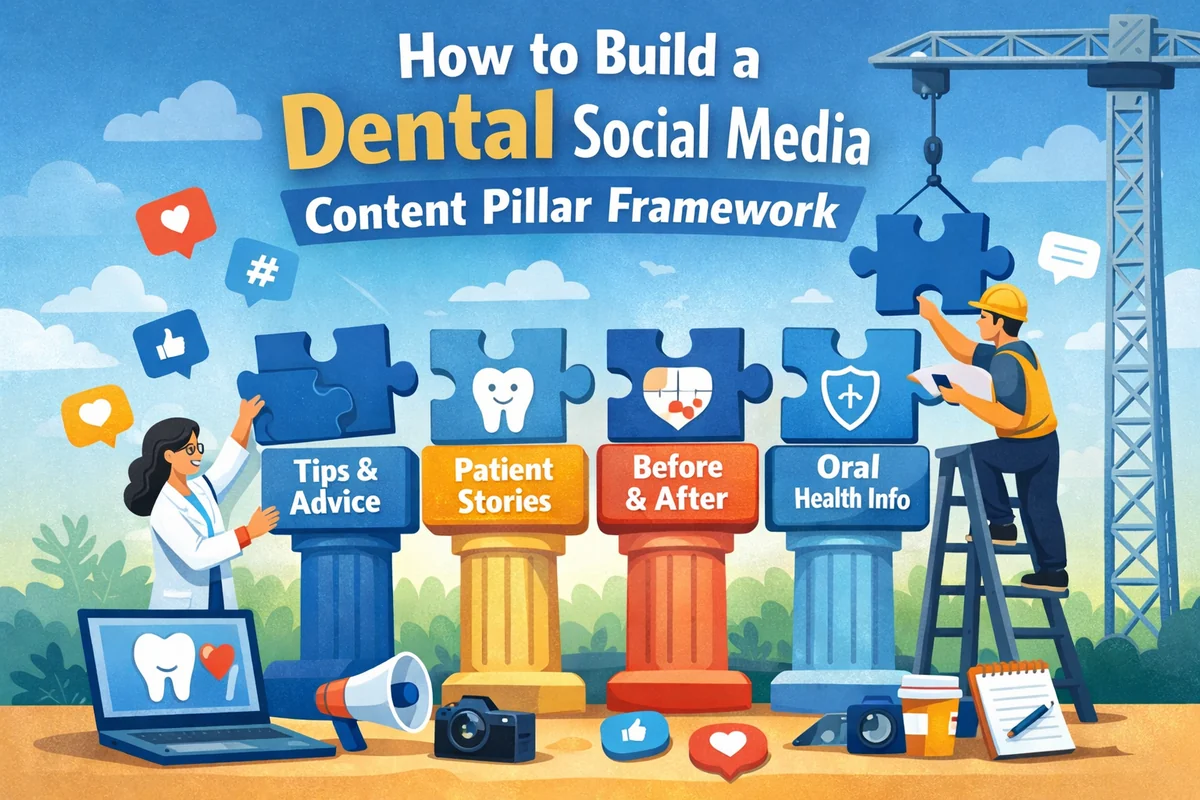 To build a dental social media content pillar framework, dental practices should organize their posting strategy around five repeating content themes—educational posts, patient social proof, team culture, community connection, and promotional offers—that create a clear structure for what to post, when to post, and why each piece of content exists. Without defined pillars, most practices fall into one of two traps: posting randomly until the team burns out, or defaulting to a stream of promotions that patients scroll past. Content pillars solve both problems by turning social media marketing from guesswork into a sustainable workflow that builds trust, earns engagement, and drives new patient inquiries month after month. To build a dental social media content pillar framework, dental practices should organize their posting strategy around five repeating content themes—educational posts, patient social proof, team culture, community connection, and promotional offers—that create a clear structure for what to post, when to post, and why each piece of content exists. Without defined pillars, most practices fall into one of two traps: posting randomly until the team burns out, or defaulting to a stream of promotions that patients scroll past. Content pillars solve both problems by turning social media marketing from guesswork into a sustainable workflow that builds trust, earns engagement, and drives new patient inquiries month after month.
The framework matters more than any single post. A well-structured pillar system ensures your dental marketing strategy covers every angle patients care about—education, social proof, personality, community connection, and timely offers—without leaning too heavily on any one category. It also makes delegation easier: when your team knows the pillars, anyone can contribute ideas without waiting for creative direction. The practices we work with that maintain a consistent social media presence almost always have some version of this structure in place, even if they don’t call it a “content pillar framework.”
This guide walks through the five core pillars that work for dental practices, how to adapt them across platforms like Facebook, Instagram, and TikTok, how to build a HIPAA-compliant content workflow, and how to measure what’s actually working. You’ll also find a pillar-to-calendar mapping approach you can implement in a single afternoon.
Written for: dental practice owners, office managers, and marketing coordinators who want a structured, repeatable system for social media content—without needing to reinvent the wheel every week.
TL;DR
If you only remember five things from this guide, make it these:
| • |
Build around five core pillars — educational content, social proof, team and culture, community connection, and promotional offers give you a balanced mix that keeps audiences engaged without feeling salesy
|
| • |
Weight your pillars intentionally — roughly 40% educational, 25% social proof, 20% team/culture, 10% community, and 5% promotional content keeps trust high and engagement consistent
|
| • |
Adapt pillars to each platform — Facebook favors community and social proof, Instagram rewards visual storytelling and behind-the-scenes content, and TikTok thrives on short-form education and personality
|
| • |
Build HIPAA compliance into your workflow — written patient consent, a designated content reviewer, and a pre-publish checklist prevent costly violations before they happen
|
| • |
Track pillar performance monthly — measure engagement rate, reach, and new patient inquiries by pillar so you can double down on what works and adjust what doesn’t |
Table of Contents
What are content pillars and why do dental practices need them?
Content pillars are recurring themes or topic categories that anchor your social media strategy. Instead of waking up each morning wondering “what should we post today,” pillars give your team a menu of proven categories to pull from. Each pillar serves a specific purpose in the patient journey—some build awareness, some build trust, and some drive action.
For dental practices specifically, content pillars matter because your audience isn’t looking for entertainment. They’re looking for reasons to trust you before they ever pick up the phone. Research consistently shows that a significant majority of patients check a dental practice’s social media profiles before booking their first appointment. That means your social media isn’t just a marketing channel—it’s an extension of your first impression.
Without pillars, most practices default to one of these patterns:
| • |
All promotion, all the time — every post is a special offer or a “call us today” message, which trains followers to ignore you
|
| • |
Random posting — one week it’s a team photo, the next week it’s silence for three weeks, then a burst of posts that feel disconnected
|
| • |
Over-reliance on one content type — some practices post nothing but before-and-after photos, which limits reach and doesn’t build the full picture of who you are
|
| • |
Inconsistency and burnout — without a system, whoever is “in charge of social media” runs out of ideas within a month and posting stops entirely |
A pillar framework eliminates these patterns by giving every post a category, a purpose, and a place in your calendar. It also makes it dramatically easier to delegate content creation, because team members don’t need creative direction—they need a pillar assignment and a prompt.
> Back to Table of Contents
The five core content pillars for dental social media
The most effective dental social media strategies we see are built around five content pillars. You can customize the names to match your brand, but the functions should stay the same. Each pillar addresses a different stage of the patient decision process.
Pillar 1: Educational content (target: ~40% of posts)
Educational posts position your practice as the trusted authority patients turn to for answers. This is the largest pillar because it drives the most consistent engagement and builds the deepest trust over time.
What this looks like:
| • |
Myth-busting posts — “Does whitening damage enamel?” or “Do I really need to floss every day?”
|
| • |
Procedure explainers — short, jargon-free breakdowns of common treatments like crowns, veneers, Invisalign, or implants
|
| • |
Oral health tips — proper brushing technique, the connection between oral health and overall health, how to handle a dental emergency (these double as patient education assets)
|
| • |
FAQ-style videos or carousels — answering the questions your front desk hears most often (these also make excellent YouTube content)
|
| • |
Seasonal content — back-to-school dental checklists, holiday candy survival guides, sports mouthguard reminders |
Why it works: Educational content reduces patient anxiety (a widespread barrier to dental visits), demonstrates expertise without being self-promotional, and performs well with social media algorithms because it generates saves and shares—two engagement signals that boost reach.
Pillar 2: Social proof and patient stories (target: ~25% of posts)
Social proof content shows prospective patients that real people trust your practice and are happy with their results. This is the pillar that most directly influences the decision to book.
What this looks like:
| • |
Before-and-after photos — cosmetic cases, smile makeovers, orthodontic results (always with written patient consent)
|
| • |
Patient testimonials — short video clips or quote graphics from satisfied patients
|
| • |
Google review highlights — repurposed positive reviews as branded social graphics
|
| • |
Milestone celebrations — patients finishing Invisalign treatment, kids graduating from the “no cavities” club
|
| • |
Case journey posts — multi-image or carousel posts that walk through a treatment from start to finish |
Why it works: Social proof carries as much weight as a personal referral for many patients researching dental providers online. It provides the emotional reassurance that data and credentials alone can’t deliver, and often improves case acceptance for patients who research before committing. This pillar also generates strong reputation management signals when shared and tagged by the patients themselves.
Pillar 3: Team and practice culture (target: ~20% of posts)
Culture content humanizes your practice. Patients choose people, not just services, and this pillar lets them see who they’ll meet when they walk through the door.
What this looks like:
| • |
Team introductions — short bios, fun facts, or “meet the team” video clips for each staff member
|
| • |
Behind-the-scenes content — morning huddles, sterilization processes, new technology arrivals, office tours
|
| • |
Team celebrations — birthdays, work anniversaries, continuing education milestones, team outings
|
| • |
Day-in-the-life content — a hygienist’s typical day, how the front desk prepares for patients, what happens in the lab
|
| • |
Practice values in action — showing (not just telling) what patient-centered care looks like in your office |
Why it works: When prospective patients see the team being real, approachable, and genuinely caring, it lowers the psychological barrier to calling. Culture content also tends to perform well on Instagram Stories and Reels, where authenticity outperforms polish.
Pillar 4: Community connection (target: ~10% of posts)
Community content ties your practice to the local area you serve. It signals that you’re not just a business—you’re a neighbor.
What this looks like:
| • |
Local event sponsorships and participation — school health fairs, charity runs, local sports teams
|
| • |
Community spotlights — highlighting other local businesses, teachers, first responders
|
| • |
Dental awareness month tie-ins — National Children’s Dental Health Month, Oral Cancer Awareness Month, Dental Hygiene Month
|
| • |
Seasonal and holiday posts — localized content that references your specific area, not generic holiday greetings
|
| • |
Give-back initiatives — free dental days, supply drives, partnerships with local nonprofits |
Why it works: Community content builds local relevance, generates shares from community members who aren’t yet patients, and supports local SEO signals when your practice name appears alongside local landmarks, events, and organizations.
Pillar 5: Promotional and service-specific content (target: ~5% of posts)
Promotional content is essential but should be the smallest pillar. When every other pillar is working, your promotional posts land with an audience that already trusts you.
What this looks like:
| • |
New patient specials — limited-time offers for exams, cleanings, or consultations (pair these with online scheduling to reduce booking friction)
|
| • |
Service launches — introducing new treatments, technology upgrades, or expanded hours
|
| • |
Insurance and financing reminders — “use your benefits before year-end” campaigns, payment plan options
|
| • |
Seasonal promotions — whitening specials before wedding season, back-to-school exam packages
|
| • |
Referral program reminders — encouraging patients to refer friends and family |
Why it works: When promotional content is 5% instead of 50%, it doesn’t trigger the “they’re just trying to sell me something” response. Patients who have been educated, reassured, and connected through other pillars are far more receptive to a well-timed offer.
> Back to Table of Contents
How to build your dental content pillar framework
Building your framework is a one-time setup process that takes roughly 2–3 hours. Once established, it becomes the foundation for every month of content going forward.
Step 1: Audit your current content
Before building forward, look back at your last 30–60 days of social media posts. Categorize each post into one of the five pillars (or mark it “uncategorized” if it doesn’t fit). Most practices discover that 60–80% of their posts fall into just one or two categories, which explains why engagement feels flat.
What you’re looking for:
| • |
Pillar gaps — which categories are you neglecting entirely?
|
| • |
Over-indexed categories — are you posting too much of one type?
|
| • |
Top performers — which posts got the most engagement, saves, shares, or comments?
|
| • |
Bottom performers — which posts fell flat, and was it the topic or the execution? |
Step 2: Define your brand voice
Your content pillars define what you post. Your brand voice defines how you say it. Before filling in your calendar, decide which voice fits your practice and patient base:
| • |
The friendly expert — warm, educational, reassuring; works well for family and general practices
|
| • |
The caring professional — empathetic, patient-focused, calming; ideal for practices that treat anxious patients or specialize in complex care
|
| • |
The approachable personality — lighthearted, conversational, relatable; effective for practices targeting younger demographics or cosmetic-focused audiences
|
Pick one primary voice and stay consistent. Inconsistent tone across posts erodes trust just as quickly as inconsistent posting frequency. Your voice should align with your overall brand identity.
Step 3: Create a pillar prompt bank
For each pillar, create a list of 10–15 specific post ideas your team can pull from. This is the step that prevents the “I don’t know what to post” problem permanently.
Example prompt bank entries for the educational pillar:
| 1. |
Myth vs. fact — “You need to brush harder to get your teeth cleaner” (myth) vs. gentle circular motions with a soft-bristle brush (fact)
|
| 2. |
Procedure explainer — what actually happens during a root canal, step by step, in plain language
|
| 3. |
Seasonal tip — how to protect your child’s teeth during Halloween candy season
|
| 4. |
Connection to overall health — how gum disease links to heart health, diabetes management, and pregnancy outcomes
|
| 5. |
Technology spotlight — what digital impressions mean for patients (no more goopy molds) |
Do this for all five pillars and feed them into your content calendar. When the prompt bank runs low after a few months, refresh it based on which prompts generated the strongest engagement.
Step 4: Assign pillar ratios to your posting frequency
Your posting frequency determines how many posts per week each pillar gets. Here’s how the ratios translate at different posting frequencies:
At 3 posts per week (12 per month): 5 educational, 3 social proof, 2 team/culture, 1 community, 1 promotional.
At 5 posts per week (20 per month): 8 educational, 5 social proof, 4 team/culture, 2 community, 1 promotional.
At 7 posts per week (28 per month): 11 educational, 7 social proof, 6 team/culture, 3 community, 1 promotional.
Start with a frequency your team can sustain consistently. Three high-quality posts per week will always outperform seven rushed posts that feel generic. Consistency matters more than volume—a pattern the strongest practices on social media all share.
> Back to Table of Contents
Platform-specific pillar adjustments
Your five pillars remain the same across platforms, but how you express each pillar should adapt to where you’re posting. Cross-posting the same content identically across every platform is one of the most common mistakes we see in dental social media strategies.
Facebook
Facebook remains the most important platform for most dental practices because its user base skews toward the age demographics most likely to be decision-makers for household dental care. On Facebook, community and social proof pillars tend to outperform other categories.
Facebook-specific adjustments:
| • |
Social proof — share Google review screenshots as image posts with a brief caption; these consistently generate high engagement
|
| • |
Community — tag local businesses and organizations in community posts for cross-audience exposure
|
| • |
Educational — longer-form text posts with a single image perform well; Facebook rewards time-on-post
|
| • |
Culture — team celebration posts generate strong organic reach through staff sharing to personal profiles; for quick ideas, see our Facebook post ideas for dentists
|
| • |
Format note — Facebook Stories are underutilized by dental practices and face less competition than feed posts; pair organic reach with Meta Ads for maximum impact |
Instagram
Instagram is a visual-first platform where your culture and educational pillars can shine through Reels, carousels, and Stories. The algorithm rewards accounts that use multiple content formats consistently.
Instagram-specific adjustments:
| • |
Educational — carousel posts (swipeable image sets) are ideal for step-by-step explainers and myth-busting content; these drive saves, which Instagram’s algorithm prioritizes
|
| • |
Culture — behind-the-scenes Reels and Stories feel native to the platform and generate strong engagement
|
| • |
Social proof — before-and-after posts perform exceptionally well; a high-converting smile gallery on your website pairs well with these posts
|
| • |
Hashtag strategy — use a mix of local hashtags (your city or neighborhood + dentist), niche hashtags (specific treatments), and branded hashtags (your practice name)
|
| • |
Format note — Reels currently receive priority distribution; even a simple 15-second team introduction as a Reel will outperform the same content as a static post |
TikTok
TikTok is increasingly relevant for dental practices targeting younger demographics or cosmetic-focused audiences. For a deeper dive, see our guide to short-form video for dental practices. The platform’s algorithm is uniquely effective at distributing content to local audiences through location signals.
TikTok-specific adjustments:
| • |
Educational — short, direct answers to common questions (“Does this actually whiten your teeth?”) perform well; aim for 15–60 seconds
|
| • |
Culture — trending audio clips paired with behind-the-scenes content feel native and generate shares
|
| • |
Social proof — patient reaction videos (with consent) and smile reveal moments are among the highest-performing dental content on the platform
|
| • |
Tone adjustment — TikTok rewards personality and authenticity more than polish; a dentist speaking directly to camera in their operatory often outperforms a professionally edited video
|
| • |
Format note — consistency matters more than production value; posting 3–5 times per week builds momentum with the algorithm |
LinkedIn
LinkedIn is most relevant for practices that want to recruit talent, build referral relationships with other healthcare providers, or establish the practice owner as a thought leader. DSOs and group practices often find LinkedIn especially valuable for recruiting and professional visibility.
LinkedIn-specific adjustments:
| • |
Educational — reframe clinical topics for a professional audience; focus on practice management insights, industry trends, and leadership lessons
|
| • |
Culture — hiring announcements, team achievements, and continuing education highlights resonate strongly
|
| • |
Community — partnership announcements and local involvement posts build professional credibility
|
| • |
Format note — LinkedIn is not a primary patient acquisition channel for most practices; invest here only if recruiting or professional networking is a goal |
> Back to Table of Contents
HIPAA compliance for dental social media content
Every piece of social media content that involves patient information must comply with HIPAA, and violations carry real financial consequences. Multiple dental practices have faced fines ranging from $10,000 to over $50,000 for impermissibly disclosing protected health information on social media—often in situations the practice didn’t recognize as violations. For a broader look at compliance risks beyond social media, see our guide to HIPAA privacy risks in dental digital marketing.
The most common HIPAA social media violations in dental practices:
| • |
Posting patient photos without written consent — verbal consent is not sufficient; you need a signed authorization that specifies how the image will be used
|
| • |
Responding to online reviews with patient details — even confirming that someone is a patient in a review response can constitute a HIPAA violation
|
| • |
Background details in photos or videos — patient charts, appointment screens, or other identifiable information visible in behind-the-scenes content
|
| • |
Sharing “anonymized” stories that are identifiable — a rare case, unusual circumstance, or combination of details can make a patient identifiable even without using their name
|
| • |
Using messaging platforms without a Business Associate Agreement — communicating with patients through Facebook Messenger, WhatsApp, or Instagram DMs without proper safeguards |
Building a HIPAA-compliant social media workflow
Compliance doesn’t have to slow you down. Build these safeguards directly into your content creation process:
| 1. |
Designate a content reviewer — one person on your team reviews every post before it goes live, checking for PHI exposure, consent documentation, and background details
|
| 2. |
Create a consent form specific to social media — your form should explain exactly how the patient’s image or story will be used, on which platforms, and for how long; keep signed forms on file
|
| 3. |
Establish a photography zone — designate specific areas in your practice for social media photos and videos where no patient information is visible in the background
|
| 4. |
Use a pre-publish checklist — before every post, verify: consent on file (if patient content), no visible PHI in images, no identifiable details in stories, and approved by designated reviewer
|
| 5. |
Train your entire team — every staff member should understand what constitutes PHI and why even well-intentioned posts can create violations; use real examples in training
|
| 6. |
Create a review response template — for online reviews, use a standard response that thanks the reviewer without confirming or denying any patient relationship or treatment details |
Integrating HIPAA compliance into your workflow from the start is far simpler than trying to audit content retroactively. Think of it as a built-in quality check rather than an added burden.
> Back to Table of Contents
Mapping pillars to a content calendar
A content pillar framework without a calendar is just a list of good intentions. The content calendar is what turns your pillars into a consistent, executable plan.
The weekly pillar rotation
For most dental practices posting 3–5 times per week, a weekly rotation template is the simplest approach to maintain pillar balance. Here’s a model for a 4-post-per-week schedule:
Week template (repeats monthly with fresh content):
| • |
Monday — educational post (tip, myth-bust, or procedure explainer)
|
| • |
Wednesday — social proof post (testimonial, before-and-after, review highlight)
|
| • |
Thursday — team/culture post (behind-the-scenes, team spotlight, day-in-the-life)
|
| • |
Friday — rotating slot (Week 1: community, Week 2: educational, Week 3: community, Week 4: promotional) |
This template ensures your educational and social proof pillars—the two highest-performing categories—get consistent weekly placement, while community and promotional content fills in on rotation.
Batch content creation
The practices that maintain consistent posting schedules almost always batch their content creation rather than creating posts one at a time. A single 2–3 hour content session per month can produce enough raw material for the entire month.
A practical batch session:
| 1. |
First 30 minutes — use dental practice photography to capture 4–6 behind-the-scenes and team moments (culture pillar)
|
| 2. |
Next 30 minutes — record 3–4 short educational videos (dentist or hygienist answering common patient questions)
|
| 3. |
Next 30 minutes — collect and screenshot recent positive reviews; draft testimonial graphics (social proof pillar)
|
| 4. |
Next 30 minutes — write captions for all content using your prompt bank and schedule posts using your social media management tool
|
| 5. |
Final 30 minutes — review all scheduled posts against HIPAA checklist and confirm consent forms are on file for any patient content |
Batching solves the consistency problem because it separates content creation from content publishing. Building this into your practice’s marketing SOPs makes it repeatable even when team members change. Your team captures raw material in bulk, then schedules it over the coming weeks.
Content recycling and evergreen pillars
Not every post needs to be created from scratch. Educational tips, team introductions, and review highlights are evergreen content—they can be refreshed and reposted every 3–6 months without feeling stale.
A smart recycling approach:
| • |
Quarterly refresh — update your top-performing educational posts with current information and repost
|
| • |
Seasonal rotation — keep a library of seasonal content (holiday posts, back-to-school, year-end benefits reminders) that can be refreshed annually
|
| • |
Format swap — turn a high-performing static image post into a Reel, or convert a long caption into a carousel; same content, new format, new reach; repurpose top performers into your email newsletter as well |
> Back to Table of Contents
Measuring content pillar performance
A content pillar framework only stays effective if you’re measuring what each pillar actually delivers. Without measurement, you’re guessing. With it, you can make data-informed decisions about where to invest more effort and where to adjust.
Key metrics by pillar
Different pillars serve different purposes, so they should be measured against different primary metrics:
| • |
Educational content — track saves and shares as primary metrics; these indicate the content was valuable enough to reference later or pass along
|
| • |
Social proof — track reach and link clicks (or profile visits); social proof content should drive action toward booking
|
| • |
Team/culture — track comments and engagement rate; culture content should generate conversation and emotional connection
|
| • |
Community — track shares and new followers; community content should expand your audience beyond existing patients
|
| • |
Promotional — track link clicks, form submissions, and phone calls
; promotional content should directly drive measurable patient actions |
Monthly pillar performance review
Set aside 30 minutes once per month to review your pillar performance. The process is straightforward:
| 1. |
Pull your post analytics — export or screenshot performance data for all posts from the past month (a marketing dashboard simplifies this step)
|
| 2. |
Tag each post by pillar — if your scheduling tool supports labels or categories, this step is already done
|
| 3. |
Calculate average performance by pillar — average engagement rate, reach, and primary metric for each of the five pillars
|
| 4. |
Identify your top 3 and bottom 3 posts — look for patterns; was the top performer’s success driven by the pillar, the format, the timing, or the specific topic?
|
| 5. |
Adjust next month’s calendar — if one pillar consistently underperforms, either improve the execution within that pillar or shift one post per month from that pillar to a higher performer |
The goal isn’t to eliminate underperforming pillars entirely. Each pillar serves a purpose in the patient journey. But if your community content consistently falls flat, for example, the issue might be execution (generic holiday greetings vs. genuinely local content) rather than the pillar itself.
Connecting social media to patient acquisition
Engagement metrics tell you whether your content is resonating, but the metric that matters most for practice growth is new patient inquiries influenced by social media.
How to track social media’s contribution to new patients:
| • |
Ask during intake — add “How did you hear about us?” to your new patient forms and include social media as an option; train your front desk to ask this question during phone bookings as well
|
| • |
Track profile link clicks — most platforms show how many people clicked your website link, phone number, or directions from your profile
|
| • |
Use UTM parameters — add tracking codes to links in your social media bios and posts so you can see social media traffic in your website analytics
|
| • |
Monitor direct messages — many patients initiate contact through social media DMs rather than calling; track these as social media-sourced inquiries |
In our experience working with dental practices, social media rarely operates as a standalone acquisition channel. It works most powerfully as a trust-building layer that influences patients who initially found you through SEO, paid advertising, or a referral. For a complete framework on tracking channel performance, see our guide to tracking dental marketing ROI by channel. When a patient Googles your practice name after a friend’s recommendation and sees an active, professional social media presence with real patient stories and helpful content, the likelihood of them booking increases significantly.
> Back to Table of Contents
Common content pillar mistakes and how to fix them
Even with a framework in place, certain mistakes can undermine your social media results. These are the patterns we see most often.
Mistake 1: Treating all platforms identically
Cross-posting the exact same content to Facebook, Instagram, TikTok, and LinkedIn saves time but costs engagement. Each platform has different audience expectations, content formats, and algorithm preferences. The fix: start with one primary platform, build your workflow there, and only expand to additional platforms when you can adapt content for each one.
Mistake 2: Skipping social proof because consent feels complicated
Some practices avoid patient content entirely because the HIPAA consent process feels like a hurdle. This leaves their social media without the pillar that most directly influences booking decisions. The fix: build consent into your existing patient workflow. Add a social media consent form to your new patient paperwork or post-treatment check-out process. Most patients are happy to share their experience when asked at the right moment.
Mistake 3: Making educational content too clinical
Dental terminology that feels natural to your team can alienate patients. A post about “the benefits of scaling and root planing” doesn’t connect with someone who doesn’t know what that means. The fix: write every educational post as if you’re explaining it to a friend at dinner. Use the patient’s language, not the clinician’s. The same principle applies to your website messaging.
Mistake 4: Neglecting to respond to engagement
Posting consistently but never responding to comments, questions, or messages sends the signal that your social media is a broadcast channel, not a conversation. The fix: designate 10–15 minutes per day for responding to comments and messages. Even a brief, friendly reply signals that there’s a real team behind the account.
Mistake 5: Abandoning the framework after a slow month
Social media growth is rarely linear. A pillar framework compounds over time—building authority, trust, and recognition gradually. Abandoning it after one month of modest engagement is like quitting SEO after 30 days because you aren’t ranking first yet. The fix: commit to a 90-day minimum before evaluating whether the framework is working. Measure trends, not individual post performance.
> Back to Table of Contents
Start Building Your Content Pillar Framework Today
A structured content pillar framework transforms dental social media from a reactive chore into a proactive growth system. Whether you’re a solo practitioner managing your own Instagram or a multi-location DSO coordinating social media across offices, the pillars remain the same—education, social proof, culture, community, and promotion.
If you want help building a social media strategy that integrates with your broader dental marketing plan—including SEO, website design, reputation management, and paid advertising—WEO Media can help. We work with dental practices nationwide to build dental growth marketing strategies that drive new patient growth consistently.
Contact us at 888-246-6906 or visit our social media marketing page to learn how we can support your practice.
> Back to Table of Contents
FAQs
What are content pillars for dental social media?
Content pillars are recurring theme categories that structure your dental social media posting schedule. The five core pillars for dental practices are educational content, social proof and patient stories, team and practice culture, community connection, and promotional offers. Each pillar serves a different purpose in building patient trust and driving new patient inquiries.
How many times per week should a dental practice post on social media?
Most dental practices see strong results posting 3 to 5 times per week across their primary platforms. Consistency matters more than volume. Three high-quality, pillar-aligned posts per week will outperform seven rushed or unfocused posts. Start with a frequency your team can sustain for at least 90 days before scaling up.
What percentage of dental social media posts should be promotional?
Promotional content should make up roughly 5 to 10 percent of your total social media output. The majority of posts should focus on education, social proof, and team culture. When promotional content is a small fraction of an otherwise valuable feed, it is received more positively by followers and generates stronger results.
How do I post patient photos on social media without violating HIPAA?
You must obtain written consent from the patient that specifically authorizes social media use, names the platforms where the content will appear, and explains how the image or story will be used. Verbal consent is not sufficient. Keep signed consent forms on file and designate a team member to verify consent before any patient content is published.
Which social media platform is best for dental practices?
Facebook remains the most broadly effective platform for dental practices because its user demographics align closely with primary dental care decision-makers. Instagram is the strongest secondary platform, especially for cosmetic-focused or visually driven practices. TikTok is growing in relevance for practices targeting younger demographics. Start with one platform, build consistency, and expand only when you can adapt content for each additional channel.
How do I measure the ROI of dental social media marketing?
Track engagement metrics like saves, shares, comments, and reach by content pillar to understand what resonates with your audience. To connect social media to patient acquisition, add a source question to new patient intake forms, monitor profile link clicks and website traffic from social platforms, and track patient inquiries that come through direct messages. Social media most often works as a trust-building layer that supports other channels like search and referrals.
Can I repost the same social media content more than once?
Yes. Educational tips, team introductions, and review highlights are evergreen content that can be refreshed and reposted every 3 to 6 months. Update the visuals or caption, swap the format from a static image to a Reel or carousel, and repost. Most of your audience will not have seen the original post, and refreshed evergreen content saves significant production time.
How long does it take for a content pillar framework to show results?
Most practices begin seeing measurable improvements in engagement within 30 to 60 days of consistent, pillar-aligned posting. Meaningful impact on new patient inquiries typically takes 90 days or more because social media compounds over time as your audience grows, trust builds, and content library deepens. Commit to a minimum 90-day evaluation period before making major changes to your framework. |
|