New Dental Practice Pre-Opening Marketing Timeline
Posted on 3/11/2026 by WEO Media |
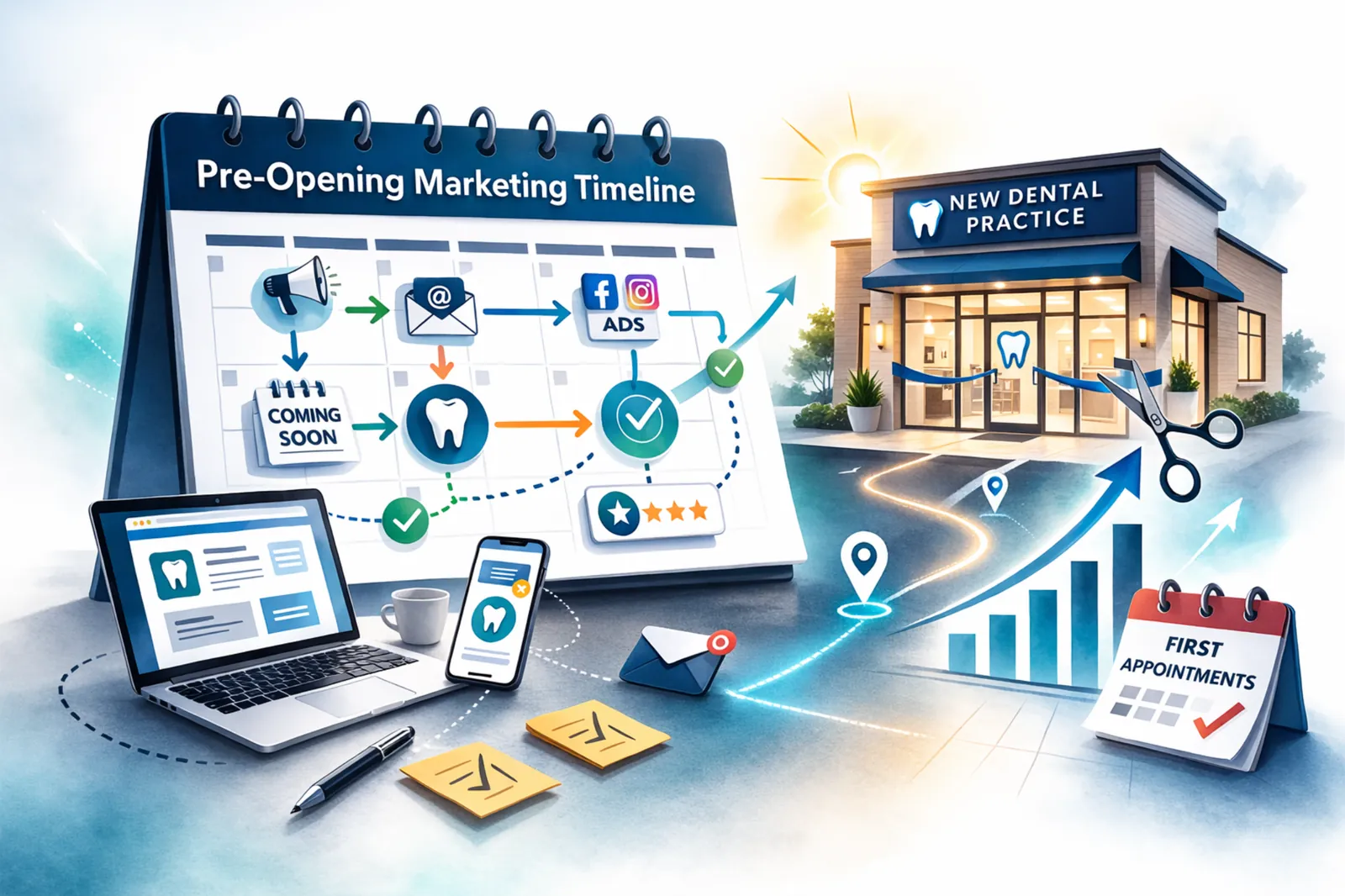 A new dental practice pre-opening marketing timeline should begin 9–12 months before opening day and cover every critical marketing milestone—from branding and website development to SEO, Google Business Profile optimization, paid advertising, and review generation. The practices that fill their schedules fastest are the ones that follow this sequence rather than scrambling to build an online presence the month they open. If you’re planning a startup or acquisition, the timeline below maps each of these marketing phases alongside the operational ones so nothing falls through the cracks. A new dental practice pre-opening marketing timeline should begin 9–12 months before opening day and cover every critical marketing milestone—from branding and website development to SEO, Google Business Profile optimization, paid advertising, and review generation. The practices that fill their schedules fastest are the ones that follow this sequence rather than scrambling to build an online presence the month they open. If you’re planning a startup or acquisition, the timeline below maps each of these marketing phases alongside the operational ones so nothing falls through the cracks.
A pattern we see repeatedly: a dentist spends a year negotiating a lease, building out operatories, and hiring staff—then realizes 30 days before opening that there’s no website, no search visibility, no Google Business Profile, and no way for patients to find or book with the practice. The result is an expensive first quarter with empty chairs and mounting overhead. That gap is entirely preventable with the right sequence.
This timeline is organized by months-before-opening so you can find your current phase and work forward. If you’re already open and playing catch-up, start with the phase closest to where your marketing stands today. For the full-picture overview, see our de novo dental practice marketing guide.
Below, you’ll find the full pre-opening marketing timeline organized into six phases—from 12 months out through your first 90 days open—with specific deliverables, decision points, and dependencies at each stage. Each phase includes what to prioritize, what can wait, and what costs you patients if it’s late.
Written for: dentists opening a new practice, associates transitioning to ownership, dental practice buyers completing an acquisition, and the consultants and office managers helping them launch.
TL;DR
If you take away seven things from this timeline, make it these:
| • |
Start branding and domain registration at 12 months - your practice name, domain, and visual identity affect every decision downstream, from signage to website to ad accounts
|
| • |
Begin website development at 9 months - a custom dental website takes 8–12 weeks to build properly; launching late means no online presence on opening day
|
| • |
Claim and build your Google Business Profile at 6 months - GBP eligibility requires a verified address, and optimization takes weeks of consistent effort before it influences local rankings
|
| • |
Start content and SEO at 6 months - search engines need time to crawl, index, and rank new domains; content published at 6 months starts earning visibility by opening day
|
| • |
Launch paid ads 6–8 weeks before opening - Google Ads and social campaigns need 2–4 weeks to optimize; launching early builds awareness and collects leads you can book on day one
|
| • |
Have your phone and intake systems ready 30 days before opening - marketing that generates calls before your team can answer them wastes budget and burns first impressions
|
| • |
Prioritize review generation in the first 90 days - early reviews on Google and Healthgrades build the social proof that sustains organic patient acquisition long after paid campaigns scale down |
Table of Contents
12–9 months before opening: foundation and identity
This phase is about decisions that lock in early and ripple through everything else. Changing your practice name at 6 months means redoing your logo, signage order, website, directory listings, and legal filings. Getting these right the first time saves thousands of dollars and weeks of rework.
Practice name and domain registration
Choose a practice name that works for both patients and search engines. A name that includes your city or neighborhood (like “Lakewood Family Dental”) gives you a built-in local SEO advantage over a purely branded name (like “Apex Dental Group”). That doesn’t mean you need a generic name—but geographic relevance in the name helps new practices compete faster in local search results.
Once the name is finalized, register your domain immediately. A .com domain matching your practice name is ideal. If the exact match isn’t available, add your state abbreviation or “dental” rather than settling for a .net or .info. Registering early—even before the site is built—ensures the domain is secured, gives you time to set up professional email addresses, and means the site is ready to launch the moment development is complete.
Visual identity and brand assets
At this stage you need a professional logo, brand color palette, and typography standards. These assets feed into your website design, signage, business cards, patient forms, social media profiles, and advertising creative. Having brand assets finalized at 9–12 months means your website designer, sign company, and print vendor can all work in parallel rather than waiting on each other.
In our work with new practices, the most common delay at this stage is logo revisions. Budget for 2–3 rounds of revision and set a hard deadline. A logo that’s “almost done” at 6 months will delay your website, your signage, and your ad creative simultaneously.
Competitive research and market positioning
Before you finalize your service mix and marketing angle, study what’s already in your market. Look at the top 5 dental practices ranking in Google Maps for your area and note what services they promote, how they position themselves, and where the gaps are. If every competitor leads with general dentistry and nobody highlights same-day emergencies or early-morning hours, that’s a positioning opportunity.
This research also informs your SEO strategy and paid search campaigns later. Knowing which keywords your competitors rank for—and which they ignore—helps you prioritize content and ad spend where you can win fastest.
> Back to Table of Contents
9–6 months before opening: website and digital foundation
This is the phase where most of your digital presence gets built. A custom dental website takes 8–12 weeks from kickoff to launch when the process runs smoothly, and longer when content approvals stall or brand assets aren’t ready. Starting at 9 months gives you a buffer for revisions without pushing your launch past the point where it can earn search visibility before opening day.
Website development
Your website is the hub of every marketing channel—SEO, paid ads, social media, and referrals all point back to it. For a new practice, the website needs to accomplish three things on day one: establish credibility (professional design, real photos where possible, clear service descriptions), capture leads (online scheduling, contact forms, click-to-call), and rank in search (proper technical SEO foundation, optimized service pages, fast load times).
Key pages to have at launch include a homepage, about/meet-the-team page, individual service pages for each major service category, a contact page with embedded map, and a blog section ready for content. Resist the temptation to launch with a one-page “coming soon” site and plan to “build it out later.” In our experience, that later almost never comes before opening day—and a thin site won’t rank, won’t convert, and won’t give your paid ads anywhere credible to send traffic.
Technical SEO foundation
While the site is being designed, the technical SEO infrastructure needs to be built in parallel. This includes proper site architecture with logical URL structures, schema markup for local business and dental practice, XML sitemap generation, mobile responsiveness, and Core Web Vitals optimization. A technically sound site from day one means search engines can crawl and index your pages efficiently—which matters more for new domains that haven’t built crawl equity yet.
One item that frequently gets missed: setting up Google Analytics, Google Search Console, and Bing Webmaster Tools and submitting your sitemap as soon as the site goes live. These free tools give you direct communication with search engines about your site’s health, indexation status, and any crawl errors that need fixing.
Practice photography
Stock photos vs. custom photography is one of the most underestimated decisions in dental website development. Patients notice when the “team photo” looks like a stock image, and it undermines the trust your site is trying to build. Schedule a professional photo shoot as soon as your office buildout is far enough along to photograph. At minimum, you need headshots of the dentist and key team members, operatory and reception area photos, and exterior building photos.
If the buildout isn’t ready for photos at 6 months, plan the shoot for as soon as construction is complete and use professional headshots with a clean background as a placeholder. Update the environmental photos within the first 30 days of opening.
> Back to Table of Contents
6–3 months before opening: marketing launch and local presence
This phase is when your marketing becomes publicly visible. The groundwork from the first two phases makes this possible—without a finished website and brand assets, you can’t launch most of what follows. A pattern we commonly see with practices that skip the earlier phases is a frantic rush at 3 months to do everything at once, which leads to shortcuts, errors in directory listings, and campaigns that launch without proper tracking.
Google Business Profile setup and optimization
Your Google Business Profile is arguably the most important single asset for a new dental practice’s local visibility. When patients search “dentist near me” or “new dental office in [city],” the Google Maps 3-pack is where most clicks go—and your GBP listing is what determines whether you appear there.
You can create and verify your GBP once you have a physical address, even before the practice is open. Google allows businesses that haven’t opened yet to create a profile and set a future opening date. Use this window to fully complete your profile: business description, service categories, hours, photos, and attributes. The practices that have a fully optimized GBP at the time they switch to “open” status consistently outperform those that create their profile on opening day and fill it in over the following weeks.
Select your primary Google Business Profile category as “Dentist” and add secondary categories for your specialty services (Cosmetic Dentist, Pediatric Dentist, Emergency Dental Service, etc.) as appropriate. Category selection directly influences which searches your listing appears for.
Directory listings and citation building
Beyond Google, your practice needs consistent NAP (Name, Address, Phone) listings across 40–60 dental and healthcare directories. These include Healthgrades, Zocdoc, Vitals, WebMD, Yelp, the ADA’s Find-a-Dentist tool, and dozens of data aggregators that feed information to search engines and mapping applications.
Consistency is critical. If your practice name is “Lakewood Family Dental” on your website, it needs to be exactly “Lakewood Family Dental”—not “Lakewood Family Dentistry” or “Lakewood Family Dental LLC”—on every directory. Mismatches create citation confusion that weakens your local search authority. Start this process at 6 months so you have time to claim, verify, and correct listings before they influence your opening-month visibility.
Content marketing and blog launch
New domains need content to rank. Search engines evaluate new sites with more scrutiny than established ones, and a domain with 5 pages will struggle to compete against a 10-year-old competitor with 200 pages of indexed content. Publishing helpful, optimized blog content starting at 6 months gives Google a reason to crawl your site regularly and begins building topical authority in your service area.
Prioritize content that targets the specific services you want to be known for and the local search terms your competitive research identified. If you’re opening in a market where no competitor ranks well for “emergency dentist in [city],” a well-optimized blog post and service page targeting that term can start earning visibility surprisingly quickly—sometimes within 4–8 weeks of indexing.
Social media profiles and pre-opening content
Create profiles on Facebook, Instagram, and any other platforms relevant to your market. For most dental practices, Facebook and Instagram are the highest-value social channels for patient acquisition and community engagement. Use your finalized brand assets for profile and cover images, complete all business information fields, and begin posting pre-opening content.
Effective pre-opening social content includes construction progress photos, team member introductions, behind-the-scenes looks at equipment and technology, and community involvement. This content builds local awareness and gives you an engaged audience ready to book when you open. Aim for 2–3 posts per week in this phase.
> Back to Table of Contents
3–1 months before opening: pre-opening marketing push
At this stage, your digital foundation should be in place: website live, GBP optimized, directories submitted, and content publishing on schedule. The final 3 months shift focus to active patient acquisition campaigns and converting the awareness you’ve built into booked appointments for opening week and beyond.
Paid advertising launch
Google Ads and paid social campaigns are the fastest way to generate patient leads for a new practice, but they need time to optimize. Google Ads campaigns typically require 2–4 weeks of data collection before the algorithm has enough conversion signals to optimize effectively. Launching 6–8 weeks before opening gives you enough runway to test ad copy, refine keyword targeting, and build a pipeline of leads that are ready to schedule when you open.
For a new dental practice, we typically recommend starting with these campaign types:
| • |
Google Search campaigns - targeting high-intent keywords like “dentist near me,” “new dental patient,” and service-specific terms for your market
|
| • |
Google Local Service Ads - these “Google Guaranteed” listings appear above traditional search ads and generate direct phone calls; eligibility requires background checks and license verification, so start the application early
|
| • |
Facebook and Instagram awareness campaigns
- geographic targeting around your practice location with “opening soon” messaging to build local awareness
|
| • |
Facebook and Instagram lead generation campaigns - transition to appointment-focused ads 2–3 weeks before opening with a clear call to action
|
Budget allocation varies by market, but a common starting framework for new practices is 60–70% of ad spend on Google (search + LSA) and 30–40% on Facebook/Instagram. The Google channels capture active demand (people searching for a dentist now), while social channels create demand by reaching people who aren’t actively searching but are open to switching.
Email and SMS setup
Before your first patient walks in, you need a communication system in place for appointment confirmations and reminders, recall messages, and review requests. Most dental practice management systems integrate with patient communication platforms that handle these automatically, but the configuration, template customization, and testing take more time than expected.
Set up and test these systems at least 4–6 weeks before opening. Send test messages through every workflow—new patient confirmation, appointment reminder sequence, post-visit review request, and recall—to make sure the timing, content, and links work correctly. A broken review request link in your first month means dozens of missed opportunities to build the social proof your practice needs most.
Community outreach and referral relationships
Digital marketing drives the majority of new patient acquisition for most practices, but local referral relationships and community presence matter—especially in the first year. Introduce yourself to nearby medical practices, pediatricians, and specialists who might refer patients your way. Attend local business networking events and consider sponsoring a community event or youth sports team to build visibility.
These efforts compound over time. A referring physician who sends you one patient per month adds 12 new patients in your first year—patients who arrive pre-qualified and with built-in trust. That referral pipeline becomes more valuable as your reputation grows, but it starts with the relationships you build before and just after opening.
> Back to Table of Contents
Final 30 days before opening: last-mile preparation
Everything converges in the final month. The goal is to have all marketing systems operational, tested, and generating leads before the first patient walks through the door. In our experience, practices that treat opening day as the marketing launch date are already behind—the ones that fill their first week started generating awareness and capturing leads weeks earlier.
Phone and intake system readiness
Your marketing is about to start driving inbound calls, form submissions, and online booking requests. Before that happens, every intake pathway needs to be tested and staffed. This means your phone system is configured with proper routing and a professional greeting, your online scheduling tool is connected to your practice management system, your website contact forms route to a monitored inbox, and someone is assigned to respond to every inquiry within business hours.
A common and expensive mistake: launching paid ads before the front desk is trained and the phone system is live. Those first calls are your most expensive leads—paid for with ad dollars and carrying the weight of first impressions. If they go to voicemail or reach someone who can’t book an appointment, the cost per acquisition skyrockets and the patient experience starts negative.
Tracking and analytics verification
Confirm that every tracking system is working before campaigns scale up. At minimum, you need Google Analytics 4 installed and tracking page views and conversions, call tracking numbers assigned to each marketing channel, form submission tracking configured as conversion events, and your CRM or practice management system set up to record lead sources.
Without accurate tracking from day one, you won’t know which marketing channels are producing patients and which are burning budget. What we typically find is that practices who skip tracking setup spend their first 6 months guessing at what’s working—and guessing wrong leads to misallocated budget that takes months to correct.
Pre-opening promotions and lead nurturing
If your paid campaigns and social media have been generating leads in the weeks before opening, those contacts need to be nurtured. Send personalized emails or texts to everyone who expressed interest, confirming your opening date and offering priority scheduling. A simple message like “We’re opening on [date] and would love to welcome you as one of our first patients—reply to this message or call [number] to reserve your preferred time” converts interest into appointments.
Practices that nurture their pre-opening leads consistently book 15–30+ appointments in their first week. Practices that let those leads sit untouched until opening day often find that interest has cooled and conversion rates drop significantly.
> Back to Table of Contents
First 90 days after opening: momentum and optimization
Opening day isn’t the finish line—it’s the start of the most critical growth period. The first 90 days set the trajectory for your practice’s long-term patient acquisition, online reputation, and marketing efficiency. The decisions and habits you establish now compound for years.
Review generation system
Online reviews are the single most influential factor in a new dental practice’s local search ranking and patient decision-making. A new practice with zero reviews is at a significant disadvantage against established competitors with hundreds. Making review generation systematic—not optional—from the very first patient visit is essential.
The most effective approach: trigger an automated review request via email or SMS within 1–2 hours of each appointment. Include a direct link to your Google Business Profile review page—reducing friction increases completion rates dramatically. Set a goal of asking every patient and aim for a 20–30% response rate. At that rate, a practice seeing 8–10 new patients per week can accumulate 30–50 reviews in the first 90 days, which is enough to meaningfully influence local rankings and patient trust.
Marketing performance review cadence
Establish a weekly or biweekly marketing dashboard review within the first month. Track these core metrics by channel:
| • |
Lead volume - total inquiries by source (organic search, paid search, social, direct, referral)
|
| • |
Cost per lead - ad spend divided by leads generated for each paid channel
|
| • |
Lead-to-appointment conversion rate - what percentage of inquiries become booked appointments
|
| • |
Cost per new patient - total marketing spend divided by new patients acquired
|
| • |
Show rate - percentage of booked new patients who actually arrive for their appointment |
In the first 90 days, expect volatility. Paid campaign performance improves as algorithms optimize, organic search traffic grows as content gets indexed and earns rankings, and conversion rates improve as your team refines intake processes. The goal of early measurement isn’t perfection—it’s establishing baselines so you can identify what’s working and what needs adjustment.
SEO and content momentum
Don’t stop publishing content after opening. The practices that build the strongest organic search presence are the ones that maintain a consistent content calendar through their first year. Aim for 2–4 blog posts per month targeting long-tail keywords relevant to your services and market. Each piece of content creates another entry point for patients to find your practice through search.
At the 90-day mark, review your Google Search Console data to identify which pages are earning impressions and clicks, which keywords are gaining traction, and where you have opportunities to create new content targeting terms where you’re appearing on page 2 or 3—close to visibility but needing additional backlinks to break through.
Paid campaign optimization
With 90 days of data, your paid campaigns should have enough conversion history to make meaningful optimization decisions. Evaluate which keywords, ad copy variations, and audiences are producing the lowest cost per new patient—not just the lowest cost per click. A keyword with a high cost per click but a 40% conversion rate to booked appointment is vastly more valuable than a cheap keyword that generates clicks but no patients.
This is also the point where budget reallocation makes sense. If Google Search is producing new patients at $150 each and Facebook is producing them at $400, shifting budget toward Search (while maintaining a smaller social presence for awareness) improves overall acquisition efficiency. Data-driven decisions like these are only possible with the tracking systems you set up before opening.
> Back to Table of Contents
Common pre-opening marketing mistakes
Having worked with dental practices through dozens of new openings, these are the patterns that consistently cost time, money, and patients:
| • |
Waiting until the buildout is done to start marketing - the biggest and most common mistake; by the time the office is finished, you’re 6–9 months behind on SEO, directory listings, and online presence
|
| • |
Using a DIY or template website - low-cost website builders can’t deliver the SEO foundation, page speed, and conversion optimization a new practice needs to compete; the money saved up front is lost many times over in missed patients
|
| • |
Neglecting Google Business Profile optimization - creating a GBP listing and leaving it half-complete is nearly as bad as not having one; incomplete profiles rank lower and convert worse
|
| • |
Running paid ads without tracking - spending $3,000–$5,000 per month on ads without conversion tracking means you’re flying blind on ROI; every dollar should be traceable to a patient outcome
|
| • |
Ignoring online reviews in the first 90 days - review velocity matters more for new practices than established ones; early momentum in review accumulation significantly impacts local rankings
|
| • |
Inconsistent NAP across directories - name, address, and phone number mismatches across listings create citation confusion that suppresses local search performance for months
|
| • |
No pre-opening lead capture - if your website or social media generates interest before you open, but you have no way to collect and follow up with those contacts, that awareness is wasted |
Each of these mistakes has a compounding effect. A late website delays SEO, which reduces organic visibility at launch, which forces heavier reliance on paid ads, which costs more without an optimized landing page experience. The timeline works as a system—the phases are interconnected, and skipping one weakens the others.
> Back to Table of Contents
Get your pre-opening marketing timeline on track
Whether you’re 12 months out and planning ahead or 6 weeks from opening and realizing your marketing isn’t where it needs to be, WEO Media specializes in building the digital marketing infrastructure new dental practices need to fill their schedules from day one. From custom website design and dental SEO to paid advertising and reputation management, we help startup and acquisition practices launch with a complete marketing foundation—on timeline.
Call 888-246-6906 or schedule a consultation to get your pre-opening marketing plan started.
> Back to Table of Contents
FAQs
How far in advance should I start marketing a new dental practice?
Start 9–12 months before your planned opening date. Branding and domain registration should happen at 12 months, website development at 9 months, Google Business Profile and directory listings at 6 months, content marketing at 6 months, and paid advertising 6–8 weeks before opening. This sequence ensures your digital presence has time to gain search visibility before your doors open.
How much should a new dental practice spend on marketing before opening?
Pre-opening marketing budgets vary by market and goals, but most new practices allocate budget across website development, branding, initial SEO and content creation, directory listing management, and 2–3 months of paid advertising. The upfront investment in a professional website and SEO foundation typically delivers the strongest long-term return because organic search becomes a self-sustaining patient acquisition channel once rankings are established.
When should a new dental practice launch Google Ads?
Launch Google Ads 6–8 weeks before your opening date. This gives the campaign enough time to collect data and optimize before you need it performing at full efficiency. Ensure your website is live, conversion tracking is installed, and your phone and intake systems are operational before turning on ads—driving paid traffic to a site that can’t convert or a phone that isn’t answered wastes budget.
Do I need a website before opening a dental practice?
Yes. Your website is the central hub for every marketing channel and the primary way new patients evaluate your practice before calling. A professionally built dental website should be live at least 2–3 months before opening to begin earning search engine visibility. Launching without a website means your paid ads, Google Business Profile, and directory listings have nowhere credible to send traffic.
How do I get patients before my dental practice opens?
Build a lead capture system on your website and social media profiles before opening. Use pre-opening paid advertising on Facebook and Instagram to build local awareness, collect contact information from interested patients, and nurture those leads with email or text updates as your opening date approaches. Practices that actively capture and nurture pre-opening leads typically book 15–30 or more appointments in their first week.
How long does it take for dental SEO to start working for a new practice?
New dental practice websites typically begin seeing measurable organic search traffic within 3–6 months of launching an active SEO and content strategy. Less competitive keywords and local search terms can gain traction in as little as 4–8 weeks, while more competitive terms may take 6–12 months. Starting SEO 6 months before opening aligns the timeline so organic visibility is building by the time you need patients in chairs.
Should a new dental practice use social media?
Social media is a valuable awareness and engagement channel for new dental practices, particularly Facebook and Instagram. Pre-opening content like construction progress photos, team introductions, and community involvement builds local interest before you open. After opening, social media supports review generation, patient retention, and paid advertising campaigns that target specific demographics in your service area.
What is the most important marketing channel for a new dental practice?
Google Business Profile and local SEO are typically the most important long-term marketing channels for new dental practices because they drive patient acquisition at no per-click cost once established. In the short term, paid search advertising (Google Ads and Local Service Ads) is critical for generating immediate patient volume while organic visibility builds. The most effective approach combines both: paid channels for immediate results while investing in SEO and content for sustainable growth. |
|