Dental Content Repurposing Across All Channels
Posted on 6/20/2026 by WEO Media |
How to Multiply Reach Without Multiplying Work
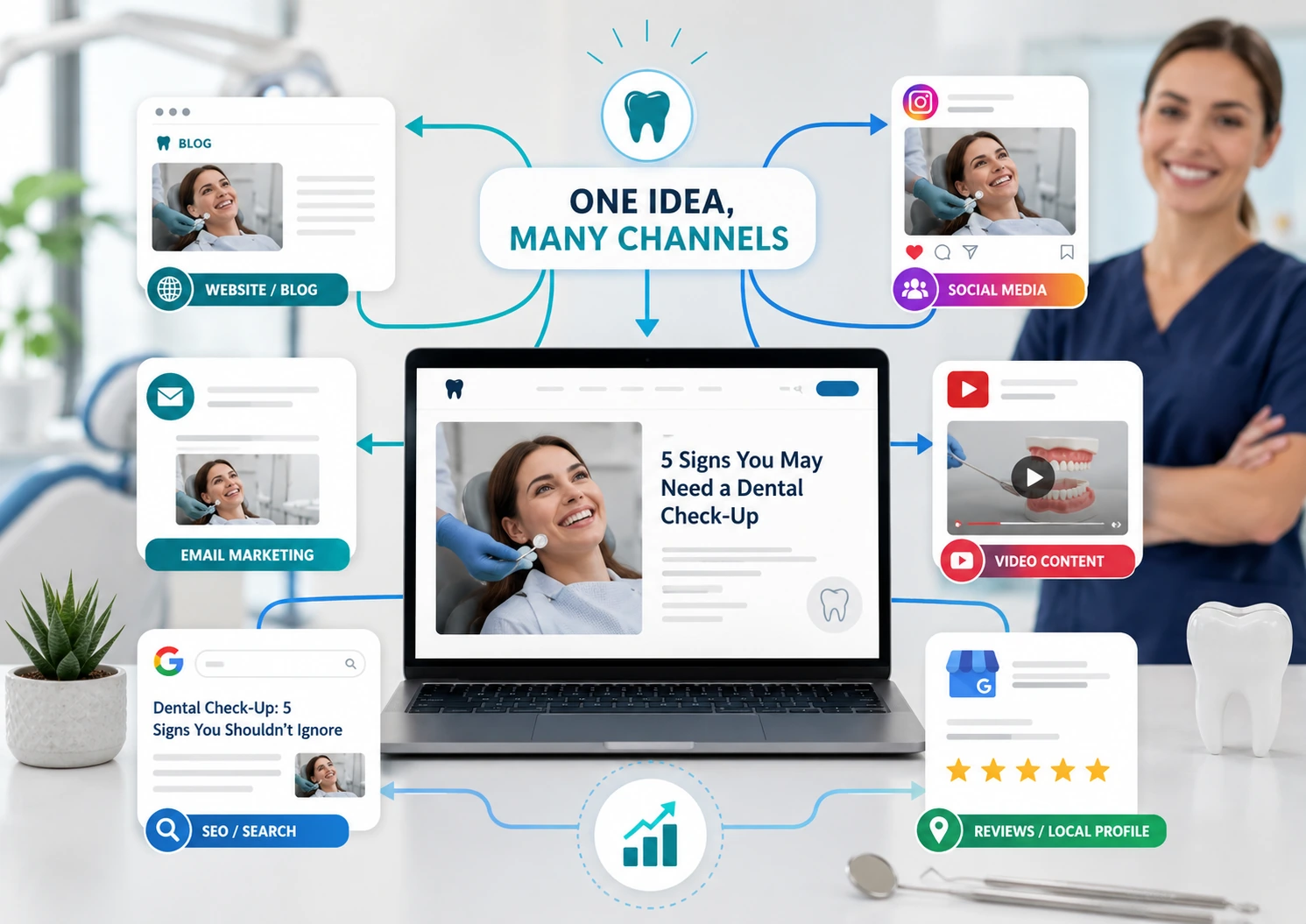 Dental content repurposing is the practice of adapting one core asset—a blog post, patient FAQ, treatment explainer, or short video—into channel-specific formats, and this guide shows dental practices, specialty offices, and DSOs how to repurpose that content across all channels—website, Google Business Profile, email, social media, and AI search—to multiply reach without multiplying the work. Most practices already sit on a content goldmine they never fully use: a single thorough answer to a common patient question can become a week of social posts, a Google Business Profile update, an email, a short video, and a section that search engines and AI assistants quote back to patients. The problem is rarely a lack of ideas. It is that good content gets published once and then forgotten. Dental content repurposing is the practice of adapting one core asset—a blog post, patient FAQ, treatment explainer, or short video—into channel-specific formats, and this guide shows dental practices, specialty offices, and DSOs how to repurpose that content across all channels—website, Google Business Profile, email, social media, and AI search—to multiply reach without multiplying the work. Most practices already sit on a content goldmine they never fully use: a single thorough answer to a common patient question can become a week of social posts, a Google Business Profile update, an email, a short video, and a section that search engines and AI assistants quote back to patients. The problem is rarely a lack of ideas. It is that good content gets published once and then forgotten.
The math is simple. Creating original content for every channel separately is slow, expensive, and unsustainable for a busy practice. Repurposing flips that: you invest once in a strong source asset, then adapt it—changing format, length, and framing—so it fits each place your patients actually look. Done consistently, repurposing builds topical authority on your website, keeps your local listings active, fills your social calendar, and gives AI search engines the clear, repeated, well-structured answers they prefer to cite.
Not sure you have enough content to repurpose? You almost certainly do. Start with the questions your front desk answers every day and the procedures you explain in every consult—those are your highest-value source assets.
Written for: dental and specialty practice owners, office managers, and in-house or agency marketing teams who want more reach and consistency from the content they already create—without burning out their team or budget.
TL;DR
If you only do five things, do these:
| 1. |
Start from a pillar, not a blank page - pick one thorough asset (a detailed blog post or a recorded consult answer) and treat it as the source for everything else
|
| 2. |
Adapt to the channel, never copy-paste - reshape format, length, and tone for each surface so it reads as native, not recycled
|
| 3. |
Feed AI search deliberately - lead with a clear, self-contained answer up top so engines like ChatGPT, Perplexity, and Google AI Overviews can quote you
|
| 4. |
Protect patient privacy first - get written HIPAA authorization before reusing any patient story, photo, or review, and follow current FTC and dental-board rules
|
| 5. |
Measure key events, not vanity metrics - track calls, booked appointments, and form submissions per channel in GA4 so you repurpose more of what converts |
Table of Contents
What dental content repurposing is (and why it beats starting over)
Repurposing is adaptation, not duplication. It means taking the core idea of one asset and rebuilding it in the native format of each channel: a 1,500-word blog post becomes a 60-second video script, a five-slide carousel, a three-line email, a Google Business Profile post, and a concise FAQ answer. Each version stands on its own and speaks the language of its platform. That is very different from pasting identical text everywhere, which reads as lazy to patients and adds nothing for search engines.
The case for repurposing comes down to three advantages. Efficiency: one round of research, fact-checking, and clinical review supports a dozen outputs instead of one. Consistency: when the same accurate message reaches patients on your site, in their inbox, and on social, it compounds trust instead of fragmenting it. Authority: covering a topic thoroughly and repeatedly across surfaces is exactly what builds the topical depth that search engines and AI assistants reward.
In our work with dental practices, the teams that struggle with marketing rarely have a creativity problem. They have a leverage problem—they create constantly but extract a fraction of the value from each piece. Repurposing is the fix because it changes the question from “what do we post today?” to “how many ways can this one strong idea work for us?”
> Back to Table of Contents
Build a content engine: the pillar-and-spoke model
The most reliable repurposing system is the pillar-and-spoke model. A pillar is a comprehensive, authoritative piece on a topic your patients care about—for example, a thorough guide to what to expect with dental implants, clear aligners, or a child’s first visit. Spokes are the smaller, channel-specific pieces you derive from that pillar.
The pillar does the heavy lifting once: deep research, accurate clinical detail, and real answers to the questions patients actually ask. Then you mine it for spokes. A single implant guide can yield a healing-timeline graphic, a “myths vs. facts” carousel, a short video answering “does it hurt?”, an email to patients considering treatment, and several Google Business Profile posts—all pointing back to the pillar on your website.
Your best pillar sources are usually already in the building:
| • |
Recurring patient questions - the things your front desk and hygienists explain every single day are proven, high-demand topics
|
| • |
Consult explanations - record yourself (audio is fine) walking through how you explain a procedure, then transcribe it into a written pillar
|
| • |
Existing blog posts - older posts that still get traffic are ideal candidates to refresh and re-spoke across channels
|
| • |
Treatment FAQs and intake materials - the documents you already hand patients are pre-vetted, practice-specific content
|
| • |
Common objections and fears - concerns about cost, anxiety, and time make for honest, trust-building content |
Choosing pillars this way means you never start from a blank page, and every spoke traces back to a question a real patient has asked.
> Back to Table of Contents
The channel-by-channel repurposing playbook
Each channel rewards a different format, length, and tone. The skill is matching the right slice of your pillar to the right surface. Below is how to adapt a single source asset across the channels that matter most for dental practices today.
Jump to a channel: website and blog, Google Business Profile, email, social feeds, short-form video, long-form video, and in-office touchpoints.
The website and blog (your content hub)
Your website is the home base every other channel points back to. The pillar lives here as a well-structured page with clear headings, a direct answer near the top, and a logical flow a reader (or an AI crawler) can follow. Strengthen it with internal links to your related service pages and other posts so each piece reinforces the rest. Everything you publish elsewhere should, where natural, drive patients back to this hub where they can book.
Google Business Profile posts and photos
For a local dental practice, Google Business Profile is one of the highest-leverage places to repurpose content—and one of the most neglected. Turn pillar takeaways into short Posts, share before-and-after or team photos (with authorization), and keep the profile active. This matters more than ever in 2026: Google now feeds Posts, products, and offers into the AI-generated summary that appears on your Maps listing, and the local algorithm increasingly rewards active, engaged profiles over merely established ones. Profiles that go stale for about a month tend to lose visibility, so a steady drip of repurposed updates does double duty. One caution: Google has wound down the user-submitted profile Q&A feature, so build your question-and-answer content on your website and in Posts rather than relying on profile Q&A.
Email and patient newsletters
Email remains the channel you actually own—no algorithm decides who sees it. Repurpose a pillar into a short, scannable email: a single takeaway, two or three supporting points, and one clear next step. Segment where you can. A piece on clear aligners is more relevant to patients who have asked about cosmetic options; a post-op care explainer fits patients with upcoming procedures. The newsletter is also the perfect place to recirculate older pillars to patients who never saw them the first time.
Social media feeds (Instagram, Facebook, and LinkedIn)
Feed-based social rewards visual, bite-sized value. From one pillar you can build a carousel that walks through a process step by step, a single-image tip, a “myth vs. fact” graphic, or a short patient-friendly explainer. Instagram and Facebook reach current and prospective patients; LinkedIn is where DSOs, specialists, and practices building referral relationships or recruiting can repurpose the same expertise for a professional audience. Keep the clinical substance, but adapt the tone to each room.
Short-form video (Reels, YouTube Shorts, and TikTok)
Short vertical video is among the most effective formats for reaching new patients, and it is easier to produce than most teams assume. The script is already written—it is a single question from your pillar answered in 30 to 60 seconds. Film one batch of answers to common questions (“Is the procedure painful?”, “How long does it last?”, “What does recovery look like?”), then post each clip natively to Reels, Shorts, and TikTok. TikTok continues to operate in the United States under its new ownership structure, so it remains a viable channel for practices whose patients are active there.
Long-form video and YouTube
YouTube is both a video platform and the world’s second-largest search engine, which makes it a natural home for deeper pillar content. A recorded consult explanation, an office tour, or a thorough “everything you need to know” walkthrough can live here as a searchable, evergreen asset. From one long video you also get raw material for every short-form clip above, plus a transcript you can turn back into a written post—closing the loop between video and text.
In-office and offline touchpoints
Repurposing is not only digital. The same pillar content can become a printed handout for the operatory, a waiting-room screen loop, a QR code on an aftercare sheet that links to your video, or a talking point your team uses during consults. This keeps your message consistent from the first online search all the way to the chair, and it turns content into a patient-experience asset rather than only a marketing one.
> Back to Table of Contents
Repurpose for AI search, not just Google rankings
A growing share of patients now begin with an AI assistant rather than a list of blue links. ChatGPT alone reached more than 900 million weekly users in early 2026, and engines like Perplexity, Microsoft Copilot, Google AI Overviews, and Apple Intelligence increasingly answer questions directly. For dental practices, this splits into two distinct opportunities.
First, informational and treatment-research questions—“how long does an implant take to heal,” “is a root canal painful”—still trigger AI Overviews and are exactly the kind of content you should repurpose into clear, quotable answers. Second, local discovery has shifted: Google pulled AI Overviews from local provider and “dentist near me” style queries in late 2025, so for being recommended as a local practice, the surfaces that matter are conversational assistants like ChatGPT Search, Copilot, Perplexity, and Apple Intelligence, plus a well-fed Google Business Profile.
The way you repurpose content determines whether AI engines can use it. They favor content that front-loads the answer—research on AI citations consistently finds that a concise, self-contained answer placed near the top of a section is one of the strongest predictors of being cited. Practical adaptations that help:
| • |
Answer first, elaborate second - open each section with a direct 40-to-60-word answer, then add the detail underneath
|
| • |
Use real question-and-answer structure - phrase headings the way patients actually ask, since that mirrors how people query assistants
|
| • |
Keep facts specific and current - dated, concrete, regularly updated information is easier for engines to trust and quote
|
| • |
Make every version consistent - when your website, email, and social all state the same accurate answer, you reinforce the signal across the web |
A note on schema for anyone tracking SEO changes: Google retired FAQ rich results in search on May 7, 2026. FAQPage structured data is still valid and still helps engines understand your pages, but the real driver of AI citations is the clear, visible, answer-first content itself—not the markup. Write for the reader and the extraction takes care of itself.
> Back to Table of Contents
Compliance guardrails for repurposed dental content
Dental marketing sits in a regulated space, and repurposing multiplies risk because one mistake gets copied across every channel. Build these guardrails into your workflow before anything goes out.
Patient privacy and HIPAA: any content that identifies a patient—a testimonial, a story, a before-and-after image—requires a specific, written HIPAA authorization before you reuse it in marketing. General treatment consent is not the same thing. Remember that an image can identify a patient even without a name, so treat clinical photos as protected information until you have documented permission for each intended use.
Reviews and testimonials: the FTC’s rule on consumer reviews, in effect since October 2024, prohibits fake, incentivized, or undisclosed reviews and carries significant civil penalties per violation. Repurpose genuine reviews honestly, disclose any material connection, and never edit a review to change its meaning. Note too that Google tightened its own review policies in 2026, barring practices from asking patients to name specific staff or offering incentives, so keep review requests open-ended.
Professional advertising standards and accessibility: avoid guarantees of outcomes and unsubstantiated superiority claims, and follow your state dental board’s advertising rules, which vary by state. Finally, accessibility is both an ethical and a practical matter: add descriptive alt text to images, captions to video, and transcripts to audio so repurposed content meets WCAG 2.2 AA expectations and reaches every patient.
> Back to Table of Contents
How to tell whether repurposing is working
Reach and likes feel good but do not fill the schedule. Tie repurposing to outcomes so you can double down on what actually drives patients.
Track key events, not vanity metrics. In GA4, the actions that matter—appointment requests, completed contact forms, click-to-call taps, and direction requests—are configured as key events (the metric Google renamed from “conversions”). Add UTM tags to the links you place in email, social, and Posts so you can see which channel and which repurposed piece sent a patient who booked, rather than guessing.
Watch the new AI and local signals too. Referral traffic from assistants is increasingly identifiable—ChatGPT, for instance, tags the visits it sends—so you can begin to see when an AI answer brings someone to your site. On the local side, monitor Google Business Profile insights for calls, direction requests, and website clicks tied to the Posts and photos you repurpose.
A pattern we see repeatedly: a topic that converts well on one channel almost always deserves more repurposing, not less. When a particular explainer reliably produces booked consults, that is your signal to build more spokes from that pillar and push it across additional surfaces.
> Back to Table of Contents
Your repeatable weekly and monthly repurposing workflow
Repurposing only compounds when it becomes a routine instead of an occasional scramble. A simple, repeatable cadence keeps every channel fed from a small amount of source work.
A practical monthly and weekly rhythm:
| 1. |
Monthly: choose one pillar - select a single high-demand topic and create or refresh one thorough source asset, with clinical review built in
|
| 2. |
Monthly: map the spokes - list every format you will derive from it (video clips, carousel, email, Posts, handout) before you start producing
|
| 3. |
Weekly: produce and adapt - reshape one or two spokes per week so the workload stays small and steady rather than overwhelming
|
| 4. |
Weekly: schedule and publish - distribute each spoke to its channel in its native format, linking back to the pillar where natural
|
| 5. |
Monthly: review and recirculate - check key events per channel, then re-spoke or re-share the pieces that performed and retire the ones that did not |
For practices with multiple locations or a DSO structure, this model scales cleanly: create a pillar once at the group level, then let each location adapt the spokes with its own photos, team, and local details. That balance—centralized substance, localized delivery—keeps the brand consistent while still feeling personal in each market.
> Back to Table of Contents
Repurposing mistakes that quietly waste effort
Repurposing tends to fail quietly. Nothing breaks; the content just underperforms. These are the patterns we see most often:
| • |
Copy-pasting identical text everywhere - the same block on every channel reads as recycled and ignores how each platform is actually used
|
| • |
Repurposing thin source material - a shallow pillar produces shallow spokes; the depth has to exist before you can mine it
|
| • |
Skipping the channel-native adaptation - a blog paragraph dropped into a video script or a Reel rarely works without reshaping for the format
|
| • |
Forgetting the call to action - reach without a clear next step does not convert; most spokes should point somewhere, usually back to a page where patients can book
|
| • |
Letting compliance slip in the rush - reusing a patient photo or review without authorization is the one mistake that gets copied everywhere at once
|
| • |
Publishing once and never recirculating - your audience grows and shifts, so strong pillars deserve to be re-shared and refreshed over time |
Avoiding these is mostly a matter of discipline: start from depth, adapt for the platform, protect privacy, and always give the patient a next step.
> Back to Table of Contents
Partner with WEO Media on a repurposing system
Building a repurposing engine that runs every month—pillars, spokes, channel-native formats, compliance checks, and measurement—takes a system and a team. WEO Media - Dental Marketing helps dental and specialty practices turn the expertise they already have into content that works across their website, local listings, email, social, and AI search. If you want a repurposing program tailored to your practice and your patients, call us at 888-246-6906 or reach out through our site to start the conversation.
> Back to Table of Contents
FAQs
What is dental content repurposing?
Dental content repurposing is the practice of adapting one core asset, such as a blog post or a recorded consult answer, into channel-specific formats for your website, Google Business Profile, email, social media, and AI search. Each version is reshaped for its platform rather than copied, so a single idea reaches patients in many places from one round of work.
What dental content should I repurpose first?
Start with the questions your front desk and clinical team answer every day and the explanations you give in consults. These are proven, high-demand topics that patients already care about. Turn one of them into a thorough pillar on your website, then derive shorter spokes for each channel from it.
Is repurposing the same as posting the same thing everywhere?
No. Repurposing means adapting the format, length, and tone of a piece to fit each channel, while copy-pasting puts identical text everywhere. Adapted content reads as native to each platform and serves patients better, while duplicated content reads as recycled and adds little value for readers or search engines.
Can I reuse patient photos and testimonials across channels?
Only with a specific, written HIPAA authorization for each intended marketing use. General treatment consent does not cover marketing, and an image can identify a patient even without a name. Reviews must also follow FTC rules, which prohibit fake or incentivized testimonials, so always reuse genuine patient content honestly and with documented permission.
Does repurposed content help with AI search and AI Overviews?
Yes, when it is structured for extraction. AI engines like ChatGPT, Perplexity, and Google AI Overviews favor content that opens with a clear, self-contained answer and uses real question-and-answer phrasing. Repurposing the same accurate answer consistently across your website, email, and social reinforces the signal and improves your chances of being cited.
How often should I repurpose dental content?
A practical rhythm is one new or refreshed pillar per month, with one or two spokes produced and published each week. This keeps every channel active without overwhelming your team. Google Business Profile in particular rewards consistency, since profiles that go inactive for about a month tend to lose local visibility.
How do I measure whether content repurposing is working?
Track key events in GA4, the metric Google renamed from conversions, such as appointment requests, contact form submissions, and click-to-call taps. Add UTM tags to links in email, social, and Posts so you can attribute booked patients to specific channels and pieces, then create more spokes from the topics that convert.
How many channels should a dental practice repurpose across?
Focus on the channels where your patients actually are rather than trying to be everywhere. For most dental practices that means your website, Google Business Profile, email, one or two social platforms, and short-form video, with AI search as a cross-cutting priority. It is better to repurpose well across a few channels than thinly across many. |
|