Dental Featured Snippets: How to Win Position Zero on Google
Posted on 5/11/2026 by WEO Media |
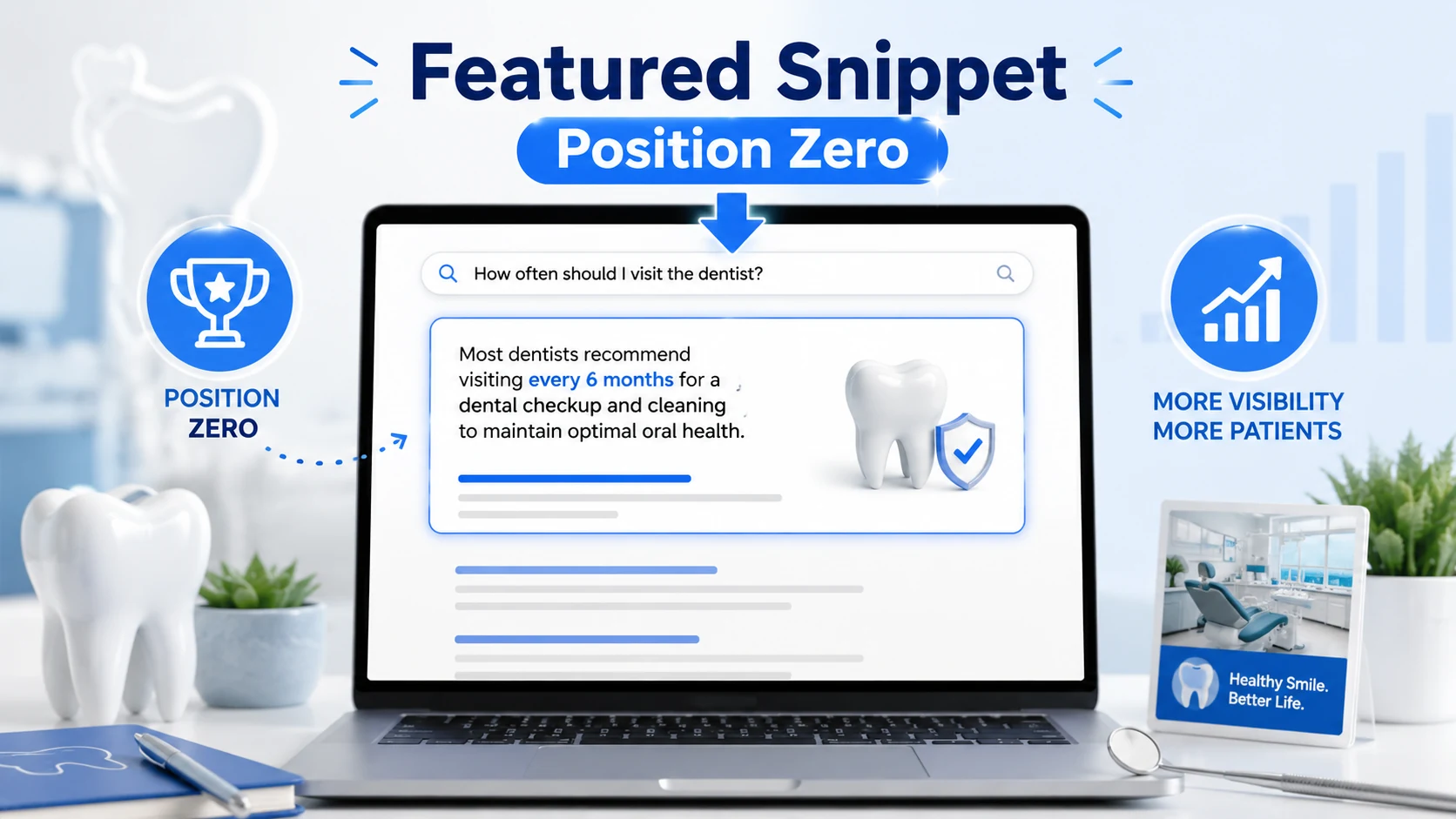 Dental featured snippets are the boxed answers Google displays above all organic results for dental questions—and they matter more for dental practices in 2026 than for most other industries. Dental featured snippets are the boxed answers Google displays above all organic results for dental questions—and they matter more for dental practices in 2026 than for most other industries.
Because Google removed AI Overviews from local healthcare “near me” queries in late 2025, traditional snippets and local results have reclaimed the top of the dental SERP that competitors in other verticals have already lost.
Here’s the dual opportunity most dental practices miss: local provider queries (“pediatric dentist near me,” “emergency dentist [city]”) no longer trigger AI Overviews at all, so traditional featured snippets and the map pack now own the top of those results. Meanwhile, clinical and educational queries (“how long do dental implants last,” “what is a sinus lift”) still trigger AI Overviews at high rates—and the pages cited inside those AI summaries are overwhelmingly the same pages that already hold featured snippets. One optimization workflow feeds both surfaces.
Already publishing service pages and patient-education content? Keep reading. If your site isn’t yet ranking on page one for any target queries, start with foundational dental SEO first—snippet optimization is a second-stage strategy.
This guide walks through which snippet formats Google awards on dental queries, how to find your highest-leverage opportunities, paragraph and list answer templates you can paste into existing pages, the schema and technical signals that support eligibility, YMYL and E-E-A-T requirements specific to dental content, a 30-day implementation workflow, and how to measure snippet performance once you start winning them.
Written for: dental practice owners, marketing coordinators, office managers, and specialty practitioners (periodontists, endodontists, oral surgeons, orthodontists, prosthodontists, pediatric dentists, and DSO/group practice leaders) who want predictable, defensible top-of-SERP visibility in an AI-disrupted search landscape.
TL;DR
If you only do five things, do these:
| 1. |
Target queries where you already rank 2–10 - snippets pull from page-one pages, so don’t chase position zero on queries where you’re still on page two
|
| 2. |
Lead with a 40–60 word direct answer - place a self-contained, definitional paragraph immediately after the matching H2 or H3, with no introductory throat-clearing
|
| 3. |
Match format to query type - “what is” queries earn paragraph snippets, “how to” and “steps in” queries earn list snippets, comparison queries earn tables (or paragraph/list hybrids on table-free CMSs)
|
| 4. |
Layer schema and credentials - FAQPage schema, MedicalProcedure schema where appropriate, and a visibly credentialed author or reviewer above the fold are baseline signals for YMYL dental content in 2026
|
| 5. |
Measure impressions, not just clicks - snippet wins often reduce CTR on the specific query while increasing brand exposure; track impression share, average position, and branded-search growth alongside clicks |
Table of Contents
What dental featured snippets are (and what changed in 2026)
A dental featured snippet is a short answer Google extracts from a single page and displays inside a bordered box at the very top of organic results for a dental query. Unlike an AI Overview, the snippet text is not AI-generated—it’s pulled verbatim (or nearly verbatim) from one source page, and that page’s URL and meta title appear directly beneath the answer.
What changed in 2025–2026:
| • |
AI Overviews were removed from local healthcare queries - searches like “dentist near me,” “pediatric dentist [city],” and “emergency dentist near me” went from full AI Overview coverage in 2023 to none by December 2025, restoring traditional snippet and map pack real estate
|
| • |
Clinical and educational dental queries still trigger AI Overviews heavily - “how long do dental implants last,” “what causes gum recession,” and similar informational searches show AI summaries on the majority of result pages
|
| • |
Snippet pages feed AI Overview citations - the same content patterns that earn paragraph and list snippets are the patterns Google’s AI systems use to identify citation-worthy sources, so one optimization effort serves both surfaces
|
| • |
Featured snippet pages still come from page one - Google selects snippet content almost exclusively from results already ranking in the top ten, which means on-page SEO and topical authority come before snippet structure
|
| • |
The 2026 core update raised the bar on author signals - YMYL content (which includes virtually all dental clinical content) now requires named, credentialed reviewers visible above the fold to compete for snippet placement |
The practical implication for a dental practice in 2026 is that snippet optimization is no longer just a vanity SEO tactic. It’s the most efficient way to defend and expand visibility across two distinct surfaces—local-pack-adjacent results and clinical AI Overviews—with a single content workflow.
> Back to Table of Contents
The four snippet formats and which dental queries trigger each
Google awards four snippet formats, and the format that wins for any given dental query is largely predictable from the query itself. Writing for the wrong format is one of the most common reasons high-ranking dental pages miss position zero.
Paragraph snippets
Paragraph snippets are by far the most common format and account for roughly 70% of all snippets shown across categories. They’re awarded for definitional, “what is,” and “why” queries.
| • |
Typical dental triggers - “what is a dental crown,” “why do gums bleed,” “what causes tooth sensitivity,” “is a root canal painful”
|
| • |
Ideal answer length - 40–60 words, written as a self-contained definition that makes sense out of context
|
| • |
Placement - directly under the H2 or H3 that matches the query phrasing, with no introductory setup |
List snippets
List snippets (ordered or unordered) appear for sequential, how-to, and enumeration queries.
| • |
Typical dental triggers - “how to floss properly,” “steps in a dental implant procedure,” “signs of gum disease,” “how to whiten teeth at home”
|
| • |
Format - 4–8 items, each leading with a bolded step or signal followed by a single descriptive sentence
|
| • |
Source signal - Google extracts from properly tagged ordered or unordered lists, or from a section where each item sits under its own H3 |
Table snippets
Table snippets are pulled for comparison and specification queries.
| • |
Typical dental triggers - “crown vs veneer,” “invisalign vs braces,” “bonding vs veneers,” “dental implant material comparison”
|
| • |
Format - 3–6 rows and 2–4 columns, with the leftmost column naming the attribute being compared
|
| • |
Practical constraint - many dental CMSs (including ours) don’t render HTML tables, so for those sites, target the same comparison query using a paragraph-plus-list hybrid instead |
Video snippets
Video snippets appear for visual procedural queries and pull almost exclusively from YouTube.
| • |
Typical dental triggers - “how a dental cleaning is done,” “what to expect during a root canal,” “invisalign attachments process”
|
| • |
Selection signal - chaptered videos with on-screen text overlays are selected at a meaningfully higher rate than equivalent-duration videos without chapters
|
| • |
Practice implication - if your practice produces patient-education videos, add chapters and accurate descriptions; the same content also tends to surface in the video carousel on the same SERP |
> Back to Table of Contents
How to find your dental snippet opportunities
Featured snippet wins are almost entirely a function of which queries you target. Spending optimization effort on queries where you rank position 25 is wasted work—Google won’t promote those pages to position zero no matter how cleanly you structure the answer.
The three-step opportunity audit:
| 1. |
Pull your page-one queries from Google Search Console - filter Performance → Search Results by an average position of 10 or better, then export the query list. These are your near-miss candidates.
|
| 2. |
Identify which of those queries currently show a snippet - manually search your top 20–30 candidates in an incognito window and flag every result page that displays a featured snippet box. The current snippet holder is the page you need to displace.
|
| 3. |
Score each opportunity by potential lift - prioritize queries where you rank 2–5 and a competitor holds the snippet; these are the highest-probability wins. Queries where you rank 6–10 with a snippet present are still worth optimizing, but they typically need additional internal linking and topical depth before structure alone moves you up. |
A pattern we commonly see on dental practice websites: procedural service pages (implants, Invisalign, root canal) rank well for transactional queries but lose informational snippet queries to dental-association sites, dental school sites, or large publishers, because the practice page never directly answers the underlying patient question. Adding a snippet-structured answer block to the top of those service pages, framed around the informational query, frequently reclaims the snippet within 4–8 weeks of recrawl.
Don’t forget query refinement. Dental patients often phrase the same underlying question several different ways: “how long do dental implants last,” “dental implant lifespan,” and “are dental implants permanent” can return the same snippet, three different snippets, or no snippet at all depending on the phrasing. Audit each variant separately, because winning one variant doesn’t automatically win the others.
> Back to Table of Contents
Paragraph snippet template for dental queries
The paragraph snippet is the format dental content earns most often, because the dominant patient query patterns—“what is,” “why does,” “is it safe to,” “how long does”—all map to short definitional answers.
The proven structure:
| 1. |
Use the patient’s exact query phrasing in an H2 or H3 directly above the answer (e.g., H3: “How long do dental implants last?”)
|
| 2. |
Open with a direct, sentence-one answer that names the subject and gives the answer in the same sentence (e.g., “Dental implants typically last 20 years or longer with proper care, and the titanium post itself can last a lifetime.”)
|
| 3. |
Add 2–3 supporting sentences that qualify or expand the answer with concrete factors (oral hygiene, bone density, smoking, restoration material)
|
| 4. |
Keep the entire block to 40–60 words—Google rarely promotes longer text to a paragraph snippet
|
| 5. |
Avoid pronouns referring outside the block—the answer must read coherently in isolation, because Google may display it that way |
Worked example — snippet-ready answer block for the query “what is a dental crown”:
A dental crown is a custom-fitted cap that covers a damaged or weakened tooth to restore its shape, size, strength, and appearance. Crowns are typically made of porcelain, ceramic, zirconia, or metal alloys and are cemented onto the prepared tooth. They are commonly used after root canal treatment, to support large fillings, or to cover dental implants.
That block is 56 words, names the subject in the first sentence, qualifies with material options, and closes with a use-case list—the four signals Google’s extraction system rewards most consistently on dental queries.
What we typically find when auditing dental sites: the answer to the target query is already on the page, but it’s buried in paragraph three or four, behind throat-clearing prose about the practice or the importance of oral health. Moving the direct answer to the top of the relevant section—immediately under the matching heading—is often the single change that flips a position-three page into a position-zero snippet.
> Back to Table of Contents
List snippet template for dental procedures and how-tos
Sequential dental queries (“steps in,” “how to,” “signs of,” “phases of”) reliably trigger list snippets when the content is structured as a properly tagged list with clear item demarcation.
Required structural elements:
| • |
Matching H2 or H3 using the patient’s exact phrasing (“What are the steps in a dental implant procedure?”)
|
| • |
4–8 list items—fewer than 4 reads as a paragraph; more than 8 is rarely promoted in full
|
| • |
Each item leads with a bolded action or stage name followed by a dash and a single descriptive sentence
|
| • |
Item length consistency—Google selects lists where items are roughly parallel in length and structure
|
| • |
No links inside list items intended for snippet eligibility—extracted text is cleaner when items contain only plain prose |
Worked example — snippet-ready list block for “steps in a dental implant procedure”:
| 1. |
Initial consultation and imaging - the dentist evaluates oral health, captures 3D imaging, and develops a treatment plan
|
| 2. |
Tooth extraction (if needed) - any remaining damaged tooth is removed to prepare the site for implant placement
|
| 3. |
Bone grafting (if needed) - additional bone material is added when the jawbone is too thin or soft to support the implant long-term
|
| 4. |
Implant placement - a titanium post is surgically placed into the jawbone, where it integrates with the bone over several months
|
| 5. |
Abutment placement - once the site is healed, a connector piece is attached to the implant
|
| 6. |
Crown placement - a custom-made crown is attached to the abutment, completing the restoration |
That list is six items, parallel in structure, each beginning with a bolded stage name followed by a short descriptive sentence—the exact pattern Google’s extraction system selects most often for procedural list snippets in healthcare.
Important YMYL note: for any procedure-related list snippet, always pair the list with adjacent prose that names the credentialed reviewer or clinical author of the page. Google’s 2026 core update specifically raised the bar on author and reviewer signals for medical and dental content—a perfectly structured list on a page with no visible author credentials is meaningfully less likely to win than the same list on a page with a named, licensed reviewer block above the fold.
> Back to Table of Contents
Comparison snippet template for table-free dental CMSs
Comparison queries (“crown vs veneer,” “invisalign vs braces,” “bonding vs veneers”) can trigger table snippets when the source page contains a properly tagged HTML table. However, many dental CMSs (including the one used for this site) don’t render HTML tables, and the project formatting standards prohibit them. The practical workaround captures the same comparison value using a structured paragraph plus parallel list, which still earns paragraph or list snippets for the same query.
The hybrid comparison structure:
| 1. |
Lead with a direct comparison summary in 1–2 sentences (“Dental crowns cover the entire visible tooth, while veneers cover only the front surface. Crowns are typically used for structurally compromised teeth; veneers are primarily cosmetic.”)
|
| 2. |
Follow with parallel labeled list items showing each comparison attribute for both options
|
| 3. |
Match each item’s structure across both options so Google can extract the comparison logic
|
| 4. |
Keep the entire structured block under 80 words for paragraph-snippet promotion, or under 8 items for list-snippet promotion |
Worked example — snippet-ready hybrid for “crown vs veneer”:
| • |
Coverage - a crown covers the entire visible tooth; a veneer covers only the front surface
|
| • |
Primary purpose - crowns restore damaged or weakened teeth; veneers improve cosmetic appearance
|
| • |
Tooth preparation - crowns require significant reshaping; veneers require minimal enamel removal
|
| • |
Typical lifespan - crowns commonly last 15 years or longer; veneers commonly last 10–15 years
|
| • |
Best candidates - crowns for cracked, decayed, or root-canaled teeth; veneers for chipped, stained, or misshapen front teeth |
This structure works because Google’s extraction system doesn’t actually require an HTML table for comparison content. What it needs is parallel, attribute-paired prose that explicitly contrasts two named options. The labeled list pattern signals the same comparison intent that table extraction targets, and on dental queries we’ve seen it earn paragraph snippets even when competitor pages with full HTML tables are ranking nearby.
> Back to Table of Contents
Schema and technical signals that support snippet eligibility
Schema markup doesn’t directly cause a featured snippet to appear, but it strengthens Google’s confidence in the page’s topic, authority, and answer structure—which raises the probability of selection on every eligible query.
The schema stack we recommend for dental snippet content:
| • |
FAQPage schema on any page with a question-and-answer section. Each Q&A pair becomes individually eligible for AI Overview citation and supports voice-search retrieval, even though FAQ rich results in standard SERPs were restricted by Google in August 2023
|
| • |
MedicalProcedure schema on procedure service pages (implants, root canals, extractions, periodontal treatments). The schema names the procedure, expected outcome, body location, and follow-up—signals that help Google match the page to specific procedural queries
|
| • |
Dentist or LocalBusiness schema on the homepage and contact page, with name, address, and phone matching Google Business Profile exactly
|
| • |
BreadcrumbList schema across the site to clarify topical hierarchy, which supports Google’s assessment of which page is the canonical answer for a given dental query |
Technical signals beyond schema:
| • |
Page speed and Core Web Vitals—snippet-source pages overwhelmingly load fast; Google rarely promotes a slow page to position zero
|
| • |
HTTPS and clean URL structure—table stakes, but still a hard filter
|
| • |
Internal links from related pages using the snippet’s target query as anchor text—one of the most underused leverage points; even 3–5 internal links with semantically matched anchor text can move a page from position 4 to position 2
|
| • |
Recency signals—updating the page (and revising the dateModified field in schema) within the past 12–18 months meaningfully increases snippet selection probability on competitive dental queries |
> Back to Table of Contents
YMYL and E-E-A-T requirements for dental snippet content
Dental content sits squarely inside Google’s Your Money or Your Life (YMYL) classification, and the bar for Experience, Expertise, Authoritativeness, and Trustworthiness (E-E-A-T) rose sharply in 2026.
The minimum E-E-A-T baseline for dental snippet eligibility in 2026:
| • |
Named, credentialed reviewer or author visible above the fold on every clinical page—not buried in a sitewide bio. The block should include the reviewer’s name, credential (DDS, DMD, MS, specialty board certification), and years of experience
|
| • |
Linked credential verification—state license number or a link to the practitioner’s ADA profile, specialty board listing, or equivalent third-party validation
|
| • |
Explicit review or medical-accuracy statement—a visible line such as “Medically reviewed by [Name], DDS on [Date]” near the top of clinical content
|
| • |
Experience signals embedded in prose—specific numbers (procedures performed, years in practice), patient outcome ranges, anonymized case context, and explicit acknowledgment of when readers should consult their own dentist instead of relying on the article
|
| • |
Accurate, current clinical claims—every dental statistic, success rate, or procedure step should be verifiable against primary sources from professional bodies (ADA, AAOMS, AAP, AAO, AAE, AAPD), not a competitor blog |
The 2026 core update reinforced what Google had been signaling for two years: the “curiosity gap” pattern—asking a question in the title and then burying the answer—is now actively penalized on YMYL pages. The direct answer must appear in the first 120 words of the section. That structural requirement is also exactly what wins paragraph snippets, so the two optimizations align naturally.
What we commonly see on dental sites that lose snippet eligibility despite high rankings: thin author bios with no credentials, “our team” bylines with no named individuals, missing or stale review dates, and clinical pages that link only to other internal pages with no external authoritative source citations. Each of these is fixable in a single focused content sprint.
> Back to Table of Contents
30-day dental featured snippet workflow
This workflow assumes you have an existing dental website with at least 10–20 indexed pages and some queries already ranking on page one. If you’re starting from a brand-new site, focus on foundational dental SEO and patient acquisition first; featured snippet optimization is a second-stage strategy.
Week 1: Opportunity audit
| • |
Export Search Console queries with an average position of 10 or better across the past 90 days
|
| • |
Manually check the top 30 queries in an incognito search and flag every result that displays a featured snippet
|
| • |
Capture the current snippet holder for each flagged query, along with the format (paragraph, list, table) and approximate word count
|
| • |
Score each opportunity - rank 2–5 with a competitor-held snippet equals priority A; rank 6–10 with a snippet present equals priority B |
Week 2: Content restructuring (priority A queries)
| • |
For each priority A query, locate the matching page on your site and confirm it has an H2 or H3 using the patient’s exact query phrasing—if not, add one
|
| • |
Place a 40–60 word paragraph answer (or 4–8 item list) immediately under that heading
|
| • |
Verify the direct answer appears in the first 120 words of the section
|
| • |
Add or update the FAQ schema block on the page to include the same question-and-answer pair |
Week 3: Schema, credentials, and internal linking
| • |
Audit every priority A page for visible author or reviewer credentials above the fold—add or update where missing
|
| • |
Add or update MedicalProcedure and FAQPage schema as appropriate
|
| • |
Add 3–5 internal links from related pages to each priority A page, using the snippet’s target query as anchor text
|
| • |
Update the dateModified field in schema and visibly on the page |
Week 4: Submit, monitor, and iterate
| • |
Submit each updated URL through Google Search Console’s URL Inspection tool to request reindexing
|
| • |
Set up monitoring for average position and impression changes on each target query
|
| • |
For priority B queries, begin the same restructuring process; expect a 4–8 week recrawl-and-evaluation window before snippet changes show up
|
| • |
Document baseline metrics—impressions, clicks, average position, and snippet ownership for each query—so month-2 reporting is straightforward |
Realistic expectations: for pages already ranking in positions 1–5, Google typically recrawls and re-evaluates within 2–8 weeks. Snippet ownership can flip multiple times during that window as Google tests new formats and sources. Pages outside position 10 will not earn snippets from structural changes alone—they need ranking gains first, which usually means topical depth, internal linking, and authority work before snippet structure becomes the bottleneck.
> Back to Table of Contents
Common dental featured snippet mistakes to avoid
Most failed snippet optimization efforts on dental sites repeat the same handful of mistakes. Avoiding them is often more important than perfecting the answer block itself.
| • |
Targeting queries where the page doesn’t rank on page one - snippets pull from positions 1–10; pages ranking 11th or lower will not earn position zero from structural changes alone
|
| • |
Burying the answer behind throat-clearing prose - opening paragraphs that talk about the practice, the importance of oral health, or “in this article we’ll cover” push the answerable content down and forfeit eligibility
|
| • |
Writing answers that depend on external context - using pronouns or referring phrases (“as we discussed above,” “this procedure”) that don’t make sense when extracted into a snippet box
|
| • |
Overstuffing the answer block - 80, 100, or 150-word paragraphs rarely earn paragraph snippets; the sweet spot is 40–60 words
|
| • |
Mismatched format and query intent - writing a long paragraph for a “how to” query that wants a list, or vice versa
|
| • |
Missing author or reviewer credentials on clinical pages - the 2026 core update specifically penalized faceless YMYL content; named credentials are non-negotiable for dental
|
| • |
Stale dateModified fields - dental content older than 18–24 months without visible updates is increasingly passed over for snippet promotion on competitive queries
|
| • |
Stuffing the answer block with internal links - the cleanest extracted snippets come from prose without embedded anchor text; save internal links for the surrounding paragraphs
|
| • |
Treating snippet wins as a one-time project - snippet ownership is contested every recrawl; a quarterly audit is the minimum cadence to defend wins |
> Back to Table of Contents
How to measure dental featured snippet performance
The traditional “more clicks equals success” metric breaks down for snippet wins. A page that holds a paragraph snippet may see fewer clicks for the specific query—because Google answered the question on the SERP—while gaining significantly higher impressions, brand exposure, and qualified downstream traffic.
The metrics that actually matter:
| • |
Impression share - how many times your page appeared in search results for the target query, regardless of clicks; pull from Search Console
|
| • |
Average position - Search Console reports a featured snippet as position 1 (the industry term “position zero” refers to visual placement above traditional results, not the reported number); watch for the position metric to drop from 3.x toward 1.x as snippet ownership flips
|
| • |
Branded search volume - patients exposed to your practice in a snippet often search the practice name later; track branded query growth in Search Console over 60–90 day windows
|
| • |
Snippet ownership over time - manually verify monthly that your page still holds the snippet for each priority query (third-party tools like Ahrefs and Semrush can automate this)
|
| • |
Downstream patient inquiry attribution - in your CRM or call tracking, monitor whether new-patient inquiries reference content from snippet-holding pages; this is the closest proxy to revenue attribution available |
What we typically advise dental clients: set the baseline before you start. Capture 30 days of pre-optimization data—impressions, clicks, average position, snippet ownership—for every target query. Without that baseline, you can’t prove whether snippet wins are driving incremental visibility or just absorbing existing traffic. The clearest evidence of snippet ROI is impression growth on target queries combined with stable or rising branded search—a pattern that consistently precedes new-patient inquiry growth in our own client engagements.
> Back to Table of Contents
Get help winning dental featured snippets
Winning featured snippets at scale for a dental practice requires the right combination of topical content, on-page structure, schema, credentialed authorship, and ongoing measurement—a workflow that’s difficult to staff in-house at most practices. WEO Media specializes in dental SEO and content strategy built around the YMYL and E-E-A-T standards Google applies to dental content. To talk through a snippet opportunity audit for your practice, call 888-246-6906, schedule a consultation, or visit our dental SEO services page.
> Back to Table of Contents
FAQs
Do dental featured snippets still matter in 2026 with AI Overviews everywhere?
Yes, and arguably more than ever for dental practices specifically. Google removed AI Overviews from local healthcare “near me” queries by December 2025, leaving traditional snippets and the local pack to dominate provider-finding searches. On clinical informational queries that still trigger AI Overviews, snippet-eligible pages are the same pages most often cited inside those AI summaries, so optimization effort serves both surfaces.
How long does it take to win a dental featured snippet after optimizing a page?
For pages already ranking in positions 1–5 for the target query, Google typically recrawls and re-evaluates within 2–8 weeks. Pages ranking in positions 6–10 often take longer and may need additional internal linking or topical depth before snippet structure alone moves them up. Pages outside position 10 will not earn snippets from structural changes alone; they need ranking gains first.
What word count is ideal for a dental paragraph featured snippet?
40–60 words is the consistent sweet spot for paragraph snippets across dental queries. Shorter answers often read as incomplete; longer answers are rarely promoted in full. The block should be self-contained (no pronouns referring outside the block), open with a direct sentence-one answer naming the subject, and include 2–3 qualifying or expanding sentences.
Does FAQ schema still help dental featured snippets after Google’s 2023 restriction?
Yes. Google restricted FAQ rich results in standard SERPs in August 2023, but FAQ schema still supports AI Overview citation eligibility, featured snippet selection on question-format queries, and voice-search retrieval. For dental content where patients repeatedly ask the same handful of questions, FAQ schema remains one of the highest-leverage technical signals available.
Can a dental practice win featured snippets without a named author on every page?
It’s increasingly difficult. The 2026 core update specifically raised the bar on author and reviewer signals for YMYL content, and dental content sits squarely in YMYL territory. A named, credentialed reviewer (DDS, DMD, or specialty-board certification) visible above the fold on clinical pages is now baseline. Faceless “our team” bylines are passed over in favor of clearly attributed content.
Will winning a dental featured snippet reduce clicks to my website?
Sometimes, for the specific query, yes—particularly for definitional questions where the snippet answers the question completely. However, snippet ownership consistently produces higher impression share, stronger brand recall, and increased branded-search volume over 60–90 day windows. For dental practices, the tradeoff usually favors snippets because brand exposure to local searchers translates into downstream patient inquiries even when individual clicks decline.
Which dental queries are easiest to win featured snippets on?
Definitional and “what is” queries about specific dental procedures (crowns, veneers, implants, root canals) are the most accessible targets, because they map cleanly to short paragraph snippets and competition is often weaker than on “cost” or “near me” queries. Procedural “steps in” and “how to” queries are next, since they map to list snippets. Start with definitional queries where you already rank 2–5.
How often should we audit dental featured snippet performance?
A quarterly cadence is the minimum to defend snippet wins, with monthly checks on your highest-value queries. Snippet ownership is recontested at every Google recrawl, and a competitor publishing a better-structured answer can take a snippet you held for months. A standing 30–60 minute monthly audit on your top 10–15 dental snippet queries is typically sufficient to catch losses early. |
|