Lead Magnets for Dentists: Ideas That Attract Patients, Not Price Shoppers
Posted on 2/9/2026 by WEO Media |
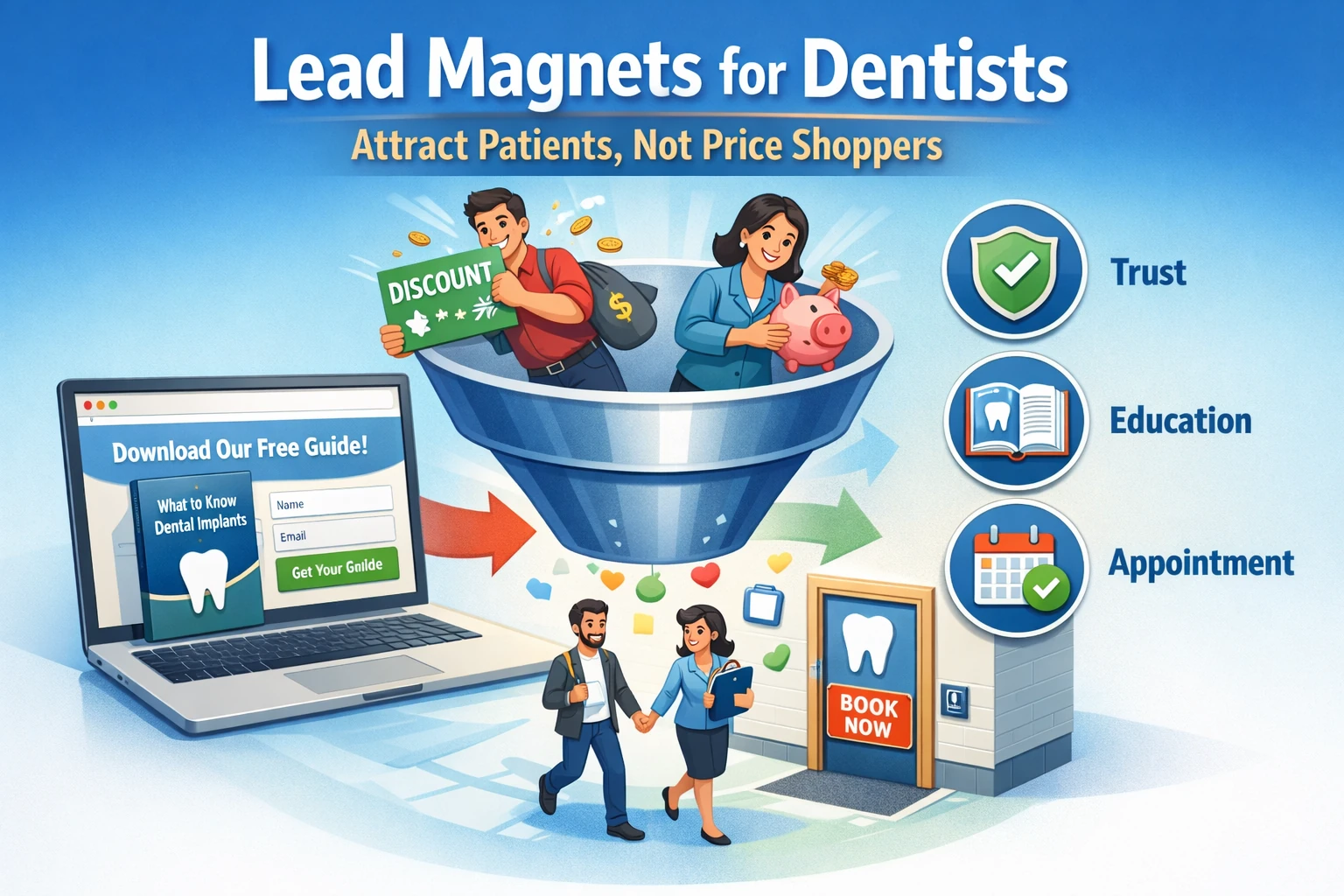 The right lead magnet pre-qualifies patients before your team ever picks up the phone. A dental lead magnet is a free resource—a guide, quiz, checklist, or video—offered in exchange for a prospective patient’s contact information. When designed well, it attracts people who are actively evaluating care options, not just hunting for the cheapest cleaning in town. When designed poorly, it floods your patient pipeline with contacts who were never going to book. The right lead magnet pre-qualifies patients before your team ever picks up the phone. A dental lead magnet is a free resource—a guide, quiz, checklist, or video—offered in exchange for a prospective patient’s contact information. When designed well, it attracts people who are actively evaluating care options, not just hunting for the cheapest cleaning in town. When designed poorly, it floods your patient pipeline with contacts who were never going to book.
The difference comes down to intent filtering. Lead magnets that promise discounts or “free” services attract price-first behavior. Lead magnets that answer a specific clinical or decision-making question attract people who are already looking for a practice—they just haven’t chosen one yet. In our work with dental practices across the country, the practices that generate the most new-patient appointments from lead magnets are the ones that educate and build trust before asking for the booking. That shift—from discount bait to decision-making support—changes who enters your marketing funnel entirely.
If your lead volume is strong but conversions are weak, the problem may be downstream. Start with patient acquisition or your front desk process first, then return here to refine what you’re offering at the top of the funnel.
Below, you’ll find a framework for matching lead magnets to patient readiness, specific ideas organized by intent level, delivery and follow-up sequences that convert without pressure, and measurement benchmarks so you know what’s working—all built around attracting patients who value care quality over the lowest price.
Written for: dental practice owners, office managers, and marketing teams who want lead magnets that fill the schedule with patients who stay, accept treatment, and refer others.
TL;DR
If you only do five things, do these:
| • |
Match the lead magnet to patient intent - high-intent formats (treatment guides, candidacy quizzes) outperform generic “tips” PDFs because they attract people already considering care
|
| • |
Educate instead of discount - a “What to Expect” guide filters for quality-focused patients; a coupon filters for whoever wants the cheapest option
|
| • |
Deliver value before asking for the appointment - the lead magnet should answer a real question so the follow-up feels helpful, not pushy
|
| • |
Build a follow-up sequence that nurtures - 3–5 emails over 2–3 weeks with education, social proof, and one clear next step per message
|
| • |
Measure cost per booked appointment, not just downloads - 50 downloads that produce 8 booked appointments outperform 500 downloads that produce 3 |
Table of Contents
Why most dental lead magnets attract the wrong people
The most common lead magnet in dental marketing is some version of a discount: “Download our coupon for a free exam,” “Get $50 off your first visit,” or “Claim your free whitening kit.” These generate downloads. They also generate a specific type of lead—someone whose primary decision filter is price. That person will book if you’re cheapest, cancel if something cheaper appears, and rarely accept treatment beyond the discounted service.
A pattern we commonly see: a practice runs a social media ad with a free whitening offer, collects hundreds of leads over a month, and then wonders why the front desk can’t convert them. The team calls, leaves messages, follows up—and most leads either never answer or book and no-show. The marketing team says “we delivered leads.” The practice says “the leads were bad.” Both are partially right, but the real problem happened earlier: the lead magnet itself selected for low-intent, price-motivated behavior.
This doesn’t mean discounts never work. It means that when a discount is the only reason someone engages, you’ve attracted a transaction, not a relationship. The practices that build long-term patient value through lead magnets do something different: they offer information that helps a prospective patient make a decision—and the decision naturally leads to booking.
The shift is simple in concept: instead of “here’s something free,” offer “here’s something that helps you decide.” A person who downloads a guide called “What to Know Before Choosing an Implant Dentist” is further along in their decision than someone who clicked “free consultation.” They’re already evaluating. Your lead magnet just positioned your practice as the one helping them evaluate well. This is especially important for high-value services like implants, where the gap between a discount-driven lead and a treatment-ready patient can represent significant case value—we cover this dynamic in depth in our guide to marketing dental implants without attracting price shoppers.
> Back to Table of Contents
The intent framework: matching lead magnets to patient readiness
Not every prospective patient is at the same stage. Someone searching “do I need a dental implant” is in a different place than someone searching “best implant dentist near me.” Your lead magnet should meet people where they are—within the broader patient journey—and move them one step closer to booking, not try to jump them from awareness to appointment in a single click.
We typically organize dental lead magnets into three intent tiers:
| • |
Awareness-stage (low intent) - the person knows they have a concern but hasn’t started evaluating solutions. Example: “Why Do My Gums Bleed When I Brush?” educational guide. These leads need more nurturing before they’re ready to book
|
| • |
Consideration-stage (medium intent) - the person is actively researching options and comparing approaches. Example: “Dental Implants vs. Bridges: Which Is Right for You?” comparison guide. These leads are closer and respond well to social proof and next-step invitations
|
| • |
Decision-stage (high intent) - the person has decided they need care and is choosing a provider. Example: “5 Questions to Ask Before Choosing Your Implant Dentist” checklist. These leads often book directly from the follow-up sequence |
The mistake most practices make is building only awareness-stage lead magnets (generic tips, basic education) or skipping straight to decision-stage offers (free consultations, discount coupons) without anything in between. The consideration stage is where the highest-quality patient relationships begin, because you’re helping someone think through a real decision—and they remember who helped.
What this looks like in practice: a multi-location group we work with tested two lead magnets for their SEO landing pages. The first was a “Healthy Smile Tips” PDF (awareness-stage). The second was a “What to Expect at Your First Implant Consultation” guide (consideration-stage). The tips PDF generated 3× more downloads. The consultation guide generated 4× more booked appointments. Volume isn’t value—intent is.
> Back to Table of Contents
Lead magnet ideas that filter for quality patients
The following ideas are organized by the intent tier they serve. For each, we’ve included the format, why it filters for quality patients, and a practical note on creation.
Consideration-stage lead magnets (highest ROI for most practices)
These attract people who are actively weighing a treatment decision and want to make a smart choice.
| • |
Treatment comparison guides - “Dental Implants vs. Dentures vs. Bridges: A Side-by-Side Guide for [Your City] Patients.” This works because it answers the exact question a person asks before booking. It positions your practice as the one that helped them understand their options without pressure. Keep it factual, include pros and cons for each, and end with “questions to ask at your consultation”
|
| • |
“What to expect” procedure walkthroughs - “What Happens During Dental Implant Placement: A Step-by-Step Guide.” Fear of the unknown stops people from booking. A clear walkthrough reduces anxiety and builds trust. Include timeline, recovery expectations, and what the first appointment looks like. Practices focused on implant marketing see especially strong results from this format
|
| • |
Candidacy self-assessment quizzes - “Could You Be a Candidate for Dental Implants? Take This 2-Minute Quiz.” Interactive quizzes have high completion rates and naturally segment leads by readiness. The result page can include a personalized next step: “Based on your answers, a consultation would help determine your options”
|
| • |
Decision checklists - “7 Things to Verify Before Choosing an Orthodontist.” This format positions your practice as confident enough to help patients evaluate any provider—including you. It builds trust through transparency. Include credentials, technology questions, and treatment planning process markers |
Decision-stage lead magnets (for people ready to choose a provider)
These attract people who have already decided they need treatment and are picking where to go.
| • |
New patient welcome guides - “Your First Visit at [Practice]: What to Bring, What to Expect, and How We’ll Take Care of You.” This reduces no-shows and pre-frames the experience positively. It works as both a lead magnet for prospects and an onboarding tool for booked patients
|
| • |
Insurance and financing explainers - “Understanding Your Dental Insurance: A Plain-Language Guide for [Your City] Patients.” Insurance confusion is a top barrier to booking. A clear, jargon-free guide that explains how coverage works for common procedures (without promising specific dollar amounts) removes a real obstacle. For practices promoting high-value services, pairing this with information on patient financing or a dental membership plan strengthens the offer further
|
| • |
Virtual consultation or video Q&A access - “Watch Our Dentist Answer the 5 Most Common Implant Questions (3-Minute Video).” Video builds trust faster than text. A short, genuine video where a clinician answers real questions demonstrates expertise and approachability simultaneously |
Awareness-stage lead magnets (use selectively)
These have a place but require longer nurturing sequences before they produce appointments.
| • |
Symptom guides - “What Your Bleeding Gums Might Be Telling You.” This is useful as a strategy for growing organic traffic through informational queries. Pair it with a 5-email nurture sequence that moves the reader from “I have a question” to “I should get this checked”
|
| • |
Oral health assessments - “Rate Your Oral Health: A 10-Question Self-Check.” Similar to quizzes but broader. These work well for general practice visibility but need clear scoring that connects results to action (“If you scored 4–6, a checkup could catch issues early”)
|
| • |
Seasonal or life-stage guides - “A Parent’s Guide to Your Child’s First Dental Visit” or “Dental Care During Pregnancy: What’s Safe and What to Ask.” These attract a specific audience at a specific moment and build long-term loyalty when the content is genuinely helpful |
A note on format: PDFs still work, but quizzes and interactive tools consistently outperform static downloads in both completion rate and downstream conversion. If you’re choosing one format to start with, a candidacy quiz for your highest-value service typically delivers the best return.
> Back to Table of Contents
How to deliver and follow up without pressure tactics
The lead magnet itself is only half the system. How you deliver it—and what happens next—determines whether a download becomes a booked appointment. The goal is to continue the helpful, educational tone of the lead magnet through every touchpoint. If the lead magnet says “here’s useful information,” and the first follow-up email says “BOOK NOW—LIMITED AVAILABILITY,” you’ve broken trust immediately.
Delivery best practices
| • |
Instant delivery - send the resource immediately via email after form submission. A confirmation page that says “check your inbox” should also display a direct download link as backup. Delayed delivery kills engagement
|
| • |
Confirmation page with next step - after download, show a brief message: “While you’re reviewing the guide, you can also schedule a consultation if you’d like to discuss your specific situation.” One soft invitation, not a hard sell. Your landing page design matters here—keep the layout clean and the next step obvious
|
| • |
Mobile-friendly format - most dental lead magnet downloads happen on phones. PDFs should be designed for mobile reading (large text, vertical layout). Quizzes should work without pinching or zooming |
Follow-up email sequence framework
A 3–5 automated email sequence over 2–3 weeks works well for most dental lead magnets. Here is a structure we’ve seen perform consistently:
| 1. |
Email 1 (immediate) - deliver the resource, set expectations. “Here’s your guide. Over the next couple of weeks, we’ll share a few more insights that patients in your situation have found helpful.”
|
| 2. |
Email 2 (day 3–4) - expand on one key point from the lead magnet. Add a short patient story or testimonial that reinforces the decision the reader is considering. No CTA beyond “reply if you have questions”
|
| 3. |
Email 3 (day 7–8) - address the most common objection or fear related to the topic (cost, pain, time, uncertainty). Provide honest, specific answers. Soft CTA: “If you’re ready to explore your options, you can schedule a consultation here”
|
| 4. |
Email 4 (day 12–14) - share a behind-the-scenes look at your practice: technology, team, or patient experience. Build familiarity. Include scheduling link
|
| 5. |
Email 5 (day 18–21) - final touchpoint. Acknowledge that timing varies and there’s no pressure. Restate your availability and provide a direct way to reach the practice. “Whenever you’re ready, we’re here” |
What to avoid in follow-up: urgency language (“spots are filling up!”), guilt-based messaging (“you downloaded this but haven’t booked”), and excessive frequency. One email every 3–5 days is enough. More than that and unsubscribe rates climb, which damages your sender reputation and future deliverability.
> Back to Table of Contents
How to measure lead magnet performance
Most practices measure lead magnets by download count alone. That tells you almost nothing about whether the lead magnet is doing its job. The metric that matters is cost per booked appointment from each lead magnet—not cost per lead, not total downloads. If you need a broader framework for tracking marketing ROI by channel, start there and layer lead magnet metrics on top.
Track these five numbers for each lead magnet:
| 1. |
Downloads (or completions for quizzes) - total number of people who received the resource. This is your top-of-funnel volume number
|
| 2. |
Email open rate across the sequence - healthy range is 35–55% for the first email, declining to 20–30% by email 5. If your first email is below 30%, check your subject line and sender name
|
| 3. |
Click-through rate on scheduling links - how many people in the sequence clicked a link to your scheduling page. A pattern we commonly see is 3–8% click-through on the email that includes the strongest social proof
|
| 4. |
Booked appointments attributed to the lead magnet - use UTM parameters or ask “how did you hear about us” at intake to connect bookings back to the lead magnet source
|
| 5. |
Kept appointments and treatment acceptance - this is the ultimate quality signal. If lead magnet patients show up and accept treatment at rates comparable to referral patients, your lead magnet is attracting the right people |
A simple benchmark to start: if your lead magnet produces booked appointments at a cost lower than your paid advertising cost per acquisition, and those patients show and accept treatment, the lead magnet is working. If downloads are high but bookings are low, the lead magnet is attracting the wrong audience or the follow-up sequence needs work.
Results vary by market, service line, and practice capacity. These benchmarks are a starting framework, not fixed targets. Track your own numbers weekly for the first month, then monthly after that.
> Back to Table of Contents
Common mistakes that attract price shoppers
If your lead magnet is generating contacts but not appointments—or appointments that cancel and no-show—one of these mistakes is usually the cause.
| • |
Leading with discounts as the primary value - when the offer is “get $X off,” you’ve told the prospect that price is the most important variable. Every subsequent interaction gets filtered through that lens. Use educational value instead, and if you offer new-patient specials, mention them in the follow-up sequence after you’ve established trust
|
| • |
Targeting too broadly - “10 Tips for a Healthier Smile” appeals to everyone and compels no one. The more specific your lead magnet is to a particular concern, treatment, or life situation, the higher quality the leads will be. “A Guide for Adults Considering Braces for the First Time” is narrower but converts far better
|
| • |
No follow-up sequence - collecting an email address and doing nothing with it—or sending a single “thanks for downloading” email—wastes the entire effort. The email nurture sequence is where conversion happens. Without it, you’re relying on the prospect to take the next step entirely on their own
|
| • |
Asking for too much information upfront - name and email are enough for most lead magnets. Every additional field (phone number, insurance provider, date of birth) reduces completion rates. You can collect additional information later in the follow-up sequence once trust is established
|
| • |
Mismatched ad-to-magnet messaging - if your paid ad says “free whitening” and the lead magnet is an educational guide, the disconnect creates frustration. The ad, landing page, lead magnet, and follow-up should all deliver on the same promise in the same tone
|
| • |
Ignoring mobile experience - if your lead magnet page takes more than three seconds to load on a phone, or if the form requires more than two thumb-taps to complete, you’re losing leads before they even see your content. If speed is an issue, start with these website performance fixes and test every lead magnet funnel on a phone before launching |
> Back to Table of Contents
Lead magnet self-assessment
Score your current lead magnet (or planned lead magnet) against these criteria. Give yourself one point for each “yes.”
| 1. |
Does the lead magnet answer a specific question a prospective patient is actually asking? (not a question you wish they were asking)
|
| 2. |
Would someone who downloads this be a good fit for your practice? (right services, right expectations, likely to value quality)
|
| 3. |
Does the content build trust and reduce uncertainty? (not just promote your practice)
|
| 4. |
Is there a follow-up email sequence of at least 3 messages? (with education, social proof, and a clear next step)
|
| 5. |
Are you tracking booked appointments from this source? (not just download count)
|
| 6. |
Does the landing page work well on mobile? (loads fast, form is simple, resource delivers instantly)
|
| 7. |
Is the lead magnet specific to a service, concern, or patient type? (not a generic “tips” document) |
If you scored 5–7: your lead magnet system is well-positioned. Focus on optimizing the follow-up sequence and testing new formats (quizzes, video).
If you scored 3–4: the foundation is there but gaps in follow-up or targeting are likely limiting your results. Prioritize building a complete email sequence and tightening your audience focus.
If you scored 0–2: start fresh with the consideration-stage framework above. Pick one high-value service, build one lead magnet, create the full follow-up sequence, and measure results before expanding.
> Back to Table of Contents
Get help building lead magnets that convert
If you want help creating lead magnets, landing pages, and follow-up sequences that attract quality patients to your dental practice, WEO Media can help. We build patient acquisition systems that connect SEO, paid advertising, and automated email nurturing into a single dental marketing strategy—so your marketing investment turns into kept appointments, not just downloads. Schedule a consultation or call us at 888-246-6906 to start a conversation.
FAQs
What is a lead magnet in dental marketing?
A lead magnet in dental marketing is a free resource—such as a guide, quiz, checklist, or video—offered to prospective patients in exchange for their contact information, typically an email address. The goal is to start a relationship by providing something genuinely useful that helps the person make a decision about their dental care, which then allows the practice to follow up with educational content and appointment invitations.
Do dental lead magnets still work?
Yes, but the type of lead magnet matters significantly. Generic tip sheets and broad discount offers tend to underperform because they attract low-intent contacts. Lead magnets that address specific treatment decisions, reduce anxiety about procedures, or help patients evaluate their options consistently outperform generic formats in terms of booked and kept appointments.
How do I stop attracting price shoppers with my dental marketing?
Focus your lead magnets and messaging on education and decision-making support rather than discounts and free services. When the primary value proposition is information that helps someone make a better health decision, you attract people who value care quality. When the primary value proposition is saving money, you attract people whose main filter is price. The shift is in what you offer at the top of the funnel.
What is the best format for a dental lead magnet?
Interactive formats like quizzes and self-assessments tend to have the highest completion and conversion rates. A candidacy quiz for a specific service (such as dental implants or Invisalign) often outperforms static PDFs because it feels personalized and gives the prospect an immediate, relevant result. That said, well-designed PDF guides and short videos also perform well when they address a specific question the patient is actively asking.
How many emails should I send after someone downloads a dental lead magnet?
A sequence of 3 to 5 emails spread over 2 to 3 weeks is a strong starting point. The first email delivers the resource immediately. Subsequent emails expand on the topic, share patient stories or testimonials, address common fears or objections, and offer a clear path to scheduling. Sending more than one email every 3 to 5 days risks increasing unsubscribes and damaging your sender reputation.
How do I know if my dental lead magnet is attracting the right patients?
Track the full funnel from download to kept appointment. If people download the resource and engage with your follow-up emails but rarely book, the follow-up sequence may need improvement. If they book but cancel or no-show at high rates, the lead magnet may be attracting the wrong audience. The clearest quality signal is whether lead-magnet patients accept treatment at rates comparable to your referral patients.
Should I require a phone number on my lead magnet form?
In most cases, asking for just a name and email address produces the highest completion rates. Every additional required field reduces conversions. You can collect a phone number later in the follow-up sequence once the person has engaged with your content and built some trust with your practice. If phone follow-up is essential to your workflow, consider making the phone field optional rather than required.
Can I use lead magnets with SEO and paid ads at the same time?
Yes, and this is often the most effective approach. Lead magnets placed on SEO-optimized landing pages capture organic traffic from people already searching for answers. The same lead magnets can be promoted through paid social or search ads to reach a wider audience. The key is ensuring your ad messaging matches the lead magnet content so there is no disconnect between what was promised and what is delivered. |
|