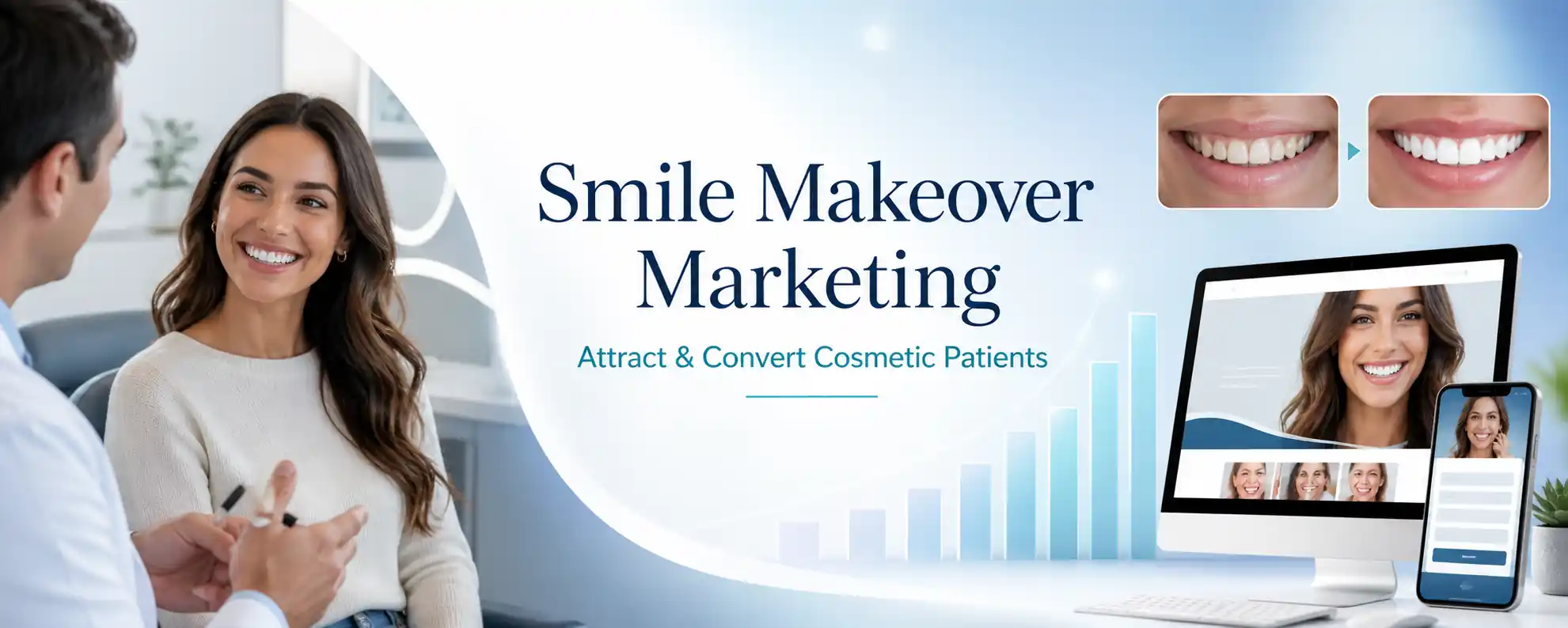
Smile makeover marketing attracts and converts more cosmetic patients when dental practices build their program around three pillars: high-intent keyword targeting, ethical before-and-after visual proof, and a low-friction consultation pathway that turns research-stage prospects into booked cosmetic exams.
Generic cosmetic dentistry marketing won’t do it—smile makeover prospects research differently, decide more slowly, and need different reassurance than someone booking a cleaning.
The pattern is predictable: someone unhappy with their smile spends weeks (sometimes months) Googling, scrolling Instagram, and watching YouTube case videos before they ever pick up the phone. By the time they reach your website, they’ve seen dozens of smiles, compared veneers vs. composite vs. orthodontic-first plans, and quietly decided whether your practice looks credible. Your marketing’s job is to be visible across that research window, earn trust through case-specific visual proof, and remove every reason to delay the consultation.
Below, you’ll learn how to define a smile makeover ideal patient profile, build a landing page that earns the consult, present case photos compliantly, run channel-matched ads, optimize Google Business Profile for cosmetic searches, and convert more consultations into accepted treatment plans.
Written for: cosmetic dentists, practice owners, and marketing managers at general or cosmetic-focused practices who want to attract higher-value smile makeover patients without competing on price.
TL;DR
If you only do six things, do these:
1.
Define one ideal smile makeover patient - age, motivation, budget range, and decision style; let it shape every ad, page, and case photo you choose
2.
Build a dedicated smile makeover landing page - separate from your general cosmetic page, with case-specific before-and-afters and one clear consultation offer
3.
Use before-and-after photos compliantly - written consent, consistent angles and lighting, and disclosure language that protects you and reassures prospects
4.
Match the channel to the research stage - SEO and YouTube for early research, Meta for visual discovery, Google Search and Local Service Ads for high intent
5.
Optimize Google Business Profile for cosmetic intent - cosmetic-specific photos, services list, and review prompts that mention smile makeovers by name
6.
Convert consultations with structure, not pressure - pre-consult intake, in-room visualization, written treatment plans, and same-visit financing options
A smile makeover isn’t a transactional service—it’s an elective, high-investment, identity-shaping decision. That changes everything about how the marketing has to work.
Three differences that matter:
•
Long research window - cosmetic prospects often research for 4–12 weeks before booking; your marketing needs to be present across that whole window, not just at the moment of intent
•
Visual-first decision-making - text-heavy pages don’t convert smile makeover prospects; they need to see results that look like their starting point
•
Higher trust threshold - the financial and emotional stakes are higher than a crown or a cleaning, so credibility signals (case work, credentials, reviews mentioning cosmetic work specifically) carry more weight
A common mistake we see: practices treat smile makeover marketing as an extension of their general cosmetic page, with a few veneer photos and a contact form. Prospects bounce because nothing on the page proves you handle their specific concern—tetracycline staining, worn-down edges, midline shifts, gummy smiles, or full-arch reconstruction.
Before you write a single ad or landing page line, define one ideal smile makeover patient in writing. This isn’t a generic persona exercise—it’s a positioning decision that determines which cases you photograph, which language you use, and which channels you invest in.
Useful framing questions:
•
Primary motivation - is it a wedding, professional advancement, post-divorce reset, retirement reward, or a long-postponed self-investment? Each one carries different urgency, language, and channel behavior
•
Age and life stage - a 32-year-old planning a wedding researches differently than a 58-year-old whose teeth have worn down over decades
•
Starting condition - mild discoloration, crowding, worn edges, missing teeth, or a combination requiring full-mouth reconstruction
•
Budget tolerance - prospects considering 6–10 veneers behave differently than full-arch implant-supported reconstruction prospects; your marketing shouldn’t try to speak to both at once
•
Decision style - some prospects book the first consultation they research; others compare 4–6 practices and want detailed treatment-planning content before they’ll inquire
Why this matters operationally: if you target everyone, you compete on price by default. If you define one ideal patient and build assets around them—case photos, written reviews, ad copy, FAQ content—you become the obvious choice for that segment and a non-obvious choice for the segments you didn’t target. That’s the goal.
The smile makeover landing page is where most cosmetic marketing investment is won or lost. It should be separate from your general cosmetic page and built specifically to convert research-stage prospects into booked consultations.
The structural elements that consistently perform:
1.
Hero section with a recent case - one strong before-and-after pair (or short transformation video) above the fold, with a one-sentence statement of who you help and one consultation offer
2.
Case gallery organized by concern - group cases in your smile gallery by starting condition (worn teeth, dark teeth, crowding, gaps, full-arch) so prospects find a case that resembles theirs
3.
Treatment options explained briefly - veneers, composite bonding, orthodontic-first plans, whitening, gum recontouring; help prospects understand your full toolkit without overwhelming them
4.
The consultation experience preview - what happens at the consult, how long it takes, what they leave with (written plan, photos, options); this lowers friction more than almost any other element
5.
Cosmetic-specific reviews - reviews that mention smile makeovers, veneers, or cosmetic work by name carry far more weight than generic five-star reviews
6.
Financing transparency - mention that patient financing options exist and roughly what they look like; the absence of this signals price opacity and pushes prospects to keep researching elsewhere
7.
One primary call to action - one consultation offer (free, complimentary photo consult, or virtual smile preview), used consistently across the page
What to leave off: stock photos of models, generic dentistry copy that could describe any practice, multiple competing CTAs (book online + call + chat + form all fighting for attention), and price-anchored language that makes the page feel transactional.
Page speed and mobile experience matter more here
Smile makeover prospects scroll through case galleries on their phones, often at night. If your case images are slow to load or your gallery doesn’t scale to mobile, you lose them silently. Aim for a Largest Contentful Paint under 2.5 seconds and verify your gallery works smoothly with thumb-only navigation.
Before-and-after photos are the single most important asset in smile makeover marketing—and the area where practices most often expose themselves to compliance risk. Done right, photos are the difference between a prospect bouncing and a prospect booking. Done wrong, they create HIPAA exposure, state dental board issues, and prospect distrust.
The non-negotiables:
•
Written photo release for every patient - signed before any image is used in marketing; specify the channels (website, social media, paid ads, print) and whether usage is time-limited
•
Consistent technical conditions - same lighting, same angle, same lip retraction, same camera distance; mismatched conditions look manipulated and undermine trust
•
No retouching beyond standard color and exposure correction - whitening teeth in post-production, removing skin texture, or smoothing the lip line creates legal and ethical exposure
•
Disclosure language nearby - “Individual results vary” or similar language; check your state dental board for any specific required disclosures
•
Treatment description with each case - what was done (number of veneers, whitening, bonding, etc.) so prospects understand what they’d be signing up for
What to photograph beyond the smile: portrait shots that show the patient looking comfortable and unposed (with consent) help prospects emotionally project themselves into the result. Clinical-only smile photos work, but pairing them with a relaxed portrait significantly increases consult requests in our experience.
Video case studies outperform static photos for high-investment cases
For prospects considering full-arch reconstruction, full mouth rehabilitation, or 8–10 veneer cases, a 60–90 second patient story video does more than a static gallery. The patient explains their starting condition in their own words, the practice walks through the treatment-planning process briefly, and the result is shown in motion (not just a posed smile). This format builds trust at the level the decision actually requires.
Cosmetic prospects don’t live on one channel—they research across several. Your ad strategy should match channel intent to research stage, not pour the whole budget into one platform.
Channel-by-channel guidance:
•
Google Search Ads - capture high-intent searches like “smile makeover [city],” “veneers near me,” or “cosmetic dentist [city]”; bid carefully, write ad copy that mirrors the search query, and send traffic to your dedicated smile makeover landing page (not your homepage)
•
Local Service Ads - where available for dental, these appear above standard search ads and are billed per qualified lead; strong fit for high-intent local cosmetic searches
•
Meta (Facebook + Instagram) - visual discovery channel; works best with case photos, short transformation videos, and detailed Facebook and Instagram ad targeting; expect a longer time-to-book than search ads because intent is lower
•
YouTube - educational and case-walkthrough video content for the long research window; pre-roll on cosmetic dentistry searches and remarketing to people who’ve visited your site
•
TikTok and Instagram Reels (organic-first) - increasingly where younger cosmetic prospects discover practices; case content, “day in the life” clips, and patient stories perform best; ad spend here is supplementary to organic
•
Display and remarketing - keep your case gallery visible to prospects who visited your smile makeover page but didn’t book; the long research window makes retargeting ads especially valuable for cosmetic
Budget framing we use: for practices serious about smile makeovers, a defensible starting allocation is roughly 50% to Google Search and Local Service Ads (high intent), 30% to Meta (visual discovery and remarketing), and 20% to YouTube and supplementary channels. Adjust based on what your tracking shows is producing accepted cases, not just leads.
Ad copy that earns the click without overpromising
The strongest smile makeover ad copy is specific, visual, and avoids superlatives. “See real veneer cases from [city] patients,” “Worn-down teeth? See how we restore them,” or “Considering a smile makeover? Start with a complimentary photo consultation” outperform generic “Get the smile of your dreams” copy. Specificity earns the click; specificity earns the consult.
Local SEO and Google Business Profile for cosmetic searches
Most smile makeover prospects begin with a local search. If your Google Business Profile and local SEO foundation aren’t built specifically for cosmetic intent, you lose the prospect before your website even loads.
Cosmetic-specific GBP optimization:
•
Primary category - select “Cosmetic Dentist” if cosmetic is your primary identity; “Dentist” with “Cosmetic Dentist” as a secondary Google Business Profile category if you’re a general practice with a strong cosmetic focus
•
Services list - explicitly list smile makeover, porcelain veneers, composite bonding, teeth whitening, full mouth reconstruction, gum contouring, and any other cosmetic offerings as separate services
•
Photos that match cosmetic intent - upload before-and-afters (with consent and disclosure), portraits of cosmetic patients, the consultation room, and any visualization technology you use; refresh monthly
Review prompts that mention smile makeovers - when asking cosmetic patients for reviews, prompt them to mention what they had done; reviews that name “veneers” or “smile makeover” help you surface for those queries
On-site SEO that supports the GBP signal
Your website needs to reinforce the same cosmetic positioning. That means a dedicated smile makeover landing page, individual pages for major cosmetic procedures (veneers, bonding, whitening, full mouth reconstruction), localized content for the cities you serve, and structured data on services and FAQs. Without this, your GBP can show up in the map pack but your website won’t support the broader keyword footprint that drives organic discovery.
Convert consultations into accepted treatment plans
Marketing’s job ends when the prospect books the consultation. The consultation experience determines whether that prospect becomes a smile makeover patient or quietly disappears.
The consultation structure that consistently works:
1.
Pre-consult intake - a short form before the appointment asking what they want to change, what they’ve tried, and what their timeline looks like; this intake process lets the team prepare and signals you take the case seriously
2.
Photo and scan capture - intraoral photos, full-face photos, and an intraoral scan if available; this becomes the visual baseline for the conversation
3.
Visualization or smile preview - digital smile design, mock-ups, or wax-ups depending on case complexity; prospects who can see their potential result accept treatment at meaningfully higher rates than prospects shown only verbal descriptions
4.
Written treatment plan with options - one recommended plan and one or two alternatives, with the trade-offs explained; well-presented treatment plans outperform verbal ones because prospects often need to discuss with a partner before deciding
5.
Same-visit financing conversation - have financing pre-approved or apply during the visit; prospects who leave to “think about financing” convert at a much lower rate than prospects who leave with an approved plan in hand
6.
Clear next step before they leave - either scheduled treatment, a scheduled follow-up to finalize the plan, or a written deadline on the quoted pricing
What undermines consultations: running late, multiple staff handoffs without context, pricing-first conversations before the patient has explained their goals, and pressure tactics. Smile makeover prospects sense pressure quickly and disengage. Structure and clarity outperform urgency every time.
Generic dental marketing dashboards don’t fit smile makeover marketing. The traffic and lead numbers that matter for hygiene volume aren’t the right scoreboard for cosmetic.
The cosmetic marketing scoreboard:
•
Cost per cosmetic consultation - not cost per generic lead; segment your call and form tracking so cosmetic-specific consultations are measured separately
•
Consultation-to-treatment-plan-acceptance rate - the percentage of consults that result in a signed treatment plan within 30 days
•
Average accepted case value - cosmetic case values vary widely; tracking the average tells you whether your positioning is attracting your target case size
•
Time-to-book by channel - how long it takes prospects from each channel to book; this informs how much remarketing investment makes sense
•
Source of accepted cases - track which channels are producing accepted cases (not just leads); often the channel with the most leads is not the channel with the most accepted cases
•
Review velocity from cosmetic patients - how often new cosmetic-specific reviews are coming in; this is the leading indicator for ongoing local search performance
A diagnostic to run quarterly: pull the last 90 days of accepted smile makeover cases and trace each one back to its original source (paid search, organic, referral, social, GBP). The pattern that emerges almost never matches the lead-volume pattern. That gap is where you reallocate budget.
Smile makeover marketing rewards practices that commit to a clear positioning, build the right assets, and run channels in coordination—not in isolation. If you’re ready to attract more cosmetic patients without competing on price, our team helps dental practices build smile makeover marketing programs from positioning through consultation conversion.
Call us at 888-246-6906 or schedule a consultation to talk through your current cosmetic marketing and where the highest-leverage improvements are.
How long does smile makeover marketing take to produce results?
Cosmetic prospects typically research for 4 to 12 weeks before booking, so the realistic time-to-first-accepted-case from a new marketing program is usually 60 to 120 days. Paid search and Local Service Ads can produce consultations in the first 2 to 4 weeks; SEO, organic social, and review-driven local search build over 3 to 6 months. Practices that expect smile makeover marketing to perform like emergency or hygiene marketing tend to underinvest and pull spend before the program has had time to mature.
Should I have a separate landing page for smile makeovers?
Yes. A general cosmetic dentistry page tries to address veneers, whitening, bonding, Invisalign, gum contouring, and full-mouth reconstruction in one place, which dilutes the message for any one prospect. A dedicated smile makeover landing page lets you build the full case for one decision: organize before-and-afters by starting concern, walk through the consultation experience, and present financing transparently. Practices that move from a single cosmetic page to a dedicated smile makeover page typically see meaningful improvement in consultation requests from cosmetic-specific traffic.
What permissions do I need to use before-and-after photos in marketing?
You need a written photo release signed by the patient before any image is used in marketing. The release should specify the channels of use (website, social media, paid ads, print, internal display), whether the use is time-limited, and how the patient can revoke consent in the future. Even with a signed release, photos remain protected health information under HIPAA in many contexts, so consult your compliance resources. Verbal consent is not sufficient.
Which channel produces the most smile makeover patients?
There is no single best channel. High-intent searches on Google produce the fastest consultations, while Meta and YouTube produce a larger volume of earlier-stage prospects who convert over weeks or months. Practices that win at smile makeover marketing run channels in coordination: search ads capture intent, social and video build awareness across the long research window, remarketing keeps the practice visible, and Google Business Profile and reviews close the loop on local intent. The right mix depends on your market, average case value, and how much capacity you have to nurture longer research timelines.
How should I price the consultation in marketing?
Three approaches commonly work for smile makeover marketing: a complimentary photo consultation (lowest friction, highest volume), a paid consultation that is credited toward treatment if the patient proceeds (filters for serious prospects), or a virtual smile preview before any in-person visit (works well for younger and out-of-area prospects). The right approach depends on your market, your typical case value, and whether your goal is consultation volume or consultation quality. Whichever you choose, present it consistently across your website, ads, and Google Business Profile.
How do I get more reviews that mention smile makeovers specifically?
Prompt cosmetic patients in the moment that produces the most genuine response, which is usually at the final reveal appointment when the result is most visible to them. The request should specifically mention the procedure name: ask the patient to share their experience and to mention the procedure (smile makeover, veneers, bonding) by name in the review. This kind of specific prompt produces reviews that name the procedure, which improves your visibility for cosmetic queries and reassures prospects reading the reviews. Generic review requests produce generic reviews.
What is a reasonable marketing budget for smile makeover patients?
Cosmetic case values are high enough that practices generally support meaningful monthly investment in cosmetic-specific marketing. The right number depends on your average accepted case value, your target case volume, your market competitiveness, and how much existing brand and review equity you have. Practices new to cosmetic marketing typically invest more aggressively in the first 90 to 180 days to build the asset base (landing page, case library, review velocity, ad accounts) and then optimize toward cost per accepted case. Tracking accepted-case attribution by channel is what tells you whether your spend is working, not lead volume alone.
Can general dentists market smile makeovers, or only cosmetic specialists?
General dentists can absolutely market smile makeovers, and many do successfully. The marketing positioning has to match the clinical reality: if your team handles up to a certain case complexity (for example, 6 to 10 veneer cases and bonding-driven makeovers but not full-arch reconstruction), build your marketing around those cases and refer the rest. Misalignment between marketing and clinical capability is what creates trust problems. Honest positioning around what you do exceptionally well outperforms vague positioning that promises everything.
We Provide Real Results
WEO Media helps dentists across the country acquire new patients, reactivate past patients, and better communicate with existing patients. Our approach is unique in the dental industry. We work with you to understand the specific needs, goals, and budget of your practice and create a proposal that is specific to your unique situation.
+400%
Increase in website traffic.
+500%
Increase in phone calls.
$125
Patient acquisition cost.
20-30
New patients per month from SEO & PPC.
Schedule a consultation that works for you
Are you ready to grow your practice? Talk to one of our Senior Marketing Consultants to see how your online presence stacks up. No strings attached. Just a free consultation from experts in the industry.



 Smile makeover marketing attracts and converts more cosmetic patients when dental practices build their program around three pillars: high-intent keyword targeting, ethical before-and-after visual proof, and a low-friction consultation pathway that turns research-stage prospects into booked cosmetic exams.


