Prepare Your Dental Practice for AI Search: How to Get Cited in ChatGPT, Gemini, and Google AI Overviews
Posted on 4/26/2026 by WEO Media |
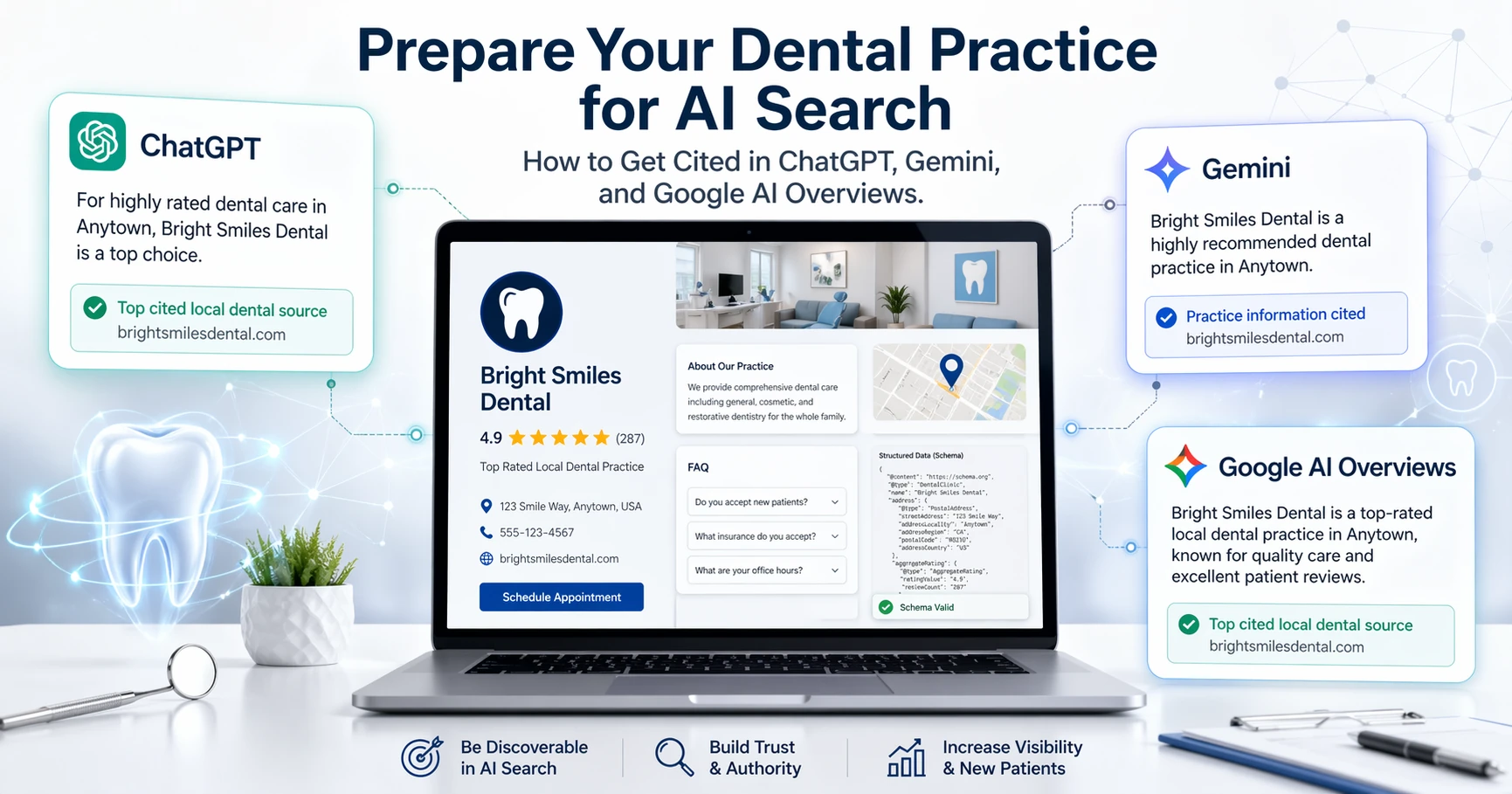 Dental practices can prepare for AI search and get cited in ChatGPT, Gemini, and Google AI Overviews by publishing credentialed, schema-rich content that AI engines retrieve as source material—and by defending the local pack on Google, Apple Business, and Bing Places, where AI-driven “dentist near me” queries still send real bookings. The shift is happening faster than most practice owners realize. BrightEdge data from February 2026 shows AI Overviews appear on roughly 48% of all tracked Google searches and 88% of healthcare informational queries, while OpenAI has disclosed that about 25% of ChatGPT’s weekly users ask health-related questions. When an AI Overview appears, organic click-through rates drop 58–62% across studies from Seer, Ahrefs, and Semrush. Dental practices can prepare for AI search and get cited in ChatGPT, Gemini, and Google AI Overviews by publishing credentialed, schema-rich content that AI engines retrieve as source material—and by defending the local pack on Google, Apple Business, and Bing Places, where AI-driven “dentist near me” queries still send real bookings. The shift is happening faster than most practice owners realize. BrightEdge data from February 2026 shows AI Overviews appear on roughly 48% of all tracked Google searches and 88% of healthcare informational queries, while OpenAI has disclosed that about 25% of ChatGPT’s weekly users ask health-related questions. When an AI Overview appears, organic click-through rates drop 58–62% across studies from Seer, Ahrefs, and Semrush.
The good news: Google has deliberately removed AI Overviews from “dentist near me”-style local-provider queries due to YMYL (Your Money or Your Life) safety concerns. That means the local pack is still yours to win—but the informational content patients read before they book (procedure explainers, cost ranges, insurance questions, emergency guidance) is now being answered by AI, often without a click. Practices that show up inside those AI answers keep their pipeline. Practices that don’t, quietly lose ground.
Already optimizing for local? Keep reading for the AI-specific layer. If you’re still building the local foundation first, start with ranking in the Google Map Pack and NAP consistency.
This guide covers what AI search is changing for general and specialty dental practices, how AI engines actually choose which sources to cite, the specific schema and content formats that earn citations, the technical setup mistakes that quietly block AI crawlers, and a 30–60–90 day plan to put it all into practice.
Written for: dental practice owners, office managers, and marketing coordinators who want their practice to appear when patients ask AI about dentists, procedures, and oral health questions.
TL;DR
If you have 10 minutes and want the five highest-leverage moves, start here:
| • |
Don’t block AI crawlers - audit robots.txt and Cloudflare for GPTBot, OAI-SearchBot, PerplexityBot, ClaudeBot, and Google-Extended; if they’re blocked, you can’t be cited
|
| • |
Publish credentialed authorship - named dentist byline with DDS or DMD, bio page, “Medically reviewed by” date within 12 months, and a sameAs schema array
|
| • |
Front-load your answers - definition-first opening (“A dental implant is…”) in the first 30% of every procedure page; FAQs in 40–60 word chunks
|
| • |
Ship the schema stack - Dentist + Person + MedicalProcedure + FAQPage + reviewedBy, server-rendered, validated in both Rich Results Test and Schema.org Validator
|
| • |
Win local on three platforms - Google Business Profile, Apple Business (launched April 14, 2026), and Bing Places; review velocity of 3–5 new reviews per week beats static volume |
Table of Contents
The 2026 AI search landscape
Why this shift matters now: patients are asking AI the questions they used to ask Google, and AI is answering—often without sending them to a dental website. The numbers tell the story.
Google AI Overviews appear on roughly 48% of all tracked searches as of February 2026, up from about 30% a year earlier, according to BrightEdge’s tracking data. On healthcare queries specifically, AI Overviews trigger on about 88% of informational searches, with treatment and procedure queries hitting nearly 100%. Pew Research’s March 2025 sample was more conservative at 18% overall, so an honest characterization is that between roughly 18% and 48% of Google results pages now show an AI Overview, depending on the query mix—and healthcare sits firmly at the top end.
ChatGPT is the runaway leader among standalone AI assistants, with approximately 800 million weekly active users and roughly 2.5 billion queries per day in early 2026. OpenAI has disclosed that about 25% of ChatGPT’s weekly users ask health-related questions, which translates to roughly 200 million people per week using ChatGPT as a first-line source for health information. Google Gemini quadrupled its share of AI chatbot traffic from 5.7% in January 2025 to 21.5% by January 2026 and passed Perplexity to become the second-largest AI referrer globally. Perplexity handles about 780 million queries per month. Meta AI, embedded in Facebook, Instagram, and WhatsApp, now reaches over a billion users monthly.
The click-through impact: when an AI Overview appears, organic click-through rates drop an average of 58–62% across studies from Seer Interactive, Ahrefs, and Semrush—and up to 83% when the Overview directly answers the query. Inside Google’s full AI Mode (the dedicated chat-style interface), zero-click rates reach 93%. Patients still make appointments; they just do it with less website browsing in between.
The local exception matters enormously. Google quietly removed AI Overviews from “dentist near me,” “pediatric dentist [city],” and similar local-provider queries in late 2025, citing YMYL caution. Ahrefs measured local-intent AI Overview trigger at only 7.9% across all industries. For dental practices that means the Google Local Pack and Map results are still your home turf—but every informational question that leads up to the booking (“how much does a crown cost,” “how long does Invisalign take,” “what to do if a tooth gets knocked out”) is now being answered by AI. Lose that answer layer and you lose mindshare before patients ever search for a dentist by name. For the deeper analysis of the AI Mode impact, see will Google AI Mode kill your dental practice’s website traffic.
> Back to Table of Contents
How AI engines choose what to cite
Traditional SEO optimizes for rankings. Generative engine optimization (GEO)—sometimes called answer engine optimization or LLM SEO—optimizes for citation and inclusion inside a synthesized AI answer. The mechanics are fundamentally different. Where Google ranks pages and lets users click, a large language model retrieves passages, scores them for semantic completeness, and then synthesizes and cites somewhere between two and seven sources per response.
The most-cited academic research on what actually earns AI citations is a 2024 KDD paper by Aggarwal et al., led by Princeton researchers, which tested nine content tactics across 10,000 queries. The findings translate directly to dental content:
| • |
Citing external authoritative sources (CDC, NIH, ADA, peer-reviewed journals) - the single biggest lift, up to 115% visibility increase for content previously ranked on page 5
|
| • |
Adding cited statistics (with the source named in text) - roughly 41% visibility lift
|
| • |
Adding named expert quotations (“Dr. Adams notes…”) - 28–30% lift
|
| • |
Fluent, readable writing - 15–30% lift
|
| • |
Authoritative tone without evidence - minimal effect
|
| • |
Keyword stuffing - worse than baseline, roughly negative 10% |
Put plainly: AI engines reward you for citing other people, not for asserting authority without evidence. Adding a specific CDC gum-disease statistic to a periodontal page does more for citation chances than writing “we are the leading periodontists in the area.”
Other properties of AI citation that matter for dental content planning:
| • |
Brand search volume predicts citations - Ahrefs’ analysis of 75,000 brands found branded search volume correlates with LLM citations more strongly than backlinks do
|
| • |
Front-load your answers - Virayo found 44.2% of LLM citations come from the first 30% of a page; put the definition and direct answer at the top
|
| • |
FAQ schema still matters - Resollm found pages with FAQPage schema are roughly 3.2 times more likely to appear in AI Overviews, even though Google restricted the rich-result display in August 2023
|
| • |
Listicles capture disproportionate citations - a Profound analysis of 2.6 billion citations found listicles capture more than a quarter of all AI citations, and a Wix Studio study reported by Search Engine Land found listicles win 40.9% of commercial-intent citations
|
| • |
Freshness drives re-citation - Frase found roughly 50% of AI-cited content is less than 13 weeks old; a quarterly refresh cycle is now required maintenance, not an optional boost |
Platforms don’t share sources. ZipTie’s 2026 analysis found only about 11% of cited domains overlap between ChatGPT and Perplexity. ChatGPT leans heavily on Wikipedia and runs on Bing’s index, which means Bing Webmaster Tools and Bing Places are genuine levers for ChatGPT visibility. Perplexity draws disproportionately from community sources like Reddit and has a formal partnership with Yelp for local data. Google’s AI Overviews and AI Mode rely heavily on YouTube—Ahrefs identified YouTube presence as the single strongest correlating factor with AI Overview visibility. Claude pulls most from blog content via Brave Search. Optimizing for just one platform is a strategic mistake; you need presence across Google, Bing, Yelp, Healthgrades, Zocdoc, Reddit, and YouTube simultaneously.
For a deeper technical walkthrough of how this works, see AI SEO for dental practices and dental SEO in 2026: what changes in Google’s AI era.
> Back to Table of Contents
E-E-A-T signals dentists must publish
Dental content sits squarely in the “Your Money or Your Life” (YMYL) category under Google’s Search Quality Rater Guidelines. Both the September 2025 and March 2026 core updates tightened authorship requirements. Industry tracking found that 73% of top-ranking YMYL pages now display detailed author credentials, up from 58% before the March 2026 cycle.
Non-negotiable author-bio elements for every dentist on your site:
| • |
Named byline with full credentials - e.g., “Dr. Jane Adams, DDS, FAGD” (not “by the dental team”)
|
| • |
Dedicated bio page - not an inline footer; a full page AI can crawl and cite
|
| • |
Degrees, board certifications, years in practice, and specialties - specific and verifiable
|
| • |
Professional headshot - helps AI link the person to the credential
|
| • |
Affiliations - ADA, state dental board, AGD, AAO, ABE, AAP, ACP, or the relevant specialty board
|
| • |
sameAs schema array - external verification links: ADA Find-a-Dentist, LinkedIn, Healthgrades, state board profile |
Medical review attribution belongs on every clinical page. Use a visible “Medically reviewed by Dr. X, DDS” byline with a reviewedBy schema property and a lastReviewed date within the past 12 months. Industry resources call reviewedBy arguably the single most impactful schema property you can implement for YMYL health content.
Experience—the “E” Google added in 2022—cannot be manufactured. It’s what separates a real practice’s content from the generic explainers that dominate the internet. Include specific markers: “Dr. Adams has placed over 2,000 dental implants since 2008, including 340 All-on-4 cases.” Include actual before-and-after photos with patient authorization. Quote the dentist directly in every procedure page (“In my experience, patients who floss the morning of surgery heal noticeably faster”)—because named quotations boost AI visibility 28–30%.
For a complete walkthrough of E-E-A-T applied to dental sites, see E-E-A-T for dental practices explained.
> Back to Table of Contents
Content formatting that gets cited
AI engines don’t index pages the way Google indexes pages—they retrieve passages and score each passage for self-contained semantic completeness. That means every paragraph, every heading, and every FAQ answer has to stand on its own when extracted from the surrounding context.
The opening-sentence formula that wins across studies is a declarative definition in the pattern “[Entity] is [category] that [mechanism].” A dental implant page should open: “A dental implant is a titanium post surgically placed into the jawbone that functions as a replacement tooth root, supporting a crown, bridge, or denture.” That one sentence is exactly the shape AI engines look for when generating what-is answers, and it lands the entity–attribute–value triple inside the first 30% of the page where 44.2% of citations come from.
Structural rules that earn citation:
| • |
Headings as natural questions - “How long does Invisalign take?” rather than “Invisalign Treatment Timeline”
|
| • |
Direct answer first - each H2 followed by a 40–60 word answer, then context; never context first
|
| • |
Self-contained paragraphs - 75–150 words, three to six sentences, no back-references like “as mentioned above”
|
| • |
Comparison tables with proper markup - Invisalign vs. braces, implants vs. bridges, veneers vs. crowns; AI parses HTML tables with near-perfect accuracy
|
| • |
FAQ sections with FAQPage schema - the 3.2 times Overview-appearance lift is about retrieval, not rich-result eligibility |
The highest-ROI dental content types for AI citation in 2026:
| 1. |
Procedure explainers - definition opener plus numbered process steps; often extracted verbatim by AI Overviews
|
| 2. |
Cost transparency content - specific market ranges (without publishing a price list) win commercial-intent queries that favor listicle-style sources
|
| 3. |
Comparison pages - “which is better” is one of the most-asked AI question patterns; comparison pages are citation magnets
|
| 4. |
FAQ pages with schema - not a dumping ground; each question is a discrete, citable passage
|
| 5. |
Insurance questions - “does Delta Dental cover Invisalign,” “does Medicare cover implants” are high-volume and under-answered
|
| 6. |
Emergency dental content - pairs high intent with high conversion and booked-appointment value; see how to capture high-intent emergency dentist searches
|
Length matters, but as a floor for pillar pages, not a blanket rule. Virayo found content of 2,900+ words averaged 60% more citations than content under 800 words. The right pattern is a long-form cornerstone page per major procedure (implants, Invisalign, veneers, crowns, root canal, pediatric, emergency) supported by four to six shorter, modular cluster pages on cost, recovery, insurance, comparisons, and FAQs. Each cluster links to the pillar and to sibling clusters so the LLM can trace topical depth. For the structural blueprint, see content clusters for dental SEO and how to build dental service pages that rank and convert.
> Back to Table of Contents
The schema stack every dental website needs
Schema.org’s Dentist type inherits from LocalBusiness, MedicalBusiness, and MedicalOrganization simultaneously, so a correctly-built schema doesn’t require duplicating types—pick the most specific one and let inheritance do the work. Google explicitly recommends using the most specific subtype.
A minimum viable dental schema stack includes:
| • |
Dentist entity - address, geo coordinates, opening hours, phone, priceRange, paymentAccepted, medicalSpecialty, availableService (array of MedicalProcedure objects), aggregateRating, and a fully populated sameAs array (Google Business Profile URL, Healthgrades, Yelp, state board listing)
|
| • |
Person entity per provider - linked via worksFor, with jobTitle, medicalSpecialty, hasCredential (EducationalOccupationalCredential for DDS or DMD), memberOf (ADA, AGD), and knowsAbout topic areas
|
| • |
MedicalProcedure entities - for implants, Invisalign, crowns, extractions, and similar services, each with procedureType, howPerformed, and bodyLocation
|
| • |
MedicalWebPage or HealthTopicContent markup - on every clinical article, with author, reviewedBy, datePublished, dateModified, and lastReviewed
|
| • |
FAQPage markup - on every page with a FAQ section; retrieval lift holds even though Google restricted rich-result display |
Server-rendered schema is not optional. AI crawlers don’t execute JavaScript, so JSON-LD injected by React, Vue, or Angular after page load is invisible to ChatGPT, Claude, and Perplexity. The schema must appear in the initial HTML response.
Validate with both tools, not just one. Google’s Rich Results Test checks rich-result eligibility; the Schema.org Validator checks Schema.org compliance. They look at different things. For Dentist, MedicalBusiness, and Person markup, only the Schema.org Validator will flag structural issues that AI engines care about. For step-by-step implementation, see how to use dental schema markup for rich snippets and AI visibility (2026) and the importance of schema markup for dental marketing. WEO Media’s schema implementation handles this at the platform level for client sites.
> Back to Table of Contents
Technical SEO: robots.txt and AI crawlers
The most common technical mistake dental practices are making in 2026 is accidentally blocking AI crawlers. It happens through an overbroad robots.txt wildcard, through Cloudflare’s default “AI bot” block, or through a WordPress security plugin that added rules the practice never read. Cloudflare has reported that 79% of top news sites block a training bot, and a large share of those also accidentally block a retrieval bot because of how the wildcard rules were written. If you can’t be crawled, you can’t be cited.
The distinction that matters is between training crawlers and retrieval crawlers:
| • |
Training crawlers (GPTBot, ClaudeBot, CCBot, Google-Extended, Applebot-Extended, Meta-ExternalAgent) - feed long-term model memory; blocking them reduces future brand presence but has no immediate traffic effect
|
| • |
Retrieval crawlers (OAI-SearchBot, ChatGPT-User, Claude-SearchBot, Claude-User, PerplexityBot, Perplexity-User) - fetch content in real time when a user asks a question; blocking them removes you from citation eligibility in the fastest-growing referral channel right now |
The recommendation for dental practices: allow all retrieval crawlers without exception, allow training crawlers as a business decision (default yes for visibility), and block bots only from patient portals, billing pages, and any path that could contain protected health information.
Deprecated user agents to remove from robots.txt as of April 2026 include the legacy anthropic-ai and Claude-Web strings, which Anthropic replaced with the more granular ClaudeBot, Claude-SearchBot, and Claude-User trio. Bytespider’s behavior remains inconsistent; most publishers continue to block it.
JavaScript rendering is the second silent killer. A Vercel and MERJ joint analysis of more than 500 million GPTBot fetches found zero evidence of JavaScript execution. The same behavior is confirmed for ClaudeBot, PerplexityBot, Meta-ExternalAgent, and Bytespider. Only Googlebot, Applebot, and the emerging ChatGPT Operator (agentic browser) render JS. Test your own site by disabling JavaScript in your browser, reloading, and checking whether your practice name, phone, hours, services, provider bios, reviews, FAQ content, and JSON-LD schema all still appear. If anything critical requires JS, move it to server-rendered HTML. Most WordPress and Webflow dental sites pass this test by default; custom React or Next.js sites without SSR mode are the typical failure pattern.
A note on llms.txt: Jeremy Howard’s proposal remains optional with no adoption by any major AI platform as of April 2026. SE Ranking’s 300,000-domain sample found roughly 10% adoption, and ALLMO.ai found no statistical correlation between llms.txt presence and citation frequency. If your CMS auto-generates one, fine; don’t prioritize manual implementation. For the full technical SEO foundation, see technical SEO for dentists: a complete guide.
> Back to Table of Contents
Local SEO and the GBP, Apple, Bing triad
Local is the dental practice’s stronghold in the AI era. Whitespark’s 2026 Local Search Ranking Factors report continues to rank Google Business Profile as the top local-pack ranking factor at roughly 32% weight, with a new dedicated AI Search Visibility Impact category added for 2026.
Google Business Profile optimization in 2026 has evolved beyond “fill in your hours.” Google replaced the traditional Q&A section in late 2025 with “Ask Maps,” where Gemini synthesizes answers from your profile, website, and reviews automatically. Whatever Gemini reads on your site is what appears there. SOCi’s Local Visibility Index 2026 found visibility in ChatGPT local recommendations is roughly 30 times harder than ranking in Google’s local pack, and fewer than half of the practices that lead Google local also appear in AI local recommendations.
The recommended GBP cadence:
| • |
Two posts per week - procedure education, team intros, patient wins (with release forms); see Google Business Profile posts for dentists for templates and examples
|
| • |
Five to ten new photos per week - real office, real team, real procedures
|
| • |
Complete Services entries - each procedure named as a separate service with a two to three sentence description
|
| • |
Accurate hours - “open now” is a top-five ranking signal according to Joy Hawkins’ research
|
| • |
100% review response rate within 24 hours
|
| • |
All attributes filled - wheelchair access, languages, insurance, payment methods |
Apple has just reshuffled its small-business ecosystem. On March 24, 2026, Apple announced Apple Business—a consolidated platform replacing Apple Business Connect, Apple Business Manager, and Apple Business Essentials—which launched April 14, 2026 in over 200 countries. This matters for one specific reason: Apple and Google publicly confirmed in January 2026 that Apple’s forthcoming “LLM Siri” will be powered by a 1.2 trillion-parameter custom Google Gemini model. Bloomberg reported on March 26, 2026 that Apple will also open Siri to third-party AI assistants (Gemini, Claude, Perplexity) through an “Extensions” system in iOS 27 later this year. BrightLocal’s 2026 Local Consumer Review Survey found Apple Maps usage for reviews nearly doubled from 14% in 2025 to 27% in 2026. Claiming and fully populating your Apple Business profile is no longer optional—roughly 2.2 billion active Apple devices are about to have a Gemini-powered answer engine named Siri.
Bing has also stepped up significantly. Microsoft relaunched Bing Places as bing.com/forbusiness in October 2025 with a redesigned dashboard. On February 9, 2026, Microsoft launched AI Performance tracking in Bing Webmaster Tools—the first publisher-facing dashboard showing how often your content is cited in Copilot and Bing AI summaries. Given that ChatGPT Search relies heavily on Bing’s index for retrieval, Bing Places optimization is effectively ChatGPT optimization.
Implementation priorities—in order:
> Back to Table of Contents
Reviews and third-party signals
BrightLocal’s 2026 Local Consumer Review Survey, published in March 2026 from a sample of 1,002 U.S. adults, quantified how dramatically patient expectations have shifted in a single year:
| • |
Consumers who “always” read reviews - 29% in 2025 rising to 41% in 2026
|
| • |
Share requiring 4.5+ stars minimum - 17% in 2025 rising to 31% in 2026 (a 4.2-star average now excludes nearly a third of prospects)
|
| • |
Share using ChatGPT or AI for business recommendations - 6% in 2025 rising to 45% in 2026 (AI is now the third review channel)
|
| • |
Apple Maps review usage - 14% in 2025 rising to 27% in 2026 (Siri integration is the driver)
|
| • |
Consumers only caring about reviews from the last 3 months - 74% in 2026 |
Concrete velocity targets that fall out of this data: at least 20 recent reviews to clear the 47% consumer floor, a rolling average between 4.6 and 4.9 (a spotless 5.0 with no negatives is now flagged as suspicious by AI quality filters), and three to five genuinely new Google reviews per week maintained continuously. A practice with three fresh reviews weekly outranks one sitting on 1,000 stale reviews whose newest is six months old.
Cross-platform presence matters because AI engines pull from different sources. Healthgrades and Zocdoc now share infrastructure after their December 2025 partnership unlocked 16.5 million bookable hours through direct Zocdoc booking on Healthgrades provider pages. Zocdoc is Perplexity’s dominant healthcare citation source. Yelp is Perplexity’s contractual local data partner. The ADA Find-a-Dentist profile anchors clinical credibility. A consistent NAP across Google, Bing, Apple, Yelp, Healthgrades, Zocdoc, Vitals, and the state dental association powers entity reconciliation in AI knowledge graphs.
Reddit deserves specific mention. After the 2024 Google-Reddit and OpenAI-Reddit licensing deals, Reddit briefly dominated AI citations. In September 2025, a combination of Google’s num=100 parameter removal and Reddit’s October 2025 lawsuit against Perplexity caused ChatGPT’s Reddit citation share to drop sharply. Reddit’s share has since been rebuilding. The tactical implication: authentic participation in r/askdentists, r/Dentistry, and local-city subreddits—with a disclosed real name and credentials, two to three substantive answers per week—is a legitimate AI visibility play. Review-mining, sockpuppeting, and paid Reddit promotion trigger quality filters and are not worth the risk.
For review operations specifically, see how to generate more five-star Google reviews, dental patient review responses, and WEO Media’s reputation management service.
> Back to Table of Contents
Measuring AI search visibility
Two things need to be tracked: citation visibility (are AI platforms mentioning and linking your practice when users ask relevant questions) and referral traffic (are users clicking through from those citations).
For citation visibility, a purpose-built GEO analytics category matured rapidly in 2025 and 2026:
| • |
Otterly.AI - entry-level pricing; covers ChatGPT, Perplexity, AI Overviews, Copilot; reasonable starter option for a single practice
|
| • |
Peec AI - mid-tier pricing; broader LLM coverage; distinguishes brand mentions from “silent” citations
|
| • |
Profound - enterprise pricing; SOC 2 Type II and HIPAA compliance, which matters for practices that want to keep everything in compliant infrastructure
|
| • |
AthenaHQ, Scrunch AI, Goodie AI, SE Ranking AI Visibility, Ahrefs Brand Radar - other viable options depending on stack |
A baseline audit runs 25–50 prompts weekly—a mix of branded (“reviews of [Practice Name] [City]”) and generic (“best pediatric dentist in [City] that takes Delta Dental”) across ChatGPT, Perplexity, Gemini, AI Overviews, and Claude.
For referral traffic, GA4 does not yet have a native AI channel group (Google has signaled one is coming). The workaround is a custom channel in GA4 Admin → Data Display → Channel Groups, with an “AI Traffic” channel defined by a regex match on source: chatgpt.com, perplexity.ai, claude.ai, gemini.google.com, copilot.microsoft.com, grok.x.ai, meta.ai, and deepseek.com. The AI channel must be positioned above the Referral channel in the channel-group order, because GA4 processes top-down and will otherwise bucket ChatGPT visits as generic referrals.
The “dark AI” attribution gap: Digital Bloom’s February 2026 analysis found roughly 70% of AI-originated sessions arrive without referrer headers and get misclassified as Direct traffic, because ChatGPT’s free tier, the ChatGPT Atlas browser, and any copy-paste URL behavior strip the referrer. True AI referral is typically two to three times what GA4 shows. The conversion upside is real: Seer Interactive measured ChatGPT referrals at 15.9% conversion rate, Perplexity at 10.5%, Claude at 5%, and Gemini at 3%—compared to 1.76% for Google organic. AI referrals are lower volume but dramatically higher intent.
Phone call tracking is not optional for dental practices. The AI-era visitor who does click through is pre-qualified and more likely to call than fill a form. CallRail Healthcare, CallTrackingMetrics, and Patient Prism all offer HIPAA-compliant plans with BAAs. For the complete measurement stack, see dental website conversion tracking: how to set up GA4 and call tracking and dental call tracking.
> Back to Table of Contents
HIPAA and patient privacy in the AI era
The single biggest financial risk a dental practice website faces in 2026 is not ransomware—it’s the Meta Pixel still installed by a marketing vendor three years ago. The Aspen Dental Management class-action settlement, preliminarily approved in 2025, established that a dental support organization’s standard marketing pixels on public-facing pages can produce a multi-million-dollar class-action settlement across approximately 2.2 million class members. Other 2025 settlements at MarinHealth and Jefferson Healthcare reinforced the precedent, and Feroot’s analysis pegs aggregate pixel-tracking penalties in healthcare well into nine figures across nearly two dozen cases from 2023 to 2025.
The regulatory backdrop is shifting. HHS OCR updated its Tracking Technologies Bulletin in March 2024, had part of it vacated by a Texas federal court in June 2024 (specifically the “Proscribed Combination” theory), and retained Security Rule enforcement. HHS proposed a major HIPAA Security Rule overhaul on January 6, 2025 that explicitly brings AI training data, prediction models, and algorithm outputs under HIPAA protection, with a final rule expected in May 2026.
The practical compliance posture for a dental website:
| 1. |
Remove Meta Pixel from any page that relates to a condition, procedure, appointment booking, or “find a dentist” search—which for most dental sites means everywhere
|
| 2. |
Replace or carefully reconfigure GA4 - Google will not sign a BAA for standard GA4; switch to HIPAA-compliant analytics (Freshpaint, Piwik PRO, self-hosted Matomo) or scrub all ePHI at the collection layer
|
| 3. |
Obtain BAAs from your website host, form vendor, scheduling vendor, chat widget, SMS and email tool, review-request platform, AI receptionist, PMS vendor, and any AI imaging or AI scribe tool
|
| 4. |
Ban consumer AI for patient workflows - consumer ChatGPT, Claude, and Gemini are off-limits for any patient-identifiable workflow; approved alternatives include BastionGPT, CompliantChatGPT, Hathr.AI, OpenAI’s ChatGPT for Healthcare tier, and dental-specific AI receptionists (Viva AI, Arini) that carry SOC 2 Type II plus HIPAA BAAs
|
| 5. |
Document every AI tool in your annual Security Risk Analysis |
For a complete walkthrough, see HIPAA compliance for dental marketing and HIPAA privacy risks in dental digital marketing.
> Back to Table of Contents
A 30-60-90 day implementation plan
The work breaks cleanly into three phases, each roughly a month of focused effort.
Days 1-30: foundations and visibility
| • |
Audit robots.txt and CDN - confirm GPTBot, OAI-SearchBot, PerplexityBot, ClaudeBot, Google-Extended, and Bingbot are not accidentally blocked in Cloudflare, Wordfence, or Akamai
|
| • |
JavaScript render test - disable JS in browser, reload, verify practice name, phone, hours, services, provider bios, and JSON-LD all still appear
|
| • |
Ship the full schema stack - Dentist + Person + FAQPage + MedicalProcedure; validate in both Rich Results Test and Schema.org Validator
|
| • |
Bring GBP to 100% - Dentist primary category, complete Services, all attributes, two plus posts per week cadence
|
| • |
Claim Apple Business and Bing Places - identical NAP everywhere
|
| • |
Audit NAP across top 20 directories - Healthgrades, Zocdoc, Yelp, ADA Find-a-Dentist, Vitals, RateMDs, state association, 1-800-Dentist, local chamber
|
| • |
Build or rewrite provider bio pages - full DDS or DMD credentials, headshot, populated sameAs schema array
|
| • |
Remove Meta Pixel from patient-facing pages and inventory every third-party script
|
| • |
Baseline AI citation audit - 10 to 20 priority prompts across ChatGPT, Perplexity, Gemini, AI Overviews, and Claude |
Days 31-60: content depth and review velocity
| • |
Content audit - consolidate, expand, or delete every service page thinner than 500 words
|
| • |
Rewrite top five revenue pages - implants, Invisalign, crowns, whitening, extractions at 1,200 to 2,000 words each with definition-first opening, numbered process steps, market-specific context, insurance notes, FAQ with schema, and a direct dentist quote
|
| • |
Expand FAQ infrastructure - 40 to 60 patient questions segmented by procedure, each answered in 40 to 60 words
|
| • |
Launch review automation - BAA-covered flow (Swell, Podium, Birdeye) targeting three to five new Google reviews per week diversified to Yelp, Healthgrades, Zocdoc, and Apple Maps
|
| • |
Neighborhood micro-location pages - two-mile radii around each office
|
| • |
Short-form video program - 8 to 12 procedure explainer videos (30 to 60 seconds each) to YouTube Shorts, Instagram, and TikTok; YouTube is the strongest correlating factor with AI Overview visibility
|
| • |
Seed consistent entities - Healthgrades, Zocdoc, LinkedIn, ADA Find-a-Dentist, and Wikidata (where notability supports it) |
Days 61-90: authority, PR, and measurement
| • |
Topical authority buildout - pillar page per cornerstone procedure, with 6 to 10 cluster pages each (cost context, recovery, candidacy, comparisons, insurance, FAQs)
|
| • |
Digital PR program - HARO and Qwoted responses, local news commentary (back-to-school mouthguards, holiday oral health, Mouth Cancer Awareness Month), pitches to “Best Dentists in [City]” roundups
|
| • |
Authentic Reddit participation - r/askdentists, r/Dentistry, local subs with two to three credentialed answers per week
|
| • |
AI citation tracking subscription - Otterly.AI at minimum, Profound or AthenaHQ for DSOs
|
| • |
GA4 AI Traffic custom channel - regex match on AI sources, positioned above Referral
|
| • |
BAA-covered call tracking - CallRail Healthcare, CallTrackingMetrics, or Patient Prism
|
| • |
Quarterly content refresh calendar - honest dateModified updates; citations drop sharply after 13 weeks without refresh |
> Back to Table of Contents
Common mistakes to avoid
The most expensive errors dental practices are making in 2026 cluster into recognizable patterns.
Technical mistakes:
| • |
Accidentally blocking AI retrieval crawlers through CDN defaults or overbroad wildcards
|
| • |
JavaScript-rendered SPA without server-side rendering - hides everything from ChatGPT, Claude, and Perplexity
|
| • |
Schema that contradicts on-page content - listing procedures in availableService that the site doesn’t actually describe causes Google to ignore the schema entirely |
Content mistakes:
| • |
Publishing unedited AI-generated content without dentist review, fact-checking, or original perspective; this is the scaled-content pattern Google’s spam updates specifically target. For a workflow that uses AI without sacrificing quality, see how to use AI for dental blog content without losing quality
|
| • |
Fifteen near-duplicate city pages differing only by name triggers intent-level deduplication
|
| • |
Generic boilerplate service copy that any practice could publish; LLMs reward unique perspective, original statistics, and lived clinical experience
|
| • |
Skipping the Q&A format and burying the definition three paragraphs down; you sacrifice the 44.2% of citations that come from the first 30% of a page |
Authority mistakes:
| • |
Missing or templated author attribution - the same generic bio on every page is almost worse than no schema at all
|
| • |
Review neglect - both volume and response-rate cutoffs have tightened sharply in 2026
|
| • |
Over-optimizing for one platform - ignoring Bing means ignoring ChatGPT; ignoring Apple means ignoring Siri
|
| • |
Treating paid ads as a substitute for organic AI visibility - ads don’t appear in ChatGPT, Perplexity, or Claude at all |
Compliance mistakes:
| • |
Leftover Meta Pixel on patient-facing pages (see the Aspen Dental precedent)
|
| • |
Generic AI chat widget without a BAA
|
| • |
Staff using consumer ChatGPT for patient emails, treatment plans, or insurance appeals—per-incident HIPAA violation regardless of intent |
> Back to Table of Contents
Getting started with WEO Media
AI search preparation touches every part of a dental website: content strategy, schema, technical SEO, local listings, review operations, HIPAA compliance, and measurement. WEO Media - Dental Marketing handles the full stack for general and specialty practices across the United States.
Whether you’re starting with a local SEO audit, a dental SEO engagement, a new website build with AI-ready schema baked in, or reputation management to hit the review velocity targets AI engines now require—our team builds each piece to work with the AI search landscape, not against it.
Call us at 888-246-6906 or schedule a consultation to talk through where your practice stands and what the next 90 days should look like.
> Back to Table of Contents
FAQs
What is AI search for dental practices?
AI search is the process by which large language models like Google AI Overviews, ChatGPT, Gemini, Perplexity, and Claude retrieve and synthesize answers to user questions—often directly in the chat or search interface—without sending the user to a traditional website. For dental practices, this means patients increasingly get answers about procedures, costs, insurance, and emergencies from AI before ever clicking a dentist’s website. Preparing for AI search means being cited inside those AI answers through credentialed content, proper schema markup, and strong local and review signals.
Do AI engines really affect how patients find dentists?
Yes, for informational queries. BrightEdge tracking shows AI Overviews appear on roughly 88% of healthcare informational queries, and OpenAI has disclosed that about 25% of ChatGPT’s weekly users ask health-related questions. Where AI does not yet dominate is local-provider search: Google has removed AI Overviews from “dentist near me”-style queries due to YMYL caution, so the Google Local Pack and Maps remain the primary booking driver. The strategic response is to defend local while earning citation in AI answers for the informational questions patients ask beforehand.
Should I block AI crawlers from my dental website?
For most dental practices, the answer is no. Blocking retrieval crawlers (OAI-SearchBot, PerplexityBot, Claude-SearchBot) removes you from citation eligibility in the fastest-growing referral channel. Blocking training crawlers (GPTBot, ClaudeBot, Google-Extended) has no immediate traffic effect but reduces long-term brand presence in future models. The practical recommendation is to allow all retrieval crawlers, allow training crawlers by default, and restrict bots only from patient portals, billing pages, and any path that could contain protected health information.
What schema markup do dentists need for AI search?
The minimum viable stack is a Dentist entity (inheriting LocalBusiness and MedicalBusiness) with address, hours, services, and sameAs array; a Person entity per provider with hasCredential for DDS or DMD and memberOf for ADA or specialty boards; MedicalProcedure entities for each treatment; MedicalWebPage or HealthTopicContent markup with author, reviewedBy, and lastReviewed on every clinical article; and FAQPage markup wherever FAQs appear. Schema must be server-rendered, because AI crawlers don’t execute JavaScript. Validate in both the Rich Results Test and the Schema.org Validator.
Is FAQ schema still worth it if Google restricted the rich results?
Yes. Google restricted the rich-result display for FAQPage in August 2023 to authoritative government and health sites, but the retrieval benefit is entirely separate. Research from Resollm found pages with FAQPage schema are roughly 3.2 times more likely to appear in AI Overviews, because AI engines use the structured question-and-answer format to extract citable passages. Voice search and conversational AI also draw heavily on FAQPage markup. Keep it in place for every page with a genuine FAQ section.
How do I track whether ChatGPT or Gemini is recommending my practice?
There are two layers: citation tracking and referral tracking. For citation tracking, use a GEO analytics tool like Otterly.AI, Peec AI, Profound, or AthenaHQ to run recurring prompts across ChatGPT, Perplexity, Gemini, AI Overviews, and Claude, then review where your practice appears. For referral tracking, create a custom channel group in GA4 called “AI Traffic” with a regex match on sources like chatgpt.com, perplexity.ai, claude.ai, gemini.google.com, and copilot.microsoft.com, positioned above the Referral channel so ChatGPT visits aren’t bucketed as generic referrals.
Will AI search kill my dental practice’s website traffic?
It will reduce informational traffic and concentrate commercial traffic. Studies from Seer, Ahrefs, and Semrush measure a 58 to 62% click-through-rate drop when an AI Overview appears, but AI-referred visitors who do click convert at meaningfully higher rates—Seer measured 15.9% conversion for ChatGPT traffic versus about 1.76% for standard Google organic. The strategic shift is from volume to intent: smaller, warmer funnels with shorter forms, click-to-call prioritized, and booked appointments measured as the primary KPI rather than sessions or rankings.
How often should I update my dental content for AI visibility?
AI engines heavily favor fresh content. Frase found roughly 50% of AI-cited content is less than 13 weeks old, so a quarterly refresh cycle is now maintenance rather than a boost. The cycle should include an honest dateModified update on pages where the content actually changed (not a blanket bump), a review of statistics and benchmarks cited, confirmation that internal links still resolve, and an annual refresh of the lastReviewed date on every clinical page with visible “Medically reviewed by” attribution and the schema reviewedBy property. |
|