All-on-4 Marketing
Posted on 4/17/2026 by WEO Media |
How to Attract Full-Arch Implant Cases
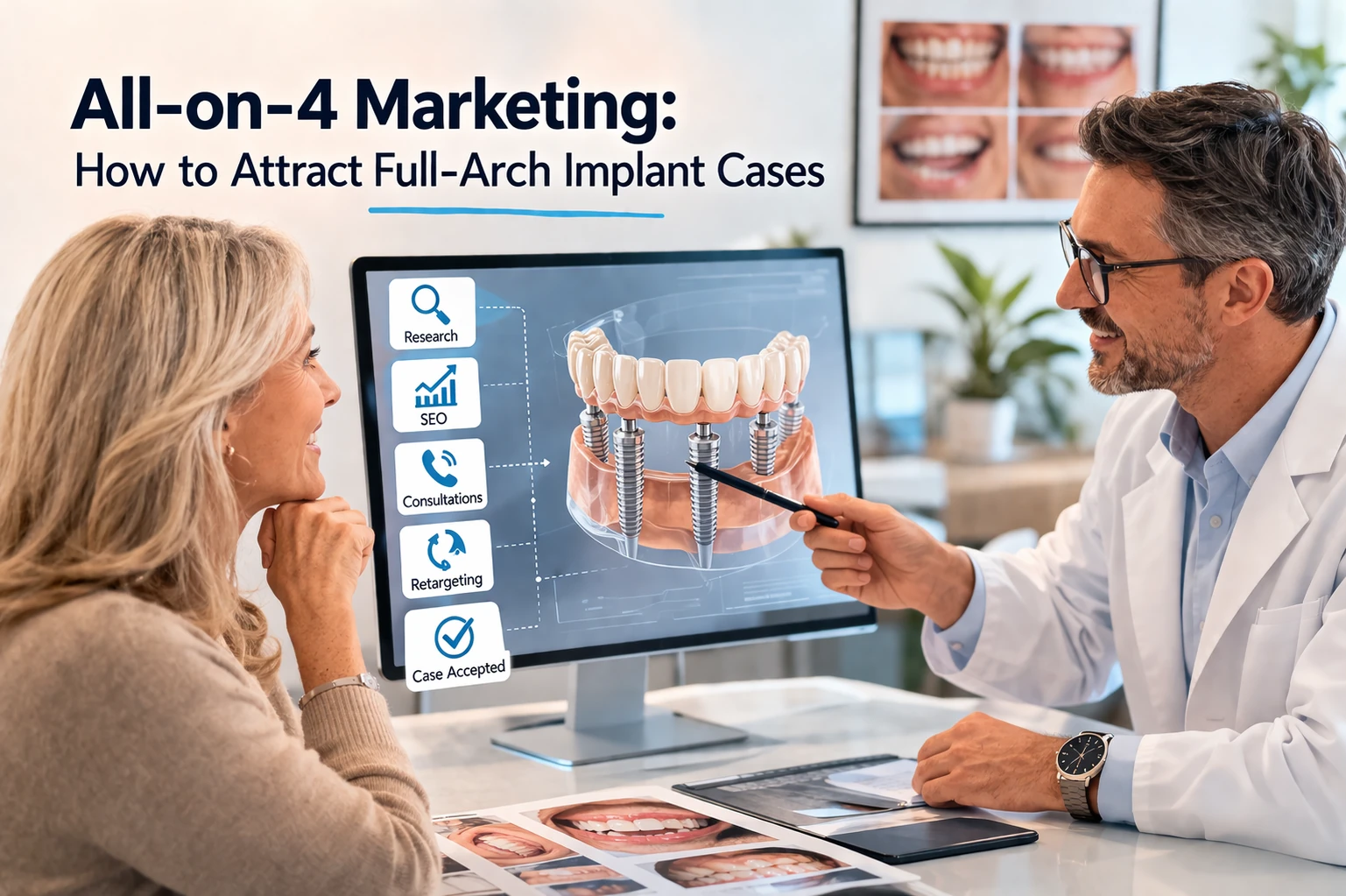 All-on-4 marketing helps dental practices attract high-value full-arch implant cases through systems built for the unique 6 to 18 month buying journey of full-arch patients. All-on-4 marketing helps dental practices attract high-value full-arch implant cases through systems built for the unique 6 to 18 month buying journey of full-arch patients.
If you offer All-on-4, Teeth-in-a-Day, or full-arch fixed-hybrid procedures but your lead flow feels inconsistent—or your consultations aren’t converting—the problem usually isn’t clinical skill. It’s a marketing system built for $300 cleanings being asked to sell $25,000–$60,000 life-changing procedures.
The pattern is consistent across the practices we work with: full-arch patients research for months, sometimes years, before committing. They compare providers, read dozens of reviews, watch hours of educational video content, and often attend two or three consultations before choosing where to have the work done. That extended journey changes everything about how you market—from keyword strategy to ad creative to nurture sequences to consultation structure.
New to full-arch marketing? Start by auditing your existing lead flow before adding paid channels. If your intake process can’t handle $50,000 consultations with the care they require, more leads won’t fix the problem.
Below, you’ll learn how to build a full-arch marketing system that matches how these patients actually shop: SEO that captures research-phase traffic, paid search that pays for itself at case-level economics, content and social proof built for high-trust decisions, and a consultation funnel designed for patients comparing multiple providers.
Written for: oral surgeons, prosthodontists, general dentists, and practice owners offering All-on-4, Teeth-in-a-Day, or full-arch fixed-hybrid procedures who want to attract more qualified consultations and close more cases.
TL;DR
If you only do seven things, do these:
| 1. |
Build a dedicated All-on-4 page - not a bullet point on your implants page; full-arch patients need depth, proof, and stage-appropriate content
|
| 2. |
Match the 6–18 month journey - most patients won’t book on the first visit; plan for retargeting, email nurture, and repeat touchpoints
|
| 3. |
Measure CPA, not CPL - cost per case acquired is the only number that matters at $25,000+ case values; cost per lead hides more than it reveals
|
| 4. |
Invest in video and case documentation - before/after photos, day-of videos, and 1-year follow-ups convert full-arch cases better than any paid ad
|
| 5. |
Qualify harder at the form - longer intake forms filter tire-kickers and give your team the context they need for meaningful first calls
|
| 6. |
Compete on continuity, not price - “the same surgeon and lab from consultation through final prosthesis” is a message corporate chains can’t match
|
| 7. |
Track by cohort - a lead who called 11 months ago may book next week; monthly attribution misses the actual economics of full-arch marketing |
Table of Contents
Why All-on-4 marketing requires a different approach
The marketing playbook that fills hygiene columns and books crown appointments fails with full-arch patients, and the reason is simple: the buying journey is fundamentally different.
A patient searching “teeth cleaning near me” wants an appointment this week. A patient searching “All-on-4 [city]” is evaluating a decision that may reshape their life, their face, and their finances. They aren’t shopping for a dentist—they’re shopping for a partner for a procedure they’ll live with for decades.
Three structural differences change the entire marketing approach:
| • |
The consideration window is 6–18 months - Most full-arch patients research for a year or more before their first consultation. Marketing systems built for 48-hour conversion cycles miss them entirely
|
| • |
Case values reshape the economics - A $50 cost per lead that felt expensive for single implants is inexpensive when the case value is $50,000; a $2,000 cost per qualified consultation that feels outrageous can still produce strong return on ad spend
|
| • |
Trust friction is the primary barrier - These patients aren’t held back by price alone; they’re held back by fear of the wrong provider, uncertainty about outcomes, and skepticism about promises |
The practices that win full-arch cases build marketing systems that acknowledge these realities. They stop trying to push for immediate booking and start building the kind of authority, proof, and patient-path clarity that earns trust over time.
> Back to Table of Contents
The All-on-4 patient profile and buying journey
Understanding who searches for All-on-4 and why is the foundation of every marketing decision that follows. Without this clarity, you’ll write content for the wrong audience and run ads to people who will never convert.
Typical All-on-4 patient characteristics:
| • |
Age range - Most full-arch patients are 55–75, though the range is widening as younger patients with severe periodontal disease or dental trauma consider fixed alternatives to dentures
|
| • |
Current dental situation - Often wearing ill-fitting dentures, facing extraction of multiple failing teeth, or managing advanced periodontal disease that will require extractions
|
| • |
Financial profile - Homeowners, pre-retirees, or retirees with access to savings, home equity, or financing; the ability to finance $25,000–$60,000 per arch is the practical entry point
|
| • |
Decision-making context - Many consult with a spouse or adult child; the decision is rarely made alone |
The four stages of the full-arch buying journey
Mapping your marketing to these patient journey stages is the difference between a system that converts and one that wastes budget on the wrong touchpoints at the wrong time.
Stage 1: Awareness (months 1–3) - The patient knows something is wrong but hasn’t committed to a solution. They’re searching “why do my teeth keep breaking,” “alternatives to dentures,” or “what to do when teeth are failing.” Marketing at this stage should educate, not sell.
Stage 2: Consideration (months 3–9) - They’ve identified All-on-4 or full-arch implants as a possibility. Searches shift to “All-on-4 vs dentures,” “how long do All-on-4 implants last,” and “All-on-4 recovery.” They’re watching video explainers and reading patient stories.
Stage 3: Evaluation (months 6–12) - Now they’re comparing providers. Local searches dominate: “All-on-4 [city],” “best oral surgeon [city],” “full mouth implants near me.” They’re reading Google reviews, scrutinizing before/after photos, and checking credentials.
Stage 4: Decision (months 9–18) - Consultations are booked, often two or three. Financing is being arranged. Timelines are being negotiated. This is where operational excellence in consultations determines who wins the case.
A pattern we commonly see: practices invest heavily in Stage 4 marketing (conversion-focused ads) while ignoring Stages 1–3. That leaves them competing on bottom-of-funnel real estate against every corporate chain in the market, paying premium costs per click for patients who’ve already chosen a competitor.
> Back to Table of Contents
SEO strategies for full-arch implant cases
SEO is the highest-leverage channel for All-on-4 marketing because it captures patients during the long research phase when they’re most open to information and least committed to a provider. Done well, it builds compounding authority that reduces paid acquisition costs over time.
Keyword architecture for full-arch content
The keyword landscape for All-on-4 sits within a broader dental implant SEO framework and breaks into three distinct buckets, and your content hub should serve all three:
Commercial local intent:
| • |
“All-on-4 [city]” - the primary conversion term; highly competitive and expensive to rank, but worth the investment
|
| • |
“Full mouth dental implants [city]” - often higher volume than All-on-4 specifically
|
| • |
“Teeth in a day [city]” - captures brand-agnostic searchers
|
| • |
“Dental implants near me” - broader but still valuable; target with a comprehensive implants page that funnels to All-on-4 |
Informational research intent:
| • |
“All-on-4 vs traditional implants” - high-value comparison content
|
| • |
“How long do All-on-4 implants last” - longevity concerns drive this search
|
| • |
“All-on-4 recovery time” - practical planning content
|
| • |
“All-on-4 cost financing options” - money-stage research |
Alternative-solution intent:
| • |
“Alternatives to dentures” - captures denture-fatigued patients before they know about All-on-4
|
| • |
“Snap-in dentures vs All-on-4” - educates on the full spectrum
|
| • |
“Zygomatic implants” - reaches patients told they have insufficient bone for traditional implants |
Service page depth and structure
Thin All-on-4 pages—500–800 words with stock photos—rarely rank against corporate competitors or specialty-focused practices. A competitive service page should run 2,500–4,000 words and include procedure overview, candidacy criteria, step-by-step process description, timeline and recovery expectations, financing information, credentials and case volume, real patient outcomes, and a comprehensive FAQ section.
Beyond the core service page, build cluster content that answers stage-by-stage questions. Multi-touch journeys are the norm: a patient may read five or six of your blog posts before ever visiting your All-on-4 service page. Each cluster post should link naturally back to the main page and to related content, creating a topic hub that search engines recognize as authoritative.
Local SEO priorities
Full-arch patients travel further than routine-care patients—often 45–90 minutes each way. This means your local SEO needs to serve a wider geographic net than your hygiene marketing.
Practical priorities:
| • |
Google Business Profile category - “Dental implants provider” is the correct implant-specific category; add it alongside your primary category, following GBP category optimization guidance
|
| • |
Reviews - Target steady monthly growth, not just total volume; recency matters as much as count, and a systematic review-generation process is the foundation
|
| • |
Schema markup - Implement LocalBusiness, MedicalProcedure, and FAQPage dental schema markup on your All-on-4 page
|
| • |
Geo-targeted content - Create neighborhood or city-specific landing pages only if you have real presence in those areas; thin geo pages hurt rankings
|
| • |
Driving directions content - Many full-arch patients mentally “pre-drive” to your practice; include easy directions and parking information |
> Back to Table of Contents
Paid search strategies for All-on-4
Paid search for All-on-4 operates at a different scale than general dental advertising. Cost per click on “All-on-4 near me” in competitive markets routinely runs $30–$90+ per click. A single qualified consultation can cost $400–$1,500, and cost per case acquired often lands between $2,000 and $8,000 depending on market and close rate.
Those numbers sound catastrophic until you plot them against a $50,000 case value. At a 25% consultation-to-case close rate, even $1,200 per consultation produces roughly a 10:1 return—a ratio that would be extraordinary in almost any other dental service line.
Campaign structure that respects case-level economics
The mistake we see most often is All-on-4 paid search managed with the same account structure as general dental ads—shared budgets, broad match keywords, and homepage landing pages. Full-arch campaigns need their own architecture.
Core structural principles:
| • |
Isolated campaigns and budgets - Never let All-on-4 budget compete with cleaning or whitening ads; the bid logic is completely different
|
| • |
Tight match types on high-intent terms - Exact and phrase match on commercial local terms; broad match hemorrhages budget on irrelevant queries
|
| • |
Dedicated landing pages - Not service pages; landing pages built specifically for the ad click with clear consultation-booking calls to action
|
| • |
Conversion tracking at the consultation level - Optimize for scheduled consultations, not form fills; a form fill that doesn’t show up to a consultation is a cost, not a conversion |
Landing page essentials for All-on-4 ads
A full-arch landing page that converts has non-negotiable elements: honest price-range information (not exact prices, but realistic ranges), financing pre-qualification options, a credentials block naming the surgeon and their case volume, genuine before/after photos with patient consent, video testimonials when available, and a consultation-booking mechanism that works on mobile in under 60 seconds.
What these pages should not include: stock photos of models, vague claims about “affordable” pricing without context, forms with fewer than five qualifying questions, or generic dental content unrelated to full-arch.
Retargeting and the extended consideration window
Because full-arch patients take 6–18 months to decide, retargeting ads are not optional. A lead who visited your site eight months ago and didn’t book may be ready to schedule next week—if they’re still seeing you in their feed.
Build retargeting audiences segmented by page depth: homepage visitors get brand awareness content, service page visitors get patient stories and credentials, and pricing or financing page visitors get consultation offers. Run these audiences across Google Display, YouTube, and Meta for full coverage.
> Back to Table of Contents
Content and social proof that convert full-arch cases
Content and social proof do more heavy lifting for All-on-4 than for any other dental service. Patients deciding on a $50,000 procedure need to see other people who look like them going through it successfully. They need to hear from patients in their own words. They need to see outcomes, not promises.
Video is the highest-ROI content format
Written testimonials don’t convert full-arch patients the way video does. When a prospective patient sees and hears a real person describe life before and after All-on-4—the embarrassment, the pain, the first meal with new teeth, the restored confidence—the emotional transfer is unmatched by any other marketing asset.
Video content that consistently performs:
| • |
Day-of-procedure documentation - Short clips from consultation, surgery day, and prosthesis delivery; assembled as a journey
|
| • |
1-year follow-up interviews - Patients one year out are the most credible voices; their enthusiasm is authentic and seasoned
|
| • |
Doctor explainer videos - Your surgeon or prosthodontist walking through the procedure; builds credibility and comfort
|
| • |
Before-and-after reveals - With explicit patient consent, these are among the most-watched content your practice will ever produce |
Every patient testimonial video requires a signed HIPAA-compliant media release before capture, storage, or publication. This isn’t optional, and the release should specify the channels where the content may appear and allow for revocation.
Before/after photography as a conversion asset
A comprehensive before/after library is one of the single most valuable assets a full-arch practice can build. It should be professionally lit, consistently staged, and organized by case type so prospective patients can see outcomes for situations similar to theirs.
A pattern we see with practices that convert well: they show before/afters prominently on the service page, landing pages, Google Business Profile photos, and in social content. Practices that bury before/afters or use only one or two generic images leave conversions on the table.
Educational content that builds trust at scale
Beyond patient stories, educational content positions your practice as the authority patients turn to during research. A blog content calendar for a full-arch practice should cover candidacy questions, comparison content, financing and insurance considerations, recovery and aftercare, and complications and how they’re managed.
The last category is counterintuitive but powerful: patients searching “All-on-4 problems” or “All-on-4 gone wrong” aren’t trying to avoid the procedure—they’re trying to find a provider who addresses risks honestly. The practice that answers these questions transparently earns trust the practice that hides from them cannot.
> Back to Table of Contents
The consultation funnel and lead qualification
Lead volume is only half the equation for full-arch marketing. The other half is how effectively your funnel qualifies, nurtures, and converts those leads into booked consultations and, ultimately, accepted cases.
Longer forms qualify better for high-ticket cases
Conventional wisdom says short forms convert better. For All-on-4, that conventional wisdom often misleads. A form with only name, email, and phone generates more leads but a higher percentage of those leads are unqualified, which wastes front-desk time and creates friction in the consultation process.
Qualifying questions that improve lead quality:
| • |
Current dental situation - “What best describes your teeth today?” with options like wearing dentures, several missing teeth, teeth failing/extractions recommended, all teeth still present
|
| • |
Timeline - “When are you hoping to have this procedure?” with options from “as soon as possible” to “just researching”
|
| • |
Financing awareness - “Have you considered how you might pay for this?” with options for savings, financing, insurance questions, or unsure
|
| • |
Consultation readiness - “Are you ready to schedule a consultation?” with yes, maybe, and just learning options |
Longer forms do lower raw form-fill volume. They also dramatically increase the percentage of form fills that become scheduled, qualified consultations. On case-level economics, this tradeoff almost always favors qualification.
Phone intake for full-arch leads
Most full-arch leads prefer to call, especially patients over 60. The first phone call sets the tone for a potential $50,000 relationship, and it should be handled with corresponding care.
A pattern that works: the staff member answering full-arch calls should have a longer phone script than the hygiene call script, should never rush the caller, and should be empowered to schedule the consultation without transfers or escalation. A warm, unhurried 12-minute call builds the trust that a cheerful 3-minute booking transaction cannot.
The nurture sequence for the patient who isn’t ready yet
Most full-arch leads are not ready to book on first contact. They need information, time, and follow-up. A 12-month email nurture sequence is the minimum; 18 months is better.
The sequence should provide patient stories, educational content, financing updates, and occasional direct consultation offers, spaced so that the patient hears from you without feeling pressured. Many of the practices we work with report that a meaningful percentage of their annual full-arch cases come from leads 9–18 months old—a cohort that would have been written off entirely by a standard short-cycle marketing approach.
> Back to Table of Contents
Competing with corporate full-arch chains
Corporate full-arch chains spend tens of millions of dollars on national advertising. They have brand recognition, financing partnerships, and multi-state footprints. A single independent practice cannot outspend them, and shouldn’t try.
What independent practices can do—and what many corporate chains structurally cannot—is compete on continuity, credentials, and local trust.
The continuity-of-care advantage
At many corporate full-arch centers, the surgeon who places the implants, the dentist who designs the prosthesis, and the team that handles post-op care are different people who may never meet each other. When a patient returns two years later with a concern, they may see a completely different team than the one who performed their original procedure.
Independent practices that keep the same surgeon, prosthodontist, and support team involved from consultation through final prosthesis and long-term maintenance offer something corporate chains cannot structurally replicate. This is a marketing message, and it should be stated explicitly: “The same surgeon who plans your case performs your surgery. The same prosthodontist who designs your teeth delivers them. The same team you meet on day one is the team you’ll see at every follow-up for the life of your implants.”
Credentials and case volume as differentiators
Corporate chains rarely name individual surgeons in marketing. Independent practices should do the opposite: name your surgeon, list their training and credentials, publish their case volume, and showcase their continuing education.
A practice that has placed 500 full-arch cases should say so. A surgeon who trained at a specific implant institute or completed specific fellowships should be named alongside those credentials. This specificity is credibility, and it’s difficult for a call-center-driven chain to match.
Local trust signals
Corporate chain reviews come from patients across wide geographies and multiple locations. Independent practice reviews can be demonstrably local—from neighbors, from community members, from people the prospective patient might actually know.
Marketing that emphasizes local connection wins on authenticity. Patient stories that mention recognizable community markers (“Before my All-on-4, I couldn’t enjoy dinners at our favorite neighborhood restaurant”) signal local trust in a way that no national chain can replicate. These stories also work as SEO content, helping your practice rank for geo-specific searches.
> Back to Table of Contents
Tracking and ROI for All-on-4 marketing
The wrong metrics will sink a full-arch marketing program even when the underlying performance is strong. Cost per lead looks terrible on All-on-4 until you examine cost per case and return on ad spend at case-level economics.
The metrics that actually matter
A full-arch marketing dashboard should track these numbers weekly or monthly:
Lead-stage metrics:
| • |
Total leads by source - Separated by SEO, paid search, referral, and direct, with channel-level ROI tracking enabled for each
|
| • |
Qualified leads - Leads who meet basic candidacy criteria based on intake information
|
| • |
Scheduled consultations - Not form fills; actual booked appointments
|
| • |
Consultation show rate - The percentage of scheduled consultations who actually attend |
Case-stage metrics:
| • |
Case presentations delivered - Consultations that resulted in a formal treatment plan presentation
|
| • |
Cases accepted - Signed treatment plans with financial arrangements in place
|
| • |
Cases started - Surgery day actually reached
|
| • |
Average case value - Revenue per accepted case |
Financial metrics:
| • |
Cost per qualified consultation - Marketing spend divided by qualified consultations
|
| • |
Cost per case acquired (CPA) - The only number that matters for channel decisions
|
| • |
Return on ad spend (ROAS) - Case revenue divided by marketing spend
|
| • |
Customer acquisition cost vs lifetime value - Full-arch patients refer other full-arch patients; lifetime value often exceeds first-case revenue |
Attribution in a 6–18 month journey
Standard monthly attribution breaks down for full-arch marketing. A case that closes in March may have originated from a blog visit in August of the previous year, been nurtured by three email sequences, seen two retargeting campaigns, and taken a final consultation after a referral conversation.
Cohort analysis is the solution. Rather than asking “what did March produce?” ask “what are all the leads from March of last year doing now?” This reveals the true economics of each channel and identifies where lead generation investment actually pays back.
Call tracking and the conversation record
The majority of qualified full-arch leads call the practice rather than submit forms. Without call tracking, the paid search program is flying blind on conversion data. With call tracking—especially call recording paired with outcome logging—the program gains the ability to optimize toward the conversations that actually produce cases.
Practices that log call outcomes systematically (qualified vs. unqualified, scheduled vs. not scheduled, reason for not scheduling) build a feedback loop that improves both marketing targeting and intake performance. Without this loop, improvement is guesswork.
> Back to Table of Contents
Ready to attract more full-arch cases?
Full-arch marketing rewards practices that build systems matching how these patients actually make decisions. If you’re ready to stop competing on cost per click and start competing on case acquisition, our team at WEO Media builds All-on-4 marketing programs—part of our comprehensive dental implant marketing services—designed for the realities of high-ticket dental cases. Call 888-246-6906 or schedule a consultation through our website to start the conversation.
> Back to Table of Contents
FAQs
What is a typical cost per case for All-on-4 marketing?
Cost per case acquired for All-on-4 marketing typically ranges from $2,000 to $8,000 depending on market competition, channel mix, and consultation close rate. At case values of $25,000 to $60,000 per arch, these acquisition costs produce healthy return on ad spend, often 6:1 to 15:1 when the full marketing program is working well. Cost per lead is a misleading metric for full-arch; cost per case is the number that matters.
How long does it take to see results from All-on-4 marketing?
Paid search can generate qualified consultations within the first 30 to 60 days. SEO investment typically shows meaningful results at 6 to 12 months. Because the patient consideration window is 6 to 18 months, the full return on a marketing investment often takes 12 to 24 months to materialize. Practices expecting immediate case closure from the first month of marketing will be disappointed; practices planning for a 12 to 18 month build see the compounding returns.
Should we do SEO or paid search first for All-on-4?
Most practices benefit from running both simultaneously, with paid search generating near-term consultations while SEO builds long-term organic authority. If budget forces a choice, paid search offers faster measurable results, but SEO offers better long-term economics. A common approach is to allocate 60 to 70 percent of marketing budget to paid channels in year one, shifting toward a more balanced mix as organic rankings mature.
How many reviews do we need to compete for All-on-4 cases?
Total review count matters less than review recency and specificity. A practice with 75 Google reviews that includes steady monthly review growth and multiple reviews mentioning full-arch procedures by name will typically outperform a practice with 300 older generic reviews. Target at least 50 Google reviews before expecting competitive local performance, and build a systematic review-request process to maintain monthly growth.
Can independent practices compete with corporate full-arch chains?
Independent practices cannot outspend corporate chains on advertising, but can compete effectively by emphasizing continuity of care, named clinician credentials, local community connection, and transparent pricing. The message that the same surgeon and team will handle the patient from consultation through long-term maintenance is a structural advantage independent practices hold over call-center-driven national chains. Targeted local marketing consistently outperforms generic national messaging in specific geographic markets.
What is the best landing page length for All-on-4 ads?
Long landing pages consistently outperform short ones for full-arch advertising. Target 1,500 to 2,500 words on the landing page, including procedure overview, candidacy criteria, credentials, real patient outcomes with photos and video, financing information, and a clear consultation booking mechanism. Short landing pages may lower bounce rate metrics but produce fewer qualified consultations, which is the only metric that matters for case-level economics.
Do we need separate pages for All-on-4, full mouth implants, and dentures?
Yes. Each major service should have its own dedicated page targeting its specific keyword cluster. Patients searching dentures have different intent than patients searching All-on-4, and a single combined page serves neither search well. Build separate service pages for All-on-4, traditional dentures, snap-in or implant-retained dentures, single implants, and zygomatic implants where applicable. Interlink them naturally so patients can navigate between options as their research evolves.
How should we handle pricing on our All-on-4 marketing materials?
Transparent price-range communication typically outperforms either exact pricing or pricing avoidance. Publishing a realistic range along with financing information builds trust and filters unqualified leads. Exact pricing is problematic because cases vary based on bone quality, extraction needs, and prosthesis material. Complete price avoidance signals evasiveness and drives patients to competitors who publish ranges. A clearly communicated range paired with a consultation-based final quote is the approach that builds trust while protecting clinical judgment. |
|