Dental Referral Marketing
Posted on 4/8/2026 by WEO Media |
How to Build a Referral System That Grows Your Practice
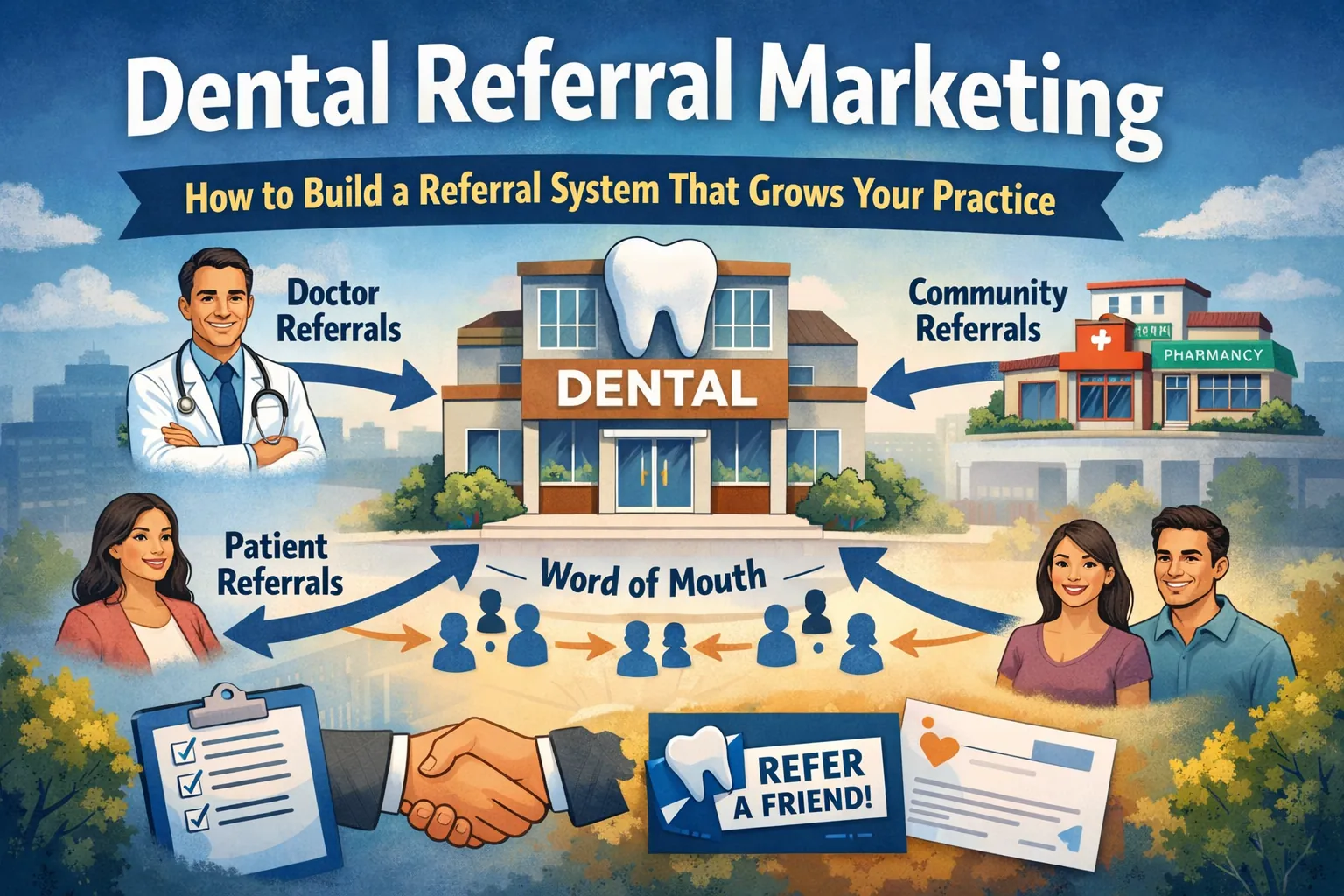 This dental referral marketing guide shows practices how to build a referral system that turns satisfied patients, professional relationships, and community partnerships into consistent new patient growth. This dental referral marketing guide shows practices how to build a referral system that turns satisfied patients, professional relationships, and community partnerships into consistent new patient growth.
Referral marketing remains one of the highest-converting, lowest-cost patient acquisition channels available to dental practices—yet most offices run their referral efforts on autopilot, relying on hope instead of a repeatable system. A structured approach changes that.
The distinction matters: referral marketing is not one thing. It includes patient-to-patient referrals (existing patients recommending you to friends and family), doctor-to-doctor referrals (general dentists and specialists exchanging patients based on clinical need), and community referrals (local businesses and healthcare providers sending people your way). Each channel requires different strategies, different materials, and different tracking—but all three share a common foundation: trust built through consistently excellent experiences.
This guide walks through how to set goals and baselines for your referral program, build systems for each referral channel, create materials that actually get used, train your team for natural referral conversations, track results without guesswork, and stay compliant with healthcare referral regulations—all without resorting to high-pressure tactics or ethically questionable incentives.
Written for: dental practice owners, office managers, and marketing coordinators who want to move beyond “we get some referrals” and build a referral engine that produces measurable, predictable growth.
TL;DR
If you only do seven things, do these:
| 1. |
Set a referral baseline - track how many new patients currently come from referrals each month and from which sources (patients, doctors, community) so you can measure improvement
|
| 2. |
Make it easy to refer - give patients a simple, low-friction way to share your practice (digital link, text-to-refer, or a referral card they can hand to someone)
|
| 3. |
Ask at the right moment - train your team to mention referrals after positive clinical outcomes, not during checkout pressure; the best window is when a patient says something positive about their experience
|
| 4. |
Build doctor-to-doctor relationships intentionally - schedule quarterly lunch-and-learns or office visits with referring providers; relationship depth drives referral volume more than marketing materials
|
| 5. |
Track every referral to its source - use your practice management system’s referral source field with specific categories (not just “referral”) so you know which channels and which patients are driving growth
|
| 6. |
Stay legally compliant - referral incentive rules vary by state and are stricter for healthcare than for other industries; check your state dental board regulations and insurance contract terms before launching any reward program
|
| 7. |
Close the loop with referring sources - send thank-you notes to patients who refer and treatment updates (with consent) to referring doctors; acknowledgment sustains the behavior |
Table of Contents
Why referral marketing outperforms other dental marketing channels
Referral marketing consistently delivers the highest-quality new patients at the lowest acquisition cost—and the data behind that claim is not close. Referred patients arrive with pre-established trust, which means they are more likely to accept treatment plans, less likely to shop on price alone, and more likely to stay with your practice long-term. Research published in the University of Pennsylvania’s Journal of Marketing found that the average lifetime value of a referred customer is at least 16% higher than that of a non-referred customer.
Cost comparison matters here. Digital marketing channels like paid search and social media advertising typically produce dental leads in the $65–$135 range per lead, with cost per acquired patient often landing between $150 and $300 for general dentistry. Direct mail and radio push even higher, frequently reaching $200–$400 per lead. Referral programs, by contrast, often produce new patients for under $50 each when accounting for the modest costs of materials, thank-you gestures, and staff time. For practices already delivering excellent patient experiences, referrals represent the highest-margin acquisition channel available.
Beyond cost, referral patients tend to exhibit a compounding effect. A patient who arrives through a trusted recommendation is more likely to refer others themselves, creating a growth cycle that accelerates over time. This compounding dynamic is what separates practices that grow steadily from those that plateau despite increasing their ad spend.
What referrals cannot do: replace your other marketing channels entirely. Referral programs build on an existing base of satisfied patients and professional relationships. If you are a new practice without an established patient base, or if your patient experience has gaps that need fixing first, referrals alone will not solve a growth problem. They work best as a multiplier layered on top of a solid digital presence, strong local SEO, and consistent patient care.
> Back to Table of Contents
How to build a patient referral program that actually works
Most dental practices receive some referrals organically—patients who had a great experience and naturally tell someone about it. A structured patient referral program does not replace that organic behavior; it amplifies it by removing friction, creating prompts, and making the act of referring feel easy and appreciated.
Set your referral baseline before changing anything
Before launching or revamping a referral program, establish where you stand. Pull three months of new patient data from your practice management system and categorize each new patient by source: patient referral, doctor referral, online search, advertising, insurance directory, walk-in, or unknown. Calculate your referral rate: new patients from referrals divided by total active patients. This number is your starting point.
A common benchmark is one referral per year from 40–60% of your active patient base. If your current rate falls well below that range, the gap likely reflects a systems problem (patients are not being asked or reminded) rather than a satisfaction problem.
Design a simple, repeatable process
Complexity kills referral programs. The most effective systems share three traits: they are easy to explain in one sentence, easy for patients to act on in under a minute, and easy for staff to execute without adding significant administrative burden.
A practical framework:
| • |
Physical referral cards - simple cards with your practice name, phone number, website, and a line reading “Referred by: ___” that patients can hand to friends and family; include a brief welcome message for the new patient
|
| • |
Digital referral link - a unique URL or QR code that patients can text or share on social media, directing the referred person to your online scheduling page with a referral tag attached for tracking
|
| • |
Text-to-refer - some patient communication platforms allow patients to send a referral link via text message directly from their phone after an appointment; this reduces friction to almost zero
|
| • |
In-office signage - tasteful signs in operatories and checkout areas reminding patients that you welcome new patients and appreciate referrals; keep the language warm and simple |
Choose appreciation gestures carefully
The goal is to acknowledge the referral, not to create a transactional relationship. A handwritten thank-you note from the dentist carries more relational weight than a gift card—and avoids the legal complications that monetary incentives can introduce in healthcare. Practices that want to offer something tangible should consider gestures that apply to all patients rather than only those who refer, such as patient appreciation events, complimentary oral care kits, or priority scheduling perks.
Important: referral incentive regulations vary significantly by state. Before offering any reward tied directly to a referral, review the compliance section of this guide and consult your state dental board’s guidelines.
When and how to ask for referrals
Timing is everything. The strongest referral window opens immediately after a positive clinical outcome—when a patient sees their new smile in the mirror, when they remark on how comfortable a procedure was, or when they express genuine gratitude. That is the moment your team can say something natural like: “We love hearing that. If you know anyone who’s been looking for a dentist, we’d be happy to take great care of them too.”
What does not work: pressuring patients during checkout, making every interaction feel like a sales pitch, or asking before you have delivered an experience worth recommending. The ask should feel like a natural extension of a positive moment, not a scripted obligation.
> Back to Table of Contents
Doctor-to-doctor referral strategies for dental practices
Professional referrals between dental providers operate on fundamentally different dynamics than patient referrals. For specialists—periodontists, oral surgeons, endodontists, orthodontists, and prosthodontists—referrals from general dentists are often the primary growth engine. For general dentists, building reciprocal relationships with specialists and medical providers like pediatricians, ENTs, and sleep medicine physicians opens additional patient pathways.
Build relationships before you need referrals
The practices that receive the most professional referrals are the ones that invest in relationships before they need anything. A pattern we commonly see: a specialist expects referrals simply because they exist in the same geographic area as general dentists, without having invested in the relationship. That approach produces unpredictable, thin referral volume.
Effective relationship-building strategies:
| • |
Lunch-and-learn sessions - host educational sessions at referring offices on topics relevant to their patient base; this positions you as a resource, not just a referral destination
|
| • |
Office visits and introductions - visit referring offices in person to introduce yourself and your team; put a face to the name so the referring staff feels comfortable sending patients your way
|
| • |
Study clubs and CE events - participate in or organize local study clubs where dentists discuss cases collaboratively; these forums build clinical trust that translates directly into referral confidence
|
| • |
Consistent communication after referrals - send timely, thorough treatment summaries back to the referring doctor after completing care; this demonstrates respect for the ongoing patient relationship and builds confidence in future referrals |
Make the referral process effortless for the referring office
If sending a referral to your office is complicated, time-consuming, or unclear, the referring office will choose the easier option—even if your clinical work is superior. Friction in the referral process is one of the most common reasons specialists lose referral volume to competitors.
Reduce friction by providing referring offices with simple referral forms (digital and physical), direct phone numbers that bypass general hold queues, and clear instructions on what information you need to schedule the patient. Some practice management platforms now include built-in referral portals that allow referring offices to submit patient information securely and track referral status in real time. If your software supports this, promote it actively to your referral network.
Reciprocity and the referring doctor relationship
Professional referral relationships are strongest when they feel reciprocal. Specialists can support referring general dentists by sending patients back for restorative or preventive care after specialty treatment, by sharing relevant clinical insights and continuing education resources, and by treating the referring office’s patients with the same care and urgency they would want for their own.
What not to do: offer financial incentives for referrals. Doctor-to-doctor referral incentives are restricted under the federal Anti-Kickback Statute and many state dental practice acts. Instead, focus on being the provider that referring offices want to send patients to because of clinical quality, communication, and ease of working together.
> Back to Table of Contents
How to create referral marketing materials that get used
The best referral materials share a common trait: they are designed for the person doing the referring, not just the practice doing the promoting. A brochure that sits in a drawer or a referral pad that collects dust achieves nothing. Materials that are compact, clear, and easy to hand to someone in a natural conversation actually get used.
Patient-facing referral materials
Keep patient-facing materials simple and action-oriented:
| • |
Referral cards - business-card size, with your practice name, phone, website, and a “Referred by” line; avoid cluttering with service lists or lengthy descriptions
|
| • |
Digital assets - a shareable link or QR code that directs to a referral-specific landing page on your website; this page should welcome the referred patient and make scheduling easy
|
| • |
Social media share templates - pre-written posts or graphics that patients can share on their own social channels if they choose to; make these feel authentic, not corporate
|
| • |
Email and text templates - short, friendly messages patients can forward to someone they think would benefit from your practice; include a direct scheduling link |
Professional referral materials
Materials for referring doctors and their staff serve a different purpose. They need to communicate clinical capability, ease of referral process, and practice contact information:
| • |
Referral pads - customized pads that include your practice information, accepted insurance plans, and fields for the referring doctor to note the reason for referral and any special instructions
|
| • |
Practice capability one-sheets - a single-page summary of your clinical services, technology, insurance participation, and what makes your practice a strong referral destination; keep this updated annually
|
| • |
Welcome packets for new referring offices - a folder or digital package that includes your one-sheet, referral forms, direct contact numbers, and a personal introduction letter from the dentist; hand-deliver these whenever possible |
The “cupcake duty” principle
A widely-used tactic among practices with strong referral networks: periodically hand-deliver something small (a box of cupcakes, coffee, or seasonal treats) to referring offices along with updated referral materials. This creates a touchpoint that keeps your brand top-of-mind without feeling like a sales call. The key is consistency—doing this quarterly is more effective than a single grand gesture once a year.
> Back to Table of Contents
Tracking and measuring dental referral program ROI
If you cannot tell which referral sources are producing results and which are not, you cannot improve your program. Most practices struggle with referral tracking not because the tools are unavailable, but because the process is inconsistent. Front desk teams ask “How did you hear about us?” and record vague answers like “online” or “referral” without specifics. That data is functionally useless.
Set up your referral source tracking correctly
The foundation is your practice management system’s referral source field. Customize this field with specific, granular categories rather than broad labels:
| • |
Patient referral (specific patient name) - recording who referred allows you to identify your top referral sources and thank them appropriately
|
| • |
Doctor referral (specific provider name) - tracking by individual referring doctor reveals which professional relationships are producing and which need more investment
|
| • |
Community referral (specific business or organization) - if you have partnerships with local businesses, gyms, or schools, track each one separately
|
| • |
Google search, Google Maps, Facebook ad, Instagram, direct mail - keep non-referral sources granular too, so your referral data is not diluted by vague categorization |
Train your front desk team to ask specific follow-up questions: “That’s great that someone referred you—would you mind sharing who so we can thank them?” This simple question transforms a vague “referral” entry into actionable data.
Key referral metrics to track monthly
| • |
Total referral volume - how many new patients came from all referral sources combined
|
| • |
Referral rate - referral new patients ÷ total active patients; tracks how effectively your base is generating growth
|
| • |
Referral conversion rate - referred inquiries ÷ referred patients who actually scheduled and kept an appointment
|
| • |
Revenue per referred patient - average first-year production from referred patients compared to patients from other sources
|
| • |
Top referral sources - which individual patients, doctors, or community partners are sending the most new patients
|
| • |
Referral program cost - total spend on referral materials, thank-you gestures, events, and staff time dedicated to the program |
These referral-specific metrics should feed into your broader dental marketing KPI dashboard so you can compare referral performance against other channels at a glance.
Calculate referral marketing ROI
The ROI formula for referral marketing is straightforward: (revenue generated from referred patients – referral program costs) ÷ referral program costs. But to get the full picture, factor in patient lifetime value rather than just first-visit production. When you track dental marketing ROI by channel and source, you can compare referral program performance against your other acquisition channels. If your average patient stays for 7–10 years and generates $4,000–$10,000 in lifetime revenue, a referral program that costs $500 per month and produces even five new patients is delivering substantial long-term returns.
A referral multiplier also matters: referred patients tend to refer others at higher rates than patients acquired through advertising. Tracking this secondary referral effect—patients who were themselves referred and then referred someone new—gives you a more complete picture of the program’s true impact.
> Back to Table of Contents
Legal and ethical compliance for dental referral incentives
Dental practices operate under stricter referral incentive regulations than most other businesses. What works perfectly for a restaurant or retail store—giving a gift card in exchange for bringing a friend—can create ethical and legal exposure for a dental practice. Understanding these boundaries is essential before launching any incentive-based referral program.
Federal regulations that apply
Two federal statutes are most relevant to dental referral programs:
| • |
Anti-Kickback Statute (AKS) - prohibits offering, paying, soliciting, or receiving anything of value to induce referrals of patients covered by federal healthcare programs like Medicaid and Medicare; violations can result in fines, criminal penalties, and exclusion from federal programs
|
| • |
Stark Law - restricts physician self-referrals involving Medicare patients; while most dental services fall outside Medicare coverage, state-level equivalents (sometimes called “mini-Stark Laws”) may apply more broadly to dental practices depending on jurisdiction |
For practices that accept Medicaid patients—particularly pediatric dental practices—these federal rules carry real weight. Any incentive tied to a referral of a Medicaid-covered patient introduces compliance risk.
State dental board regulations
Many state dental practice acts include their own restrictions on fee-splitting, rebates, and referral incentives. The ADA’s ethical rule 4.E, adopted by many state dental associations, prohibits dentists from accepting or tendering rebates or splitting fees—and this prohibition extends to any referral source, including patients. Some state boards have interpreted gift cards, discounts, and even raffle entries given in exchange for referrals as potential violations of fee-splitting rules.
What this means in practice: before offering any monetary or tangible reward directly tied to a patient referral, consult your state dental board’s regulations and review your insurance participation contracts, which may include their own restrictions on fee adjustments and incentives. Additionally, any referral program that involves sharing patient information must comply with HIPAA requirements for dental marketing.
Compliant alternatives that still work
Practices can acknowledge and encourage referrals without crossing legal lines:
| • |
Handwritten thank-you notes - a personal note from the dentist is one of the most effective referral acknowledgments and carries zero compliance risk
|
| • |
Patient appreciation events - hosting events for all patients (not only those who refer) creates goodwill and naturally prompts referral behavior without tying a reward to a specific action
|
| • |
Small, non-cash gifts for all patients - oral care kits, branded items, or seasonal gifts given to your patient base broadly are generally not considered referral incentives
|
| • |
Charitable donations in patients’ names - in states where direct rewards are restricted, donating to a local charity on behalf of referring patients offers a compliant alternative
|
| • |
Outstanding patient experience - the most sustainable “incentive” is consistently excellent care that patients want to talk about; no regulation restricts this |
> Back to Table of Contents
How to train your dental team for referral conversations
A referral program only works if the team executes it. The most common failure mode is not a bad program design—it is a well-designed program that the team forgets to mention, feels awkward about, or deprioritizes under daily operational pressure.
Define each team member’s role
Not everyone needs to deliver the same message or carry the same responsibility. Assigning specific roles reduces the “everyone’s job is no one’s job” problem:
| • |
Dentist - mention referrals naturally after positive clinical outcomes; “Your results look great—if you know anyone who’s been looking for a dentist, we’d love to help them too”
|
| • |
Hygienist - during the rapport-building portion of the appointment, mention that you welcome new patients; hygienists often have the strongest ongoing relationship with patients
|
| • |
Front desk - ensure every new patient’s referral source is recorded accurately; hand referral cards to patients at checkout; send thank-you notes to referring patients within 48 hours
|
| • |
Office manager - track referral metrics monthly, review program performance in team meetings, and keep materials stocked and current |
Practice the language until it feels natural
Referral conversations fail when they sound scripted. Instead of memorizing lines, give your team the intent behind the ask and let them put it in their own words. The intent is simple: if a patient has had a positive experience, let them know you are accepting new patients and would appreciate being recommended. Role-playing these conversations during team meetings—even briefly—removes the awkwardness and builds confidence.
What to avoid: tying team compensation directly to referral counts. This creates pressure that patients can feel, and it shifts the motivation from genuine care to transactional behavior. Instead, celebrate referral wins as a team and recognize staff members who consistently execute the program well.
Keep the program visible internally
Programs fade when they are not discussed regularly. Include referral metrics in your morning huddle or weekly team meeting: how many referrals came in this week, who they came from, and any thank-you notes that need to go out. This keeps referrals on the team’s radar without adding significant meeting time. Some practices post a simple referral tracker in the break room—not as a competition, but as a shared awareness tool that keeps momentum going.
> Back to Table of Contents
Start building your dental referral system
A referral marketing system is only as strong as the patient experience behind it and the tracking infrastructure supporting it. If your practice is ready to move beyond informal word-of-mouth and build a structured, measurable referral program—or if you need help integrating referral marketing into a broader dental marketing strategy—WEO Media can help. Contact us at 888-246-6906 to discuss how referral marketing fits into your overall dental marketing plan.
> Back to Table of Contents
FAQs
What is the average cost per new patient from referral marketing?
Referral marketing typically produces new patients at a significantly lower cost than paid advertising channels. Many practices report referral acquisition costs under $50 per patient when accounting for materials, thank-you gestures, and staff time. By comparison, digital advertising channels like Google Ads and social media typically cost $150–$300 per acquired patient for general dentistry. The exact cost depends on your program structure, the volume of referrals you generate, and how you choose to acknowledge referring patients.
Can I offer gift cards to patients who refer new patients to my dental practice?
It depends on your state. Many state dental boards and dental practice acts restrict or prohibit fee-splitting and rebates tied to referrals, and gift cards can be interpreted as a form of rebate. Federal regulations like the Anti-Kickback Statute also apply if you treat patients covered by Medicaid or Medicare. Before offering any monetary incentive for referrals, review your state dental board’s guidelines, check your insurance participation contracts, and consider consulting a healthcare attorney. Non-monetary alternatives like handwritten thank-you notes and patient appreciation events are generally compliant everywhere.
How do I track which patients were referred and by whom?
Use your practice management system’s referral source field and customize it with specific categories rather than broad labels like “referral.” When a new patient schedules, train your front desk to ask who referred them by name. Recording the specific referring patient or provider allows you to identify top referral sources, send timely thank-you acknowledgments, and measure which relationships are driving the most growth.
What is a good referral rate for a dental practice?
A commonly cited benchmark is one referral per year from 40–60% of your active patient base. Practices with strong referral systems and high patient satisfaction often exceed this range. If your referral rate is significantly lower, the issue is usually a lack of systematic asking and follow-up rather than a patient satisfaction problem. Tracking your referral rate monthly helps you identify trends and measure the impact of program changes.
How do I get more referrals from other dentists as a specialist?
Invest in the relationship before expecting referrals. Host lunch-and-learn sessions at referring offices, attend local dental society meetings and study clubs, and make the referral process as friction-free as possible with simple forms and direct contact numbers. After treating a referred patient, send a timely, detailed treatment summary back to the referring doctor. Consistent communication and clinical quality build the trust that drives ongoing referral volume.
Should I create a formal referral program or just let referrals happen naturally?
Both matter, but a structured program amplifies what happens naturally. Most practices receive some organic referrals from satisfied patients without any formal effort. A structured program adds systems that prompt, simplify, and track referrals—turning inconsistent word-of-mouth into a measurable growth channel. The structure does not need to be complex; even basic steps like stocking referral cards, training staff to mention referrals at the right moment, and tracking sources monthly can significantly increase volume.
How long does it take for a dental referral program to show results?
Most practices begin seeing measurable increases within 60–90 days of launching a structured referral program, though it takes longer for professional referral relationships to mature. Patient referral programs tend to produce faster results because they leverage existing relationships. Doctor-to-doctor referral networks typically require 6–12 months of consistent relationship-building before producing reliable volume. Set realistic short-term goals and review progress monthly rather than expecting immediate transformation.
What is the lifetime value of a referred dental patient?
Industry data places the average dental patient lifetime value between $4,000 and $10,000, depending on services offered, patient retention rates, and visit frequency. Referred patients often exceed these averages because they arrive with higher trust, accept treatment recommendations more readily, and tend to stay with the practice longer. Additionally, referred patients are more likely to refer others themselves, creating a compounding value effect that makes each referral worth more than its direct revenue alone.
|
|