Learn how to create dental implant ad campaigns that convert. Get targeting strategies, video tips, and ROI optimization from WEO Media.
Key Takeaways
| • |
Budget Wisely: Dental implant Google Ads CPC averages $15–25 per click, with overall dental conversion rates around 4–10%; expect $150–400 per qualified consultation lead depending on location and optimization.
|
| • |
Prioritize Video Content: Video testimonials significantly boost trust and consultation bookings compared to text ads, with studies showing up to 150%+ conversion lifts in dental campaigns.
|
| • |
Implement Retargeting: Retargeting yields 70–150% higher conversion rates than cold traffic, critical for the typical implant patient decision journey, which can take months.
|
| • |
Optimize for Mobile: Mobile "dental implants near me" searches have surged in recent years (e.g., over 100% growth patterns since 2020), requiring fully mobile-first ad and landing page design.
|
| • |
Target the Right Demographics: Focus on ages 45–74 (peak implant demand), household incomes $75,000+ (due to high costs), within a 15–25 mile radius of your practice for best ROI. |
Dental implant marketing campaigns require a specialized approach, one that differs significantly from general dental advertising. Unlike routine cleanings or basic procedures, the basic 3-stage implant patient decision journey (awareness, consideration, decision) can take months. They compare providers and build confidence before scheduling a consultation.
Successful paid campaigns must account for this extended decision-making journey. They must also target qualified candidates who can afford procedures ranging from $3,000 to $6,000 per implant.
What Makes Dental Implant Advertising Different?
Dental implant campaigns demand a distinct approach due to high patient lifetime value, extended consideration periods, elevated CPCs, and intense emotional/financial objections. Patients often enter a multi-stage buyer's journey (awareness > research > consultations), spanning weeks to months as they compare costs, success rates, and risks. Implant decisions involve prolonged nurturing, in part, due to the procedure's months-long clinical timeline.
Understanding the Dental Implant Patient Journey and Why It Demands Specialized Campaigns
When patients consider dental implants, they’re not making an impulse decision. They're embarking on a transformative healthcare journey. This journey involves significant financial investment, emotional considerations, and extensive research.
This extended research period fundamentally changes how practices should approach paid advertising. Unlike patients searching for emergency dental care or routine cleanings, implant candidates move through distinct phases (awareness, consideration, and decision). Each phase requires different messaging, creative assets, and targeting strategies to effectively nurture prospects toward conversion.
Patient Journey Mapping
Patient Journey Mapping is the process of documenting every touchpoint a potential patient has with your practice. This covers everything from initial awareness through consultation booking and treatment completion. It's used to create targeted messaging for each stage of the decision process.
The financial stakes amplify these challenges. With average cost-per-click rates reaching $10–15 dollars in competitive markets for dental implant keywords, practices cannot afford waste. Budget spent on unqualified clicks or poorly optimized campaigns hurts your bottom line. Every dollar must strategically move prospects closer to booking consultations.
Why Generic Dental Marketing Fails for Implants
Most dental practices struggle because they apply the same advertising templates used for general dentistry, failing to address unique concerns implant candidates have. These include fears about pain, uncertainty about candidacy, questions about financing, and anxiety about choosing the right provider. Successful campaigns speak directly to these emotional barriers. They demonstrate expertise and showcase real patient transformations.
The competitive landscape further complicates matters. Corporate dental chains often dominate paid advertising with substantial budgets. This makes it essential for independent practices to compete through strategic targeting and compelling creative. You cannot simply outspend competitors… you must outsmart them.
Working with a specialized dental marketing agency
can help practices navigate these complexities while avoiding costly mistakes.
Building High-Converting Audience Targeting Strategies for Implant Candidates
Effective dental implant PPC campaigns begin with precise audience targeting. The most successful practices create detailed ideal patient profiles, and utilize platform targeting capabilities to reach prospects most likely to convert.
"The U.S. dental implants market size was estimated at USD 1.54 billion in 2024 and is projected to reach USD 3.22 billion by 2033, growing at a CAGR of 8.6% from 2025 to 2033." —Grand View Research
This market growth means more patients actively seek implant solutions. But it also means increased competition for their attention. Winning requires sophisticated targeting. You must identify and reach qualified candidates before competitors capture their interest.
Demographic and Behavioral Targeting Parameters
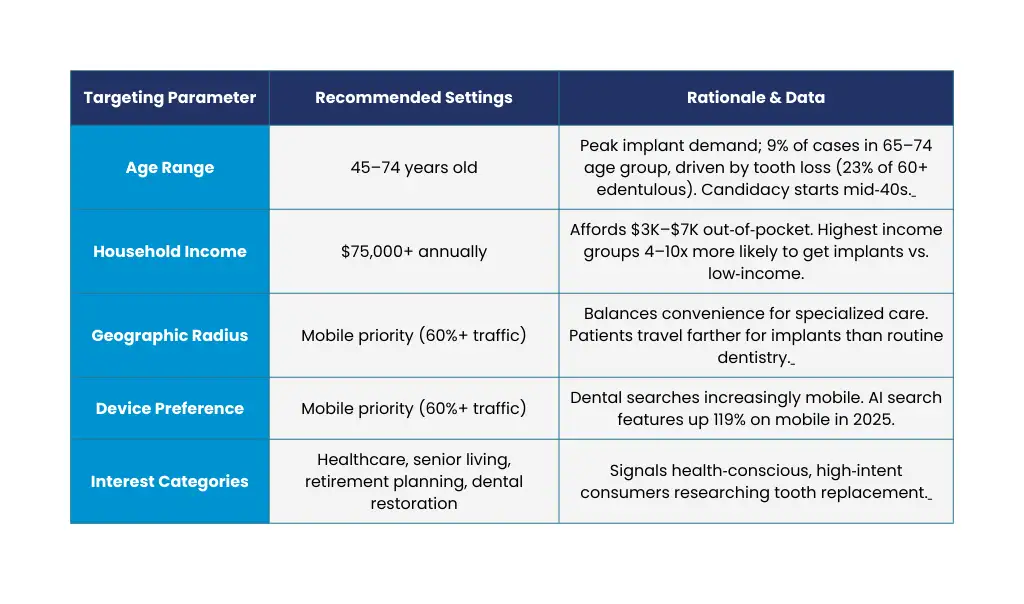
Start by defining your ideal implant patient based on actual conversion data from your practice. Most successful implant campaigns target:
Beyond basic demographics, behavioral targeting reveals prospects actively researching implant solutions. Google Ads allows targeting based on in-market audiences. These are people Google has identified as actively shopping for dental services. Facebook and Instagram enable targeting based on interests, behaviors, and life events that correlate with implant need.
Mobile dominates dental searches, with AI-enhanced mobile search features up 119% in 2025. “Dental implants near me” queries continue surging as patients prioritize local specialists.
This demands campaigns optimized for smartphone users. Ensure landing pages load quickly on mobile devices. Call-to-action buttons must be easily tappable. Phone numbers should be click-to-call enabled. Practices that fail to prioritize mobile experience lose significant potential patients to competitors.
Custom and Lookalike Audience Development
The most sophisticated implant campaigns leverage custom audiences built from existing patient data. Upload your current implant patient list (emails, phone numbers) to advertising platforms. They'll create lookalike audiences—new prospects who share characteristics with your best existing patients.
This approach dramatically improves targeting efficiency (2–3x ROAS reported). You're reaching people statistically similar to those who've already chosen your practice for implant treatment.
Segment by research stage for maximum relevance:
| • |
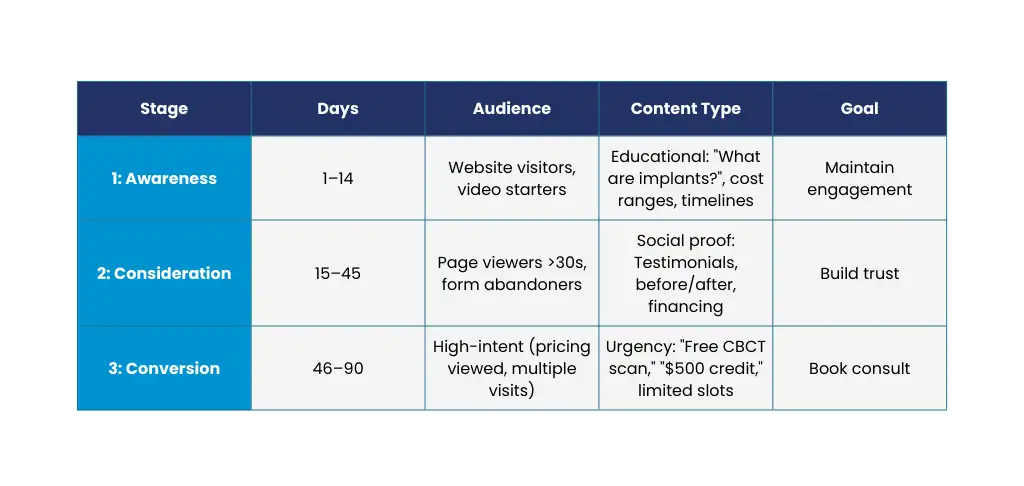
Awareness (new explorers): Educational content ("What are dental implants? Cost?").
|
| • |
Consideration (1–3 months research): Social proof, financing options.
|
| • |
Decision (ready to book): Free consults, CBCT scan offers. |
Combined with dental SEO for full-funnel coverage, PPC captures active searchers while SEO nurtures long-term researchers across the months-long patient journey.
Creating Compelling Ad Creative That Drives Consultations
With high cost-per-click rates and skeptical audiences, your ads must immediately capture attention. They must build credibility and compel action. Ad creative can truly make or break your dental implant campaigns.
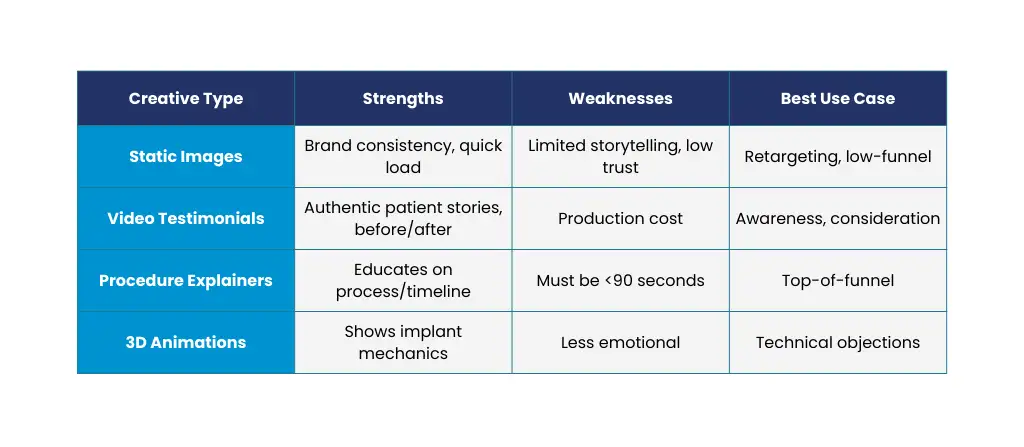
Video ads generate significantly higher engagement than static images across dental campaigns. Industry agencies consistently report video outperforming static by 2–5x in metrics like view time, shares, and click-through rates—especially for high-consideration procedures.
Video content represents the single most impactful creative upgrade most practices can make. Potential patients want to see real results. They want to hear from actual patients. They want to understand what the implant experience looks like. Static images simply cannot convey this information as effectively.
Top-performing video formats (verified by dental agencies):
| • |
Patient testimonials (45–60 seconds): "I can eat steak again" moments convert 3–5x better
|
| • |
Before/after transformations: Silent visual proof works universally
|
| • |
Doctor explainer: "What to expect Day 1, Month 3, Year 1"
|
| • |
Practice tours: Humanizes the surgical environment |
Static images work only for remarketing (prospects who already know you). For cold traffic, video builds the trust required for consultation booking in a category where 95%+ success rates must be proven, not promised.
Social Proof Creative
Social Proof Creative refers to advertising content that features testimonials, reviews, before/after photos, and patient success stories. It demonstrates credibility and reduces perceived risk for prospective patients considering high-investment treatments.
Ad Copy Frameworks for Each Funnel Stage
Your ad copy must align with where prospects are in their decision journey. Use these frameworks:
Awareness Stage Copy: Focus on education and problem recognition. Headlines like "Missing Teeth Affecting Your Confidence?" attract prospects just beginning their research. "Why Dental Implants Feel Like Natural Teeth" works well here too.
Consideration Stage Copy: Emphasize differentiation and address common objections. "See Why 500+ Patients Chose [Practice Name] for Their Dental Implants" speaks to prospects comparing options. “Financing Options Make Implants More Affordable Than You Think” addresses cost concerns.
Decision Stage Copy: Create urgency and reduce friction. "Schedule Your Free Implant Consultation This Week" motivates action. "Limited Appointments Available with Dr. [Name]" creates scarcity.
Optimizing Landing Pages for Maximum Conversion Rates
Even perfectly targeted ads fail without dedicated implant landing pages. Industry data shows dedicated landing pages convert 2.35x better than homepages for specific dental services—yet most practices send high-value implant traffic ($10–15 CPC) to generic "Services" pages.
This is a critical mistake that wastes advertising budget and loses qualified leads.
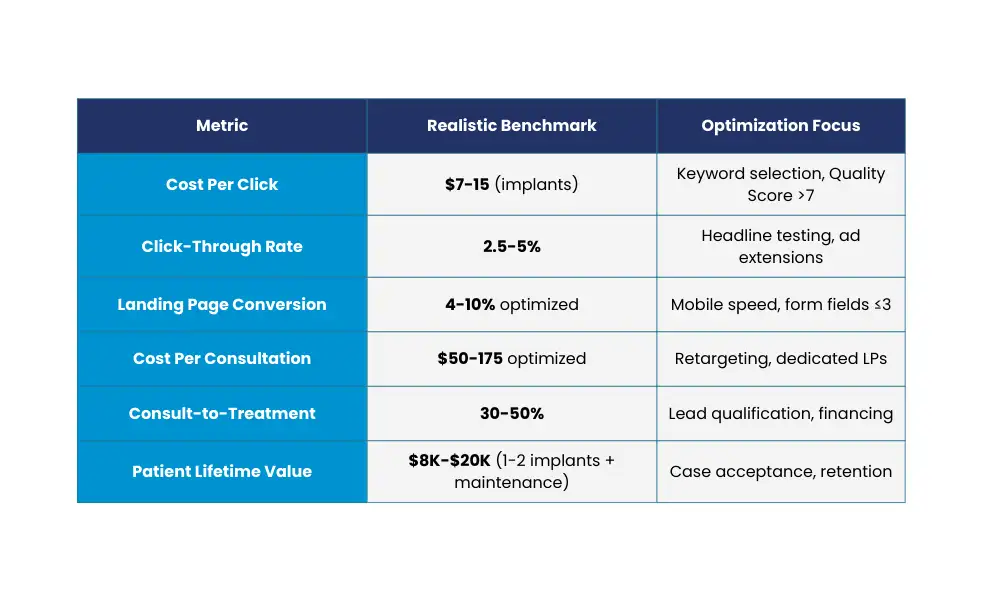
Current dental PPC benchmarks (2025):
| • |
Average CPC: $7–15 for implant keywords (not $28)
|
| • |
Conversion rates: 2–10% across dental ads; 4–6% typical for optimized implant campaigns
|
| • |
Cost per lead: $50–150 when landing pages match ad messaging |
At these figures, linking to generic homepages wastes most of your qualified traffic. Visitors click "dental implants near me" expecting implant specifics, not a homepage navigation hunt.
Essential Landing Page Elements
Headline Alignment: Your landing page headline must directly match your ad message. If your ad promotes "Free Implant Consultations," your landing page headline should reinforce that offer immediately. Message mismatch creates confusion and increases bounce rates.
Social Proof Above the Fold: Display patient testimonials, review ratings, and credentials before visitors scroll. This immediately establishes credibility. It reduces skepticism about whether your practice can deliver results.
Clear Value Proposition: Explain what makes your practice different within the first few seconds. Do you offer sedation options? Financing plans? Same-day consultations? Advanced technology? Communicate your unique advantages prominently.
Single Conversion Goal: Resist the temptation to offer multiple options. Your landing page should have one clear call-to-action—typically scheduling a consultation. Remove navigation menus, footer links, and other distractions.
Mobile Optimization: Your landing pages must deliver flawless mobile experiences. Test every element on multiple devices. Ensure forms are easy to complete. Buttons must be easily tappable. Page load times should remain under three seconds.
Professional dental website design ensures your landing pages meet these standards while maintaining brand consistency.
Form Design and Lead Capture Best Practices
Your consultation request form represents the final conversion point. Make it as frictionless as possible while capturing necessary information. Best practices include:
Limit fields to essentials: Name, phone number, email, and preferred contact time typically suffice
Use smart form features: Auto-fill capabilities, dropdown menus instead of text fields, and clear error messages reduce abandonment
Add trust signals near forms: Display HIPAA compliance badges, privacy assurances, and security indicators
Offer multiple contact options: Some prospects prefer calling directly, others prefer form submission, many prefer text messaging
Implementing Strategic Retargeting for the Extended Patient Journey
Single-touch advertising fails for implant patients who research extensively before deciding. Retargeting campaigns re-engage website visitors, pixel-tracked prospects, and form abandoners, keeping your practice top-of-mind through their weeks-to-months decision process.
Retargeting delivers 70–150% higher conversion rates than cold traffic across dental campaigns. Prospects who've visited your implant page or watched 50%+ of a video already show intent. Retargeting provides the final trust signals needed to book.
Building Effective Retargeting Sequences
Industry-leading dental agencies use proven three-stage funnels to guide implant prospects from awareness to booking, matching messaging to their research timeline:
Frequency Capping
Frequency Capping is the practice of limiting the number of times individual prospects see your retargeting ads within specified time periods. It prevents ad fatigue and negative brand perception from overexposure to the same messaging.
Set frequency caps to prevent retargeting fatigue. Seeing the same ad repeatedly creates annoyance rather than conversion motivation. Most platforms recommend limiting exposure to 3-5 impressions per week per prospect.
Cross-Platform Retargeting Strategies
Prospects research across multiple platforms. They might discover your practice through Google search. They continue research on Facebook. They ultimately convert through a display ad. Cross-platform retargeting ensures consistent messaging regardless of where prospects encounter your brand.
Implement tracking pixels for:
| • |
Google Ads remarketing
|
| • |
Facebook/Instagram custom audiences
|
| • |
Display network retargeting
|
| • |
YouTube video remarketing |
This multi-platform presence reinforces your practice’s credibility. It maintains awareness throughout the extended decision journey. Prospects who encounter your messaging across multiple channels perceive your practice as established and trustworthy.
Comprehensive dental PPC management
services can help practices implement and optimize these complex retargeting strategies effectively.
Measuring ROI and Optimizing Campaign Performance
Dental implant campaigns require sophisticated tracking and attribution. You must accurately measure return on investment. The extended patient journey and high-value conversions demand more nuanced measurement than simple cost-per-lead calculations.
Key Performance Indicators for Implant Campaigns
Track these metrics to evaluate campaign effectiveness:
The ultimate measure of campaign success isn't cost-per-click or even cost-per-consultation. It’s a return on advertising investment based on actual treatment revenue.
True ROI Calculation
Campaign success = Treatment Revenue ÷ Ad Spend (not cost-per-lead):
Example: $25K ad spend > 150 consults ($167 CPL) > 60 treatments (40% conversion)
> 60 implants × $5K avg = $300K revenue > 12x ROAS
Continuous Optimization Strategies
Successful implant advertising requires ongoing testing and refinement. Implement systematic A/B testing across:
Ad Creative: Test video versus static images, different patient testimonials, various headline approaches, and alternative value propositions.
Audience Targeting: Compare performance across demographic segments, interest-based audiences, and lookalike audience variations.
Landing Pages: Test headline variations, form lengths, social proof placements, and call-to-action button designs.
Bidding Strategies: Experiment with manual versus automated bidding, different campaign objectives, and dayparting schedules.
Document test results and apply learnings systematically. Small conversion rate improvements compound significantly given high implant case values. A 1% landing page conversion improvement could represent thousands of dollars in additional annual revenue. This is why long-term optimization pays dividends.
Frequently Asked Questions About Dental Implant Marketing Campaigns
How much do dental implant ads cost?
Dental implant keywords typically cost $10-25 per click in competitive U.S. markets, while overall dental advertising averages around $7-15 per click. Costs vary by location—smaller markets range from $6-12, mid-sized cities fall between $10-18, and major metros like NYC or LA can reach $15-25 or higher.
The real focus should be cost-per-consultation rather than raw cost-per-click. A single implant consultation generates $3,000-7,000 in potential revenue, so optimizing for quality leads matters far more than minimizing clicks. Industry benchmarks show $50-175 per qualified consultation for well-optimized campaigns, with $150-400 being common before full-funnel refinement. What is the best way to advertise dental implants?
The most effective approach combines Google Ads for high-intent searchers with Facebook/Instagram for awareness and retargeting. Google captures patients actively typing "dental implants near me" (immediate leads), while Meta builds top-of-funnel trust through video content and nurtures them across their extended research journey.
Video testimonials showing real patient transformations significantly outperform static images. Agencies consistently report 2–5x higher engagement and 3–5x better conversions with authentic patient stories vs. generic imagery. Prospects demand proof before investing $3K–$7K per tooth—videos deliver emotional trust static ads cannot. How long does it take to get dental implant leads?
Initial leads typically appear within the first week of launching campaigns. But optimizing for quality leads takes 2-3 months of data collection and refinement. The months-longs patient research journey means some leads won't convert for several months. Practices should evaluate campaign success on 90-day windows rather than weekly performance. Why are dental implant ads so expensive?
Dental implant keywords command premium pricing because they represent high-value patients. These patients make significant purchasing decisions. Competition from corporate dental chains, dental implant specialists, and general practices drives costs higher. The $3,000-7,000+ case values justify these advertising costs when campaigns are properly optimized. How do I target dental implant patients effectively?
Effective targeting combines proven demographic parameters with sophisticated behavioral signals. Focus on ages 45-74 (peak implant demand due to tooth loss patterns), household income $75,000+ (ability to afford $3K-7K out-of-pocket), and 15-25 mile geographic radius from your practice for specialized care travel distance.
Google's "in-market for dental services" audiences deliver users actively researching dentists and procedures—20-50% higher conversion rates than broad targeting. These prospects show purchase intent through recent searches and site behavior.
Pro tip: Layer mobile-first targeting since dental searches skew 60%+ mobile, and test retargeting for site visitors showing pricing/process page interest. This multi-signal approach minimizes waste while maximizing qualified implant consultations. What should a dental implant landing page include?
High-converting implant landing pages include a headline matching ad messaging. Add patient testimonials and before/after photos above the fold. Include a clear explanation of your consultation process. Display trust signals like credentials and reviews. Use a simple consultation request form. Ensure mobile-optimized design throughout. Remove navigation menus and other distractions. How do I track ROI on dental implant advertising?
Implement comprehensive conversion tracking across the full patient journey using platform pixels, call tracking, and practice management software integration. The goal is measuring true treatment revenue ROI, not just clicks or leads, given implants generate $3K-7K per tooth over 3-9 month clinical timelines.
Account for the extended timeline: Patients click Day 1, research 30-90 days, book consult Day 120, complete treatment 6-9 months later. Use 90-180 day evaluation windows rather than weekly snapshots. What if leads increase but consults don’t—where is the funnel breaking?
When dental implant leads rise but consultations don't follow, the breakdown typically occurs at lead follow-up (80% of cases) or landing page experience (15% of cases). Here's where to diagnose and fix: | 1. |
Lead Response Breakdown (Most Common - 80% of Issues)
| • |
Callback speed: Industry standard is <5 minutes. After 5 minutes, show-up rates drop 391% per ClientConnectionGroup benchmarks. Check CallRail logs.
|
| • |
Contact rate: Minimum 20-25% of leads reached. Below this, staff must call/text more aggressively.
|
| • |
Recording review: Listen to calls. Top issues: Staff talking > listening, no personalized follow-up, generic scripts instead of addressing implant fears (cost, pain, timeline). |
|
| 2. |
Landing Page Friction (15% of Issues)
| • |
Form overload: >3 fields drops conversion 62%. Use name + phone only.
|
| • |
No cost transparency: 60-70% of implant searchers want pricing first. Show "$3K-7K range, financing available."
|
| • |
Mobile speed: >3 seconds load = 53% bounce rate. |
|
| 3. |
Offer Mismatch (5% of Issues)
| • |
Patients want "Free CBCT scan" over generic "consultation." Specific value converts 3x better.’
|
| • |
Missing urgency: "Limited slots this month" or "$500 credit if booked by Friday." |
|
What messaging reassures patients who fear being judged about finances or oral health?
Normalize their concerns upfront with empathetic, transparent language that prioritizes understanding over judgment. Use these proven messaging frameworks:
For financial anxiety: | • |
"We understand implants are a significant investment. That's why we offer flexible financing with 0% markup and payments as low as $X/month."
|
| • |
"No upfront cost surprises. Get your custom treatment plan and financing options at no charge during consultation."
|
| • |
"We've helped hundreds of patients just like you afford the smile they deserve—let's find what works for your budget." |
For oral health embarrassment (common with missing teeth): | • |
"Missing teeth? You're not alone—23% of adults over 60 have lost 6+ teeth. We specialize in discreet restoration."
|
| • |
"No judgment here. Our patients come to us embarrassed about gaps, dentures, or decay. We focus on solutions, not history."
|
| • |
"Your smile transformation starts with a confidential consultation. We've seen it all and helped everyone." |
Patients fear judgment + rejection. Counter with empathy + solutions + proof (video testimonials). |
Conclusion: Transform Your Implant Practice Growth with Strategic Paid Campaigns
Dental implant marketing offers massive opportunity but demands precision. The global market will exceed $11B by 2033 as aging populations drive demand. Patients research extensively online before investing in procedures that cost $3K-7K per tooth. Practices that master Google Ads + Facebook retargeting techniques will capture a larger market share of patient acquisition, it’s as simple as that.
Ready to dominate implant marketing in your area? Schedule your free PPC consultation with one of your senior marketing consultants! We can analyze your current performance, identify revenue leaks, and deliver a custom implant patient acquisition roadmap. Don’t lose high-value cases to under-optimized competitors. Schedule your consultation today! |