Running a Legal Dental Social Media Contest
Posted on 7/2/2026 by WEO Media |
How to Give Away Prizes and Stay Compliant
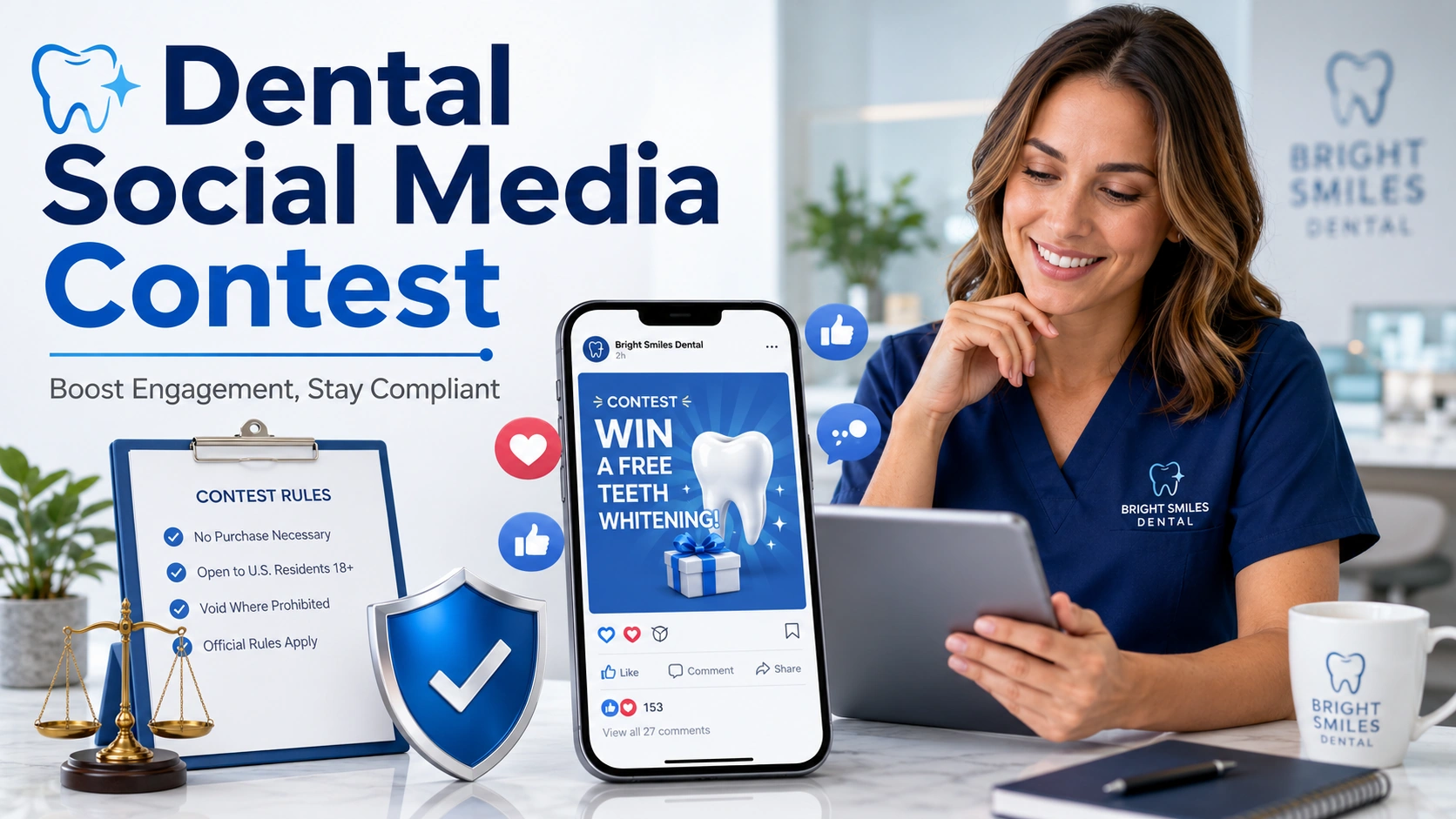 To run a legal dental social media contest, a dental practice can give away prizes through a free-to-enter sweepstakes or a skill-based contest and stay compliant—as long as the promotion avoids being an illegal lottery, which happens only when prize, chance, and consideration are all present. To run a legal dental social media contest, a dental practice can give away prizes through a free-to-enter sweepstakes or a skill-based contest and stay compliant—as long as the promotion avoids being an illegal lottery, which happens only when prize, chance, and consideration are all present.
But avoiding the lottery trap is only the first layer. A giveaway on Facebook, Instagram, or TikTok also has to satisfy each platform’s promotion rules, the Federal Trade Commission’s disclosure requirements, HIPAA when patient photos or stories are involved, and—the part general marketing advice almost always skips—the federal and state healthcare laws that limit what you can offer patients.
Contests are one of the most effective ways to earn reach, engagement, and user-generated content for your practice’s social media marketing, which is exactly why agencies love to recommend them. But the “tag three friends and share to win” mechanic that works for a restaurant can create real exposure for a dental office, because dentistry sits inside a stack of regulations that most social playbooks were never written for. The upside: once you understand the layers, compliant contests are simple to run, and they tend to perform better because they attract patients and neighbors rather than one-time prize hunters.
This guide walks through each layer in order—contest law, consideration, platform rules, FTC disclosure, the review-for-entry trap, HIPAA, healthcare inducement law, and state registration—then gives you official-rules essentials and a set of contest ideas that are easy to keep clean.
Written for: dental practice owners, office managers, and in-house marketing coordinators who want the engagement of a giveaway without the legal headaches.
TL;DR
If you only remember seven things, remember these:
| 1. |
Remove one element - prize plus chance plus consideration equals an illegal lottery, so offer a free way to enter and your promotion is a sweepstakes instead
|
| 2. |
Follow the platform rules - Meta prohibits requiring people to share to their timeline or tag friends; asking for likes, comments, and follows is allowed
|
| 3. |
Disclose the entry - the FTC treats a contest entry as a material connection, so require a hashtag that names your practice plus the word “contest” or “sweepstakes”
|
| 4. |
Never trade entries for reviews - incentivized reviews violate Google and Yelp policies and the FTC’s consumer-reviews rule
|
| 5. |
Protect patient privacy - get written HIPAA authorization before any patient photo, video, or story goes public
|
| 6. |
Mind healthcare inducement law - prizes offered to patients can trigger federal and state anti-kickback rules, so keep the value per chance nominal or open the contest to the general public
|
| 7. |
Write official rules and check state registration - Florida and New York require registration and bonding once prize value crosses a threshold |
Table of Contents
Sweepstakes, contest, or lottery? Start here
The whole legal framework rests on three words: prize, chance, and consideration. When all three are present, you have a lottery—and private businesses cannot run lotteries in the United States. Remove any one of the three and you are back in legal territory, which gives you two clean structures to choose from.
| • |
Sweepstakes - you remove consideration by letting people enter for free (a “no purchase necessary” promotion) and pick the winner at random
|
| • |
Contest - you remove chance by judging entries on skill or merit, such as the best caption, the best kids’ drawing, or the most creative video |
Both are perfectly legal. The structure to avoid is a random drawing that also requires people to buy something, pay to enter, or do something of real value in order to have a chance to win. In our work with dental practices, the most common unintentional mistake is a random drawing that requires booking an appointment or purchasing a service to enter—that exact combination is what turns a friendly giveaway into an illegal lottery.
> Back to Table of Contents
What counts as consideration on social media
Consideration is anything of value an entrant has to give up to participate. That clearly includes money, but it can also include a substantial expenditure of time or effort that benefits your practice. The reassuring news for social campaigns is that ordinary engagement actions are generally treated as too minor to count.
Generally not consideration: liking a post, following your account, leaving a comment, or answering a simple question. Most attorneys treat these as everyday, low-effort actions that do not rise to the level of consideration under United States sweepstakes law.
Where it gets risky: requiring a purchase, requiring a paid download, demanding extensive content creation, or requiring an in-person visit to your office. That last one is the classic front-desk trap—“stop by to enter” or “enter at your next appointment” can be treated as consideration, and a required visit paired with a random draw and a prize is the recipe for a lottery. A few states also treat handing over marketing contact information as consideration when the practice will use it to promote services. The safe move every time is to offer a free way to enter that requires no purchase and no visit, and to give those entrants the same odds as everyone else.
> Back to Table of Contents
Platform rules: Facebook, Instagram, and TikTok
Every network layers its own promotion rules on top of the law, and breaking them can get a post removed, an account restricted, or a page deleted. Here is what actually matters on the platforms dental practices use most.
Facebook and Instagram (Meta)
Meta’s controlling policy is short and widely misread. Promotions may be run on Pages, Groups, and Events, but the policy states that “Personal Timelines and friend connections must not be used to administer promotions.” In plain terms, you cannot require people to share your post to their own timeline, share it to a friend’s timeline, or tag friends to enter. You can ask people to like, comment, follow, post on your Page, or send a message. Instagram adds one more rule that trips up smile campaigns: you cannot ask people to tag themselves in a photo they are not actually in. Every Meta promotion must also include a release stating the promotion is not sponsored, endorsed, administered by, or associated with Meta, and it should link to your official rules. For a deeper look at what performs organically on the platform, see our guide to Instagram marketing for dentists.
TikTok
TikTok continues to operate in the United States under its current joint-venture ownership structure, and for contest purposes you treat it like the others: publish official rules, keep entry free, and disclose the promotional nature of the posts. TikTok separately prohibits buying or faking engagement, so purchased followers, likes, or bot comments are off the table—which is also good practice, since fake engagement is a red flag under federal rules discussed below. If you are weighing paid promotion there, we cover TikTok ads for dentists separately.
Paid ads change the rules
The moment you boost a giveaway or run it through Ads Manager, stricter advertising standards apply—the same ones that govern Facebook and Instagram ads for dentists. You generally need a dedicated landing page with the full official rules accessible before anyone enters, clearer disclosures in the ad copy, and a genuinely free entry path. Requiring likes, shares, or tags as the only way to enter is commonly flagged as engagement bait and is one of the most frequent reasons giveaway ads get rejected.
> Back to Table of Contents
FTC disclosure: an entry is a material connection
The Federal Trade Commission treats a contest entry as a material connection. The logic is simple: the chance to win a prize is something of value, so when someone posts about your practice in order to enter, that post is an endorsement that has to be disclosed. The disclosure has to be clear, conspicuous, and understandable to an average viewer.
A bare “#sweepstakes” is not enough. The FTC wants the disclosure to identify your practice and the promotional nature together—so “#SmileGiveaway” on its own will not do, but combining your brand with the full word, as in “#BrightSmile_Contest” or “#BrightSmile_Sweepstakes,” works. Abbreviations like “#sweeps” are considered insufficient because many people will not understand them. Place the disclosure where it will be seen, such as the start of the caption, not buried in a wall of hashtags or hidden in a profile bio.
A post does not have to be flattering to count as an endorsement—simply posting about your practice qualifies. And the responsibility is yours as the sponsor: you have to instruct entrants how to disclose and then monitor that they actually do. The best-known cautionary tale is the FTC’s closing letter to Cole Haan, where an unbranded contest hashtag was deemed inadequate to signal that participants were posting for a chance to win. For the wider set of advertising claims that trip up practices, see our guide to FTC advertising rules for dentists.
> Back to Table of Contents
The review-for-entry trap
The single most tempting dental contest idea is also one of the most dangerous: “leave us a review to be entered to win.” It fails on two fronts at once.
First, Google and Yelp both prohibit incentivized reviews outright, a point we cover in our Google review policy for dental practices. Offering anything of value in exchange for reviews can get your listing penalized and your reviews removed, and Yelp is especially aggressive about it. Second, the FTC’s Rule on the Use of Consumer Reviews and Testimonials, in effect since October 2024, bars offering incentives that are conditioned—openly or by implication—on reviews expressing a particular sentiment. Because a review-to-win promotion almost always signals that you are hoping for positive reviews, it lands squarely in the danger zone. The FTC has moved from guidance to active enforcement, issuing warning letters and pursuing significant per-violation civil penalties.
We routinely steer practices away from review-for-entry promotions, because it is the fastest way to get a Google listing flagged and, since late 2024, to land on the FTC’s radar. If you want more authentic reviews, our reputation management approach shows how to ask for them the right way—without a prize attached—and keep those requests completely separate from your contest entry mechanic.
> Back to Table of Contents
HIPAA and patient smiles
The moment a contest involves a patient’s photo, video, before-and-after image, or story, HIPAA is in play. An identifiable patient image—or even the fact that a specific person is your patient—is protected health information, and a name is not required for a violation. Distinctive features, a recognizable background, or context that implies someone is a patient can all identify an individual.
Before that content goes public, you need a written, HIPAA-compliant marketing authorization. A verbal “sure, go ahead” and a general intake form do not satisfy the rule. A compliant authorization has to specifically name marketing and social media, list the platforms where the content may appear (a website release does not automatically cover Instagram or TikTok), state the purpose, and include an expiration date and the patient’s right to revoke. HIPAA also prohibits conditioning treatment on signing a marketing authorization, so keep it separate from clinical paperwork and genuinely voluntary.
Two practical rules for contests:
| • |
Get signed authorizations for every featured entrant - a “best smile” or transformation contest requires written authorization from each person whose image or story you will publish
|
| • |
Never disclose care in a public reply - do not respond to a contest comment, message, or review with any detail about someone’s treatment; federal regulators have penalized dental practices for revealing patient information in exactly that way |
That caution matters just as much when you respond to reviews and comments publicly—keep every reply free of patient specifics. The cleanest way to avoid these risks altogether is to choose contest formats that never touch protected health information in the first place, which is where the ideas section below comes in.
> Back to Table of Contents
The inducement problem: prizes, patients, and healthcare law
This is the layer that general “how to run a giveaway” guides never mention, and it is unique to healthcare. If your practice treats Medicare or Medicaid patients, a prize offered to patients can be treated as remuneration under the federal Beneficiary Inducements Civil Monetary Penalties Law and the Anti-Kickback Statute. The reasoning from the Office of Inspector General is that a giveaway could influence a patient’s choice to keep receiving services that a government program pays for. This is the question dental teams ask about least and the one worth worrying about most.
Two concepts keep most dental sweepstakes safely inside the lines.
Nominal value: gifts of nominal value that are not cash or cash equivalents—a retail value of up to fifteen dollars per item and seventy-five dollars in total per patient per year—are not treated as improper inducements.
Value per chance: for a sweepstakes, the OIG measures the value of each chance to win, not the total prize. A prize worth one hundred dollars shared among twenty entrants with equal odds is treated as roughly five dollars per chance, which stays within the nominal range. In other words, a modest prize spread across many entrants is generally low risk.
To keep a patient-facing giveaway clean, follow these rules:
| • |
Keep it equal - make the prize equally available to everyone in the group, and never give Medicare or Medicaid patients better odds or bigger prizes
|
| • |
Skip cash and open gift cards - these count as cash equivalents and fall outside the nominal-value protection, while a store-specific or purpose-restricted card is treated more favorably
|
| • |
Never tie entry to treatment or referrals - a referral-for-prize structure is the highest-risk design and fits no safe harbor
|
| • |
Be careful with prizes to referral sources - prizes for other dentists or physicians get no patient-inducement protection at all and carry the most risk |
The two simplest ways to reduce exposure are to keep the value per chance nominal, or to open the contest to the general public rather than limiting it to patients or conditioning it on becoming one—so it is not remuneration aimed at a patient’s choice of provider. Remember that several states apply anti-inducement rules to all patients, not just federal ones, so this matters even if you never bill Medicare or Medicaid. When a prize is substantial, run the structure past a healthcare attorney before you launch.
> Back to Table of Contents
State registration and bonding: Florida, New York, Rhode Island
A handful of states require you to register a sweepstakes, and sometimes post a bond, once the total prize value crosses a threshold. Three states catch practices off guard.
| • |
Florida - a total announced prize value over five thousand dollars requires registration with the Florida Department of Agriculture and Consumer Services plus a surety bond or trust equal to the total prize value, filed at least seven days before the promotion begins, with a winners list filed afterward; it applies to any promotion open to Florida residents even if your practice is elsewhere
|
| • |
New York - prizes over five thousand dollars open to New York residents require registration and bonding with the New York Department of State, generally at least thirty days before launch, with a winners list within ninety days after
|
| • |
Rhode Island - a much lower threshold of over five hundred dollars, but only for promotions run at a retail or physical location where entrants have to come in to enter, and with no bond required |
Here is the bind for a local practice: you generally cannot dodge these rules by excluding your own state’s residents, because that defeats the purpose of a local giveaway. So a Florida practice running a Florida-facing contest either keeps the total prize value under the threshold or completes the registration and bond. A common structuring move is to keep each contest’s total prize value modest, or to split a large prize pool into several smaller, shorter contests that each stay under the line. Rhode Island’s retail-location rule is also a good reminder to keep entry online and free rather than “enter in the office,” which helps with the consideration and inducement issues covered earlier.
> Back to Table of Contents
Your official rules: the document that protects you
Every compliant promotion needs a written set of official rules, linked from the post and, for paid ads, hosted on a landing page that people can reach before they enter. Good rules are what protect you when a non-winner claims the drawing was rigged or a regulator asks for documentation.
Include at minimum:
| • |
Eligibility - minimum age, residency, and an exclusion for staff and their immediate families
|
| • |
Entry period - start and end dates with the time zone stated
|
| • |
How to enter - every entry method, including the free option, spelled out clearly
|
| • |
Winner selection - how and when the winner is chosen and notified, and the odds or how they depend on the number of entries
|
| • |
Prize description - what the prize is and any conditions on it
|
| • |
Sponsor identity - your full legal practice name and address
|
| • |
Required language - “no purchase necessary,” “void where prohibited,” and the release stating the promotion is not associated with the platform
|
| • |
Data handling - what information you collect and how you will use it |
Keep your entry records and the winner’s information for a defined period after the promotion ends, since some states require it and it is your best protection in a dispute.
> Back to Table of Contents
Dental contest ideas that stay legal
The easiest contests to keep compliant are the ones that require no purchase, no in-office visit, no review, and no patient health information. A few formats work especially well for practices.
| • |
Caption or trivia contest - post a fun image or an oral-health question and draw the winner from correct answers, or judge the best caption; free to enter and no protected information involved
|
| • |
Kids’ art or “spooky smile” drawing contest - families submit drawings with a parent’s permission and a media release for any child’s name or image you will show; a natural fit for pediatric and family practices
|
| • |
Community give-back - partner with a local business for the prize and give away a family-friendly experience, which broadens reach and attracts neighbors instead of prize hunters
|
| • |
Follow-and-comment sweepstakes - enter by following and commenting, both allowed on Meta, with a free alternate entry and a random draw |
For prizes, favor modest, non-cash items that are easy to value: an electric toothbrush, a professional whitening session offered as a stated-value prize, a local experience, or a family gift basket. Avoid cash and general-purpose gift cards, which raise both inducement and tax complications, and avoid anything that requires becoming a patient to use. Because a giveaway is a form of advertising, it is also worth checking your state dental board advertising rules before you promote a prize. One more note on branded prizes: if you give away a name-brand item, do not put the trademark in your contest title without permission—list it in the official rules instead. The practices that get the most from contests treat them as a reach-and-goodwill play, not a lead-generation gimmick.
> Back to Table of Contents
Run your next contest with confidence
A well-run giveaway can build real visibility and goodwill for your practice—as long as it is structured correctly across all of these layers. WEO Media - Dental Marketing plans and manages compliant social campaigns for general, pediatric, and specialty practices, so your team can focus on patients while the promotion runs cleanly. To talk through a contest idea or a broader social media content strategy, call 888-246-6906 or reach out through our contact page.
> Back to Table of Contents
FAQs
Is a dental social media giveaway legal?
Yes, when it is structured correctly. A giveaway is legal as long as it is not an illegal lottery, which means removing prize, chance, or consideration—usually by offering a free way to enter. On top of that, a dental practice must follow each platform’s promotion rules, disclose entries under FTC guidance, protect patient privacy under HIPAA, and account for healthcare inducement laws if patients are eligible.
Can I require patients to leave a Google review to enter my contest?
No. Google and Yelp both prohibit incentivized reviews, and offering entries in exchange for reviews can get your listing penalized and reviews removed. The FTC’s consumer-reviews rule also bars incentives conditioned on reviews expressing a positive sentiment. Ask for reviews separately, without tying them to a prize.
Can I ask people to tag friends or share my post to enter on Facebook or Instagram?
No. Meta’s promotion policy prohibits requiring people to share a post to their timeline, share it to a friend’s timeline, or tag friends to enter. You can ask entrants to like, comment, follow your page, or send a message, and you can encourage sharing without making it a requirement.
Do I need to register my dental sweepstakes with the state?
It depends on prize value and where entrants live. Florida and New York require registration and bonding once the total prize value passes five thousand dollars, and Rhode Island requires registration above five hundred dollars for promotions run at a physical location. Many practices keep the total prize value modest to stay under these thresholds.
Can I post a patient’s before-and-after smile photo from a contest?
Only with written HIPAA authorization. An identifiable patient image is protected health information even without a name, so you need a signed authorization that specifically names marketing and social media, lists the platforms, and includes an expiration and the right to revoke. A general intake form or verbal consent is not enough.
What is the difference between a sweepstakes and a contest?
A sweepstakes picks the winner by chance and must be free to enter, so there is no consideration. A contest picks the winner by skill or merit, such as the best caption or drawing, which removes chance. Both are legal structures; a promotion becomes an illegal lottery only when prize, chance, and consideration are all present.
Can I give a prize to patients who have Medicare or Medicaid?
Be cautious. Prizes to federal program beneficiaries can be treated as improper inducements, but the Office of Inspector General measures the value of each chance to win rather than the whole prize, so a modest prize spread across many entrants is usually low risk. Keep prizes non-cash, make them equally available, avoid conditioning entry on treatment or referrals, and consider opening the contest to the general public. Confirm substantial prizes with a healthcare attorney.
What makes a good prize for a dental contest?
Choose modest, non-cash items that are easy to value, such as an electric toothbrush, a whitening session offered as a stated-value prize, a local experience, or a family gift basket. Avoid cash and general-purpose gift cards, which create inducement and tax complications, and avoid prizes that require becoming a patient to use. |
|