Instagram Marketing for Cosmetic Dentists
Posted on 6/24/2026 by WEO Media |
How to Turn Smile Transformations Into Booked Consultations
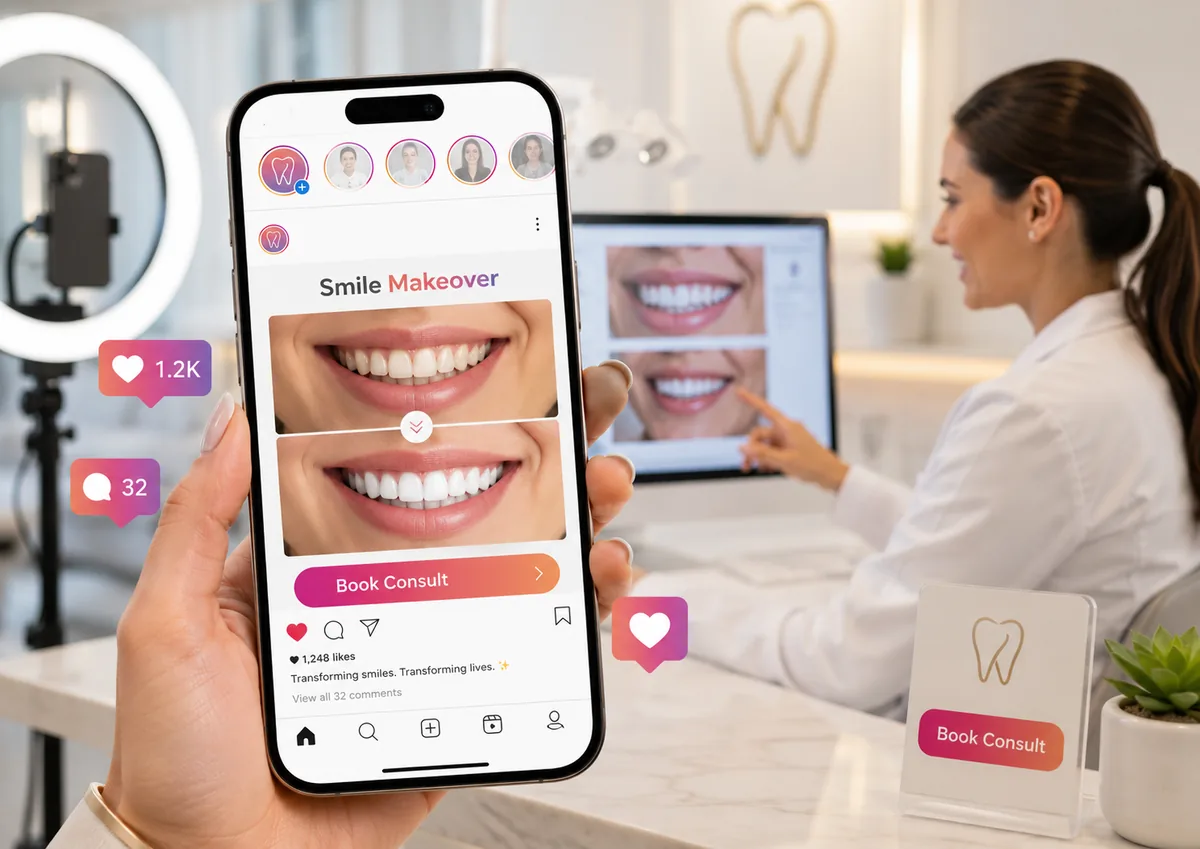 Instagram marketing for cosmetic dentists is how a practice turns smile transformations into booked consultations—attracting high-value veneer, smile-makeover, and clear-aligner patients with a Reels-first content plan built for how Instagram actually distributes content, a frictionless booking path, and HIPAA- and FTC-compliant consent and disclosure workflows. Instagram marketing for cosmetic dentists is how a practice turns smile transformations into booked consultations—attracting high-value veneer, smile-makeover, and clear-aligner patients with a Reels-first content plan built for how Instagram actually distributes content, a frictionless booking path, and HIPAA- and FTC-compliant consent and disclosure workflows.
The opportunity is real, and it is routinely wasted. Cosmetic dentistry is one of the most visual categories in all of healthcare, and the audience scrolling Instagram is the same demographic that pays for veneers, bonding, and clear aligners. Yet most cosmetic practices post inconsistently, lean on stock images and motivational quotes, and have no working path from a scroll to a scheduled consult. The result is a feed that looks busy but books almost nothing.
This guide is the strategy, not a list of post ideas. It covers what to post and why, how the current Instagram algorithm decides who sees it, how to keep before-and-after content legal under HIPAA and the FTC, and—most importantly—how to fix the broken path between a viewed Reel and a kept appointment. The goal throughout is the same: reach high-intent patients in your area and convert them, not collect vanity followers who will never sit in your chair.
Written for: cosmetic and aesthetic-focused dental practices, practice owners, office managers, and the marketing teams responsible for turning a smile-makeover Instagram into booked, high-value cases.
TL;DR
If you only change five things, change these:
| 1. |
Lead with consented before-and-after Reels - the single highest-performing format for cosmetic dentistry, shot with a consistent photography protocol and a signed marketing authorization on file before anything is posted
|
| 2. |
Put the dentist on camera - patients choose a clinician they trust, and an unpolished phone video of your dentist explaining a treatment outperforms a glossy branded graphic
|
| 3. |
Build for the 2026 algorithm - watch time, DM shares (sends), and saves drive reach, Reels carry discovery to non-followers, and keyword-rich captions now matter more than hashtag stuffing
|
| 4. |
Fix the path to booking - a single-purpose link, a direct-to-schedule booking option, and a same-day DM response turn interest into consults
|
| 5. |
Stay compliant - written HIPAA authorization for every patient image, clear-and-conspicuous FTC disclosures on testimonials and paid partnerships, and no review gating |
Table of Contents
Why Instagram is the highest-leverage channel for cosmetic dentistry
Cosmetic dentistry sells a visible outcome, which makes it almost uniquely suited to a visual platform. A veneer case, a composite-bonding refinement, or a clear-aligner finish produces a tangible, dramatic change that a single image or short video can communicate faster than any paragraph of copy. That is the structural advantage: your product photographs beautifully, and the people most likely to invest in it are already on the platform.
The catch is that the same advantage makes the category crowded and easy to do badly. A pattern we see constantly is the practice whose feed is technically active—stock smiles, quote graphics, the occasional flat before-and-after—but that generates almost no consultations. The problem is rarely effort. It is the absence of a strategy that connects content to intent, and intent to a booking.
It also helps to be honest about how patients actually behave. People do not open Instagram to find a dentist. They open it to be entertained, inspired, and reassured—and a genuine smile transformation does all three at once. Cosmetic treatment is an elective, emotional, high-consideration decision, often weighed for months and tangled up with worries about cost, comfort, and whether the result will look natural. Instagram earns its place by quietly resolving those worries over time, so that when a patient is finally ready, your practice is the one they already trust.
> Back to Table of Contents
Define the job: local high-value patients, not vanity followers
Before you post anything, decide what you want Instagram to do. Brand awareness, patient acquisition, and recruiting are three different jobs, and trying to serve all of them from one feed produces a muddle. For nearly every cosmetic practice, the right priority order is narrow: build an audience of potential patients in your catchment area, prove your clinical results, and convert that audience into booked consultations.
That priority has a sharp implication—follower count is close to a vanity metric for a local cosmetic practice. Ten thousand followers scattered across the country are worth less than a few hundred high-intent people who live within driving distance of your chair. This is why giveaways for free whitening and viral-bait tactics so often backfire: they inflate reach with an audience that will never book, and on today’s algorithm a flood of low-intent engagement that never converts can actually work against you.
The strategic move is to optimize for local discovery from the start. Add location tags to posts and Reels, weave your city and region into your captions and profile, and use geographically specific phrasing that names the areas you serve rather than relying on generic hashtags alone. The aim is to be found by the patient two towns over who is quietly researching veneers, not to win a popularity contest.
> Back to Table of Contents
Build a Reels-first content engine around five pillars
A sustainable Instagram presence is a content system, not a series of one-off posts. The most reliable structure for cosmetic dentistry rests on five pillars, weighted toward short-form video because that is what the platform distributes most widely:
| • |
Before-and-after transformations - consented smile-makeover, veneer, bonding, and aligner results, shown as reveals rather than flat side-by-sides
|
| • |
The clinician on camera - your dentist explaining treatments in plain language, because patients are choosing a person, not a logo
|
| • |
Educational explainers - short, clear answers to the questions patients actually ask in the chair, which double as search-friendly content
|
| • |
Process and technology - digital smile design, mock-ups, and the craft behind a case, which justifies the investment and reduces fear
|
| • |
Patient stories and team culture - the human, emotional side of a transformation, shared with consent, plus the people who deliver it |
Before-and-after Reels: your highest-performing format
The before-and-after Reel is the workhorse of cosmetic dentistry on Instagram, and it consistently outperforms branded graphics and static posts. A short clip that moves from the consultation smile to the finished result—ideally with a moment of authentic patient reaction—captures both the technical outcome and the emotion that actually drives bookings. To produce these at volume without scrambling, put three things in place: a consent step at consultation so every eligible case is cleared for use, a photography protocol so every case is shot at the same angle, lighting, and background, and a simple, repeatable edit so no one is reinventing the format each time. Two cautions that the later sections expand on: never post a case without a signed marketing authorization on file, and never imply that one patient’s result is what every patient should expect.
Put the dentist on camera
Patients buy from the clinician, not the practice. Across the practices we work with, the ones who put the dentist on screen—relaxed, conversational, in scrubs, talking through a treatment—reliably outperform those hiding behind polished branded templates. It does not need to be a production. A sixty-second phone clip of your dentist explaining the difference between composite bonding and porcelain veneers is worth more than a professionally produced ad, because the patient is deciding whether they trust this specific person to work in their mouth. If your dentists are camera-shy, start small: one question a week, recorded on a phone, edited with simple captions. After a few months you will have a relaxed on-camera team and a deep library of content to repurpose.
Educational explainers that answer chair-side questions
The fastest way to never run out of content is to answer the questions patients already ask. “What’s the difference between veneers and bonding?” “How long does clear-aligner treatment take?” “Is whitening safe for sensitive teeth?” “Will veneers look natural?” Each is a short, valuable Reel or carousel that builds authority and lowers the friction of booking. This content carries a second benefit worth understanding: public Reels are now indexed by Google and Bing, and clear, keyword-rich captions help your answers surface in search results and AI-generated overviews—so a single explainer can work for you on Instagram and in search at the same time.
> Back to Table of Contents
How the 2026 Instagram algorithm ranks your content
You do not need to chase the algorithm, but you do need to understand what it rewards, because the rules have shifted. Instagram is not one algorithm but several—Feed, Reels, Stories, and Explore each rank content differently—and in recent guidance the platform’s leadership has pointed consistently to three signals that matter most across surfaces: watch time, likes relative to reach, and sends relative to reach. In plain terms, the content that travels is content people watch to the end and, above all, send to a friend in a direct message.
A few practical implications follow directly from that:
| • |
Reels are your discovery engine - most Reel views come from people who do not yet follow you, which is exactly where local growth happens, so video should anchor your plan
|
| • |
Earn the first three seconds - retention is decided almost immediately, so open with the transformation or the question, not a slow logo intro
|
| • |
Design for shares and saves - a result worth sending to a friend, or an explainer worth saving for later, is worth far more than a post that only collects passive likes
|
| • |
Write keyword-rich captions - hashtags now mostly categorize rather than distribute, so a handful of specific, relevant tags plus clear, descriptive captions beats a wall of generic hashtags
|
| • |
Stay original - the platform now favors fresh, native content and downranks reposted or watermarked material, so do not recycle other accounts’ clips or cross-post a video still stamped with another app’s logo |
One more shift is worth noting for a careful, compliance-minded category: the platform has signaled a clear preference for authentic, human content over generic or AI-generated filler. For cosmetic dentistry that is good news—real patients, real clinicians, and real results are exactly what the algorithm is trying to surface.
> Back to Table of Contents
Patient consent and HIPAA for before-and-after content
This is the part most exciting strategies skip, and it is the one that can cost a practice the most. Under HIPAA, a patient photo or video used for marketing is a disclosure of protected health information, and it requires that patient’s specific written authorization—separate from, and not covered by, the general consent-to-treat or clinical informed-consent forms. A standard intake packet does not authorize you to post a smile on Instagram.
It is also a mistake to assume that cropping out a name or a face makes content safe. Full-face images and “comparable images” are treated as identifying, and a patient can still be recognized by distinctive features, tattoos, jewelry, or even the background of a clip—so blurring eyes or adding a sticker is rarely enough on its own. A compliant marketing authorization generally needs to spell out several things:
| • |
Who may use the images - your practice, named providers, and any marketing vendor involved
|
| • |
Where they may appear - each specific platform by name, because a release for your website does not automatically cover Instagram, TikTok, or anywhere else
|
| • |
How they may be used - promotional, educational, or other clearly defined purposes
|
| • |
An expiration and a right to revoke - a date or event, plus a plain explanation of how the patient withdraws permission and what happens to content already published |
A few operational habits keep this clean. Store consented images securely rather than on personal phones or consumer apps that lack a business associate agreement, train every team member who handles patient images, and build a simple way to honor a revocation with a good-faith effort to remove active content. Separately from HIPAA, state dental boards regulate before-and-after advertising—many require disclaimers when results are atypical and prohibit guarantees or unsupported comparative claims—so confirm your own state’s rules before you run a campaign. None of this is legal advice; treat it as the baseline to review with your own compliance counsel.
> Back to Table of Contents
FTC compliance: testimonials, reviews, and disclosures
The Federal Trade Commission’s 2023 Endorsement Guides reset the expectations for testimonials, influencer partnerships, and reviews, and they apply squarely to how cosmetic practices use Instagram. The core principle is simple: any material connection between your practice and someone endorsing it must be disclosed clearly and conspicuously. A material connection includes payment, free or discounted treatment, gifts, or an employment or personal relationship—so both a staff member’s glowing review and an influencer’s free-veneers post require disclosure.
What counts as “clear and conspicuous” has teeth. The disclosure must be hard to miss and easy to understand, and on a platform like Instagram it should be unavoidable—not buried under a “more” tap or in a thicket of hashtags. The FTC has signaled that a platform’s built-in “paid partnership” label, or a bare “#ad,” may not be enough on its own; naming the sponsor plainly is safer. In a Reel or Story, the disclosure should appear on screen long enough to read, appear early, and ideally be stated aloud when the endorser is speaking to camera. A few more rules are worth building into your process:
| • |
Testimonials must be honest and typical - an endorser can only convey claims you could substantiate, and if a result is not what most patients should expect, the typical outcome has to be disclosed
|
| • |
Do not gate reviews - selectively publishing five-star reviews while suppressing critical ones is prohibited, as is editing reviews to distort what patients actually said
|
| • |
Never fabricate or buy reviews - fake reviews, purchased ratings, and undisclosed insider reviews carry real regulatory exposure
|
| • |
Responsibility is shared - the practice, the endorser, and any marketing intermediary can each be held liable, which is why training and monitoring matter |
The throughline with the consent section is the same: the content that converts best in cosmetic dentistry—real patients, real results, real endorsements—is exactly the content that has to be handled carefully. Doing it correctly is not a brake on growth; it is what makes the growth durable.
> Back to Table of Contents
Fix the path from Reel to booked consultation
A brilliant Reel is wasted if the path to booking is broken—and in most cosmetic practices, it is. The familiar failure looks like this: a patient watches a transformation, taps the profile, finds a link to a generic homepage, gets distracted, and leaves. Every extra click and every moment of friction bleeds off the intent you paid for in attention.
Tightening that path is where social finally turns into revenue, and it is the discipline that separates practices that merely post from practices that book:
| • |
Make the profile do its job - a clear name, a keyword-aware bio that says what you do and where, plus location and contact details, so a first-time visitor instantly understands they are in the right place
|
| • |
Use a single-purpose link - point your bio link to a focused destination with a few clear options, such as book a consult, see more cases, or learn about a treatment, rather than a busy homepage that invites distraction
|
| • |
Shorten the booking - the strongest path lets a patient request or book a consultation directly, ideally into the schedule, instead of filling out a form that lands in an inbox no one checks promptly
|
| • |
Treat the DMs as a front desk - many cosmetic patients raise their hand by sending a message or replying to a Story poll, and a same-day, helpful, no-pressure reply is often what converts a quiet scroller into a booked consult |
This is the same intake discipline that determines whether any marketing channel pays off: demand is generated upstream, but it is won or lost in the handful of steps between interest and a kept appointment. Decide who owns DM responses, how quickly they reply, and what a strong first message sounds like—then make sure the booking option actually works on a phone.
> Back to Table of Contents
Measure what matters, not vanity metrics
If follower count is the scoreboard, the strategy will drift toward content that wins applause instead of patients. The metrics that actually map to a cosmetic practice’s revenue sit much further down the funnel, and they are worth tracking deliberately:
| • |
Reach and watch time on Reels - whether your content is being distributed to new, local people and held long enough to matter
|
| • |
Saves and sends - the engagement signals that both predict reach and indicate genuine interest in a treatment
|
| • |
Profile visits and link taps - the bridge metrics that show people moving from content toward your booking path
|
| • |
DM conversations started - the clearest early signal of buying intent for a high-consideration treatment
|
| • |
Consultation requests and booked cosmetic cases - the only numbers that ultimately justify the effort |
The honest way to read these is as a funnel, not a shelf of trophies. Strong reach with no profile visits points to content that entertains but does not invite action. Plenty of link taps with no booked consults points to a broken landing page or a slow front desk. Track the whole path—view to profile to tap to DM to consult to case—and you can see exactly where patients drop off and fix that specific step instead of guessing. Results vary by market, capacity, and how consistently you publish; the aim is to measure impact, not to promise a number.
> Back to Table of Contents
Bring this strategy to your practice
A working cosmetic dentistry Instagram is a system: the right content, built for how the platform actually distributes it, wrapped in airtight consent and disclosure, and connected to a booking path that converts. Building and running that system consistently is the hard part—and it is exactly what we do. WEO Media - Dental Marketing helps cosmetic and aesthetic-focused practices turn smile transformations into booked, high-value cases. To talk through a strategy for your practice, call 888-246-6906 or reach out through our website.
> Back to Table of Contents
FAQs
How often should a cosmetic dentist post on Instagram?
Consistency matters more than volume. A sustainable rhythm for most practices is a few high-quality posts each week, weighted toward Reels, supported by regular Stories to stay visible to your warmest audience. A steady cadence of strong content outperforms a burst of daily low-effort posts, which can actually signal low quality to the algorithm.
Do I need patient consent to post before-and-after photos?
Yes. Under HIPAA, using a patient’s image for marketing requires that patient’s specific written authorization, separate from the standard consent-to-treat form. The authorization should name the platforms where the content may appear, define how it will be used, and include an expiration and the patient’s right to revoke. Cropping out a name or face does not remove the requirement, because patients can still be identifiable by distinctive features or context.
What kind of Instagram content works best for cosmetic dentistry?
Consented before-and-after Reels are the highest-performing format, because they show both the result and the patient’s emotion. They work best alongside the dentist on camera explaining treatments, short educational explainers that answer common questions, and glimpses of your process and team. Stock photos and generic motivational quotes tend to underperform.
Are giveaways a good way to grow a cosmetic dental Instagram?
Usually not, for a local cosmetic practice. Giveaways for free whitening or similar prizes tend to attract followers chasing the prize rather than patients seeking treatment, which inflates vanity metrics while lowering conversion. Reaching high-intent people in your area through strong, local, educational content is far more valuable than a temporary follower spike.
How do I get more cosmetic consultations from Instagram, not just followers?
Fix the path between content and booking. Optimize your profile and bio, point your link to a focused destination with a clear option to book a consultation that goes directly into your schedule, and respond to direct messages the same day. Most lost cosmetic patients are lost not on the Reel but in the broken steps between watching it and reaching a person who can book them.
Do FTC rules apply to patient testimonials on Instagram?
Yes. The FTC’s 2023 Endorsement Guides require that any material connection—payment, free or discounted treatment, gifts, or an employment relationship—be disclosed clearly and conspicuously. Testimonials must be honest and reflect typical results, you cannot suppress negative reviews or publish only positive ones, and the practice, the endorser, and any marketing partner can each be held responsible.
Should cosmetic dentists use Instagram Reels or feed posts?
Lead with Reels. Reels are Instagram’s primary discovery engine and reach people who do not yet follow you, which is where local growth happens. Feed posts and carousels still have a role for educational and reference content, but if you only have time for one format, make Reels.
How long does it take to see results from a cosmetic dentistry Instagram strategy?
It is a compounding channel, not an overnight one. Early signals like reach, saves, and DM conversations usually appear within weeks of consistent, well-targeted posting, while booked consultations build as trust accumulates over months. Results vary with your market, your capacity, and how consistently you publish, so the strategy is best treated as a long-term asset rather than a quick campaign. |
|