Dental Team Page: How to Use Photos, Bios, and SEO to Earn New Patients
Posted on 6/14/2026 by WEO Media |
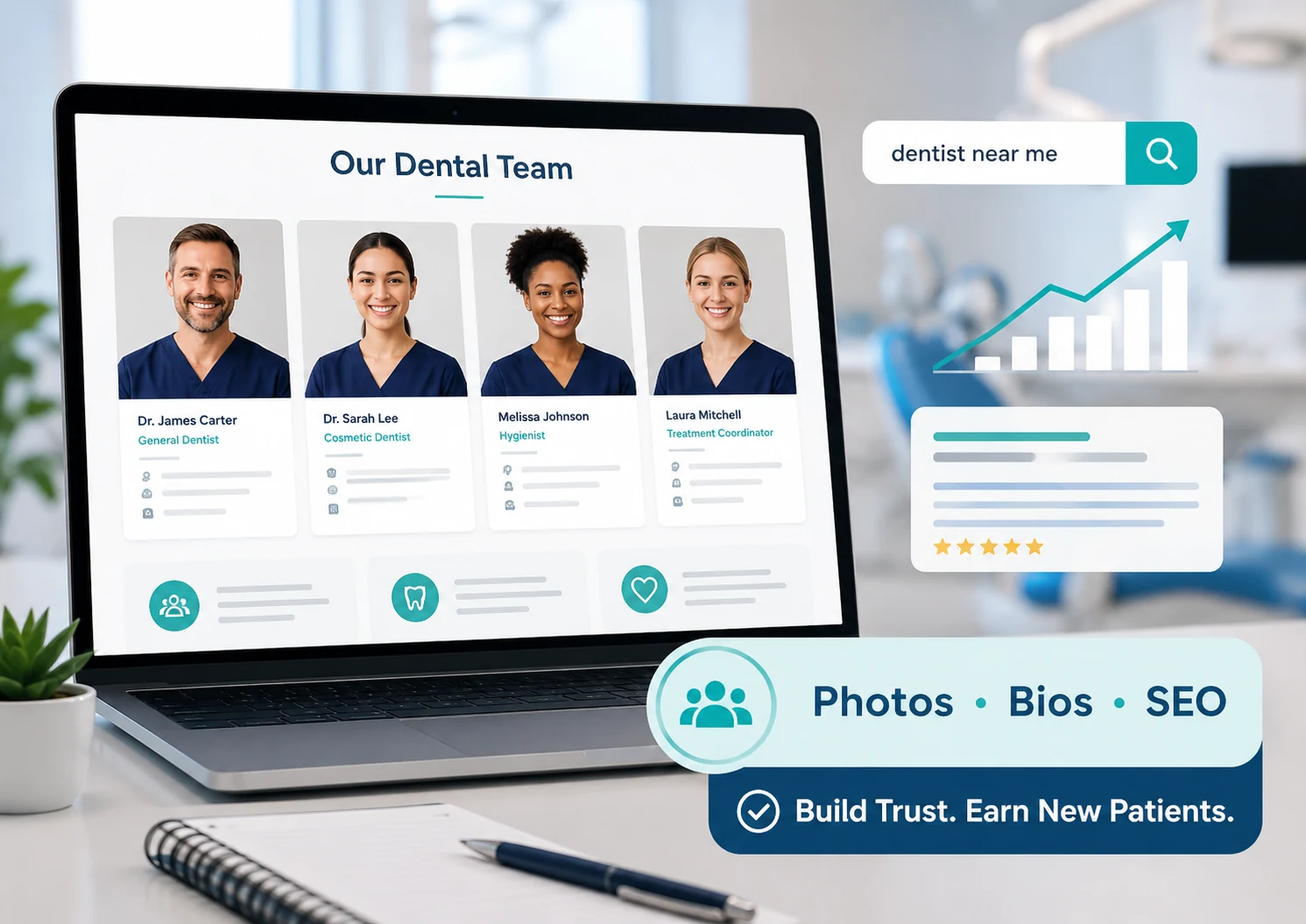 A high-performing dental team page earns new patients with three things working together: authentic provider photos that build trust, credential-rich bios that prove expertise, and on-page SEO that helps the right patients find your dental practice. A high-performing dental team page earns new patients with three things working together: authentic provider photos that build trust, credential-rich bios that prove expertise, and on-page SEO that helps the right patients find your dental practice.
For most dental websites, the team page is one of the most-visited pages after the homepage—because choosing a dentist is personal, and patients want to see who they’ll actually be sitting in front of.
Done well, your team page reassures nervous patients, signals real expertise to Google, and gives AI search tools the structured facts they need to recommend your practice by name. Done poorly—stock photos, thin bios, no structure—it quietly sends prospective patients to a competitor who feels more trustworthy.
This guide walks through the three pillars that make a dental team page perform: photos that build instant trust, bios that turn visitors into booked appointments, and the SEO details that help patients (and AI assistants) find your providers in the first place.
Written for: dental practice owners, office managers, and marketing teams who want a team page that builds trust, ranks in local search, and shows up when patients research providers online.
TL;DR
If you only do five things, do these:
| 1. |
Use real, professional photos - authentic, consistent headshots of your actual team build far more trust than stock photography
|
| 2. |
Write bios for patients, not peers - lead with credentials to prove expertise, then add personality so patients feel a connection before they call
|
| 3. |
Nail the SEO basics - descriptive file names, accurate alt text, smart internal links, and Person schema help providers get found
|
| 4. |
Optimize for AI search - clear, factual, structured bios help tools like ChatGPT Search and Perplexity surface and recommend your practice
|
| 5. |
Keep it current - update photos, bios, and staff changes promptly so the page stays accurate and signals an active, well-run practice |
Table of Contents
Why your dental team page matters more than you think
Choosing a dentist is a high-trust decision. Patients are inviting someone to work inside their mouth, often while they feel vulnerable, and many carry some level of dental anxiety. Before they book, they want to know who you are. That’s why the team page consistently ranks among the most-visited pages on a dental website—people read it to decide whether your practice feels safe, competent, and worth the call.
Your team page does three jobs at the same time:
| • |
Builds trust - real faces and warm, human bios lower anxiety and help a stranger feel like a future patient
|
| • |
Proves expertise - credentials, education, and professional memberships are exactly the kind of evidence Google’s quality guidelines look for on health-related sites
|
| • |
Drives discovery - clear provider information gives search engines and AI tools the entity signals they use to understand and recommend your practice |
That last point is easy to overlook. For health and medical topics, search engines weigh the experience, expertise, and trustworthiness behind a site heavily—and a detailed, accurate team page is one of the clearest places to demonstrate all three.
> Back to Table of Contents
Dental team photos that build trust at a glance
Photos are the first thing visitors notice on a team page, and they make a snap judgment in seconds. The goal is simple: look like a real, professional, approachable team that a nervous patient would feel comfortable seeing.
What works best:
| • |
Real photos of your actual team - never use stock photography of models; patients can sense it, and it undermines the trust the page is supposed to build
|
| • |
Professional, consistent headshots - the same background, lighting, and style across every provider reads as polished and intentional
|
| • |
A mix of formal and candid - clean headshots establish credibility, while a few natural, smiling shots add warmth and personality
|
| • |
Approachable expressions - genuine smiles and eye contact go a long way toward easing dental anxiety before the first visit
|
| • |
A team or group photo - one shot of the whole team reinforces that patients are joining a real, cohesive practice |
A pattern we see often: practices spend on a great website but fill the team page with mismatched selfies or a single outdated group photo. Investing in professional dental photography—with a consistent look for every team member—beats a folder of generic stock photos, and it’s one of the highest-return upgrades you can make.
Don’t forget consent and privacy: get a signed photo release from every staff member before publishing their image, and never include photos of patients without proper written authorization. Protecting patient privacy isn’t optional, even when a happy patient offers.
> Back to Table of Contents
How to write dental team bios that turn visitors into patients
A strong bio does two things: it proves the provider is qualified, and it makes the patient feel like they already know them a little. Most bios fail because they do only one—either a dry list of credentials with no warmth, or a friendly paragraph that never establishes expertise. You need both.
A reliable structure for every provider bio:
| 1. |
Name and role - lead with who they are and what they do at your practice
|
| 2. |
Credentials and education - degrees, licenses, and where they trained, so patients see real qualifications up front
|
| 3. |
Experience and focus areas - years in practice and the services they concentrate on, such as implants, orthodontics, or pediatric care
|
| 4. |
Professional memberships - affiliations and continuing education that signal an active, current clinician
|
| 5. |
A human touch - why they chose dentistry, their approach to patient care, and a little about their life outside the office |
Write for patients, not other dentists. Translate clinical language into what it means for the person reading, using the same patient-first principles behind website copy that converts. Instead of listing a procedure name and moving on, explain the benefit—why that training or focus helps the patient feel comfortable and get great care.
Keep bios scannable and consistent. Aim for a short, readable paragraph or two per provider, with the most important information first. Use a similar length and structure for everyone so the page feels cohesive rather than scattered.
Name each provider’s focus areas. Listing what each clinician concentrates on helps patients self-select the right provider—and gives search engines and AI tools specific, matchable detail about what your practice offers and who delivers it.
> Back to Table of Contents
SEO tips for your dental team page
Great photos and bios only help if patients can find the page. These on-page dental SEO details make your team page work harder in search—and lay the groundwork for the structured data that AI tools rely on.
One team page or individual provider pages?
This is the first decision, and it shapes everything else, because it’s part of how you structure your dental website for search. A single, well-built team page—whether it stands alone or lives within your About Us page—can be enough for a small practice with one or two dentists. But practices with multiple providers—or specialists who want to rank for their own names—benefit from giving each provider a dedicated page with its own URL, photo, bio, and schema.
Individual provider pages can rank for searches like a clinician’s name plus “dentist,” build deeper topical authority, and act as distinct entities that search engines and AI assistants can recognize. Link each provider page from your main team page so visitors and crawlers can move between them easily.
File names and alt text
Two small details on every team photo do real SEO and accessibility work:
| • |
Descriptive file names - use something like dr-jane-smith-dentist-orlando.webp instead of IMG_4821.jpg so the image describes itself to search engines
|
| • |
Accurate alt text - describe who is in the photo and their role, such as the provider’s name and title; this helps image search and lets screen readers convey the image to visitors who can’t see it |
Write alt text for a real person, not a search engine. Describe the image honestly and avoid stuffing in keywords, which hurts both accessibility and SEO.
Internal links and navigation
Make the team page easy to reach and well-connected:
| • |
Link it prominently - the team or “Meet the Team” page should live in your main navigation and be linked from the homepage
|
| • |
Connect providers to services - link a provider who places implants to your implant service page, and vice versa, so related pages reinforce each other
|
| • |
Cross-link relevant content - point bios to and from related blog posts or service pages where it adds genuine value for the reader |
Thoughtful internal linking helps both patients and search engines understand how your providers, services, and content fit together.
Structured data for provider pages
Structured data, or schema markup, translates your team page into facts search engines and AI tools can read directly. For providers, Person schema is the workhorse—marking up each provider’s name, role, photo, the practice they work for, where they trained, and links to their professional or social profiles. Provider profile pages can also use ProfilePage markup, which is designed for exactly this kind of person-focused page.
The payoff is entity clarity: schema helps search engines and AI assistants recognize each provider as a distinct, real person and connect them to their credentials and content. Recommended details include a profile image, a description, links to verified profiles, and the dates the profile was created and updated. One rule matters above all—your schema must accurately reflect what’s visible on the page, so validate it before publishing.
> Back to Table of Contents
How dental team pages show up in AI search
The way patients discover dentists is splitting across two surfaces, and your team page now serves both.
On Google, local provider searches stay traditional. In late 2025, Google removed AI Overviews from local “near me” healthcare searches—queries like “dentist near me” or “pediatric dentist near me” now return the familiar map and local results rather than an AI summary. That means your local SEO, Google Business Profile, and trust-building pages still do the heavy lifting for local discovery, and a strong team page remains a core part of that.
Off Google, AI assistants are increasingly part of the search. More patients are using tools like ChatGPT Search, Perplexity, Copilot, and Apple Intelligence to research and shortlist providers—a shift that makes preparing your practice for AI search increasingly important. These tools browse practice websites, provider profiles, reviews, and directories, then recommend practices by name. To help your team page surface in those answers:
| • |
Lead with clear, factual detail - state each provider’s name, role, location, and focus areas plainly so AI tools can extract them
|
| • |
Use Person and ProfilePage schema - structured data gives AI assistants the identity signals they need to attribute and recommend your providers correctly
|
| • |
Stay consistent everywhere - keep provider names and details aligned across your website, Google Business Profile, and directory listings
|
| • |
Keep it current - fresh, accurate information signals an active practice to both patients and AI tools |
The takeaway: a well-structured team page now does double duty—earning trust from human visitors and feeding machine-readable facts to the AI tools patients increasingly rely on.
> Back to Table of Contents
Dental team page mistakes that cost you patients
Most underperforming team pages share the same handful of avoidable problems:
| • |
Stock photos or no photos - generic model images (or empty placeholders) erode the trust the page exists to build
|
| • |
Inconsistent, low-quality images - mismatched backgrounds, selfies, and varying styles make a practice look less established
|
| • |
Credential-only or warmth-only bios - all qualifications and no personality feels cold; all personality and no credentials feels unqualified
|
| • |
An outdated team - listing providers who have left, or omitting new hires, creates awkward first visits and signals neglect
|
| • |
Generic, interchangeable copy - bios that could belong to any practice do nothing to differentiate yours
|
| • |
No individual pages for a multi-provider practice - a missed opportunity to rank providers and build entity authority
|
| • |
Missing or poor alt text and schema - a quiet loss of accessibility, image SEO, and AI visibility
|
| • |
A buried page - if the team page isn’t in your main navigation, patients and search engines struggle to find it |
None of these are hard to fix—but left unaddressed, they add up to a page that subtly works against you.
> Back to Table of Contents
How to keep your team page current
A team page is a living asset, not a one-time project. An accurate, up-to-date page builds trust; a stale one does the opposite—and search engines and AI tools both weigh freshness.
Build updates into your workflow:
| • |
Tie it to onboarding and offboarding - add new team members promptly and remove departing ones as part of your standard staffing process
|
| • |
Refresh photos periodically - update headshots every couple of years or after meaningful changes so the page reflects your current team
|
| • |
Keep credentials and focus areas current - update bios when providers earn new certifications or shift their areas of concentration
|
| • |
Update your schema dates - refresh the modified date in your structured data whenever you make changes |
A current team page tells patients—and the tools recommending you—that yours is an active, well-run practice worth choosing.
> Back to Table of Contents
Work with a dental marketing partner
Your team is one of your biggest competitive advantages, and your website should make the most of it. WEO Media - Dental Marketing helps dental practices build team pages that earn patient trust, rank in local search, and surface in AI-powered results—as part of a complete dental marketing strategy. To talk through your team page and what would move the needle for your practice, call 888-246-6906 or schedule a consultation.
> Back to Table of Contents
FAQs
What should a dental team page include?
A strong dental team page includes a professional photo and a bio for each provider, with credentials, education, experience, and focus areas, plus a touch of personality. It should also be easy to find in your main navigation, use descriptive image file names and alt text, and ideally include structured data so search engines and AI tools can recognize each provider.
Should each dentist have their own page or one shared team page?
A single team page can work for a small practice. Practices with multiple providers or specialists usually benefit from giving each provider a dedicated page with its own URL, photo, bio, and schema, because those pages can rank for the provider’s name, build deeper authority, and act as distinct entities. Link individual provider pages from your main team page.
How long should a dental team member bio be?
Aim for a short, scannable paragraph or two per provider—long enough to cover credentials, experience, focus areas, and a bit of personality, but not so long that patients stop reading. Lead with the most important information, and use a similar length and structure across all providers so the page feels cohesive.
Do dental team photos really affect new patient bookings?
Yes. Choosing a dentist is a high-trust, often anxiety-tinged decision, and authentic, approachable photos help a prospective patient feel comfortable before they call. Real, professional, consistent headshots of your actual team tend to build far more confidence than stock images or mismatched snapshots.
Can I use stock photos on my dental team page?
Avoid it. Stock photos of models on a team page tend to backfire, because patients can usually tell and it undermines trust at the exact moment you’re trying to build it. Invest in a professional photo session with your real team instead—it’s one of the highest-return improvements you can make to the page.
What is Person or ProfilePage schema, and does my team page need it?
Person schema is structured data that describes a provider—name, role, photo, where they work and trained, and links to their profiles—so search engines and AI tools can read those facts directly. ProfilePage markup is designed for person-focused pages like provider profiles. It isn’t strictly required, but it helps search engines and AI assistants recognize and recommend each provider as a distinct, real person. Your schema should always match what’s visible on the page.
How do I write alt text for dental team photos?
Describe who is in the photo and their role—for example, the provider’s name and title at your practice. Write it for a real person who can’t see the image, since alt text supports both accessibility and image SEO. Keep it accurate and natural, and avoid stuffing in extra keywords.
How does a dental team page help with AI search like ChatGPT?
AI tools like ChatGPT Search and Perplexity browse practice websites, provider profiles, reviews, and directories, then recommend practices by name. A team page with clear, factual bios, consistent provider details across your listings, and Person or ProfilePage schema gives these tools the identity signals they need to surface and attribute your providers correctly. |
|