Why Dental Patients Decline Treatment and How Dentists Should Respond
Posted on 2/2/2026 by WEO Media |
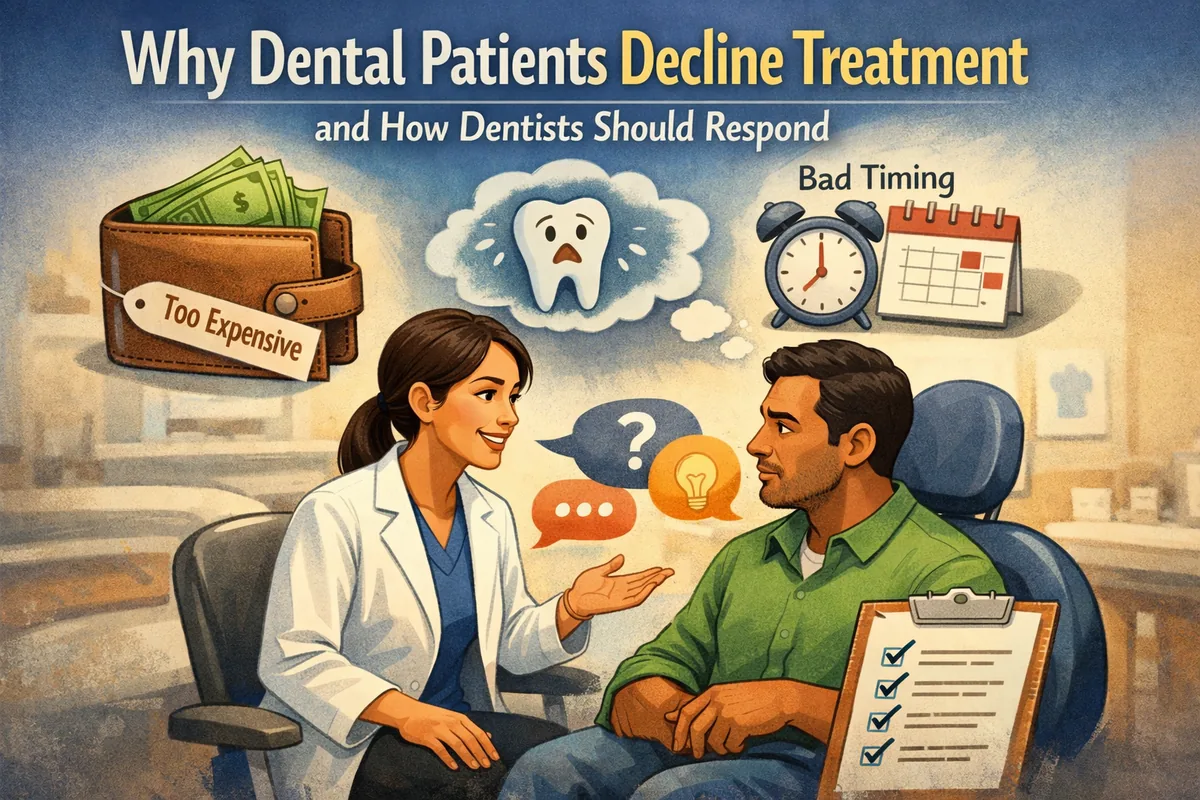 Patients decline treatment for reasons that rarely match their stated objections. When someone says “I need to think about it” or “that’s more than I expected,” the real barrier is usually unaddressed fear, unclear value, or poor timing—not the treatment itself. Understanding this distinction changes how you respond and whether that patient eventually moves forward. Patients decline treatment for reasons that rarely match their stated objections. When someone says “I need to think about it” or “that’s more than I expected,” the real barrier is usually unaddressed fear, unclear value, or poor timing—not the treatment itself. Understanding this distinction changes how you respond and whether that patient eventually moves forward.
Treatment acceptance is the percentage of recommended care that patients agree to schedule. In our work with dental practices, we commonly see acceptance rates between 40–60%—meaning nearly half of diagnosed needs go unscheduled. That’s not a patient problem. It’s a communication and follow-up system problem, and it’s fixable.
This blog focuses on patient communication and response strategies. If you’re also working on getting more new patients through the door, see our guide on dental patient acquisition for marketing-side strategies.
Below, you’ll learn the real reasons patients say no (beyond what they tell you), what not to say when they decline, word-for-word response frameworks that keep the door open, and follow-up systems that recover declined treatment without pressure tactics.
Written for: dentists, treatment coordinators, office managers, and dental teams who want to improve case acceptance through better communication—not harder selling.
Start here: Why patients say no, Response frameworks, Follow-up systems
TL;DR
If you take away five things from this blog, make it these:
| • |
Surface objections hide real concerns - “it’s too expensive” often means “I don’t understand why I need this” or “I’m afraid”
|
| • |
Respond with curiosity, not defense - ask what’s behind the hesitation instead of countering the objection directly
|
| • |
Give patients a clear next step - even if they decline today, offer a specific follow-up action so they don’t disappear
|
| • |
Build systematic follow-up - one check-in call or message within 48 hours recovers more treatment than any chairside script
|
| • |
Track acceptance by treatment type - knowing where patients say no most often reveals whether it’s a communication issue, a financial barrier, or a trust gap |
Table of Contents
The real reasons patients decline dental treatment
When a patient says no, what they say and what they mean are often different. Understanding this gap is the first step toward responding effectively. In our experience working with dental practices on patient journey optimization, we see the same underlying barriers repeatedly—regardless of what the patient actually says out loud.
What patients say vs. what they mean
“It’s too expensive.” This is the most common stated objection, but it’s rarely purely about money. When a patient says this, they’re often communicating: I don’t understand why this costs what it costs, I’m not convinced I really need this, or I don’t trust that this is the right solution. A patient who truly understands the value and urgency of treatment will find a way to afford it—or at least ask about payment options. The “too expensive” response often signals that the value conversation didn’t land.
“I need to think about it.” This typically means the patient has unanswered questions they didn’t feel comfortable asking. Maybe they’re unsure about the diagnosis, worried about pain, or want to research alternatives. This response is an invitation to slow down and ask what they’re weighing—not a signal to end the conversation.
“I’ll call you to schedule.” This is the polite exit. The patient has decided not to move forward but doesn’t want confrontation. Without a specific follow-up plan, this patient will not call back. Patients who leave without scheduling rarely return on their own initiative—which is why your front desk follow-up process matters so much.
The five core barriers to treatment acceptance
Behind every stated objection, one or more of these barriers is at work:
| • |
Fear and anxiety - dental anxiety is one of the most common healthcare-related fears; anxious patients may decline treatment to avoid the experience entirely, even when they understand the clinical need
|
| • |
Lack of perceived urgency - if it doesn’t hurt, patients struggle to prioritize treatment; they don’t see the consequence of waiting
|
| • |
Unclear value - patients don’t understand what they’re getting for the cost; the treatment feels like an expense rather than an investment in their health
|
| • |
Trust gaps - new patients or those with past negative experiences may question whether the recommendation is in their best interest
|
| • |
Competing priorities - even patients who understand and want treatment may have genuine financial or scheduling constraints |
The first four barriers are addressable through communication. The fifth requires flexibility and follow-up. Treating every declined treatment as a “price objection” misses the real opportunity.
> Back to Table of Contents
Common mistakes when patients say no
How you respond in the moment shapes whether that patient ever moves forward. A pattern we commonly see in practices with low case acceptance: the team has good clinical skills but inadvertently pushes patients away with well-intentioned responses that backfire.
Defending the price
When a patient says “that’s expensive,” the instinct is to justify the cost: explaining the quality of materials, the time involved, the expertise required. This rarely works. The patient didn’t ask for a cost breakdown—they signaled that they don’t yet see the value. Defending the price feels like selling, and it puts the patient in a position where they have to either agree with you or dig into their objection further. Neither moves them toward acceptance.
Accepting the objection at face value
The opposite mistake is accepting “I need to think about it” without any follow-up questions. When a team member says “okay, just let us know when you’re ready,” they’ve lost the opportunity to understand what’s really happening. The patient leaves with their concerns unaddressed, and the practice loses the chance to help.
Using pressure or fear tactics
Telling patients their tooth will “definitely” need an extraction if they wait, or that they’ll “regret” not doing this now, damages trust. Even when clinically accurate, fear-based framing makes patients defensive. They’re more likely to seek a second opinion (and not return) than to schedule out of fear. Trust-based patient relationships produce better long-term outcomes than pressure tactics.
Failing to offer a next step
This is the most damaging mistake. Letting patients leave without any defined path forward—no follow-up call scheduled, no written treatment plan to take home, no “let me check in with you next week”—turns a “not today” into a “never.” Patients who leave without a next step rarely initiate contact themselves.
> Back to Table of Contents
How to respond when a patient declines
Effective responses share a structure: acknowledge the concern, explore what’s behind it, provide relevant information, and establish a next step. This isn’t a sales technique—it’s how you help patients make informed decisions about their own health.
The acknowledge-explore-inform-next step framework
Acknowledge means validating the patient’s response without agreeing or disagreeing. “I completely understand—this is a lot to consider” shows you heard them without pushing back. Acknowledgment creates space for the real conversation.
Explore means asking what’s behind the hesitation. “Can you help me understand what’s weighing on you?” or “Is it the cost, the timing, or something else I can address?” These questions surface the actual barrier. Often, patients will share concerns they didn’t initially voice.
Inform means providing relevant information based on what you learned. If the concern is cost, discuss payment options. If it’s fear, explain your comfort protocols. If it’s urgency, show them what happens if they wait—with images or examples, not scare tactics. Patient education videos can help explain procedures in a way that reduces anxiety and builds understanding.
Next step means giving them a specific action, even if they’re not ready to schedule. “Let me send you some information about this, and I’ll check in with you on Thursday to see if you have questions.” This keeps the door open and demonstrates that you’re invested in their care, not just their payment.
Response scripts for common objections
These are starting points—adapt the language to your style and patient relationship. For more detailed guidance on structuring these conversations, see our guide on how to present dental treatment plans.
When the patient says “it’s too expensive”:
“I hear you—this is a significant investment. Can I ask what you were expecting, or what would make this work for you? We have some payment options that might help, and I want to make sure you understand what we’re preventing by doing this now versus waiting.”
When the patient says “I need to think about it”:
“Of course—I want you to feel confident in whatever you decide. Can you tell me what you’re weighing? Sometimes there are questions I can answer now that might help.”
When the patient says “I want to check with my spouse”:
“Absolutely—that makes sense for a decision like this. Would it help if I gave you a written summary to share with them? And let’s set a time for me to follow up so I can answer any questions they might have.”
When the patient says “I’ll call you to schedule”:
“I appreciate that. Just so it doesn’t slip through the cracks on either end, let me give you a call next week to check in. What day works best for you?”
Adjusting for different patient types
New patients require more trust-building. They don’t have a relationship with you yet, and recommending significant treatment on a first visit can feel aggressive. Focus on the diagnostic process: show them what you see, explain your reasoning, and give them time to process. A new patient who declines initially but receives good follow-up often becomes a long-term patient who accepts treatment later.
Anxious patients need reassurance more than information. They’ve often heard the clinical explanation before—what they need is confidence that the experience will be manageable. Focus on comfort measures, sedation options, and the step-by-step process.
Long-term patients who suddenly decline treatment may be signaling a trust issue. Something has changed—maybe a billing problem, a rushed appointment, or a feeling that they’re being “sold.” With these patients, it’s worth asking directly: “You’ve always been great about staying on top of your care. Is there something about this recommendation that doesn’t feel right?”
> Back to Table of Contents
Follow-up systems that recover treatment
What happens after the patient leaves matters more than what happens in the chair. Practices with strong follow-up systems consistently recover 20–30% of initially declined treatment—without pressure, without repeated phone calls that feel like harassment. The key is systematic, patient-centered outreach.
The 48-hour follow-up rule
If a patient declines treatment and leaves without scheduling, someone from your team should reach out within 48 hours. Not to ask if they’ve “decided yet”—but to check in, answer questions, and restate your availability.
Sample follow-up message:
“Hi [Patient], this is [Name] from [Practice]. I wanted to follow up on your visit yesterday and see if you had any questions about the treatment we discussed. No pressure at all—I just want to make sure you have the information you need. Feel free to call or text if anything comes up.”
This follow-up should be logged, tracked, and assigned to a specific person. If no one owns it, it won’t happen consistently.
Building a treatment follow-up workflow
Effective practices build declined treatment into their patient tracking systems with defined stages:
| 1. |
Initial decline - patient leaves without scheduling; log the treatment, the stated objection, and any notes about the real concern
|
| 2. |
48-hour check-in - call or message to answer questions and restate availability
|
| 3. |
Two-week follow-up - if no response, one more outreach with a specific offer (“we had a cancellation next Tuesday if that works better for your schedule”)
|
| 4. |
Ongoing recall integration - if patient doesn’t schedule, flag the outstanding treatment in their chart for discussion at their next hygiene visit
|
| 5. |
Close-out - after 90 days with no movement, mark as “declined—patient aware” and stop active outreach |
This workflow prevents patients from falling through the cracks while respecting their autonomy. For practices looking to scale this process, automated email sequences can handle the initial follow-up touchpoints while freeing staff for live conversations.
Follow-up without being pushy
The difference between helpful follow-up and pushy sales is intent and framing. Helpful follow-up focuses on the patient’s needs: “I want to make sure you have what you need to decide.” Pushy follow-up focuses on the practice’s needs: “Have you decided yet?”
Practical ways to stay on the helpful side:
| • |
Lead with value, not urgency - “I wanted to share some information about what we discussed” vs. “Your tooth is getting worse”
|
| • |
Give them an out - “If you’ve decided this isn’t right for you, just let me know and I’ll update your chart”
|
| • |
Limit outreach attempts - 2–3 contacts over 2–3 weeks is appropriate; more than that feels like harassment
|
| • |
Vary the channel - if they didn’t answer a call, try a text or email; some patients prefer written communication |
> Back to Table of Contents
Measuring and improving case acceptance
You can’t improve what you don’t measure. Practices that track case acceptance systematically identify patterns—specific treatments that get declined more often, team members who have higher acceptance rates, times of day when patients are more receptive. This data turns “patients just don’t want treatment” into actionable insights.
What to track
At minimum, track these metrics monthly:
| • |
Overall case acceptance rate - treatment dollars accepted ÷ treatment dollars presented; benchmark varies by practice, but 60–70% is a reasonable target for comprehensive practices
|
| • |
Acceptance by treatment type - crown acceptance vs. implant acceptance vs. cosmetic acceptance; this reveals where your communication or pricing may be off
|
| • |
Acceptance by provider - if one dentist has significantly lower acceptance, there may be a presentation style issue worth addressing
|
| • |
Declined treatment recovery rate - of patients who initially decline, what percentage eventually schedule?
|
| • |
Time to acceptance - how long between initial presentation and scheduling? Longer times may indicate follow-up gaps |
Using data to improve
Once you have data, look for patterns. If implant acceptance is 30% while crown acceptance is 70%, the issue might be how implants are presented, or it might be a financing gap (implants cost more, so payment options matter more). For practices focused on growing implant cases specifically, our guide on marketing dental implants without attracting price shoppers addresses the unique challenges of high-value treatment acceptance.
Run a simple audit: pull 10 charts of patients who declined treatment in the last 90 days. For each one, answer: What was the stated objection? Was there a follow-up attempt? Did the patient receive written treatment information? What could we have done differently? This exercise often reveals system gaps that are easy to fix.
Team training for better acceptance
Case acceptance is a team skill, not just a dentist skill. The treatment coordinator, the financial coordinator, and the front desk all influence whether a patient moves forward. Your marketing funnel doesn’t end when the patient walks in—it extends through treatment acceptance and retention.
Invest in training that covers:
| • |
Active listening - hearing what patients are really saying, not just their surface objections
|
| • |
Value communication - explaining why treatment matters in patient terms, not clinical terms
|
| • |
Financial conversations - presenting payment options confidently and without judgment
|
| • |
Follow-up protocols - knowing exactly what to do when a patient declines |
Monthly team meetings that review declined cases (without blame) and discuss alternative approaches build skills faster than any external training program. For a structured approach to building these skills across your team, see our guide on training dental teams to improve case acceptance.
> Back to Table of Contents
Start improving your case acceptance
Better case acceptance starts with understanding why patients say no and building systems to respond effectively. If your dental marketing is bringing patients through the door but they’re not accepting treatment, the communication and follow-up systems we’ve outlined here will help close that gap.
Your website messaging also plays a role—patients who arrive with clear expectations about your approach and services are often easier to convert than those who come in cold. A well-designed dental website sets the stage for trust before the patient ever walks through your door.
Once you’ve improved acceptance rates, a strong reputation management strategy helps turn satisfied patients into referral sources, creating a cycle of growth that compounds over time.
For practices looking to improve both patient acquisition and treatment acceptance, WEO Media - Dental Marketing provides comprehensive dental marketing support including patient communication strategy. Schedule a consultation to discuss how we can help your practice grow.
> Back to Table of Contents
FAQs
What is a good case acceptance rate for a dental practice?
Most dental practices should aim for a case acceptance rate between 60–70% of treatment dollars presented. Rates below 50% often indicate communication gaps, pricing concerns, or trust issues that can be addressed through better presentation and follow-up systems. Track acceptance by treatment type to identify specific problem areas.
How do you handle a patient who says dental treatment is too expensive?
Avoid defending the price. Instead, acknowledge the concern and explore what is behind it. Ask what they were expecting or what would make it work for them. Often, the real issue is unclear value or fear rather than pure cost. Present payment options and help them understand what the treatment prevents, then establish a follow-up plan.
How soon should you follow up with a patient who declined treatment?
Follow up within 48 hours of the patient leaving your office. This check-in should focus on answering questions and providing information, not pressuring them to decide. A second follow-up at two weeks is appropriate if they have not responded. After 2–3 contact attempts over 2–3 weeks, reduce active outreach to avoid feeling pushy.
Why do patients say they need to think about dental treatment?
Patients who say they need to think about it usually have unanswered questions they did not feel comfortable asking. They may be uncertain about the diagnosis, worried about pain, or want to research alternatives. This response is an invitation to slow down and ask what they are weighing rather than a signal to end the conversation.
How can dental practices recover declined treatment?
Build a systematic follow-up workflow with assigned owners and defined timelines. Start with a 48-hour check-in call or message, follow up again at two weeks if needed, and integrate outstanding treatment into recall visits. Practices with strong follow-up systems typically recover 20–30% of initially declined treatment without pressure tactics.
What is the biggest mistake dentists make when patients decline treatment?
The most damaging mistake is letting patients leave without any defined next step. When a patient says they will call back to schedule and no follow-up is planned, that patient rarely returns. Always establish a specific follow-up action, whether it is a scheduled check-in call, written information to review, or a timeframe for the patient to decide.
Should dentists use fear tactics to get patients to accept treatment?
No. Fear-based framing damages trust and makes patients defensive, often leading them to seek a second opinion instead of scheduling. While it is appropriate to explain the clinical consequences of delaying treatment, this should be done factually and supportively, not as a pressure tactic. Focus on helping patients understand rather than scaring them into compliance.
How do you present treatment cost without losing the patient?
Present value before price. Help the patient understand what the treatment accomplishes and what it prevents before discussing cost. When you do present the fee, do so confidently and without apology, then immediately offer payment options. Hesitation or apologetic language around pricing signals that you also think it is too expensive. |
|