TCPA Compliance for Dental Text Marketing
Posted on 7/10/2026 by WEO Media |
How to Text Patients Without Triggering Costly Violations
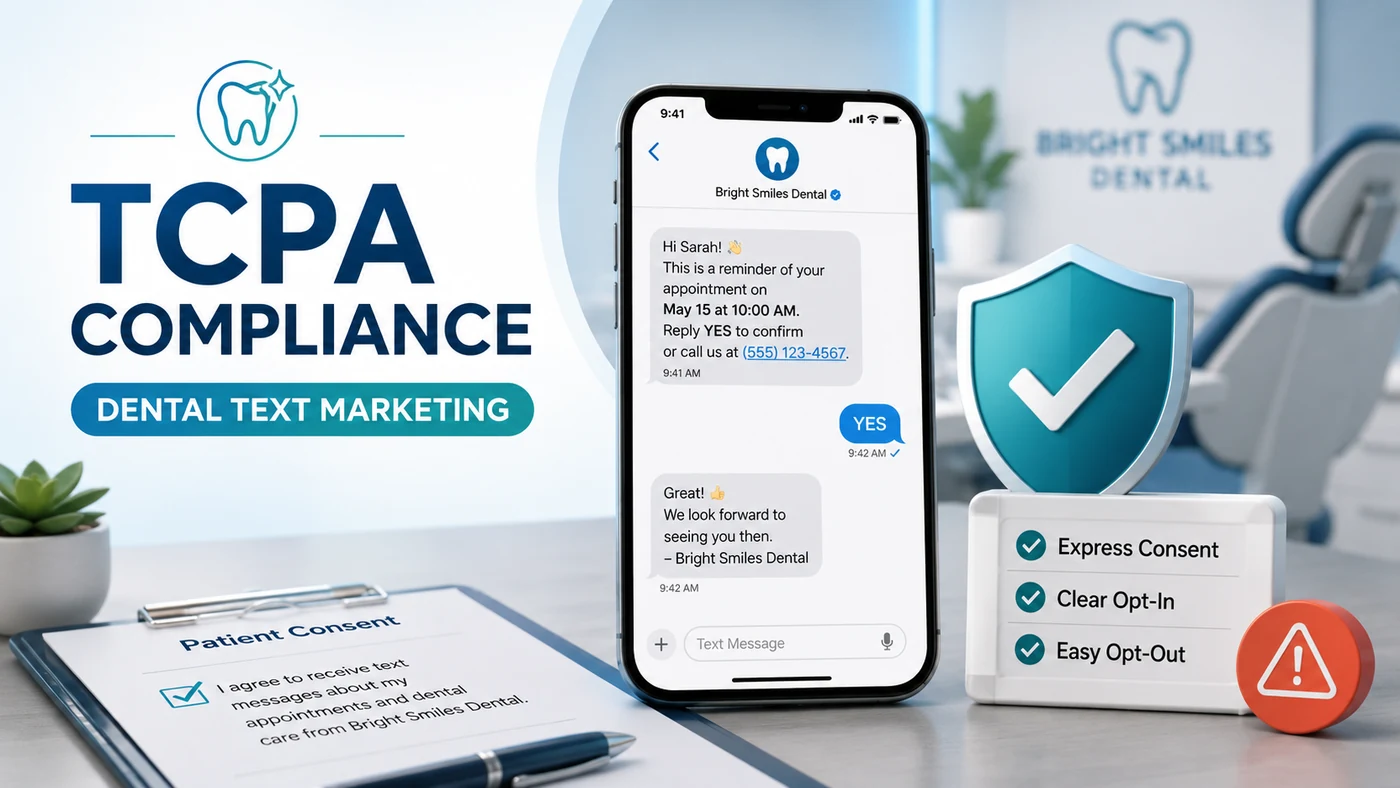 To keep dental text marketing TCPA-compliant, collect documented prior express written consent before you send any promotional text, keep appointment reminders strictly informational, and honor every opt-out request quickly and completely. To keep dental text marketing TCPA-compliant, collect documented prior express written consent before you send any promotional text, keep appointment reminders strictly informational, and honor every opt-out request quickly and completely.
Texting is one of the highest-response channels a dental practice has — open rates dwarf email — but it is also one of the most heavily litigated. The Telephone Consumer Protection Act (TCPA) treats a marketing text the same way it treats an automated marketing call, and a single non-compliant campaign sent to a patient list can turn into class-action exposure measured per message.
The core idea is simple: the law draws a hard line between informational texts (an appointment reminder, a “your hygienist is running a few minutes behind” note) and marketing texts (a whitening special, a new-patient offer, a membership-plan promotion). Each side of that line carries a different consent standard, and slipping promotional content into a reminder collapses the two — pulling an otherwise routine message into the strictest rules.
This guide walks through who the TCPA covers, the consent standard for each message type, the timing and opt-out rules that most often trip practices up, the state laws layered on top (Florida and Texas included), the carrier requirements that decide whether your texts even get delivered, and a practical compliance checklist. It is educational, not legal advice — the rules shift often and apply differently by situation, so confirm your specific program with qualified counsel.
Written for: dental practice owners, office managers, and marketing teams who use (or want to use) text messaging for reminders, recall, reactivation, and promotions — and who want the growth without the lawsuit.
TL;DR
If you do only five things, do these:
| 1. |
Separate consent by message type - collect prior express written consent for marketing texts and keep it distinct from the number a patient gives you for appointment reminders
|
| 2. |
Keep reminders strictly informational - the moment a reminder promotes a service or offer, it becomes marketing and needs the stricter consent standard
|
| 3. |
Honor every opt-out fast and completely - treat STOP (and any reasonable opt-out) as final, stop within 10 business days at the outside, and aim for immediate
|
| 4. |
Mind the clock and your state - default to sending between mid-morning and early evening in the patient’s local time, and check Florida, Texas, and other state rules that go beyond the TCPA
|
| 5. |
Register and document everything - complete carrier (10DLC) registration and keep timestamped records of every consent, message, and opt-out |
Table of Contents
Does the TCPA apply to your dental text messages?
Yes. The FCC has long treated a text message as a “call” under the TCPA, so the rules that govern automated marketing phone calls also govern marketing texts. If your practice sends promotional messages to patients’ mobile phones — directly or through a marketing platform or agency — you are operating inside the TCPA, and so is anyone texting on your behalf.
Dental practices are a natural target for two reasons. First, patient lists are large, and a mass send multiplies risk: because damages accrue per message, one bad campaign to a few thousand patients is not one violation but potentially thousands. Second, healthcare texting sits right next to the line the law cares about most — the line between a message that informs a patient about their care and a message that sells them something.
One point that trips up practices: the 2021 Supreme Court decision in Facebook v. Duguid narrowed the federal definition of an “automatic telephone dialing system” to equipment that uses a random or sequential number generator, and many modern texting platforms do not fit that definition. It is tempting to conclude the TCPA no longer applies. That is the wrong lesson. Separate do-not-call rules still govern telemarketing texts regardless of the technology, state laws use their own broader definitions, carriers enforce consent independently, and the cost of defending even a meritless claim is real. The safe posture — and the one that keeps your texts deliverable — is to build the whole program on documented consent.
> Back to Table of Contents
Informational vs. marketing texts: the distinction that decides everything
Every dental text falls into one of two buckets, and the bucket determines the consent you need.
Informational (transactional) texts relate to care a patient is already receiving: appointment confirmations and reminders, recall and hygiene-due notices, pre-visit instructions, post-operative follow-ups, and “we have an earlier opening” messages. These require prior express consent — a lower bar that a patient generally meets by knowingly giving you their mobile number for that purpose, for example on an intake form that says you will text appointment information.
Marketing (promotional) texts encourage a patient to buy or book something: whitening or cosmetic specials, new-patient offers, membership-plan promotions, referral campaigns, and reactivation offers with a discount. These require prior express written consent — a higher, documented standard covered in the next section.
The dual-purpose message is the mistake we see most often. If an appointment reminder also says “and ask us about our whitening special,” the promotional content pulls the entire message into the marketing category, and the reminder now needs written consent it probably never had. Keep the two streams clean: reminders inform, promotions sell, and they travel on separate consent.
Where the healthcare exemption fits (and where it stops)
The FCC created a narrow exemption for healthcare messages sent by a HIPAA-covered provider to a number the patient supplied. It lets certain treatment-related texts go out under the lower consent standard, but only if the message stays strictly non-promotional, avoids billing and financial content, identifies the practice, gives an easy opt-out, and stays within tight frequency and length limits. The instant a message markets a service, it steps outside the exemption and back into the written-consent rules. And a critical clarification: HIPAA compliance is not TCPA compliance. A reminder can satisfy HIPAA and still violate the TCPA if it is sent without the consent the TCPA requires. Treat the two laws as separate checkpoints a message must pass.
> Back to Table of Contents
What valid prior express written consent looks like
For marketing texts, “we have their number” is not enough. Federal rules define prior express written consent as a signed, written agreement that clearly and conspicuously authorizes your practice to send automated marketing texts to a specific number. In practice, a compliant opt-in has a few non-negotiable parts:
| • |
A clear, conspicuous disclosure - plain language stating the patient agrees to receive automated marketing texts from your practice at the number provided
|
| • |
Identification of your practice - the patient should know exactly who will be texting them
|
| • |
A no-strings statement - the disclosure must say that agreeing is not a condition of receiving treatment or any other service
|
| • |
An affirmative action - a checked box, a typed name, or a keyword reply the patient sends on purpose; a pre-checked box or buried fine print does not count
|
| • |
A retrievable record - the signed agreement or a timestamped log of the opt-in, stored so you can produce it later |
Electronic consent is valid: a checkbox on a web form, a patient-portal setting, or a documented keyword opt-in all work, as long as the disclosure is clear and the patient acts affirmatively. What does not work is treating a phone number collected for appointments as blanket permission to market, or hiding the consent language inside a wall of terms.
A note on a rule you may have heard about. In late 2023 the FCC adopted a “one-to-one consent” rule that would have required separate consent for each individual seller and limited follow-up messages to topics tied to the original interaction. A federal appeals court vacated that rule in January 2025, and the FCC has since removed it, so the long-standing written-consent standard described above is what applies today. It is still smart practice to keep consent specific to your practice and tied to what the patient signed up for.
> Back to Table of Contents
Timing, opt-outs, and do-not-call rules
Consent gets you permission to text. These three rules govern how and when you actually send — and they are where practices most often slip.
Quiet hours and the lawsuit wave you should know about
The TCPA restricts telephone solicitations to the window between 8 a.m. and 9 p.m. in the recipient’s local time. Since late 2024, a small number of plaintiff firms — concentrated in Florida — have filed a surge of near-identical class actions arguing that marketing texts sent outside that window are illegal, even when the recipient had opted in. The stronger legal reading is that a text sent with the patient’s permission is not an unsolicited “solicitation” at all — a petition asking the FCC to confirm this is pending, and at least one federal court has dismissed such a claim on that basis. The question is still unsettled, though, and the filings are cheap to bring and expensive to defend. The defensive move is straightforward: send marketing texts during safe daytime hours based on the patient’s area code or a known time zone, and keep documentation of both consent and send times.
Honoring opt-outs the right way
A patient can revoke consent at any time and by any reasonable method — not only by texting STOP, but through words like “quit,” “cancel,” “unsubscribe,” or a plain request to stop. Once they do, you must stop within a reasonable time that federal rules cap at 10 business days; the right operational target is immediate. You may send one confirmation text acknowledging the opt-out, but only if it goes out within five minutes and contains no marketing. In our work with practices, the two habits that prevent most opt-out disputes are simple: process opt-outs across your entire system, not just the campaign that prompted them, and never re-add a number without a fresh, documented opt-in.
Do-not-call obligations
Telemarketing texts are also subject to do-not-call rules. Scrub promotional sends against the National Do Not Call Registry, and — just as important — maintain your own internal do-not-call list of patients who have opted out, with written procedures for keeping it current. An established business relationship with a patient can matter for registry purposes, but it does not substitute for the written consent that automated marketing texts require. Treat these as layered obligations, not either-or.
> Back to Table of Contents
State texting laws: Florida, Texas, and the growing patchwork
Federal law is the floor, not the ceiling. A growing number of states have their own “mini-TCPA” statutes, several stricter than the federal rules and each with its own twists, from long opt-out record-retention rules to tighter timing limits. If you text a resident of one of these states, that state’s law can apply no matter where your practice sits, so the safest approach for a multi-state or growing patient base is to follow the strictest rule that reaches any patient on your list. Two states stand out.
Florida
Florida is the state to watch most closely. Its Telephone Solicitation Act requires prior express written consent before making automated sales calls or texts to Florida residents, recognizes a checked box or an affirmative text reply as a valid signature, and — importantly for defense — requires a consumer to text STOP and give the sender 15 days to comply before suing over texts. Florida also tightens the calling window to 8 a.m. through 8 p.m. local time, an hour narrower than the federal cutoff. For a Clermont practice, or any practice texting Florida patients, these are the operative rules.
Texas
Texas expanded its telemarketing law in 2025 (SB 140) to expressly cover text and image messages and to make violations actionable under the state’s deceptive-trade-practices statute, which can triple damages and add attorney’s fees. It also created a seller-registration requirement, though the state has since clarified that genuine opt-in, consent-based texting programs are exempt from registration — the heightened damages exposure still applies.
> Back to Table of Contents
Carrier compliance: 10DLC registration and CTIA rules
There is a second rulebook layered on top of the law, written by the mobile carriers, and it decides whether your texts get delivered at all. Business texting over standard 10-digit numbers runs through a registration system known as 10DLC, and carriers apply the CTIA messaging guidelines — industry best practices covering consent, opt-in and opt-out handling, sender identity, and prohibited content categories (often summarized as sex, hate, alcohol, firearms, and tobacco).
These guidelines are not statutes, but ignoring them has immediate consequences: unregistered or non-compliant traffic gets filtered or blocked, so your reminders and offers quietly fail to arrive. For a dental practice, the implication is practical — complete brand and campaign registration through your texting provider, describe your use case accurately, and keep your opt-in and opt-out flows consistent with what you registered. Doing this well also reinforces your legal compliance, because the carrier rules and the TCPA point in the same direction: get real consent, honor opt-outs, and say who you are.
> Back to Table of Contents
What TCPA violations actually cost
The TCPA is enforced partly by regulators but mostly by private lawsuits, and its damages are what make it dangerous. A violation carries statutory damages of 500 dollars per message, rising to as much as 1,500 dollars per message when the violation is willful or knowing — and a plaintiff does not have to prove they lost a cent. Because every text is a separate violation, exposure scales with your list: a single non-compliant campaign to a few thousand patients can climb into seven figures before any multiplier.
A few features sharpen the risk. Claims can be brought for up to four years. Federal TCPA cases do not shift attorney’s fees to the loser, but several state analogs — Florida and Texas among them — do allow fees and multiplied damages, which fuels the plaintiff’s bar. And recent court decisions have made the litigation landscape less predictable, with judges no longer bound to defer to the FCC’s interpretations. None of this should scare a practice away from texting. It should push you toward doing it correctly, because a documented consent-and-opt-out program is both the best marketing asset and the best legal defense you can have.
> Back to Table of Contents
Your dental text marketing compliance checklist
Use this as a working checklist for any practice running a texting program:
| 1. |
Separate your consent streams - one opt-in for appointment and care texts, a distinct written opt-in for marketing, each documented
|
| 2. |
Write compliant opt-in language - clear disclosure, your practice named, an automated-marketing acknowledgment, and a statement that consent is not required for treatment
|
| 3. |
Capture consent affirmatively - checked boxes, typed names, or intentional keyword replies, never pre-checked or buried
|
| 4. |
Keep reminders clean - no promotions inside transactional messages
|
| 5. |
Send within safe hours - default to daytime in the patient’s local time, and follow the strictest applicable state window
|
| 6. |
Make opt-out effortless and instant - honor STOP and any reasonable request, apply it system-wide, and confirm only once with no marketing
|
| 7. |
Maintain do-not-call hygiene - scrub against the national registry for promotions and keep an internal opt-out list with written procedures
|
| 8. |
Register with the carriers - complete 10DLC brand and campaign registration and match your live flows to it
|
| 9. |
Document relentlessly - timestamped records of every consent, message, and opt-out, retained and retrievable
|
| 10. |
Get a legal review - have qualified counsel check your consent language, workflows, and state coverage before you scale |
No checklist replaces legal advice, but a practice that can honestly check every box here has closed the gaps that generate the overwhelming majority of texting claims.
For an overview of the federal rules straight from the regulator, the FCC’s guidance on unwanted robocalls and texts is a useful reference: the FCC’s consumer guide on robocalls and robotexts.
> Back to Table of Contents
Build a texting program that grows your practice and protects it
Text marketing works — when it is built on real consent, clean message separation, fast opt-outs, and airtight documentation. That is the kind of compliant, high-performing patient communication WEO Media - Dental Marketing builds for dental practices every day, alongside the SEO, websites, and campaigns that keep the schedule full. If you want a texting and marketing program engineered to grow your practice without the legal exposure, our team can help. Call 888-246-6906 to talk with a dental marketing specialist.
> Back to Table of Contents
FAQs
Does the TCPA apply to text messages or only phone calls?
Both. The FCC treats a text message as a call under the TCPA, so marketing texts to mobile phones are governed by the same consent, timing, and opt-out rules that apply to automated marketing calls.
Do dental appointment reminders require written consent?
Generally no. A purely informational reminder needs only prior express consent, which a patient usually provides by giving you their mobile number for appointment communication. The reminder must stay strictly non-promotional, though — adding an offer converts it into a marketing message that needs written consent.
Can we text a promotion to patients who already gave us their number?
Not on that basis alone. A number collected for appointments is not permission to market. Promotional texts require prior express written consent — a clear, affirmative opt-in that names your practice and states that agreeing is not a condition of treatment.
What are the quiet hours for marketing texts?
Federal rules restrict solicitations to between 8 a.m. and 9 p.m. in the recipient’s local time, and some states are stricter — Florida limits it to 8 a.m. through 8 p.m. Because a wave of lawsuits targets off-hours texts, the safe practice is to send only during daytime hours based on the patient’s time zone.
How quickly do we have to honor a STOP request?
Federal rules require you to stop within a reasonable time that cannot exceed 10 business days, and the patient can opt out by any reasonable method, not just the word STOP. The best operational standard is to stop immediately and apply the opt-out across every list and campaign.
Does an established business relationship count as consent for marketing texts?
No. An existing patient relationship can matter for do-not-call registry purposes, but it does not satisfy the prior express written consent that automated marketing texts require. You still need a documented marketing opt-in.
What can a TCPA texting violation cost?
Statutory damages run 500 dollars per message and up to 1,500 dollars per message for willful violations, with no need to prove actual harm. Because each text is a separate violation, a single non-compliant campaign to a large list can create very large aggregate exposure.
Do state laws add rules beyond the TCPA?
Yes. States including Florida and Texas have their own texting laws, some stricter than federal rules and some allowing attorney’s fees and multiplied damages. If you text a resident of one of these states, that state’s law can apply regardless of where your practice is located. Confirm your coverage with qualified counsel. |
|