Dental Call Scoring: How to Grade Your Front Desk
Posted on 6/29/2026 by WEO Media |
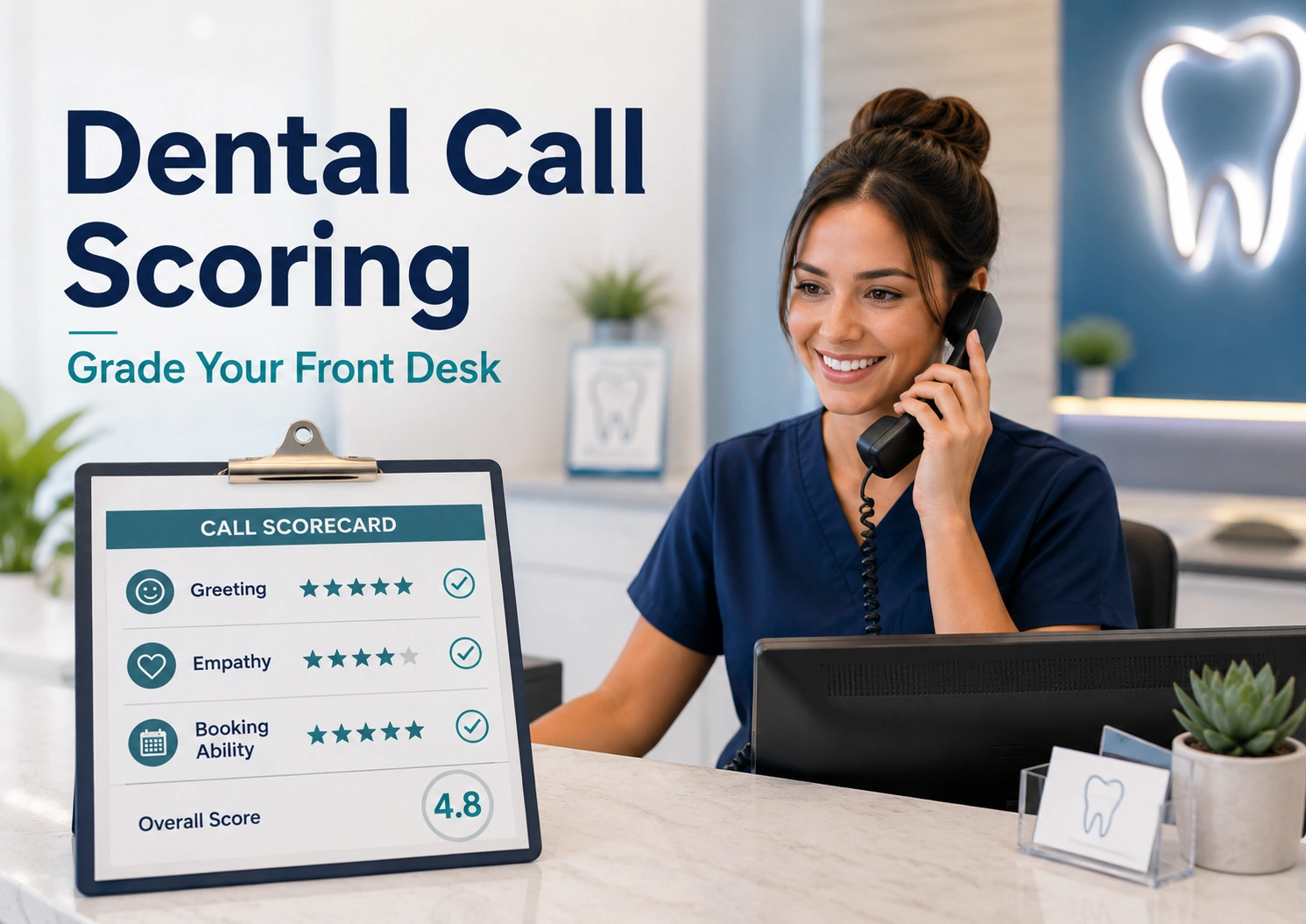 Dental call scoring is a simple, repeatable way to grade your front desk on how it handles new-patient phone calls—so practice owners, office managers, and DSO teams can see exactly where callers drop off and coach the fixes. Dental call scoring is a simple, repeatable way to grade your front desk on how it handles new-patient phone calls—so practice owners, office managers, and DSO teams can see exactly where callers drop off and coach the fixes.
If your marketing is making the phone ring but your schedule isn’t filling, the problem usually isn’t the leads. It’s what happens in the first 60 seconds of the call.
Most practices manage the front desk on a feeling: the phones “seem fine.” Scoring replaces that feeling with a number. You listen to a sample of real calls, grade each one against a short rubric, and suddenly you can see the difference between a team member who books the anxious caller and one who sends a price shopper away. This guide covers what to grade, how to record and review calls legally and within HIPAA, how to keep scoring consistent, and how to turn scores into booked and kept appointments—without turning your scorecard into a weapon.
Written for: dental practice owners, office managers, front desk leads, and DSO operations and marketing teams who want to stop losing new patients on the phone.
TL;DR
If you do only a handful of things, do these:
| • |
Score calls, don’t guess - a short scorecard turns “the phones feel fine” into measured facts about where callers drop off
|
| • |
Grade the moments that matter - answer speed, warmth, needs discovery, insurance and cost handling, and—most important—actually offering and booking the appointment
|
| • |
Get consent and stay HIPAA-safe - recorded calls contain protected health information, so disclose recording, sign a business associate agreement with your vendor, and lock down access before you review a single call
|
| • |
Sample and calibrate - grade a consistent weekly sample and calibrate your scorers so the same call earns the same grade
|
| • |
Coach, don’t blame - use scores to build scripts and role-play wins, then re-score to confirm the change stuck
|
| • |
Watch the funnel, not one number - inquiries → answered → booked → kept shows whether scoring is moving the metric that actually pays |
Table of Contents
What dental call scoring is (and why “the phones seem fine” isn’t a plan)
Dental call scoring is the practice of listening to a sample of your front desk’s inbound phone calls and grading each one against a fixed rubric—so you can measure how consistently your team answers quickly, greets callers warmly, uncovers their needs, handles insurance questions, and offers an appointment. Instead of guessing whether the phones are working, you get a score you can track and improve.
Here is why the feeling fails you. Your front desk is answering the phone while checking patients in, verifying insurance, taking payments, and managing walk-ins. Calls get rushed, put on hold, or missed entirely during predictable peaks like lunch, the end of the day, and Monday mornings. Owners almost never hear these calls, so a slow, flat, or booking-shy phone style can run for months without anyone noticing.
A pattern we see constantly: a practice invests in SEO and paid ads to make the phone ring, then loses a large share of those callers at the desk—and blames “bad leads” when the real leak is call handling. Industry estimates commonly put missed-call rates somewhere between one in five and one in three calls, climbing past half during busy windows, and of the calls that are answered, many practices book fewer than half of their new-patient callers. Treat those numbers as context, not gospel—your own baseline is what matters—but the direction is clear: the phone is where marketing quietly becomes revenue, or quietly leaks it.
Scoring makes that invisible moment visible. Once you can see a call as a graded event instead of a vague impression, you can fix the specific behavior that is costing you patients.
> Back to Table of Contents
Build your dental front desk call scorecard
A good scorecard fits on one page, grades observable behavior rather than personality, and weights most heavily the behaviors that actually book patients. Overbuilt checklists with 40 line items get abandoned in a week; a short rubric you run every week wins. Grade each call across a handful of dimensions:
| • |
Answer and access - answered live within a few rings during open hours, or a fast, logged callback—no cold voicemail dead-ends
|
| • |
Greeting and warmth - practice name, a team member name, a warm tone, and the caller’s name used; the first 15 seconds set the tone for the whole call
|
| • |
Needs discovery - the team member asks why the caller is calling, whether they are new, and any urgency such as pain, swelling, or a broken tooth before quoting anything
|
| • |
Insurance and cost handling - coverage and price questions are handled with confidence and redirected toward a visit, not shut down with a flat “we don’t take that” that ends the call
|
| • |
Offering the appointment - the single most predictive behavior; the team member offers a specific time, not a vague “we can get you in”
|
| • |
Booking and next step - the call ends with a booked visit or a clear next step such as a held time, a scheduled callback, or a waitlist spot—never “just call us back”
|
| • |
Follow-up commitment - contact details are captured and a follow-up owner is named if the caller does not book on the call |
Score each dimension simply—pass, partial, or miss, or a 0 to 2 scale—then weight offering the appointment and booking the heaviest. A warm, chatty call that never offers a time should not earn a high score, because it failed at the one thing that fills the schedule. Roll each call up to a percentage, then average by team member and by time of day so you can see who needs support and when coverage breaks down.
One fast way to feel the caller’s experience is a mystery call: have someone place a new-patient call and score it exactly as a stranger would experience it. It often surfaces problems your team cannot hear in their own calls. Before you record a single call to grade it, though, read the consent and HIPAA rules below—for a dental practice, that step is not optional.
> Back to Table of Contents
Record and review calls the right way: consent and HIPAA
You cannot score what you cannot hear, and reviewing calls means recording and storing them. For a dental office, that creates two separate obligations you need to handle before you start: recording-consent law and HIPAA. Neither is hard, but skipping either turns a coaching project into a legal problem.
Get recording consent right
Federal law and most states follow one-party consent, which means that because your team member is on the call, they can record it. About a dozen states, however, require all-party (sometimes called two-party) consent—every person on the call must be told and agree before recording. The exact list varies a little by source but includes states such as California, Florida, Illinois, Pennsylvania, and Washington. Because a caller may be sitting in a stricter state than you are, the safe default is to disclose recording on every call and treat all-party consent as your standard. A short pre-call line does the job: “This call may be recorded for quality and training purposes.” If the caller stays on the line, that is generally treated as consent. Note in your employee handbook that calls are recorded and reviewed so your team knows too. This is general information rather than legal advice, so confirm your state’s rule and your script with a qualified attorney.
Handle recorded calls as protected health information
The moment a call captures a caller’s name along with why they are calling, that recording contains protected health information, and a stored digital recording is electronic PHI under HIPAA. If a call-tracking platform or phone system stores or transcribes those recordings, that vendor is a business associate—you need a signed business associate agreement in place before any patient information flows to them. Most consumer recording apps will not sign one and are not built for this. From there, apply the basic HIPAA Security Rule safeguards: encrypt recordings in transit and at rest, restrict access by role to the minimum staff who genuinely need it, keep audit logs of who listens, and set a retention and secure-deletion schedule, since retention periods vary by state and some recordings can become part of the patient’s designated record set. When you share a call as a coaching example, keep it inside that secured, minimum-necessary group and avoid identifiers where you can.
> Back to Table of Contents
Who scores calls, how often, and how to stay consistent
Consistency matters more than volume. You do not need to score every call—you need to score a steady, representative sample and grade it the same way every time.
Pick a sample, not the ocean: a practical starting point is five to ten new-patient calls per team member each week, plus any call that did not result in a booking. Non-booked calls are where the lessons hide.
Give scoring one owner: an office manager or a designated lead should own the rubric, or a small panel can share it. Avoid letting everyone grade only their own calls—self-scoring drifts toward generous.
Calibrate regularly: every so often, have two scorers grade the same three to five calls independently, then compare and reconcile. Scorer drift—where the rubric quietly means something different to each person—is the quiet killer of any scoring program. Keep the rubric stable long enough to see a trend, and change it deliberately rather than every week.
For a DSO or multi-location group, standardize one rubric across every office, calibrate scorers across locations, and roll scores up by location and by team member. That is what turns call scoring from a single-office habit into a management system you can compare fairly across the group.
> Back to Table of Contents
Turn call scores into coaching, not blame
A score is a coaching tool, not a scoreboard for punishment. Front desk work is interrupt-driven and genuinely hard, and the fastest way to ruin honest call handling is to make the scorecard a threat. Lead with that, and the rest works.
Review calls with the team member, not at them. Start by naming a specific moment that worked—the way they calmed an anxious caller or offered a Tuesday morning slot—then pick one or two concrete fixes rather than a laundry list. Build your scripts from your own best calls instead of a generic template: capture how your strongest booker offers a time or answers “how much will this cost?” and teach that.
Role-play is where scores turn into skill. Rehearse the hard moments the scorecard keeps flagging—the price shopper, the fully booked day, the nervous first-timer, and the “just checking” caller who is closer to booking than they sound. Recognize wins in the open and coach in private. Then re-score the same team member a couple of weeks later to confirm the change actually stuck, because coaching that is never re-measured tends to fade.
> Back to Table of Contents
Connect call scores to booked and kept appointments
A high call score that does not move bookings is a vanity metric. The point of scoring is to fill and keep chairs, so tie every scorecard to outcomes.
Watch the whole funnel: inquiries → answered → booked → kept. Scoring should lift the answered-to-booked step first, because that is the step your rubric most directly influences. For context, commonly cited industry figures put the average answered-call-to-appointment conversion at roughly half or below, with top practices landing well above that, and most estimates still show the majority of dental appointments being booked by phone rather than online. Use those as a rough map, but measure your own numbers for four weeks before and after you start scoring—that before-and-after is the proof that scoring is working, not the benchmark.
Do not stop at “booked.” A booking that no-shows is not revenue, so track the kept rate too, and pair scoring with the phone data you already have, such as answer rate and missed calls by time of day. Together they tell you not just that calls are leaking, but exactly where to point your next coaching session.
> Back to Table of Contents
Front desk call-scoring mistakes to avoid
Most scoring programs stall for the same handful of reasons. Watch for these:
| • |
Recording before you are compliant - hitting record with no disclosure and no business associate agreement turns a quality project into a legal and HIPAA problem
|
| • |
Grading personality instead of behavior - “friendly” is subjective; score observable actions like whether a specific appointment time was offered
|
| • |
Scoring everything and trending nothing - a short rubric you run every week beats a giant checklist no one sustains
|
| • |
Weighting every criterion equally - a warm call that never offers an appointment failed at the one behavior that books patients, so weight for it
|
| • |
Using scores to punish - the moment the scorecard becomes a threat, honest call handling disappears
|
| • |
Ignoring missed and after-hours calls - the calls that never reach a person are often your biggest leak, so count them and decide on overflow or after-hours coverage |
> Back to Table of Contents
Grade your front desk with WEO Media
If you would rather not build and run this alone, WEO Media - Dental Marketing helps dental practices, specialty practices, and DSOs track calls, review how they are handled, and turn front desk performance into booked patients. Call 888-246-6906 or reach out to talk through where your calls are leaking and how to plug it.
> Back to Table of Contents
FAQs
What is dental call scoring?
Dental call scoring is grading a sample of your front desk’s inbound phone calls against a fixed rubric so you can measure how consistently your team answers quickly, greets callers warmly, uncovers their needs, and offers an appointment. It replaces a vague sense that the phones are fine with a number you can track and improve.
What should a dental front desk call scorecard include?
A practical scorecard grades answer speed and access, greeting and warmth, needs discovery, insurance and cost handling, whether a specific appointment time was offered, whether the call ended in a booking or a clear next step, and follow-up commitment. Weight offering the appointment and booking most heavily, since those behaviors fill the schedule.
Is it legal to record patient phone calls for scoring?
In most states one-party consent applies, so a team member on the call can record it, but about a dozen states require all-party consent from everyone on the line. Because callers may be in a stricter state, the safe practice is to disclose recording on every call with a line like “this call may be recorded for quality and training purposes” and treat all-party consent as the default. Confirm your state’s rule with a qualified attorney.
Are recorded patient calls covered by HIPAA?
Yes. Once a call captures a caller’s identity along with why they are calling, the recording contains protected health information, and a stored digital recording is electronic PHI. If a vendor stores or transcribes it, you need a signed business associate agreement, plus safeguards such as encryption, role-based access limited to the minimum necessary staff, audit logs, and a retention and secure-deletion policy.
How many calls should we score each week?
Consistency beats volume. A practical starting point is five to ten new-patient calls per team member each week, plus any call that did not end in a booking, since those calls hold the most useful lessons. Calibrate your scorers periodically so the same call earns the same grade every time.
What is a good call-to-appointment conversion rate for a dental office?
Commonly cited figures put the average answered-call-to-appointment conversion at roughly half or below, with top-performing practices well above that. Treat those as rough context rather than a fixed target. The number that matters is your own baseline measured over a few weeks, and whether it improves after you start scoring and coaching calls.
How is call scoring different from call tracking?
Call tracking counts and records calls and tells you how many came in, when, and from which marketing source. Call scoring grades what happened during those calls—how well the team handled each one. Tracking shows you the volume and the leak; scoring shows you the behavior behind it so you know what to coach.
How do we get staff to accept call scoring?
Frame scoring as coaching, not surveillance. Tell the team upfront that calls are reviewed to build better scripts and share what works, start each review by naming something the team member did well, and coach one or two fixes at a time. Recognize wins openly, keep corrections private, and role-play the hard calls together so scores translate into confidence. |
|