Dental Practice Citation Audit
Posted on 6/25/2026 by WEO Media |
How to Find and Fix the Listing Errors Hurting Your Local Rankings
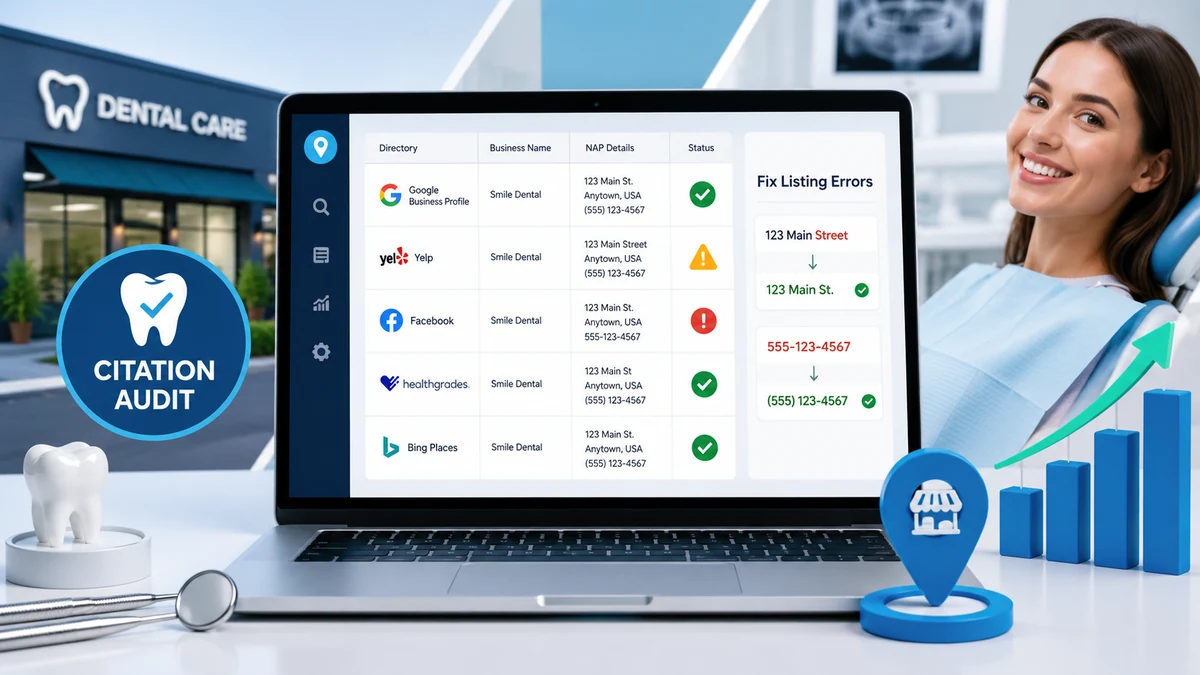 A dental practice citation audit is how you find and fix every inconsistent, duplicate, or outdated listing of your practice’s name, address, and phone number (NAP) across the web—the listing errors that quietly push your office down in Google’s local Map Pack and out of AI recommendations. A dental practice citation audit is how you find and fix every inconsistent, duplicate, or outdated listing of your practice’s name, address, and phone number (NAP) across the web—the listing errors that quietly push your office down in Google’s local Map Pack and out of AI recommendations.
If your phones aren’t ringing the way your reviews and website suggest they should, scattered or conflicting listings are one of the most common—and most fixable—reasons why.
Here’s the problem most practices never see: your NAP data didn’t end up on dozens of sites because you put it there. Data aggregators, old directory submissions, a previous marketing company, and even patients have created listings over the years—and any one of them with a wrong suite number or a disconnected phone line sends a conflicting signal to Google. This guide walks you through exactly how to audit those listings, fix what’s broken, and keep them clean.
Already have a Google Business Profile and a few directory listings but still aren’t showing up on the map? That’s the exact gap a citation audit closes.
Below, you’ll learn the four problems an audit uncovers, a step-by-step process to run it yourself, the dental directories and data aggregators that carry the most weight, how to fix duplicates without losing reviews, and how to measure whether the cleanup actually moved the needle.
Written for: dental practice owners, office managers, and marketing teams—plus specialty practices and DSOs managing listings across multiple locations and providers.
TL;DR
If you only remember five things, remember these:
| 1. |
Consistency beats volume - a smaller set of accurate, matching listings outperforms hundreds of conflicting ones, so fix what you have before chasing new directories
|
| 2. |
Fix the source first - correct your data aggregators (Data Axle, TransUnion Digital Business Profile, Foursquare) before individual directories, or the bad data simply repopulates
|
| 3. |
Duplicates split your reputation - two listings for one practice divide your reviews and confuse Google, and deleting the wrong one can erase reviews permanently
|
| 4. |
Watch for practitioner listings - associate dentists, staff turnover, relocations, and DSO acquisitions are the top sources of duplicate and outdated profiles in dental
|
| 5. |
Citations still decide local visibility - even as AI reshapes search, consistent NAP data is what lets Google’s Map Pack and AI assistants confidently match patients to your office |
Table of Contents
Why dental citations still drive new patients in 2026
A citation is any online mention of your practice’s name, address, and phone number—your NAP—whether it lives on Google, Apple Maps, Yelp, Healthgrades, a local chamber page, or a directory you’ve never heard of. Some citations are structured (a formal directory listing with dedicated NAP fields) and some are unstructured (a mention inside a blog post, news article, or sponsorship page). Search engines cross-reference all of them to confirm your practice is real, established, and located where you say it is.
Here’s why that still matters in an AI-driven search landscape. When a prospective patient searches “dentist near me” or “pediatric dentist accepting new patients,” Google answers with the local Map Pack and organic listings—not an AI Overview. Independent analysis from BrightEdge found that Google removed AI Overviews from local provider-intent healthcare searches entirely, while still showing them for informational queries like procedure or recovery questions. In plain terms: the searches that actually book patients are won in the Map Pack, and the Map Pack runs on the entity confidence that consistent citations create.
Standalone AI assistants behave differently. When someone asks ChatGPT, Gemini, or Perplexity “who’s the best dentist near me for anxious patients,” the assistant scans your entire digital footprint—website, Google Business Profile, directory listings, and reviews—and decides whether it trusts your practice enough to name it. Conflicting NAP data across sources is exactly the kind of ambiguity that makes an assistant hedge or recommend a competitor whose information is cleaner. So citations now do double duty: they feed the Map Pack and the AI layer sitting on top of it.
None of this means citations outrank reviews or your Google Business Profile itself. In the major local-search ranking surveys—Whitespark, BrightLocal, and Moz—Google Business Profile signals and reviews carry more weight than citations. But citation consistency remains a recognized foundational factor, and it’s the one most likely to be quietly broken without anyone noticing. Think of it as the base layer for your dental SEO: when it’s wrong, everything built on top of it works harder for less.
> Back to Table of Contents
The four problems a citation audit uncovers
An audit isn’t just checking whether your address is right. A useful one sorts every listing into one of four problem types, because each is fixed differently:
| • |
Inconsistent NAP - the listing exists but something doesn’t match: “Ste 200” versus “Suite 200,” an old phone number, an abbreviated practice name, or a tracking number that never matched your main line
|
| • |
Duplicate listings - two or more profiles for the same practice on the same platform, which split reviews and force Google to guess which one to show
|
| • |
Missing citations - authoritative directories where your practice should appear but doesn’t, leaving gaps in the data Google uses to verify you
|
| • |
Outdated or orphaned listings - profiles tied to a former address, a previous practice name, a retired associate, or a marketing vendor you no longer work with |
The reason this taxonomy matters: inconsistent listings get corrected, duplicates get merged or suppressed, missing ones get built, and orphaned ones get closed or claimed. Lumping them together is how cleanup projects stall. Sorting them first is how they finish.
> Back to Table of Contents
How to run your dental citation audit, step by step
You can run a credible first-pass audit in an afternoon with nothing but a spreadsheet and your browser. The goal is a documented, repeatable record—not a perfect one—so you can see exactly what’s wrong and prove what you fixed.
| 1. |
Set your canonical NAP - write down the exact practice name, address format, primary phone, website URL, hours, and primary categories you want used everywhere; this master record is the answer key for the entire audit
|
| 2. |
Confirm your website matches - your contact page and footer should show that exact NAP, because your site is the source of truth you control most directly
|
| 3. |
Search your practice name - on Google Search and Google Maps, then note every listing that appears, including ones with old or wrong details
|
| 4. |
Search your phone number and address separately - in Google Maps; any result that isn’t your primary profile is a likely duplicate or conflict hiding behind old data
|
| 5. |
Check your Google Business Profile dashboard - for duplicate listings you already own or profiles you’ve been added to as a manager without realizing it
|
| 6. |
Spot-check the core directories - Apple Maps, Bing, Yelp, Facebook, Healthgrades, and Zocdoc, comparing each against your canonical record
|
| 7. |
Log every finding in one sheet - capture the platform, the URL, the exact NAP shown, the problem type, and a screenshot, so progress is measurable and reversions are easy to catch later |
A faster path for larger or multi-location practices: citation audit tools—BrightLocal’s Citation Tracker, Whitespark, Moz Local, and Semrush Listing Management among them—scan dozens of directories and the major aggregators at once, flag inconsistencies, and surface duplicates that manual searching misses. They don’t replace judgment, but for anything beyond a single location they save hours and catch the long tail of smaller directories you’d never check by hand.
> Back to Table of Contents
The dental directories and data aggregators to check
Not every listing carries equal weight, so audit in tiers and spend your time where it counts. Quality and authority matter far more than racking up hundreds of low-value directories, so if you’re choosing where to build new ones, start with our guide to the top dental directories for 2026. For platform-by-platform setup, we have deeper walkthroughs on optimizing your Google Business Profile, claiming your Apple Maps listing, and setting up Bing Places.
Tier one—core platforms everyone must get right:
| • |
Google Business Profile - the single most important listing and the anchor your other citations should match
|
| • |
Apple Business Connect - powers Apple Maps and Siri results, which reach a large share of mobile patients
|
| • |
Bing Places - still relevant and a data source for some downstream platforms
|
| • |
Yelp - especially influential for dental and often ranking on page one for your brand
|
| • |
Facebook - a public business profile with NAP that counts as a legitimate citation |
Tier two—data aggregators that feed everything downstream:
| • |
Data Axle - formerly Infogroup; one of the largest US business databases, feeding Yahoo, Bing, Apple, and many secondary directories
|
| • |
TransUnion Digital Business Profile - formerly Neustar Localeze; a key supplier to Bing, Apple, navigation systems, and dozens of smaller directories
|
| • |
Foursquare - powers Apple Maps, Uber, and thousands of apps after absorbing Factual’s location data |
Tier three—dental and healthcare directories patients actually use:
| • |
Healthgrades, Zocdoc, and RateMDs - the platforms Google leans on to confirm you’re a licensed, active provider, and where many patients start before they ever reach Google
|
| • |
Vitals and WebMD - additional healthcare directories that reinforce provider legitimacy
|
| • |
ADA Find-a-Dentist and 1-800-Dentist - dental-specific listings that add topical relevance generic directories can’t
|
| • |
Specialty platforms - orthodontic, oral surgery, and cosmetic directories where your specialty patients look first |
Tier four—local and community sources:
| • |
Chamber of commerce and local business associations - high-trust local citations that strengthen geographic relevance
|
| • |
Regional news sites and sponsorship pages - unstructured citations that double as local links |
One important note on aggregators: they are the leverage point. Correct your record at the aggregator level and the fix propagates to dozens of downstream sites automatically; leave it wrong and your manual directory edits get overwritten the next time the aggregator re-pushes its data. That single dynamic is why so many do-it-yourself cleanups feel like whack-a-mole.
> Back to Table of Contents
How to fix and clean up what you find
Once your audit sheet is populated, work the fixes in an order that prevents re-contamination. The sequence matters as much as the corrections themselves.
| 1. |
Correct the aggregators first - update Data Axle, TransUnion Digital Business Profile, and Foursquare before touching individual directories, so propagation works for you instead of against you
|
| 2. |
Fix your core platforms - bring Google Business Profile, Apple, Bing, Yelp, and Facebook into exact agreement with your canonical NAP
|
| 3. |
Resolve duplicates deliberately - merge, suppress, or close them rather than deleting, because a deleted listing can take its reviews with it permanently
|
| 4. |
Standardize categories and attributes - keep your primary category, services, and attributes consistent so platforms stop guessing
|
| 5. |
Correct the dental and local directories - update Healthgrades, Zocdoc, and the rest against your master record
|
| 6. |
Re-check after changes publish - some platforms take days to update and others revert from upstream sources, so verify rather than assume |
Set expectations on timing. Aggregator corrections typically take several weeks—often four to twelve—to propagate across downstream directories, so this is a project measured in weeks, not minutes. Ranking and call-volume changes, when they come, tend to show up gradually as the corrected data spreads. Anyone promising an overnight jump in the Map Pack from citation cleanup alone is overselling it.
Two cleanup traps worth flagging. First, resist the urge to stuff keywords into your business name to climb the Map Pack—a name like “Best Downtown Dental Implants” when your real practice name is different violates Google’s guidelines and risks suspension; if you genuinely operate under a keyword-inclusive name, use a registered DBA and apply it consistently everywhere. Second, be deliberate with call-tracking numbers: dropping a tracking number into directories while your main line lives elsewhere fragments your NAP, so keep one consistent primary number across listings and route tracking carefully to keep your citation data clean.
> Back to Table of Contents
Duplicate and practitioner listings: the dental trap
Duplicates deserve their own section because dental practices generate them more than almost any other local business—and because getting the fix wrong can cost you years of reviews.
A few patterns we see constantly: a practice relocates but the old address listing never closes; an associate dentist joins or leaves and a practitioner profile lingers; front-desk turnover means a new staffer creates a second Google listing while the first is still pending verification; or a DSO acquires a practice and now two brand names point at the same address. Each scenario quietly spawns a duplicate or an orphaned profile.
There’s a specific wrinkle in healthcare: Google does allow separate profiles for individual practitioners and the practice itself, but only when each is a distinct, eligible entity—a dentist who is a genuinely separate, public-facing provider, for example. Used correctly, a practitioner profile and a practice profile can coexist. Used carelessly, they read as duplicates that split your reviews and dilute your Map Pack signal. The audit question is always the same: is this a legitimately separate provider, or an accidental second listing?
Fix duplicates in a safe order: identify the keeper (the verified listing with the correct details and the strongest review history), claim or request access to the duplicate—often it’s still controlled by a former employee or agency—and then merge, suppress, or close it through the platform’s official process. For stubborn cases, Google’s duplicate-resolution and business-redressal tools exist for exactly this. Document everything with screenshots before you submit changes, and never delete a listing that holds unique reviews, because those reviews usually don’t come back.
> Back to Table of Contents
Multi-location and DSO citation governance
Everything above gets harder at scale, and the failure modes change. For groups and DSOs, the enemy isn’t a single wrong phone number—it’s drift across locations and listings that compete with each other.
| • |
Build a single source of truth - one governed master record per location, so a new associate or an hours change updates from a controlled source rather than ad hoc
|
| • |
Give each location its own NAP and landing page - tie every location’s citations to a dedicated, location-specific page, not the homepage, to strengthen entity alignment
|
| • |
Prevent locations from cannibalizing each other - distinct categories, service emphases, and landing pages keep your own offices from competing in the same Map Pack
|
| • |
Brief every vendor with existing profile IDs - the most common source of agency-created duplicates is a vendor building a new listing instead of claiming the one that already exists
|
| • |
Audit on a schedule - multi-location data drifts continuously as aggregators re-push and platforms merge, so tighter process control prevents cross-contamination |
At scale, listing-management platforms with API connections to the major aggregators usually earn their keep—not because they replace strategy, but because manually maintaining NAP consistency across dozens of locations and providers isn’t realistic by hand.
> Back to Table of Contents
How to measure impact and keep listings clean
Citation work is easy to do and easy to leave unmeasured. Tie it to evidence so you know whether it paid off—and so it doesn’t silently decay.
| • |
Track a consistency score - audit tools grade NAP consistency across major platforms, so moving from partial to near-complete consistency is your clearest progress signal
|
| • |
Benchmark local rankings before and after - use a geo-grid rank tracker for your top service-and-city terms so you can see Map Pack movement instead of guessing at it
|
| • |
Watch calls from online sources - a corrected phone number that had been wrong for months often shows up as recovered calls once it propagates
|
| • |
Add a source field in your practice management system - ask new patients how they found you and log it, so you can see which directories actually send appointments
|
| • |
Re-audit on triggers, not just the calendar - run a full audit after any move, rebrand, new phone system, added location, or new associate, and a quick core-listing check each quarter |
The honest framing for any practice owner: citation consistency is foundational, not flashy. It rarely produces a dramatic before-and-after on its own. What it does is remove the friction and ambiguity that hold back everything else you’re investing in—your reviews, your content, and your Google Business Profile—so those efforts convert at full strength.
> Back to Table of Contents
Get help auditing your practice citations
Auditing and cleaning up citations is straightforward in concept and tedious in practice—tracking down listings, reclaiming profiles from old vendors, merging duplicates without losing reviews, and keeping aggregators from undoing your work. If you’d rather have it handled, WEO Media - Dental Marketing audits your full citation profile, corrects it at the source, and monitors it so it stays consistent across every location and provider.
> Back to Table of Contents
FAQs
What is the difference between a citation audit and citation building?
An audit finds and diagnoses every existing mention of your practice’s name, address, and phone number, sorting them into inconsistent, duplicate, missing, or outdated. Citation building and cleanup are the corrective steps that follow—creating missing listings and fixing or removing the problem ones. You audit first so you know exactly what to build and what to fix, instead of piling new listings on top of broken data.
How often should a dental practice audit its citations?
Run a full audit at least once a year, plus a quick check of your core listings (Google, Apple, Yelp, Facebook, Healthgrades) each quarter. More importantly, audit immediately after any trigger event: a move, a new phone system, a rebrand, an added location, or a new associate joining or leaving. The best time to audit is before a change goes live, not after the old data has already spread.
Do citations still matter now that patients use AI to find providers?
Yes, arguably more. For local provider searches like “dentist near me,” Google shows the Map Pack rather than an AI Overview, and the Map Pack depends on the entity confidence that consistent citations create. Standalone assistants like ChatGPT and Perplexity also cross-reference your listings and reviews before naming a practice, so conflicting NAP data can keep you out of AI recommendations entirely.
Will fixing my citations improve my Google rankings?
It can, but it’s rarely a standalone silver bullet. Citation consistency is a recognized foundational ranking factor, and practices that resolve major inconsistencies and duplicates often see gradual local-visibility improvement as the corrected data propagates. It works best alongside a complete Google Business Profile, steady reviews, and strong local content, which clean citations allow to perform at full strength.
Why do my old listings keep coming back after I fix them?
Because data aggregators periodically re-push their records to downstream directories. If you correct a directory but leave the aggregator record wrong, the aggregator simply overwrites your fix. The solution is to correct the source—Data Axle, TransUnion Digital Business Profile, and Foursquare—first, then the individual directories, and to monitor for reappearance over the following weeks.
We have two Google listings for one practice—can I just delete one?
Be careful. Deleting a listing that holds unique reviews usually erases those reviews for good. Instead, identify the listing you want to keep (the verified one with the correct details and best review history), then merge, suppress, or close the duplicate through Google’s official process. If both are verified in different accounts, you may need Google support to complete a formal merge.
Should each of our dentists have a separate listing?
Only if each is a genuinely distinct, public-facing provider. Google permits separate practitioner profiles alongside the practice profile when they represent real, eligible entities, but accidental or duplicate practitioner listings split your reviews and confuse the algorithm. During an audit, the key question for any practitioner profile is whether it represents a separate provider or simply a second, unnecessary listing.
How long does citation cleanup take to show results?
The hands-on corrections take a few weeks of active work, but aggregator data can take roughly four to twelve weeks to propagate fully across downstream sites. Any ranking or call-volume changes tend to appear gradually over that window rather than all at once. Treat citation cleanup as foundational maintenance with compounding benefits, not an instant fix. |
|