Dental Brand Voice: How to Stay Consistent on All Channels
Posted on 5/29/2026 by WEO Media |
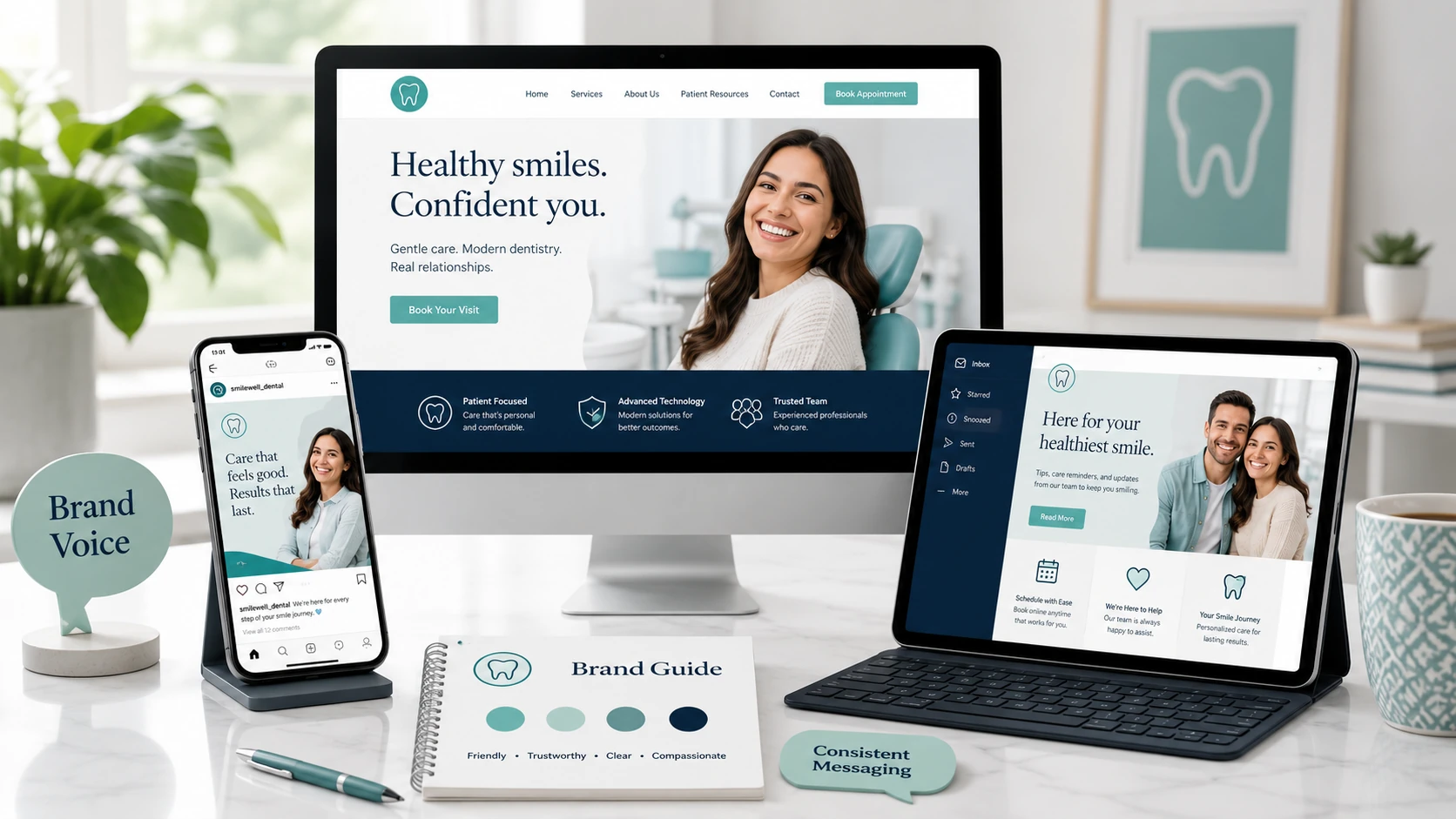 To keep a dental brand voice consistent across all channels, dental practices should define their voice once—a short set of traits, sample phrases, and words to avoid—then apply that same reference everywhere patients hear from them: website, Google Business Profile, reviews, social media, email, and text messages. To keep a dental brand voice consistent across all channels, dental practices should define their voice once—a short set of traits, sample phrases, and words to avoid—then apply that same reference everywhere patients hear from them: website, Google Business Profile, reviews, social media, email, and text messages.
When that voice drifts from one channel to the next, patients feel it even if they can’t name it: the website sounds warm and reassuring, the appointment texts read like system errors, and the social feed sounds like a different office entirely. This guide shows how to define your brand voice once and keep it consistent everywhere—without sounding scripted.
Why this matters for marketing: Voice is the connective tissue between every channel you invest in. Paid ads, SEO content, and social posts all work harder when patients recognize the same practice behind each one. Inconsistent voice quietly erodes trust—and trust is the single biggest factor in whether a nervous patient picks up the phone.
Short on time? Jump to the one-page brand voice guide and build your reference sheet first, then come back for the channel-by-channel detail.
Written for: dental practice owners, office managers, and marketing coordinators who want every channel—website, social, email, reviews, and in-office—to sound like one trusted practice.
TL;DR
If you only do five things, do these:
| 1. |
Define voice in plain terms - pick 3–4 traits (for example, warm, clear, confident, low-pressure) and write one “we sound like / we don’t sound like” example for each
|
| 2. |
Build a one-page voice guide - traits, sample phrases, words to avoid, and a reading-level target so anyone on the team can apply it
|
| 3. |
Audit your channels side by side - read your website, GBP, last 10 social posts, and last 5 patient texts in one sitting and flag the mismatches
|
| 4. |
Assign one owner per channel - voice drifts when nobody is accountable for how a channel sounds
|
| 5. |
Recheck quarterly - voice erodes slowly as staff change and platforms get added, so schedule a short review |
Table of Contents
What dental brand voice is (and why consistency matters)
Dental brand voice is the consistent personality and tone your practice uses in every piece of communication—the words you choose, how you explain procedures, how you handle anxiety, and the warmth or formality patients feel when they interact with you. It is distinct from your logo and colors; those are your visual brand. Voice is how you sound.
A pattern we commonly see: a practice invests in a polished website with a calm, reassuring tone, then sends appointment reminders that read like error messages and posts on social media in a casual, emoji-heavy style that feels like a different business. Each piece may be fine on its own, but together they tell patients the practice isn’t quite organized—or quite trustworthy. Consistency is what turns scattered touchpoints into a brand patients remember and refer.
Voice vs. tone: a quick distinction
Your voice stays the same everywhere; your tone flexes with context. If your voice is warm and clear, the tone of a post-operative instruction is calmer and more careful, while the tone of a community-event post is lighter and more upbeat. Same voice, different tone—both still recognizably you. Confusing the two is why some practices think consistency means sounding identical in every situation, which feels stiff and unnatural.
> Back to Table of Contents
Where your dental brand voice shows up
Your brand voice appears in far more places than most teams realize. Each of these is a channel patients use to judge whether you’re the right practice:
| • |
Your website - the homepage, service pages, and about page set the baseline patients expect everywhere else
|
| • |
Google Business Profile - your description, posts, and especially your replies to reviews are read by people deciding between you and a competitor
|
| • |
Online reviews and responses - how you reply to a 5-star review and a 1-star review says more about your voice than any tagline
|
| • |
Social media - the feed where casual tone most often drifts away from the rest of the brand
|
| • |
Email and newsletters - recall reminders, promotions, and practice updates
|
| • |
Text messages - reminders and confirmations that too often sound automated and cold
|
| • |
Paid ads - the headline a patient reads before they ever reach your site
|
| • |
In-office and on the phone - the front-desk greeting and how the team explains treatment in person |
The danger zones are usually the “operational” channels—texts, review replies, and automated email—because they often get written by whoever set up the software, not by whoever shaped the brand. Those channels also reach patients most frequently, so a cold, off-voice reminder can undo the warmth a beautifully written homepage worked to build.
> Back to Table of Contents
How to define your dental brand voice
Defining your voice doesn’t require a branding agency or a 40-page document. Work through four steps:
| 1. |
Pick 3–4 core traits - choose adjectives that describe how you want patients to feel, such as warm, clear, confident, and low-pressure; avoid vague words like “professional” that every practice claims
|
| 2. |
Define each trait with a do/don’t pair - for “clear,” you might write: we explain procedures in plain language; we don’t hide behind clinical jargon
|
| 3. |
Set a reading level - aim for a grade 6–8 reading level so explanations are easy for anxious or rushed patients to follow
|
| 4. |
Write sample phrases - draft three or four real sentences in your voice that the team can copy and adapt |
The output of this exercise isn’t a mission statement—it’s a working reference your front desk can use to rewrite a cold appointment text in under a minute.
Choosing traits that actually differentiate
Most dental practices describe themselves with the same handful of words: caring, gentle, professional, state-of-the-art. If your traits could belong to any office on the same street, they won’t shape distinctive writing. Pick at least one trait a competitor wouldn’t also claim—maybe you’re refreshingly direct about cost, unusually patient with dental anxiety, or genuinely funny in a field that rarely is. That differentiating trait is what makes your voice yours.
> Back to Table of Contents
Build a one-page brand voice guide
A one-page voice guide is the single most useful asset for keeping voice consistent, because it turns “sound like us” into something anyone can apply. Keep it to one page and include:
| • |
Your 3–4 voice traits - each with a one-line do/don’t example
|
| • |
Words and phrases you use - the specific language your practice prefers (for example, “visit” instead of “procedure” when reassurance matters)
|
| • |
Words to avoid - jargon, fear-based language, and anything that sounds pushy
|
| • |
Punctuation and formatting norms - how you handle exclamation points, emoji, and capitalization across channels
|
| • |
Two or three before/after rewrites - a cold text and its on-brand version side by side |
Store it where the whole team can reach it—not buried in a folder only the marketing coordinator opens. The practices that keep voice consistent are the ones that make the guide a one-click reference for the front desk, the social poster, and anyone replying to reviews.
> Back to Table of Contents
Keep your voice consistent across the team
A brand voice guide only works if the people writing actually use it, and voice drifts most when responsibility is fuzzy. A few habits keep everyone aligned:
| • |
Assign one owner per channel - one person accountable for how that channel sounds, even if several people post to it
|
| • |
Use saved templates for high-volume messages - reminders, confirmations, and common review replies written once in your voice, then reused
|
| • |
Add voice to onboarding - new front-desk and marketing hires should read the guide in their first week
|
| • |
Do a 30-second voice check before publishing - a quick read of anything public-facing on your owned channels |
In our work with practices, the single biggest source of voice drift is staff turnover—a new team member writes the way they always have, and within a few months the texts and review replies no longer sound like the brand. Templates and a short onboarding step prevent most of it before it starts.
> Back to Table of Contents
Common brand voice mistakes (and how to fix them)
A few patterns show up again and again when we audit dental practices’ channels:
| • |
Robotic automated messages - fix by rewriting reminder and confirmation templates in your defined voice, even if the software defaults are technically clear
|
| • |
Inconsistent review replies - fix with three or four approved response templates that still feel personal and on-brand
|
| • |
A social feed that sounds like a different practice - fix by applying the same traits and reading level you use on the website
|
| • |
Over-formal service pages - fix by reading copy aloud; if you wouldn’t say it to a patient in the chair, rewrite it
|
| • |
Fear-based or pushy language - fix by replacing pressure with clarity, since anxious patients respond to reassurance, not urgency |
None of these require new software or a rebrand. They require one person reading your channels side by side and applying the same guide to each. The fix is usually editing, not creating from scratch.
> Back to Table of Contents
How to measure voice consistency
You can’t improve what you don’t check, so build a short quarterly audit that makes voice drift visible before patients notice it:
| 1. |
Pull a sample from every channel - your homepage, three service pages, your last 10 social posts, your last 5 review replies, and your reminder and confirmation texts
|
| 2. |
Score each against your voice traits - mark each piece as on-voice, off-voice, or borderline
|
| 3. |
Calculate a simple consistency rate - on-voice pieces ÷ total pieces reviewed, so you have a number to improve next quarter
|
| 4. |
Fix the lowest-scoring channel first - usually texts or review replies, where small rewrites have the biggest payoff |
Results vary by practice size and how many channels you run, so treat the consistency rate as a directional measure rather than a precise benchmark. The point isn’t the number itself—it’s catching the drift early, when a quick template rewrite can fix it.
> Back to Table of Contents
Make every channel sound like one trusted practice
A consistent dental brand voice is one of the highest-return, lowest-cost improvements a practice can make, because it strengthens every other marketing investment you’ve already paid for. If you’d like help defining your voice and applying it across your website, profiles, and patient messaging, the team at WEO Media - Dental Marketing can help. Call 888-246-6906 or schedule a consultation to start the conversation.
> Back to Table of Contents
FAQs
What is dental brand voice?
Dental brand voice is the consistent personality and tone a practice uses across every form of communication—website, social media, reviews, email, text messages, ads, and in-office conversations. It covers the words you choose, how you explain treatment, and the warmth patients feel, and it is separate from your visual brand of logo and colors.
What is the difference between brand voice and tone?
Voice stays the same everywhere; tone flexes with context. A practice with a warm, clear voice uses a calmer tone for post-operative instructions and a lighter tone for a community-event post, while still sounding like the same recognizable practice. Voice is the constant identity, and tone is the situational adjustment.
How many traits should define a dental brand voice?
Three to four traits is the practical sweet spot. Fewer than three rarely captures enough personality, and more than four becomes hard for a team to remember and apply. Choose specific, differentiating adjectives such as warm, clear, confident, or low-pressure, and avoid generic words like professional that every practice claims.
Which channels most often break brand voice consistency?
The operational channels usually break first—automated text reminders, appointment confirmations, and review replies—because they are often written by whoever set up the software rather than whoever shaped the brand. These channels also reach patients most frequently, so an off-voice message there can undo the trust your website worked to build.
How often should a dental practice audit its brand voice?
A short quarterly audit works well for most practices. Pull a sample from each channel, score each piece as on-voice or off-voice, and fix the lowest-scoring channel first. Quarterly reviews catch the slow drift that comes from staff turnover and newly added platforms before patients start to notice it.
Can a small dental practice keep a consistent brand voice without a marketing team?
Yes. A one-page voice guide and a small set of reusable templates do most of the work. Define three to four traits, write a few before/after examples, save approved templates for reminders and review replies, and assign one person to each channel. Consistency comes from a shared reference and clear ownership, not from headcount.
Does brand voice affect SEO?
Indirectly, yes. A clear, consistent voice supports stronger engagement signals such as time on page and return visits, and it builds the trust that earns reviews and referrals. While voice is not a direct ranking factor, content that reads as helpful, expert, and trustworthy aligns with the experience and trust signals that search engines reward. |
|