DSO PPC Budgeting Across Locations
Posted on 5/19/2026 by WEO Media |
How to Allocate, Tier, and Scale Spend Without Overspending
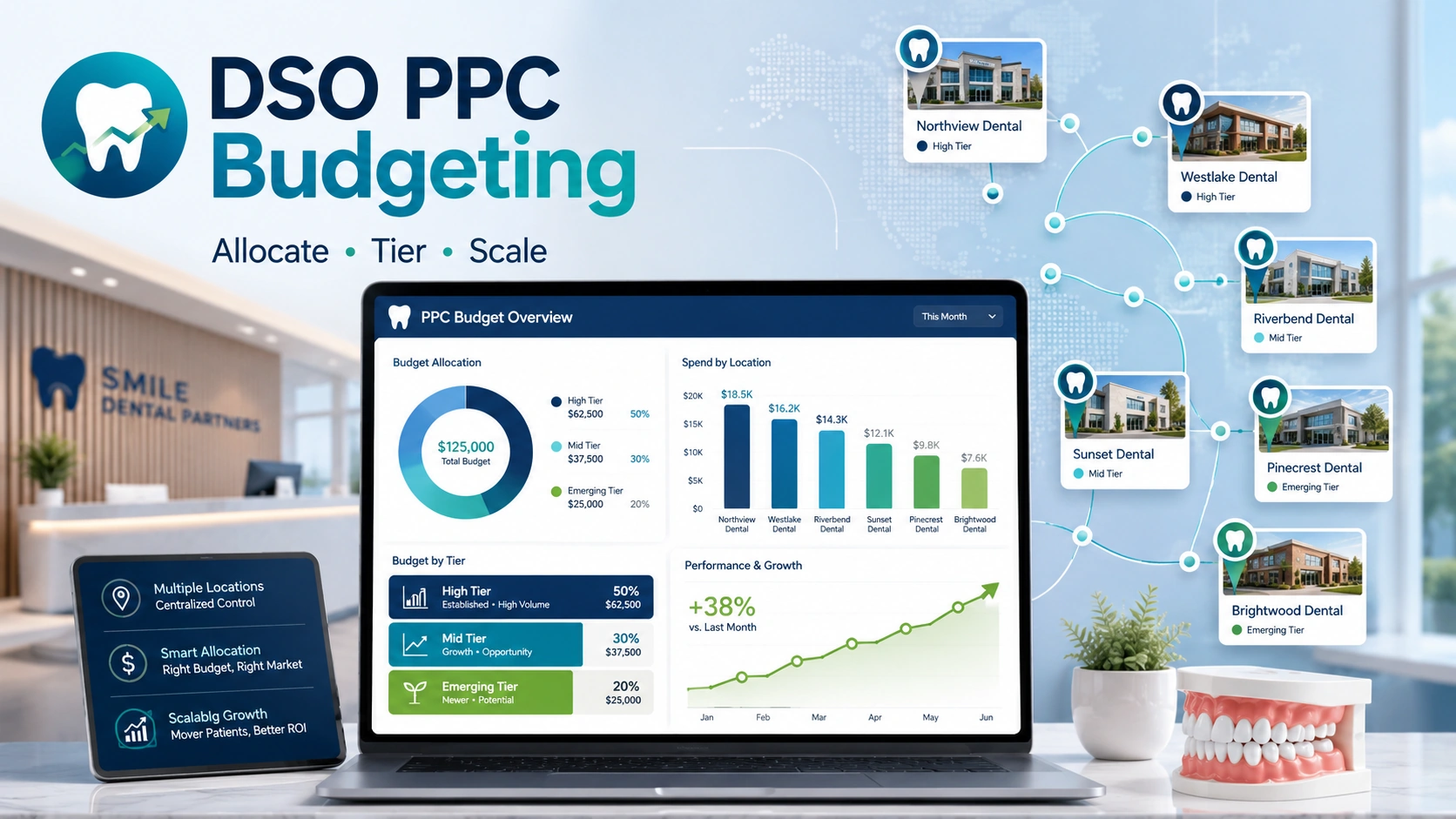 DSO PPC budgeting across locations works best when each office’s paid-search spend is tiered by market opportunity, capacity, and growth stage—not split evenly across the group—so multi-location dental organizations can allocate, scale, and reallocate budget without overspending in saturated markets or starving growth-tier offices. DSO PPC budgeting across locations works best when each office’s paid-search spend is tiered by market opportunity, capacity, and growth stage—not split evenly across the group—so multi-location dental organizations can allocate, scale, and reallocate budget without overspending in saturated markets or starving growth-tier offices.
If you’re budgeting paid search the same way for every location in your group, you’re almost certainly overspending where chairs are already full and underspending where you could grow fastest. This guide shows how to set a defensible total budget, allocate it across locations using market-aware tiers, structure accounts to scale, and avoid the pitfalls that quietly drain DSO marketing dollars.
The pattern we commonly see: a DSO sets one flat per-location budget at the corporate level, then wonders why some offices are starved for new patient appointments while others have diminishing returns. The locations aren’t the problem. The allocation method is. Markets differ in competition, cost per click, population density, payer mix, and the maturity of your local presence—and your PPC spend has to differ too.
This guide assumes you already run dental PPC in some form. If you’re standing up paid search for a new group from scratch, start there and return for allocation strategy.
Below, you’ll learn how to build budgets from the bottom up using market data, how to tier locations into growth, maintenance, and recovery groups, how to choose between single-account and per-location account structures, and how to set up the conversion tracking that lets you reallocate confidently every quarter.
Written for: DSO marketing directors, multi-location practice owners, group-level marketing coordinators, and operations leaders responsible for paid search performance across more than one dental office.
TL;DR
If you only do five things, do these:
| 1. |
Budget from the location up, not the corporate down - calculate each location’s capacity, market size, and growth stage before splitting any total
|
| 2. |
Tier your locations - group offices into growth, maintenance, and recovery tiers; each tier gets a different spend logic, not the same flat amount
|
| 3. |
Match account structure to your reporting needs - one MCC with per-location accounts gives cleaner attribution; a single account with location-targeted campaigns is simpler but harder to compare
|
| 4. |
Track conversions by location and by service - new-patient calls and form fills must be attributable to a specific office, or your reallocation decisions will be guesses
|
| 5. |
Reallocate quarterly, not monthly - PPC data needs enough volume to be trustworthy; monthly swings cause whiplash, not improvement |
Table of Contents
Why DSO PPC budgeting is different from single-location budgeting
A single-practice owner can afford to budget PPC intuitively. They know their chair capacity, their average new-patient value, and roughly how much they’re willing to spend to fill the schedule. At a DSO, that intuition breaks down the moment you add a second location—and it collapses entirely at five, ten, or fifty.
The four variables that change at scale:
| • |
Market heterogeneity - a downtown urban office and a suburban office in the same metro can have cost-per-click differences of two or three times for the same keywords
|
| • |
Capacity asymmetry - some locations have open chairs and producers ready to take patients; others are at 95% utilization and don’t need more demand
|
| • |
Brand maturity differences - a 15-year-established office has organic demand a brand-new acquisition doesn’t; their PPC roles are fundamentally different
|
| • |
Service mix variation - one office may lean on implants and cosmetic dentistry, another on general family care; the cost-per-conversion math is not comparable |
Treating these as if they’re the same is the single biggest source of waste in DSO paid search. A flat per-location budget will overspend the saturated, mature, and capacity-constrained offices—while starving the growth-stage offices that could absorb significantly more spend profitably.
What good DSO PPC budgeting actually requires: a bottom-up view of each location’s opportunity and capacity, a tiered allocation framework, and a quarterly review cadence with enough data per location to make real decisions.
> Back to Table of Contents
How to set your total DSO PPC budget
Before you allocate anything across locations, you need a defensible total. The wrong way to set this number is to take last year’s spend and add a percentage. The right way starts with patient economics and works backward.
Start with new-patient value and target cost per acquisition
For each location (or for each location tier if you have many similar offices), calculate two numbers:
| • |
Average first-year new-patient value - what a new patient is worth in production during their first 12 months, including any follow-up treatment they accept
|
| • |
Target cost per acquisition (CPA) - what you’re willing to pay to acquire one new patient through paid channels, typically expressed as a percentage of first-year value |
A common framework in dental marketing is to target a paid-acquisition CPA at a low-to-mid single-digit percentage of first-year patient value for general dentistry, and somewhat higher for specialty services where lifetime value is concentrated up front. Your finance team should set the exact target—PPC budgeting is downstream of how DSOs should allocate marketing budgets across channels, not upstream.
Calculate target net new patients per location, per month
For each location, determine how many new patients per month would meaningfully move production without breaking capacity. This is your net new patient demand—the number above your current organic and referral baseline that paid search needs to deliver. Locations at 95% utilization have a small or negative net new patient demand; locations at 70% utilization with available provider time may have substantial demand.
Build the total from the bottom up
Total monthly PPC budget equals the sum of (target net new patients × target paid CPA) across all locations, plus a reserve for testing and seasonality. This bottom-up total will almost always look different from a top-down “percent of revenue” benchmark. When the two disagree significantly, trust the bottom-up number and investigate the discrepancy—usually it points to a location that’s either capacity-constrained or undersaturated relative to its market.
> Back to Table of Contents
How to tier locations for budget allocation
Once you have a total, the next decision isn’t how much each location gets—it’s which tier each location belongs in. Tiers determine the logic of allocation; per-location numbers come second.
Growth tier
Locations with open chair capacity, recent provider additions, expanded operatories, or low local brand awareness. These offices can absorb more spend profitably because their constraint is demand, not supply. Growth-tier locations should receive disproportionate budget—not because they’re “better,” but because the marginal new patient costs less to acquire when you’re below the market saturation point.
Signals a location belongs in growth tier:
| • |
Hygiene schedule has visible openings within the next 2–3 weeks consistently
|
| • |
New provider added in the last 12 months with available chair time
|
| • |
Recently acquired location with limited local brand recognition under your group’s name
|
| • |
Strong existing conversion rate but low impression volume on core keywords |
Maintenance tier
Established locations operating at healthy utilization (typically 80–90% chair utilization) where PPC’s role is to backfill normal patient attrition and protect market share from competitors bidding on your brand and category. These locations get steady, defensible budgets—not aggressive growth budgets, not starvation budgets.
Maintenance-tier budgets focus on:
| • |
Brand defense - bidding on your own practice name to protect existing demand from competitors poaching branded search traffic
|
| • |
Core service keywords - the bread-and-butter terms that drive your most reliable new-patient flow
|
| • |
Local-intent terms - geographic modifiers that capture in-market searchers |
Recovery tier
Locations underperforming on production, with declining new patient counts, or recovering from a clinical or operational disruption (provider turnover, leadership transition, capacity issue). The instinct is to throw budget at these locations. The data usually says the opposite—more PPC spend on a location with operational problems just wastes money on leads that don’t convert or don’t return.
The recovery-tier rule: fix the operational issue first, restore the basic conversion math, then return the location to maintenance or growth tier. Until the underlying problem is solved, recovery-tier locations get a maintained floor budget—enough to protect brand defense and not let competitors poach—but not aggressive spend.
> Back to Table of Contents
Three allocation methods (and when to use each)
Once locations are tiered, you need a method for distributing budget within and across tiers. Three approaches dominate in dental DSO marketing, each with clear trade-offs.
Method 1: Market-weighted allocation
Allocate based on local market opportunity—population, search volume for core dental keywords in the service area, and competitive density. Higher-opportunity markets get more budget, regardless of current performance.
Best for: DSOs entering new markets, recent acquisitions, or groups with significant capacity headroom across many locations.
Trade-off: ignores current performance, so you may overspend in high-opportunity markets where your offering hasn’t reached product-market fit yet.
Method 2: Performance-weighted allocation
Allocate based on each location’s recent paid-search performance—cost per new patient, conversion rate, and return on ad spend (ROAS). Locations with stronger unit economics get more budget.
Best for: mature DSOs with stable operations, consistent reporting, and locations that have been running paid search for at least 6 months.
Trade-off: creates feedback loops where the same locations always “win” budget while struggling locations never get the spend they’d need to improve. Pure performance-weighting also penalizes growth-tier locations that haven’t reached scale yet.
Method 3: Hybrid market-and-performance allocation
Use market data to set a floor for each location (a minimum spend that reflects market opportunity), then layer performance data on top to determine where excess budget goes above that floor. This is the approach most mature DSOs settle into.
Best for: DSOs with 5+ locations spanning multiple markets and growth stages—which is most of them.
How it works in practice:
| 1. |
Calculate a market-based floor for each location based on its tier, local search volume, and competitive density
|
| 2. |
Sum the floors—this is your committed baseline
|
| 3. |
Allocate the remaining budget based on rolling 90-day performance, weighted toward growth-tier locations with proven unit economics
|
| 4. |
Review quarterly—not monthly, not weekly—and rebalance based on what the data actually shows |
> Back to Table of Contents
Account structure: one account or many?
Account structure is the most under-debated decision in DSO PPC, and one of the most consequential. The choice between a single Google Ads account with location-targeted campaigns versus a Manager (MCC) account with per-location sub-accounts affects reporting, attribution, optimization speed, and how easily you can on- and off-board locations.
Single-account structure
One Google Ads account, with campaigns segmented by location (and often by service within location).
Advantages:
| • |
Simpler billing and access management - one invoice, one set of credentials
|
| • |
Shared learning across campaigns - Google’s automated bidding can leverage signal across the full account
|
| • |
Easier conversion action management - shared conversion definitions across all locations |
Disadvantages:
| • |
Reporting fragility - per-location ROAS requires careful campaign naming and disciplined labeling; one misnamed campaign breaks the rollup
|
| • |
Slower decision-making - changing budget at the campaign level requires more clicks than changing it at the account level
|
| • |
Harder to off-board locations - removing a divested location from a single-account structure is more work than pausing a sub-account |
MCC with per-location accounts
A Google Ads Manager account containing one sub-account per location.
Advantages:
| • |
Clean per-location reporting - each account is naturally siloed; no rollup gymnastics required
|
| • |
Faster optimization decisions - account-level budget changes apply cleanly to a single location
|
| • |
Easier acquisitions and divestitures - new location means a new sub-account; sold location means pause the sub-account |
Disadvantages:
| • |
More overhead - more accounts to monitor, more conversion actions to maintain, more potential for setup drift between accounts
|
| • |
Less automated-bidding signal per account - smaller-volume locations may struggle to feed Smart Bidding enough data
|
| • |
Risk of inconsistent setup - without strong standards, sub-accounts drift apart in structure over time |
How to choose
A reasonable rule of thumb: under 5 locations, a well-organized single account is fine. From 5 to 15 locations, the choice depends on your reporting needs and team capacity. Above 15 locations, MCC with per-location accounts almost always wins because the per-location reporting and on/off-boarding advantages outweigh the overhead. If you’re currently in a single-account structure and growing, plan the migration before you hit the breaking point—migrating during peak growth is significantly harder than migrating during a quiet quarter.
> Back to Table of Contents
Conversion tracking across locations
No DSO budget allocation method works without trustworthy per-location conversion data. If you can’t answer “how many new patients did paid search drive to Location X last month” with confidence, your allocation decisions are guesses dressed up as analysis.
The conversions that matter
For dental PPC, three conversion actions carry the most weight:
| • |
Phone calls from ads - tracked via call extensions and call tracking numbers, attributed to the specific location campaign
|
| • |
Form submissions - new-patient inquiry forms, with the location captured in form data and passed to the conversion event
|
| • |
Online appointment bookings - the highest-intent conversion, when your booking platform supports source attribution |
Each must be attributable to a single specific location. Generic group-level conversion tracking gives you total volume but tells you nothing about where to reallocate.
GA4 setup for multi-location DSOs
GA4 changed how dental marketers think about conversions. The platform now uses key events rather than the older “conversion events” terminology, a change Google rolled out in March 2024. Set up key events for each conversion type, and use location-specific event parameters so per-location reporting flows cleanly into your dashboards. Without parameter-level location data, a group-level GA4 property collapses everything into a single bucket and undoes the entire point of per-location tracking.
Call tracking is non-negotiable
Dental practices still drive most paid-search conversions through phone calls, especially for higher-value services. Call tracking with dynamic number insertion (DNI), location-aware routing, and call quality scoring is the difference between knowing your CPA and guessing at it.
What to track on calls:
| • |
Source campaign and ad group - so you know which keyword cluster drove the call
|
| • |
Call outcome - did the caller book, leave a message, or hang up?
|
| • |
Call duration - a filter to separate qualified inquiries from wrong numbers
|
| • |
Location attribution - which office the caller was attempting to reach |
Without these, you’re optimizing on raw call volume, which inflates CPA reporting and rewards campaigns that generate cheap, low-quality calls.
Avoid double-counting across channels
Multi-touch journeys are the norm in dental: a patient sees a Google Ad, searches the brand name a week later, clicks an organic listing, and finally calls. Without rules, each touch gets full credit and your channel reporting overstates everything. Set attribution windows, agree on a single source-of-truth model, and apply it consistently across all locations and channels.
> Back to Table of Contents
Common DSO PPC budgeting pitfalls
The same mistakes show up repeatedly in DSO paid search, almost regardless of group size. Knowing the patterns is half the prevention.
Pitfall 1: The flat per-location budget
Assigning every location the same dollar amount because it “feels fair.” This treats market opportunity and capacity as if they don’t exist and guarantees both overspending and underspending in the same group.
Pitfall 2: Reallocating monthly based on small-sample data
Monthly budget swings based on 30 days of per-location data produce noise, not signal. Most individual locations don’t generate enough conversion volume in 30 days to make rebalancing decisions trustworthy. Quarterly reviews with rolling 90-day data are far more reliable.
Pitfall 3: Letting Smart Bidding optimize without enough signal
Google’s automated bidding strategies need conversion volume to perform well. A per-location campaign that generates fewer than roughly 30–50 conversions per month may struggle on tCPA or tROAS bidding. For low-volume locations, manual bidding or portfolio bid strategies (sharing signal across similar locations) often outperform fully automated approaches.
Pitfall 4: No reserve budget
Committing 100% of budget at the start of each quarter leaves no room to capitalize on seasonal opportunity (back-to-school, end-of-year benefits, January New Year searches) or to respond to underperformance mid-quarter. Reserve roughly 10–15% of total budget for in-quarter reallocation.
Pitfall 5: Ignoring the recovery-tier trap
Pouring budget into struggling locations to “turn them around” almost always fails when the underlying issue is operational rather than demand-side. PPC can’t fix a phone that nobody answers, a hygiene schedule with no openings, or a provider with poor reviews. Diagnose the constraint before adding spend.
Pitfall 6: Treating brand and non-brand spend the same
Brand-keyword PPC (bidding on your own practice or DSO name) has fundamentally different economics than non-brand PPC. Brand campaigns defend existing demand at low cost; non-brand campaigns create new demand at higher cost. Reporting them together obscures both. Separate brand and non-brand budgets at the campaign level and review them independently.
> Back to Table of Contents
How to scale budget allocation as you grow
DSO PPC budgeting isn’t a one-time setup. As you acquire locations, add providers, or enter new markets, the allocation framework has to evolve.
Onboarding a new location
Newly acquired locations almost always belong in the growth tier for at least the first 6–12 months. They have low local brand awareness under your group’s name, capacity to absorb new patients, and unknowns that justify investment to learn the market.
New-location budget approach:
| 1. |
Set an aggressive learning budget for the first 90 days—significantly above what pure market math would suggest
|
| 2. |
Run a wider keyword set than mature locations to find out what actually converts in this specific market
|
| 3. |
Track everything—CPA, conversion rate by service, call quality—to build the baseline you’ll use for future decisions
|
| 4. |
Re-tier after 90–180 days based on actual performance, not assumptions |
Reallocating when a location is divested
When a location leaves the group, don’t just delete the budget—redistribute it. Growth-tier locations in similar markets can usually absorb the freed budget profitably. Pause the divested location’s campaigns immediately to avoid driving leads you can’t serve.
Adding capacity at existing locations
A new provider, additional operatories, or expanded hours shifts a location’s tier. A maintenance-tier location adding a provider often moves temporarily back to growth tier for 6–12 months while the new capacity fills.
Building budget governance
As you scale past 10–15 locations, informal budget decisions stop working. Formalize the governance:
| • |
Quarterly budget review cadence - calendar-locked, not ad-hoc
|
| • |
Defined tier criteria - written down, not in someone’s head
|
| • |
Single owner for total budget allocation - decisions made by committee tend toward equal splits, which we’ve already established as the wrong answer
|
| • |
Performance threshold for re-tiering - clear rules for when a location moves between tiers, not vibes-based judgment calls |
> Back to Table of Contents
Get help with your DSO PPC strategy
DSO PPC budgeting is one of the highest-leverage decisions in multi-location dental marketing. The difference between a tiered, capacity-aware allocation and a flat per-location budget often shows up as meaningfully more new patients from the same total spend—or the same patient volume from significantly less spend.
If you’re running paid search across multiple dental locations and want a second opinion on your account structure, allocation method, or conversion tracking, the WEO Media - Dental Marketing team has worked with DSOs and multi-location dental groups across the country. Call us at 888-246-6906 or send a message through our contact form to start a conversation.
> Back to Table of Contents
FAQs
How much should a DSO spend on PPC per location?
There is no single right per-location number because markets, capacity, and brand maturity vary too much. The defensible approach is bottom-up: calculate each location’s target net new patients per month, multiply by your target paid cost per acquisition, and sum across locations. A flat per-location budget almost always overspends mature, capacity-constrained offices and underspends growth-tier ones.
Should a DSO use one Google Ads account or multiple?
A well-organized single account works fine under 5 locations. Between 5 and 15 locations, the decision depends on reporting needs and team capacity. Above 15 locations, a Manager (MCC) account with one sub-account per location almost always wins because per-location reporting and on/off-boarding are significantly cleaner. Plan the migration before hitting the breaking point, since migrating during a growth surge is much harder than during a quiet quarter.
How often should a DSO reallocate PPC budget across locations?
Quarterly reviews using rolling 90-day data work better than monthly swings. Most individual dental locations don’t generate enough conversion volume in 30 days to make reallocation decisions trustworthy. Monthly rebalancing tends to produce whiplash rather than improvement. Reserve roughly 10 to 15 percent of total budget for in-quarter adjustments when a clear opportunity or problem emerges.
What is the biggest mistake DSOs make with PPC budgeting?
Treating every location the same. Flat per-location budgets feel fair but ignore the four variables that change at scale: market heterogeneity, capacity asymmetry, brand maturity differences, and service mix variation. A tiered approach—growth, maintenance, and recovery—produces meaningfully better unit economics than equal splits at almost any DSO size.
Should a struggling dental location get more PPC budget to turn it around?
Usually not. When a location is underperforming because of operational issues—provider turnover, capacity constraints, poor phone handling, declining reviews—more PPC spend wastes money on leads that don’t convert or don’t return. Fix the operational issue first, then return the location to growth or maintenance tier. Recovery-tier locations should hold a floor budget for brand defense but not receive aggressive growth spend.
How do you track PPC conversions across multiple dental locations?
Set up call tracking with dynamic number insertion for each location, capture location data on every form submission, and integrate online booking platforms that support source attribution. In GA4, configure key events with location-specific event parameters so per-location reporting flows cleanly into dashboards. Agree on a single attribution model across the group and apply it consistently to avoid double-counting multi-touch journeys.
Should brand and non-brand PPC spend be budgeted together?
No. Brand-keyword campaigns (bidding on your DSO or practice name) defend existing demand at low cost; non-brand campaigns generate new demand at higher cost. The unit economics are fundamentally different, and combining them in reporting obscures performance on both sides. Separate brand and non-brand budgets at the campaign level and review them as distinct line items. |
|