Google Ads for Oral Surgeons: How to Build a PPC Strategy That Converts
Posted on 4/16/2026 by WEO Media |
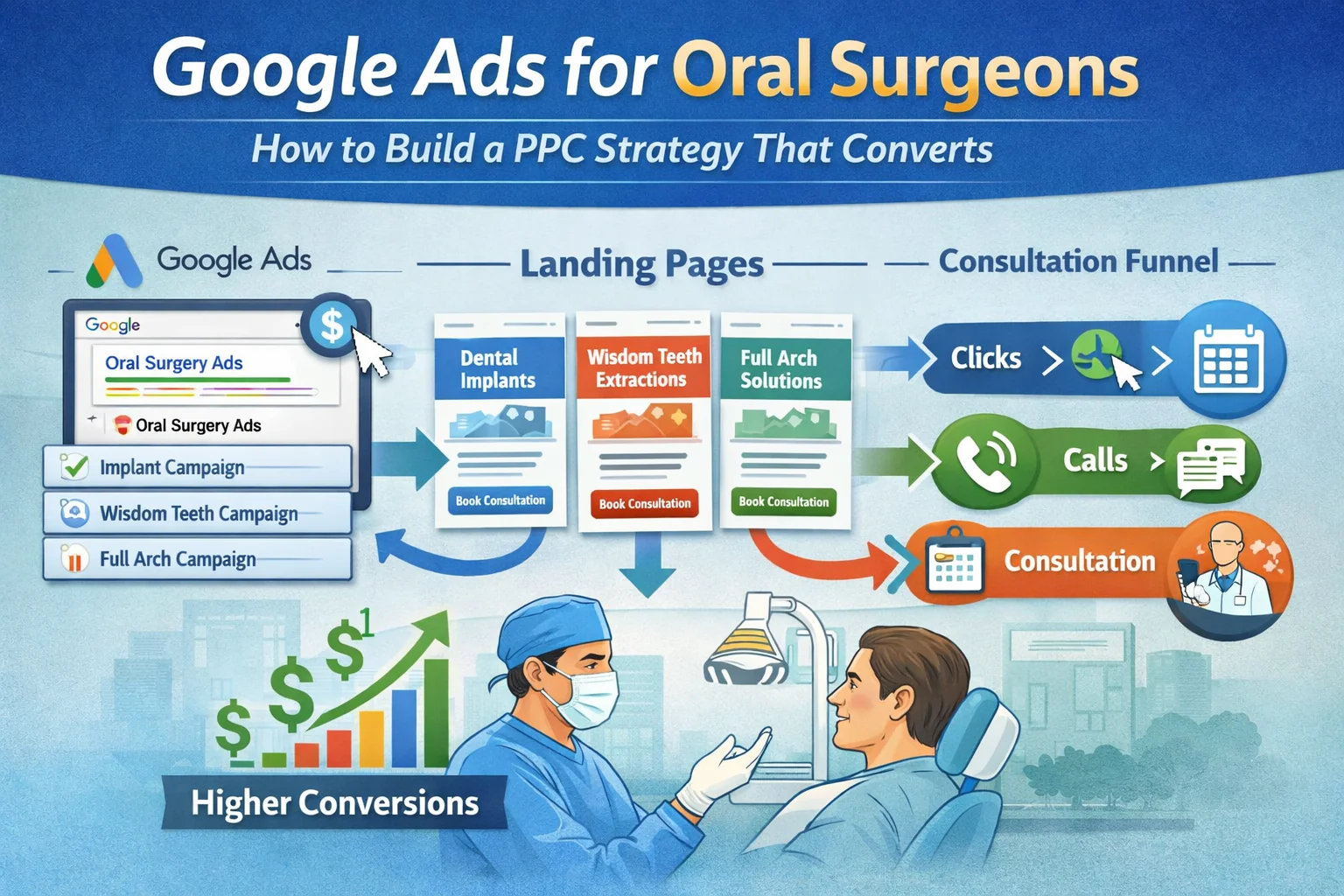 This guide shows oral surgery practices how to build a Google Ads PPC strategy that converts high-intent searchers into booked consults for dental implants, wisdom teeth extractions, bone grafts, and full-arch cases—without wasting budget on low-intent clicks or straining general-practitioner referral relationships. This guide shows oral surgery practices how to build a Google Ads PPC strategy that converts high-intent searchers into booked consults for dental implants, wisdom teeth extractions, bone grafts, and full-arch cases—without wasting budget on low-intent clicks or straining general-practitioner referral relationships.
The pattern we see most often: oral surgery accounts built on a general-dentistry playbook. One campaign, broad keywords, ads pointing at the homepage, and conversion tracking that counts clicks instead of patients. That structure works for cleanings and whitening. It doesn’t work when your case mix is 80% implants, extractions, bone grafts, and full-arch restorations with average case values 10× higher than a hygiene recall.
Already running Google Ads and not seeing results? Jump to common mistakes. Considering PPC for the first time? Start with how oral surgery differs.
Below, you’ll learn how to structure campaigns around your actual case mix, write ad copy that pre-qualifies surgical prospects, design landing pages that convert consults rather than general appointments, protect your referral base while running direct-to-consumer ads, and measure ROI on a per-procedure basis—so you can scale what’s working and cut what isn’t.
Written for: oral surgery practice owners, practice administrators, and marketing leads evaluating whether to launch, scale, or overhaul a Google Ads program.
TL;DR
If you only do six things, do these:
| • |
Segment campaigns by procedure - implants, wisdom teeth, and full-arch each need their own campaign with tailored copy, landing pages, and target CPAs
|
| • |
Prioritize high-intent commercial keywords - “oral surgeon near me,” “dental implants [city],” and “emergency wisdom tooth extraction” outperform informational keywords for paid spend
|
| • |
Build procedure-specific landing pages - homepages convert surgical consult seekers at a fraction of the rate of dedicated procedure pages
|
| • |
Track phone calls as primary conversions - most oral surgery consults start with a call, and call tracking is the single biggest measurement gap we find in existing accounts
|
| • |
Protect GP referral relationships - position your practice as a specialist complementing the general dentist, not replacing one, to grow direct-to-consumer cases without straining referral volume
|
| • |
Measure revenue per dollar spent, not just cost per lead - real ROI lives downstream in consult kept rates, case acceptance, and average case value |
Table of Contents
How oral surgery PPC differs from general dental Google Ads
Oral surgery has three economic and behavioral characteristics that make a standard dental marketing PPC playbook ineffective:
| • |
Higher case values - a single full-arch case can exceed $40,000, and a single implant case often exceeds $4,000, which changes the math on cost-per-lead and allowable cost-per-acquired-patient
|
| • |
More specialized search intent - patients searching “wisdom teeth removal near me” or “dental implant specialist” have different expectations and decision cycles than patients searching “dentist near me”
|
| • |
Dual audiences - you serve direct-to-consumer patients and referring general dentists at the same time, so your PPC strategy needs to consider both without alienating either |
In our work with oral surgery practices across the country, we commonly see accounts built like general dentistry accounts: one campaign, broad keywords, ads pointing at the homepage, and limited conversion tracking. That structure burns budget on low-intent visitors and obscures which procedures are actually profitable.
The economic reality: if your average implant case generates $4,500 in revenue and your allowable cost-per-acquired-patient is 10–15% of case value, you can spend $450–$675 per booked implant consult and still hit target economics. That’s enough budget to compete aggressively for high-intent surgical keywords—but only if your campaign structure captures that intent efficiently.
> Back to Table of Contents
High-value procedures and keyword intent
Not every oral surgery search signals the same buying stage. Organize your keyword strategy around three intent tiers and allocate budget accordingly.
High-intent commercial keywords (allocate the majority of your budget here):
| • |
“oral surgeon near me”
|
| • |
“dental implants [city name]”
|
| • |
“wisdom teeth extraction [city name]”
|
| • |
“emergency tooth extraction”
|
| • |
“full arch dental implants [city name]”
|
| • |
“oral surgeon that accepts [insurance provider]” |
Mid-intent research keywords (allocate modest budget; expect lower conversion rates):
| • |
“dental implants cost”
|
| • |
“wisdom teeth removal recovery”
|
| • |
“All-on-4 vs dentures”
|
| • |
“IV sedation oral surgery” |
Low-intent informational keywords (generally avoid in paid search; better captured through SEO and blog content):
| • |
“what is an oral surgeon”
|
| • |
“why do wisdom teeth need to be removed”
|
| • |
“how long does implant surgery take” |
A pattern we see consistently: accounts that bid on informational keywords burn budget on visitors who aren’t ready to book—one of the clearest ways dental PPC keywords waste budget instead of driving high-value cases. Those same searchers can be captured organically over time while your paid budget focuses on prospects actively looking for an oral surgeon.
Procedure-specific keyword pools to prioritize
Each major procedure in your case mix should become its own keyword pool and its own ad group or campaign—not a single shared ad group with mixed keywords.
| • |
Dental implants - single, multiple, All-on-4, All-on-X, and mini implants
|
| • |
Wisdom teeth extraction - routine, impacted, urgent/emergency, and pediatric
|
| • |
Bone grafting and sinus lifts - often bundled with implant searches but worth isolating to measure independently
|
| • |
Full-arch restoration and full-mouth reconstruction - longer sales cycle, higher case value, often wider geographic targeting
|
| • |
Corrective jaw surgery - if you offer orthognathic procedures
|
| • |
IV sedation and general anesthesia - use as modifiers on procedure keywords rather than primary keywords
|
| • |
Emergency extractions and dental trauma - separate urgent campaign with different landing page and response expectations |
> Back to Table of Contents
Campaign structure for oral surgery Google Ads
Oral surgery Google Ads accounts that perform share a consistent structural pattern. Start with separation by procedure category:
| • |
Implants campaign - with separate ad groups for single implant, multiple implants, and All-on-4/All-on-X
|
| • |
Wisdom teeth campaign - with ad groups for routine extraction, urgent/emergency, and consultation-focused searches
|
| • |
Full-arch campaign - kept separate because average case values and sales cycles are meaningfully different from single-tooth implant searches
|
| • |
Branded campaign - your practice name, doctor names, and brand variations to protect search traffic from competitors bidding on your name
|
| • |
Emergency/urgent campaign - if you take same-day surgical cases, this needs its own targeting, copy, and landing page built for patients in pain |
Why separate campaigns instead of shared ones: each procedure has different target CPAs, different landing pages, different ad copy, and often different geographic radii. Full-arch patients will drive two hours for the right surgeon; wisdom teeth patients won’t drive thirty minutes. Pooling them into one campaign prevents Google from optimizing for each procedure’s actual performance.
Ad group discipline: within each campaign, create 3–5 tightly themed ad groups. “Dental implants” should not be a single ad group with fifty keywords. Break it into cost-focused keywords, near-me keywords, specialist-focused keywords, and single-vs-full-arch groupings so ad copy can match each search theme.
Ad copy alignment: each ad group needs two to three responsive search ads with headlines that include the specific keyword theme. An implant-cost ad group should surface financing, consultation pricing transparency, and insurance acceptance. A near-me ad group should emphasize location, convenience, and same-week availability.
When to add Performance Max and Local Services Ads
Performance Max can work well for oral surgery once you have solid search campaign data and robust conversion tracking with accurate values. Start with search, build 30 to 60 days of reliable conversion data, then layer Performance Max as a supplement rather than a replacement.
Local Services Ads are worth testing in markets where they’re available for oral surgeons. They appear above traditional search ads, use a pay-per-lead pricing model, and offer the Google Screened badge. Lead quality varies significantly by market and category, so monitor the first 60 days closely and dispute off-target leads through the LSA dashboard to preserve your effective CPA. LSAs work best as a complement to traditional search campaigns.
> Back to Table of Contents
Landing pages that convert surgical consults
Sending Google Ads traffic to your homepage is one of the most common and most expensive mistakes in oral surgery PPC. Homepages are built for the general visitor; surgical consult seekers need procedure-specific landing pages with messaging and calls-to-action aligned to the ad that brought them there.
| • |
Headline that mirrors the ad - if the ad says “Dental Implants in [City],” the landing page H1 should say the same
|
| • |
Clear specialist positioning - board certifications, years in practice, procedure volume, and credentials visible above the fold
|
| • |
Sedation options stated explicitly - IV, general, and oral, because this is a primary concern for surgical patients and often the deciding factor
|
| • |
Financing and insurance transparency - not exact pricing, but honest information about the consultation process, payment plans, and insurance handling
|
| • |
Primary CTA above the fold - tap-to-call button on mobile, form on desktop, with the phone number persistent in the header as the user scrolls
|
| • |
Procedure-specific social proof - reviews from implant patients on implant pages, not generic practice testimonials
|
| • |
Consultation process explanation - what happens, how long it takes, what’s included, and whether imaging is performed at the consult
|
| • |
Procedure-specific FAQ section - addressing top concerns for that procedure rather than general practice FAQs |
Mobile-first design is non-negotiable. The majority of oral surgery Google Ads traffic comes through mobile, so your dental website mobile UX directly determines whether that traffic converts. If your landing page loads slowly, requires pinching to read, or hides the phone number behind a menu, you’re paying for clicks that bounce before they convert. Google’s Largest Contentful Paint threshold for a good mobile experience is 2.5 seconds—landing pages exceeding that threshold consistently underperform in both ad quality scores and actual booking rates.
The call button is the primary CTA
For oral surgery specifically, phone calls outperform form submissions for booking rates. Patients with surgical needs—especially pain-driven, trauma, or emergency searches—prefer to talk to a human immediately. Your mobile landing pages should have a tap-to-call button in the first 200 pixels, persistent in the header, and repeated at natural decision points throughout the page.
Forms still matter for non-urgent implant or full-arch prospects who are researching quietly before committing to a call. Offer both call and form options, but don’t bury the phone number. A short, three-to-four-field form (name, phone, procedure interest, preferred contact time) outperforms long qualification forms on first-touch landing pages because every additional field reduces completion rates.
> Back to Table of Contents
Budget, bidding, and expected performance
What you spend depends on case mix, market competition, geographic scope, and how mature your account is. Here are typical benchmarks we see across oral surgery accounts.
Monthly budget ranges for oral surgery practices:
| • |
Solo practice, single location, non-metro market - $3,000–$6,000/month
|
| • |
Multi-doctor practice or competitive urban market - $6,000–$15,000/month
|
| • |
Multi-location practice or full-arch specialist targeting a wide geographic region - $15,000–$40,000/month |
Typical cost-per-lead benchmarks (leads, not booked consults; expect a percentage of leads to fall off before becoming kept consults):
| • |
Wisdom teeth leads - $40–$100 per lead depending on market
|
| • |
General implant leads - $80–$250 per lead
|
| • |
Full-arch and All-on-X leads - $200–$600 per lead (higher because fewer searches compete across fewer advertisers bidding at higher budgets) |
Bidding strategy guidance:
| • |
New campaigns - start with Maximize Clicks or manual CPC to gather data efficiently before handing control to an automated strategy
|
| • |
After 30+ conversions in a 30-day window - move to Maximize Conversions so the algorithm has enough signal to optimize
|
| • |
Target CPA - now a setting within Maximize Conversions rather than a standalone bidding strategy; set a Target CPA only once you have at least 30 conversions and confidence in the right target
|
| • |
Target ROAS - generally avoid for oral surgery unless you have accurate revenue-per-conversion values flowing into Google Ads from your practice management system |
Results vary by staffing, market competition, landing page quality, and how quickly your front desk answers leads. These ranges are planning starting points, not guarantees. A practice with weak call handling can spend at the high end of these ranges and produce poor ROI, while a practice with strong intake processes can produce excellent ROI at the low end.
> Back to Table of Contents
Balancing PPC with general-practitioner referrals
This is the question oral surgeons ask most often, and it’s the one generic PPC agencies rarely answer well: will running Google Ads cannibalize my referring general dentists?
Done poorly, yes. Done well, no.
The cannibalization risk is real when:
| • |
Your ad copy heavily emphasizes “why skip your dentist” messaging
|
| • |
Your landing pages disparage or dismiss the role of general practitioners
|
| • |
You run broad dental keywords (“dentist near me”) that attract patients already connected to a GP
|
| • |
You target post-treatment follow-up care that properly belongs with the referring dentist |
The complementary approach looks like:
| • |
Ad copy that emphasizes surgical specialization rather than replacing the general dentist (“Specialist care for your surgical procedure”)
|
| • |
Landing pages that mention coordination with the patient’s general dentist for ongoing and restorative care
|
| • |
Keyword focus on surgical-specific terms, because patients who search “oral surgeon” typically already know they need one
|
| • |
Copy that respects the patient’s existing GP relationship and frames your role as specialized rather than competitive |
In our experience, practices that communicate transparently with their referral base about their PPC strategy—“we advertise to patients who don’t yet have a GP, and we always coordinate care back to the referring doctor for restorative work”—maintain strong referral volume while growing direct-to-consumer cases. Practices that hide their marketing or run adversarial copy often create avoidable friction with their referring dentists. Our complete guide to oral surgeon marketing covers the broader patient acquisition and referral playbook in depth.
> Back to Table of Contents
Common mistakes we see in oral surgery PPC accounts
When we audit existing oral surgery Google Ads accounts, the same issues surface repeatedly. Each one is fixable, and most produce measurable improvement within 30 days of correction.
| • |
Sending all traffic to the homepage - procedure-specific landing pages typically convert at multiples of the homepage rate; this is the single highest-impact fix in most accounts
|
| • |
Running broad match keywords without negative keyword lists - broad match on “dental implants” will match “dental implant cleaning,” “cheap dental implants abroad,” and “dental implant training course,” all wasted spend
|
| • |
Tracking form submissions but not calls - without call tracking, you’re measuring 20–30% of your actual leads and making optimization decisions on incomplete data
|
| • |
No conversion tracking at all - some accounts run for months with only clicks and impressions as metrics, which makes ROI impossible to measure
|
| • |
Targeting too wide a geographic radius - wisdom teeth patients won’t drive 90 minutes for surgery; match radius to procedure type and case value
|
| • |
Pausing accounts during slow months - Google’s learning algorithms penalize stop-start patterns, so lower budgets rather than pausing entirely
|
| • |
Ignoring the search terms report - this shows what users actually typed to trigger your ads; review it weekly and add irrelevant terms as negative keywords
|
| • |
Generic ad copy that could belong to any practice - specific credentials, procedure volume, sedation options, and specialist positioning drive better click-through and conversion rates than “quality care, caring staff, call today”
|
| • |
No offline conversion import - if kept consults and accepted cases aren’t imported back into Google Ads, the algorithm optimizes for clicks and form fills instead of the outcomes that actually matter |
> Back to Table of Contents
Measuring real ROI on Google Ads spend
The metric that matters for oral surgery PPC is revenue per dollar of ad spend, not cost per click or even cost per lead. Everything else is a leading indicator of that final number.
To measure it accurately, you need to track six data points monthly:
| 1. |
Leads generated - calls plus form fills plus chats, with duplicates removed across channels
|
| 2. |
Consults scheduled - the lead-to-scheduled-consult rate often reveals front desk intake issues more than ad issues
|
| 3. |
Consults kept - the no-show rate separates lead quality from operational execution
|
| 4. |
Cases treatment-planned - how many kept consults produced an actual treatment plan
|
| 5. |
Cases accepted - treatment plan presentation and financing availability dominate this number
|
| 6. |
Revenue produced - separated by procedure type so you can calculate per-procedure ROI |
Most oral surgery practices can’t answer all six questions honestly for their Google Ads leads. Building this reporting—even on a simple spreadsheet—often reveals where the real drop-off happens, and it’s rarely at the ad level.
The operational reality: Google Ads can deliver excellent cost-per-lead and still produce weak ROI if leads aren’t answered promptly, consults aren’t scheduled flexibly, or case acceptance is weak at presentation. Ad performance is only the first link in a five-link chain, and the downstream links usually matter more to final economics.
In our work with oral surgery practices, we consistently find the biggest ROI wins come from fixing post-click workflows: front desk response speed, after-hours lead handling, consult scheduling flexibility, financing presentation, and treatment plan follow-up. Ads can be performing exactly as designed and still produce disappointing ROI when the rest of the operation doesn’t support them.
A simple monthly review: pull ad spend, leads, consults kept, cases accepted, and revenue produced. Calculate cost per consult kept, cost per accepted case, and revenue per dollar spent. Track the trend over three to six months before making major budget decisions, and separate the trend by procedure type because implants and full-arch usually produce very different ROI curves on the same ad spend.
> Back to Table of Contents
Ready to build your oral surgery PPC strategy?
WEO Media’s oral surgery marketing team has worked with practices across the country to build, audit, and scale Google Ads programs for dental implant marketing, wisdom teeth, full-arch, and trauma care—aligned to case mix, referral dynamics, and growth goals. If you want a second opinion on your current PPC account, a strategic plan for launching one, or a full-service partner for ongoing management, our team can help.
Call us at 888-246-6906 to start a conversation about your practice’s specific case mix, market, and growth targets.
> Back to Table of Contents
FAQs
What is a reasonable monthly Google Ads budget for an oral surgery practice?
Monthly Google Ads budgets for oral surgery practices typically range from $3,000 to $6,000 for solo practices in non-metro markets, $6,000 to $15,000 for multi-doctor practices or competitive urban markets, and $15,000 to $40,000 or more for multi-location practices or full-arch specialists targeting wide geographic regions. Running below $3,000 per month in competitive markets often produces inconsistent results because Google’s learning algorithms need enough conversion data to optimize effectively.
Should oral surgeons run Google Ads if most cases come from GP referrals?
Yes, if your goals include controlled growth or reducing concentration risk from over-reliance on a small number of referring dentists. Google Ads reach patients who don’t currently have a general dentist or whose GP doesn’t refer to your practice. The key is running campaigns that position your practice as a surgical specialist complementing the general dentist, not replacing one. Practices that communicate their PPC strategy transparently with referring doctors typically maintain referral volume while growing direct-to-consumer cases.
How long until Google Ads produces measurable results for oral surgery?
New Google Ads campaigns typically need 60 to 90 days to reach stable performance. The first 30 days gather data and expose issues like negative keyword gaps, weak ad copy, and landing page friction. Optimization in days 31 through 60 usually produces measurable CPA improvement. Accounts that switch agencies or strategies every 30 days rarely reach the optimization phase where most of the gains happen, so commit to a meaningful testing window before evaluating performance.
Do oral surgeons need separate landing pages for each procedure?
Yes, at minimum for your top three procedures by case value or search volume. Sending implant searchers, wisdom teeth searchers, and full-arch searchers to the same generic page produces significantly lower conversion rates than procedure-specific landing pages with matching headlines, tailored social proof, and procedure-relevant CTAs. The production cost of building three or four procedure-specific landing pages is typically recovered in the first 30 to 60 days of campaign performance.
Are Local Services Ads worth it for oral surgeons?
Local Services Ads can be worth testing in markets where they’re available for oral surgeons. They appear above traditional search ads, use a pay-per-lead pricing model, and display the Google Screened badge. Lead quality varies significantly by market and category, so monitor the first 60 days closely and dispute off-target leads through the LSA dashboard to preserve your effective cost per lead. Local Services Ads work best as a supplement to traditional search campaigns rather than a replacement.
How do I know if my PPC leads are actually becoming patients?
Track six numbers monthly: leads generated, consults scheduled, consults kept, cases treatment-planned, cases accepted, and revenue produced. Divide revenue produced by monthly ad spend to calculate return on ad spend. Most practices can’t answer all six questions for their PPC leads, and that reporting gap is often where the biggest optimization opportunities hide. Importing offline conversions (kept consults and accepted cases) back into Google Ads also helps the algorithm optimize for the outcomes that actually matter to the practice.
Should oral surgeons bid on competitor names in Google Ads?
Competitor bidding is legal and common in oral surgery PPC, but it carries tradeoffs. You’ll pay higher cost-per-click because competitor keywords have low quality scores, and some competitors may reciprocate by bidding on your name. If you pursue competitor bidding, also defend your own brand with a branded campaign so competitors can’t siphon your search traffic cheaply. Many oral surgery practices find better ROI in non-branded procedure keywords than in competitor bidding strategies.
Can oral surgeons manage Google Ads in-house or should they hire an agency?
Some oral surgery practices successfully manage Google Ads in-house with dedicated internal time of 5 to 10 hours weekly for active optimization. Most practices don’t sustain that commitment long-term because PPC management competes with clinical priorities and administrative work. Agencies bring specialized tooling, cross-account benchmarking data, and continuous optimization capacity. The right choice depends on your internal capacity, the consistency of your available time, and whether your case values and growth goals justify the management fee in addition to ad spend. |
|