Google Ads for Periodontists: How to Build a PPC Strategy That Converts
Posted on 4/14/2026 by WEO Media |
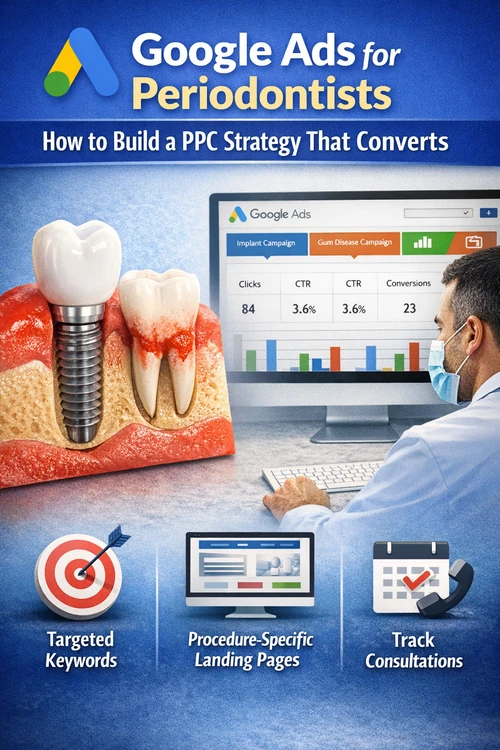 Google Ads for periodontists converts high-intent dental implant and gum disease patients into booked consultations only when the PPC strategy is built around procedure-specific campaigns—not broad dental searches like “dentist near me.” This guide shows periodontists how to structure campaigns, choose keywords, write ad copy, and build landing pages that attract qualified implant, gum disease, and referral patients without burning budget on clicks that never become consults. Google Ads for periodontists converts high-intent dental implant and gum disease patients into booked consultations only when the PPC strategy is built around procedure-specific campaigns—not broad dental searches like “dentist near me.” This guide shows periodontists how to structure campaigns, choose keywords, write ad copy, and build landing pages that attract qualified implant, gum disease, and referral patients without burning budget on clicks that never become consults.
The pattern we see across periodontal practices: accounts get set up like a general dental campaign, target broad terms, and burn through budget on clicks that never convert. The fix isn’t more spend—it’s tighter targeting, better tracking, and landing pages built for the procedures that actually drive revenue.
If you’re new to dental PPC fundamentals, start with the basics of dental pay-per-click advertising first. This guide assumes you understand how Google Ads bidding, match types, and conversion tracking work at a basic level.
Written for: periodontists, practice owners, and marketing managers who want to use Google Ads to grow implant, gum disease treatment, and referral-based case volume.
TL;DR
If you only do six things, do these:
- Separate campaigns by procedure - implants, gum disease, gum grafting, and crown lengthening each need their own ad groups, ad copy, and landing pages
- Use phrase and exact match—not broad - broad match in periodontal PPC consistently wastes budget on irrelevant clicks
- Build a negative keyword list before launch - exclude general dentistry, DIY, cheap, free, jobs, and student-related terms
- Send clicks to procedure-specific landing pages - never your homepage; every campaign needs a dedicated page that matches the ad
- Track calls, forms, and consults as separate conversions - call tracking is non-negotiable for periodontal practices
- Measure cost per consult, not cost per click - the only metric that matters is what you spend to get a qualified patient in the chair
Table of Contents
Why Google Ads for periodontists is different from general dentistry PPC
General dental PPC is a volume game—cleanings, exams, whitening. Periodontal PPC is a precision game. You’re trying to reach a much smaller pool of patients searching for specific, often expensive procedures, and you’re competing against general dentists who also offer implants, oral surgeons, and other specialists. If you haven’t already invested in SEO for periodontists alongside paid search, your PPC will work harder than it should.
Three things make periodontal PPC unique:
| • |
Procedure-specific search intent - patients aren’t searching for “periodontist”; they’re searching for “dental implants near me,” “gum disease treatment,” or “bleeding gums dentist”
|
| • |
Higher case values, lower volume - one implant case can be worth more than dozens of cleanings, so cost-per-acquisition tolerances are different
|
| • |
Mixed referral and direct-to-consumer dynamics - some patients arrive via GP referral, but more are self-referring after symptoms or research |
This means your account can’t look like a general dental account. You need tighter campaigns, more aggressive negative keywords, and landing pages built for high-consideration procedures.
> Back to Table of Contents
How to structure your periodontal Google Ads account
The biggest mistake periodontists make is dumping every keyword into one campaign. The right structure separates campaigns by procedure so each has its own budget, bid strategy, ad copy, and landing page. For a deeper look at this approach, see our guide on structuring dental PPC campaigns to attract high-value cases.
Recommended campaign structure
| 1. |
Dental Implants - your highest-value campaign; should usually receive the largest share of budget
|
| 2. |
Gum Disease Treatment - covers scaling and root planing, periodontal maintenance, and laser gum treatment
|
| 3. |
Gum Grafting and Recession - smaller volume but high-intent searches
|
| 4. |
Crown Lengthening and Cosmetic Perio - lower volume; only run if you have capacity
|
| 5. |
Brand and Competitor - protect your practice name and bid on local competitor terms strategically |
Why separation matters
When you separate campaigns this way, you can see exactly which procedures are driving consults, adjust budgets by performance, and write ad copy that mirrors what the patient typed. A “dental implants” ad shouldn’t mention gum disease, and a “bleeding gums” ad shouldn’t mention implants. Match intent to message at every step.
> Back to Table of Contents
The highest-intent keywords for periodontal PPC
Not all periodontal keywords are equal. Some signal a patient ready to book; others signal someone doing early research who won’t convert for weeks or months. Bid aggressively on high-intent terms and either avoid or carefully manage research-stage terms. Our breakdown of the best dental PPC keywords for high-value patient acquisition covers this prioritization in more detail.
High-intent implant keywords
| • |
Transactional - “dental implants near me,” “dental implant consultation,” “tooth replacement options”
|
| • |
Procedure-specific - “all-on-4 dental implants,” “single tooth implant,” “full mouth implants”
|
| • |
Problem-aware - “missing tooth replacement,” “denture alternatives,” “failed bridge replacement” |
High-intent gum disease keywords
| • |
Symptomatic - “bleeding gums dentist,” “swollen gums treatment,” “receding gums treatment”
|
| • |
Diagnosis-aware - “periodontitis treatment,” “gingivitis treatment,” “deep cleaning dental”
|
| • |
Treatment-specific - “scaling and root planing,” “laser gum treatment,” “LANAP near me” |
Why match types matter
For periodontal PPC, default to phrase match and exact match. Broad match—even with modern Google Ads improvements—will pull in irrelevant searches like “dental insurance” or “dentist hiring near me.” Tight match types plus a strong negative keyword list is the only way to keep cost per consult in line.
> Back to Table of Contents
Negative keywords every periodontist needs from day one
Negative keywords tell Google what NOT to show your ads for. For periodontists, this list matters more than for almost any other dental specialty because broad dental searches can drain budget fast. If you’re inheriting an existing account, our guide to PPC keywords that waste budget vs. drive high ROI is a useful starting point for cleanup.
Build these negative keyword categories before launch:
| • |
General dentistry terms - cleaning, whitening, exam, checkup, cavity, filling, kids dentist, pediatric
|
| • |
Career and education terms - jobs, hiring, salary, school, residency, student, training, courses
|
| • |
DIY and price-shopping terms - DIY, home remedy, free, cheap, cheapest, low cost, financing only
|
| • |
Insurance and Medicaid terms - if you don’t accept Medicaid or specific insurance plans, exclude them
|
| • |
Wrong-specialty terms - orthodontist, oral surgeon, endodontist, root canal (unless you offer it)
|
| • |
Information-only terms - what is, definition, meaning, symptoms (unless you want education traffic) |
Review the search terms report weekly for the first month after launch and add new negatives based on what’s actually triggering your ads. This single habit—weekly negative keyword grooming—separates profitable periodontal accounts from money-losing ones.
> Back to Table of Contents
Ad copy and landing pages built for periodontal conversions
Once your structure and keywords are dialed in, the ad and the landing page do the actual conversion work. Periodontal patients are making a high-stakes decision, so the messaging has to do more than just announce you exist.
What strong periodontal ad copy includes
| • |
The exact procedure in the headline (matches the search query)
|
| • |
A trust signal - board certification, years of experience, technology offered
|
| • |
A specific outcome - “Same-day implant consultations” or “Sedation available”
|
| • |
A clear call to action - “Request a Consultation” beats “Learn More” for high-intent searches
|
| • |
Ad extensions - sitelinks to specific procedures, call extensions, location extensions |
What landing pages must do
Send every paid click to a procedure-specific landing page—never the homepage. The landing page should mirror the ad word-for-word in the headline, explain the procedure in plain language, address common fears (pain, cost, recovery), show the periodontist’s credentials, and offer multiple ways to convert: a form, a click-to-call button, and a chat option. For implant campaigns specifically, our walkthrough on building dental implant landing pages that convert covers the layout and copy patterns that work.
A pattern we commonly see: practices spend thousands on Google Ads but send everyone to a generic homepage. The result is a 1–2% conversion rate when a dedicated landing page would deliver 5–10%. The math on that gap is brutal.
> Back to Table of Contents
Conversion tracking and measuring ROI
You cannot improve a periodontal Google Ads account you can’t measure. The accounts that scale profitably are the ones that track every meaningful action and connect ad spend to actual patient revenue. If you’re not yet using dental call tracking to measure marketing ROI by source, that’s the first gap to close.
Track these as separate conversions:
| • |
Phone calls from ads - use a call tracking number with a minimum call duration (commonly 60 seconds) to filter out hangups
|
| • |
Form submissions - new patient inquiry forms on landing pages
|
| • |
Chat conversations - if you use a chat tool, track engaged conversations as a conversion
|
| • |
Booked consultations - the ultimate metric; requires connecting your practice management system to your ad data |
The metric that actually matters
Cost per click and click-through rate are vanity metrics for periodontal PPC. The metric that matters is cost per booked consultation—or even better, cost per started case. If you don’t know that number, you don’t know if your Google Ads are working. If your CPA is creeping up, our guide on lowering dental Google Ads cost per acquisition without losing lead quality walks through the levers that actually move it. Build a simple weekly report that shows ad spend, leads, consultations booked, consultations kept, and cases started. Review it every Monday.
> Back to Table of Contents
Budget and bid strategy for periodontal practices
Periodontal PPC is expensive per click. Implant keywords are some of the most competitive in all of healthcare advertising. A small budget spread across too many campaigns will produce nothing but frustration.
Budget guidance:
| • |
Concentrate, don’t spread - it’s better to dominate one campaign (usually implants) than to underfund five
|
| • |
Plan for a learning period - the first 30–60 days are about gathering data, not maximizing ROI
|
| • |
Use Maximize Conversions or Target CPA bidding only after you have at least 30 conversions in a 30-day window
|
| • |
Start with Manual CPC on new accounts so you control bids while Google’s algorithms gather data
|
| • |
Day-part by call answer hours - don’t run search ads when no one can answer the phone |
A common pattern: practices want to test PPC with a tiny budget across implants, gum disease, and brand campaigns simultaneously. The result is too little data per campaign to optimize anything. Pick one procedure, fund it properly for 60–90 days, prove the model, then expand. If you’re worried about attracting the wrong implant inquiries, our piece on marketing dental implants without attracting price shoppers is worth reading alongside this section.
> Back to Table of Contents
Common Google Ads mistakes periodontists make
After auditing hundreds of dental PPC accounts, the same mistakes show up over and over. Avoid these and you’re ahead of most periodontal practices already running ads. For a broader list, see our breakdown of Google Ads mistakes dentists make that waste the most money.
| 1. |
Sending clicks to the homepage - kills conversion rate and wastes budget
|
| 2. |
Using broad match keywords - drains budget on irrelevant searches
|
| 3. |
No negative keyword list - same problem, different angle
|
| 4. |
Running only Performance Max - PMax can hide where spend is going; pair it with traditional Search campaigns
|
| 5. |
Not tracking phone calls - most periodontal conversions happen by phone; if you’re not tracking calls you’re flying blind
|
| 6. |
Pausing during “slow” weeks - ad accounts lose momentum and learning data; better to lower budget than pause
|
| 7. |
Bidding on every procedure equally - implants and gum disease have very different economics
|
| 8. |
Setting it and forgetting it - PPC requires weekly attention, especially in the first 90 days |
> Back to Table of Contents
Get help building your periodontal Google Ads strategy
Google Ads for periodontists rewards specialization and punishes generalists. If you’d rather focus on patients than spend your evenings inside Google Ads, our team builds and manages periodontal PPC accounts as part of a complete periodontist marketing strategy. To talk through your goals, current account, or what a periodontal PPC build-out would look like, call us at 888-246-6906 or request a strategy session through our website.
> Back to Table of Contents
FAQs
How much should a periodontist spend on Google Ads per month?
Periodontal PPC budgets vary widely based on market competition, procedures targeted, and growth goals. The more important question is whether your budget is large enough to gather meaningful data—generally at least 30 conversions per campaign per month. Underfunding a campaign produces no data and no patients, so it’s usually better to concentrate budget on one procedure (typically implants) than to spread it thin across multiple campaigns.
Are Google Ads worth it for a periodontist?
Google Ads can be highly profitable for periodontists when the account is built correctly—procedure-specific campaigns, tight match types, strong negative keywords, dedicated landing pages, and call tracking. Because case values for implants and full-mouth treatment are high, even one or two cases per month can produce a strong return. Poorly built accounts, however, can burn budget quickly with little to show for it.
Should periodontists use Performance Max campaigns?
Performance Max can work for periodontal practices but should rarely be the only campaign type. PMax obscures which placements and queries drive results, which makes optimization difficult. The stronger approach is traditional Search campaigns with phrase and exact match keywords for core procedures, with Performance Max layered on top once you have a baseline of conversion data.
What is the best landing page for a periodontal Google Ads campaign?
The best landing page is one built specifically for the procedure being advertised, not a homepage or general services page. It should match the ad headline word-for-word, explain the procedure clearly, address common patient concerns (pain, cost, recovery), display the periodontist’s credentials, and offer multiple conversion paths including a form, click-to-call button, and chat option.
How long does it take for periodontal Google Ads to start working?
Most periodontal Google Ads accounts need 30 to 90 days to gather enough data for meaningful optimization. The first 30 days are typically a learning period where Google’s algorithms calibrate and the account team identifies negative keywords and underperforming ad groups. Practices expecting immediate ROI in week one are usually disappointed; practices that commit to 90 days of disciplined management typically see strong results.
Should I bid on competitor periodontist names in Google Ads?
Bidding on competitor names is allowed by Google but should be approached carefully. You cannot use competitor names in your ad copy, and click costs can be high because of low quality scores on those keywords. For some periodontal practices, a small competitor campaign produces meaningful patient volume; for others, it’s a budget drain. Test it with a controlled budget and measure cost per consult before scaling.
What conversions should I track for periodontal PPC?
Track phone calls from ads (with a minimum call duration filter), form submissions on landing pages, chat conversations if you use chat software, and ideally booked consultations connected back from your practice management system. The ultimate metric is cost per booked consultation or cost per started case—not cost per click or click-through rate.
|
|