Dental Patient Journey Map: 7 Stages From Awareness to Acceptance
Posted on 12/31/2025 by WEO Media |
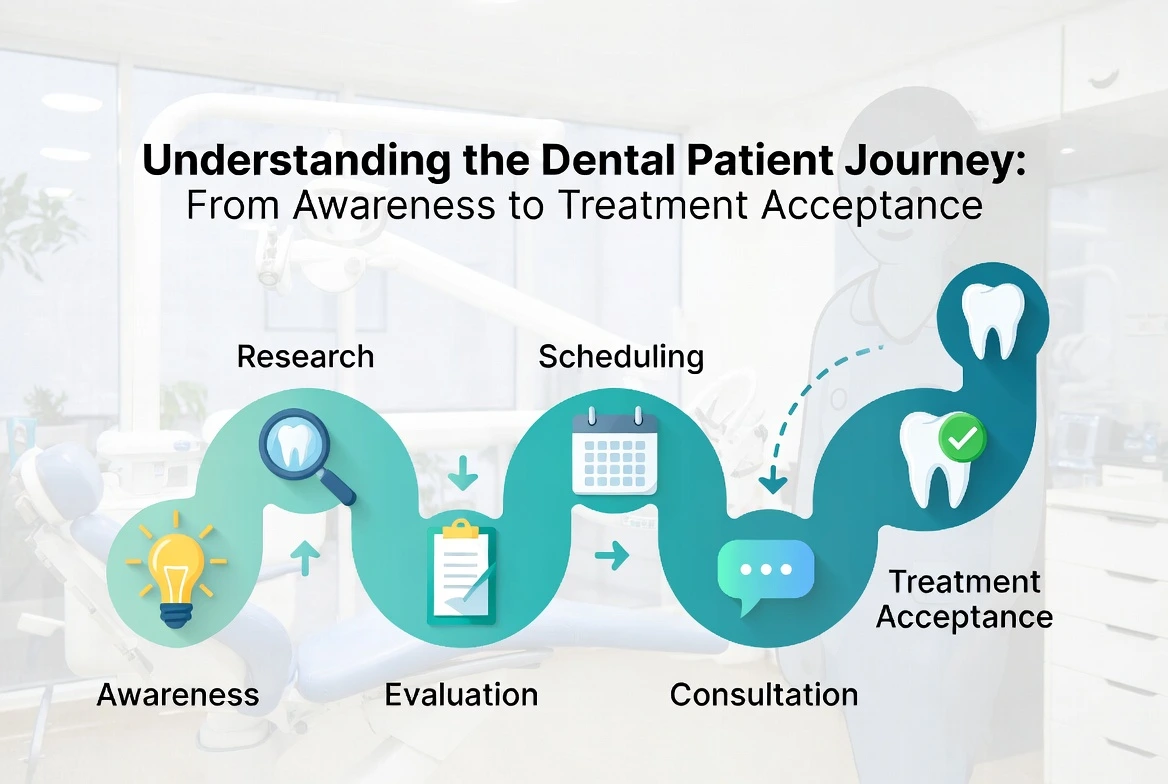 The modern dental patient journey is a multi-stage decision process shaped by psychology, user intent, and the evolving ways patients search for and evaluate dental care. Each stage—from initial awareness to final treatment acceptance—requires strategic alignment between marketing, messaging, and the in-office experience. The modern dental patient journey is a multi-stage decision process shaped by psychology, user intent, and the evolving ways patients search for and evaluate dental care. Each stage—from initial awareness to final treatment acceptance—requires strategic alignment between marketing, messaging, and the in-office experience.
As a framework for dental practices, this journey highlights where patients experience friction, what influences their decision-making, and how communication clarity impacts outcomes. Insights from WEO Media - Dental Marketing and our dental marketing experts reflect industry-wide best practices rooted in behavioral research, search engine patterns, and patient experience design.
Stage 1 — Awareness: Recognizing a Need or Problem
Awareness begins when a patient identifies a concern or becomes curious about improving their oral health. Search engines typically register these users as early-intent searchers—those typing symptom-based queries (“why does my tooth hurt?”) or exploratory terms (“what is a dental implant?”). At this point, the individual is not solution-focused; they are problem-validating.
During this stage, content that informs rather than persuades performs best. Search engines prioritize pages that demonstrate expertise and clearly address informational intent.
| • |
Common patient thoughts - “Do I need to get this checked out?” “Is this normal?”
|
| • |
Friction points - Conflicting online advice and uncertainty about urgency.
|
| • |
Opportunities - Educational blogs and guides that map symptoms to potential causes with clear next steps. |
Our dental marketing agency often sees that practices with strong educational content at this stage naturally earn authority signals and earlier patient trust—two key components in later conversion stages.
Stage 2 — Consideration: Exploring Solutions and Providers
Once patients understand their concern, their intent shifts toward evaluating options. Search terms become more solution-oriented (“best treatment for gum recession,” “Invisalign vs. braces”). Search engines label these as mid-intent queries, where comparison, clarity, and depth matter.
Patients are also beginning to assess providers. They are collecting evidence of credibility, often through reviews, before-and-after photos, or explanations of treatment processes.
| • |
Common patient thoughts - “What are my options?” “Who can I trust with this?”
|
| • |
Friction points - Fear of choosing the wrong provider or misunderstanding procedures.
|
| • |
Opportunities - Clear subpages for each treatment, transparent explanations, and credibility markers such as social proof. |
Our dental marketing company recommends that practices address both clinical and emotional factors here, as patients rely heavily on reassurance before moving into a decision-ready mindset.
Stage 3 — Evaluation: Narrowing Choices and Deciding Whether to Reach Out
Patients in the evaluation stage compare not only what your practice offers but also how it is communicated. Page structure, tone, and clarity directly influence trust. Algorithmically, search engines favor sites with intuitive navigation and strong topical authority—factors that also benefit users.
At this point, the patient’s internal dialogue becomes more personal and experience-focused.
| • |
Common patient thoughts - “Will I feel comfortable here?” “Is this practice experienced with my needs?”
|
| • |
Friction points - Limited social proof, lack of human-centered communication, overwhelming technical language.
|
| • |
Opportunities - Patient stories, approachable language, and structured content that walks readers through what to expect. |
Because this stage is psychologically sensitive, practices see better engagement when explanations reduce uncertainty and emphasize clarity rather than persuasion.
Stage 4 — Conversion: The First Contact and Appointment Scheduling
Conversion occurs when the patient feels confident enough to take action—usually by calling, texting, or booking online. Any friction here disproportionately impacts results.
From a usability perspective, search engines and users both reward streamlined experiences. Slow load times, unclear calls to action, and overly complex forms increase abandonment rates.
| • |
Common patient thoughts - “Is scheduling simple?” “Will someone respond quickly?”
|
| • |
Friction points - Complicated forms, delayed replies, uncertainty about appointment types.
|
| • |
Opportunities - Logical navigation, simplified booking steps, and warm, consistent communication. |
Industry best practices show that transparency and friction reduction—not persuasion—drive higher conversion at this stage.
Stage 5 — Consultation Experience: Building Trust and Understanding
During the consultation, the patient begins evaluating the practice on emotional and experiential criteria as much as clinical expertise. This moment carries significant weight: first impressions, communication style, and clarity of explanation all influence treatment acceptance later.
Search intent transitions off-screen here, but the psychological principles remain the same—patients want confidence, predictability, and a sense of partnership.
| • |
Common patient thoughts - “Do they understand my goals?” “Do I feel respected and heard?”
|
| • |
Friction points - Jargon-heavy discussions, rushed interactions, unclear diagnostic pathways.
|
| • |
Opportunities - Visual demonstrations, step-by-step explanations, and an empathetic communication style. |
Practices that excel at this stage often see significantly higher long-term patient satisfaction and retention.
Stage 6 — Treatment Presentation: Explaining Options and Value
Presenting treatment requires balancing clarity, transparency, and patient autonomy. Behavioral research shows that patients decide emotionally but justify logically—meaning the presentation must address both the “why” and the “how.”
Patients need time to understand the benefits, risks, costs, and expectations, all delivered in an organized, digestible format.
| • |
Common patient thoughts - “Will this solve my problem?” “Is this worth the investment?”
|
| • |
Friction points - Complex terminology, unclear pricing, pressure-based communication.
|
| • |
Opportunities - Visual aids, structured breakdowns, realistic timelines, and transparent financial explanations. |
Search engines reward clear, structured information for these topics as well, reinforcing the value of strong practice-level content.
Stage 7 — Acceptance: Committing to Treatment
Acceptance occurs when the patient trusts the provider, understands the plan, and feels confident in their ability to manage the financial commitment. Much of this trust is earned through earlier stages of the journey, not during the presentation itself.
Here, emotional reassurance and logistical clarity are more influential than persuasion.
| • |
Common patient thoughts - “I feel comfortable moving forward.” “This will truly help me.”
|
| • |
Friction points - Fear of pain, financial uncertainty, misunderstanding of the next steps.
|
| • |
Opportunities - Reinforcing expected outcomes, outlining support systems, and offering clear scheduling pathways. |
Practices that guide patients with transparency and empathy see higher acceptance rates over time.
Aligning Marketing With the Modern Dental Patient Mindset
Today’s patients expect consistency between what they see online and what they experience in person. Algorithm behavior mirrors this expectation by prioritizing content that is expert-level, structured, and user-focused. When marketing frameworks support patient psychology—clarity, trust-building, emotional reassurance—practices see stronger engagement and smoother journeys.
A single strategic brand mention fits most naturally here:
Insights developed by WEO Media - Dental Marketing emphasize that lasting patient trust comes from establishing topical authority, reducing cognitive load, and aligning messaging with user intent across every stage of the journey. Rather than relying on promotional tactics, our dental marketing experts focus on frameworks that help practices communicate clearly and meet patients exactly where they are in their decision process.
By understanding and optimizing each stage, practices can create a cohesive, trustworthy patient experience that supports informed decisions from the first moment of awareness through treatment acceptance.
FAQs
Why is mapping the dental patient journey so important?
Understanding the patient journey helps dental practices identify friction points, align messaging with user intent, and create a smoother decision-making experience. Each stage—from awareness to acceptance—reflects different psychological needs and expectations, making strategic communication essential for trust-building and treatment readiness.
How does search intent influence the early stages of the patient journey?
Search intent shifts as patients move from problem awareness to solution exploration. Early queries are symptom-based and informational, while later searches focus on treatments and providers. Content aligned with these intent types performs better algorithmically and helps guide patients more effectively through their research process.
What role does website structure play in a patient's evaluation of a dental practice?
Patients interpret website clarity, navigation, and readability as indicators of professionalism and trustworthiness. Search engines also favor well-structured sites with strong topical authority. Together, these factors influence how patients perceive the practice before they ever make contact.
Which stage most affects treatment acceptance?
While acceptance happens at the end of the journey, earlier stages—especially the consultation and treatment presentation—carry the most influence. Patients commit to treatment when they feel informed, emotionally supported, and confident in both the provider and the proposed plan.
How can dental practices reduce friction during the scheduling process?
Streamlined navigation, simplified booking forms, fast response times, and clear expectations all reduce friction. Practices benefit from processes that minimize cognitive load and reduce uncertainty—two key factors that influence whether a patient follows through with scheduling. |
|