How to Optimize Google Business Profile Categories for Dentists
Posted on 12/25/2025 by WEO Media |
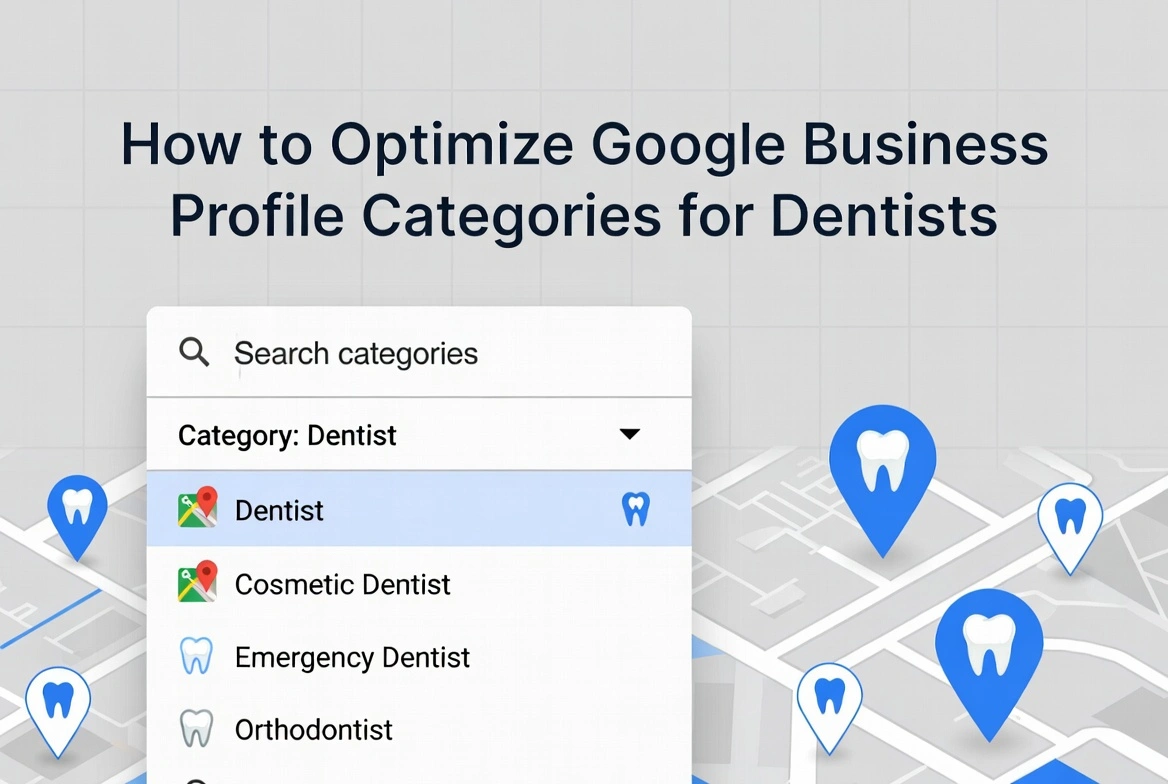 Choosing accurate Google Business Profile (GBP) categories is one of the strongest ways dentists can improve map pack visibility and ensure their listings match high-intent searches. Because Google uses categories to understand what a business is—not simply what it offers—category precision directly affects ranking, relevance, and how consistently your profile appears for searches like “dentist near me,” “emergency dentist,” or “dental implants.” Choosing accurate Google Business Profile (GBP) categories is one of the strongest ways dentists can improve map pack visibility and ensure their listings match high-intent searches. Because Google uses categories to understand what a business is—not simply what it offers—category precision directly affects ranking, relevance, and how consistently your profile appears for searches like “dentist near me,” “emergency dentist,” or “dental implants.”
WEO Media – Dental Marketing evaluates GBP category patterns across markets, helping clarify how Google’s category logic, practitioner guidelines, and user intent interact. This article provides a framework based on observed algorithm behavior rather than assumptions or outdated tactics.
How Google Business Profile Categories Influence Local SEO for Dentists
Google relies heavily on categories to determine whether a local business aligns with user intent. Categories act as a classification system that influences which searches your practice appears for, especially within the map pack.
GBP categories influence ranking through:
| • |
Relevance Matching - Categories help Google determine whether your practice is an appropriate result for specific dental queries.
|
| • |
Local Entity Classification - Categories place your practice into dental-specific clusters such as orthodontics, periodontics, or pediatric care.
|
| • |
User Intent Alignment - Different categories map to different high-intent behaviors, such as urgent care, cosmetic enhancement, or specialty treatment.
|
| • |
Competitive Context - Practices with clearer identity-based categories tend to appear more consistently for the searches that matter most. |
Our dental marketing experts frequently observe measurable visibility changes shortly after category corrections, especially when practices shift from broad or inaccurate selections to precise ones.
The Only GBP Categories Available to Dentists
Google restricts category selection to a predefined list. A dental practice may choose one primary category and up to nine secondary categories (maximum of 10 total).
Here are the only available GBP categories for dentists and dental specialists:
| • |
Cosmetic dentist
|
| • |
Dental clinic
|
| • |
Dental hygienist
|
| • |
Dental implants periodontist
|
| • |
Dental implants provider
|
| • |
Dental laboratory
|
| • |
Dental radiology
|
| • |
Dentist
|
| • |
Denture care center
|
| • |
Emergency dental service
|
| • |
Endodontist
|
| • |
Oral and maxillofacial surgeon
|
| • |
Oral surgeon
|
| • |
Orthodontist
|
| • |
Pediatric dentist
|
| • |
Periodontist
|
| • |
Prosthodontist
|
| • |
Teeth whitening service |
Google does not allow custom categories, so strategic selection from this list is essential.
How to Follow Google’s Category Guidelines
Google instructs businesses to select categories that complete the sentence:
“This business IS a …”
—not—
“This business HAS or OFFERS …”
This guideline prevents businesses from listing every service and instead focuses on their true professional identity.
Examples for dental practices:
| • |
Correct Application – A practice that strongly identifies with cosmetic dentistry may appropriately choose “Cosmetic dentist.”
|
| • |
Incorrect Application – Selecting “Teeth whitening service” solely because whitening is offered, even if it’s not a defining aspect of the business. |
Our dental marketing agency frequently sees ranking improvements when practices reduce unnecessary categories and focus on identity-driven selections.
Best Primary Category for Most Dental Practices
The primary category shapes the strongest relevance signals for Google’s algorithm.
For general practices, the best primary category is: Dentist
This aligns with broad search behavior and ensures visibility for patients who have not yet narrowed their treatment needs.
Specialty practices should choose a specialty category as primary, such as:
| • |
Orthodontist
|
| • |
Endodontist
|
| • |
Pediatric dentist
|
| • |
Periodontist
|
| • |
Oral surgeon
|
| • |
Prosthodontist |
Selecting the correct specialty category helps Google classify your expertise and match you with more relevant high-intent searches.
Strategic Secondary Category Selection for Dentists
Secondary categories refine Google’s understanding of your practice, helping you appear for additional—but still relevant—intent clusters. Although up to nine secondary categories may be added, precision matters more than quantity.
Common strategic choices include:
| • |
Cosmetic dentist
|
| • |
Dental clinic
|
| • |
Dental implants provider
|
| • |
Dental implants periodontist
|
| • |
Denture care center
|
| • |
Emergency dental service
|
| • |
Teeth whitening service (when cosmetic identity is central) |
Adding categories solely because they are available can weaken overall clarity, so each choice should reinforce what the practice is.
Recommended Category Combinations for Different Dental Practice Types
Below are category combinations aligned with Google’s identity-based category guidelines:
| • |
General Dentistry - Dentist (primary), Dental clinic, Cosmetic dentist, Emergency dental service, Denture care center.
|
| • |
Implant-Focused Practices - Dentist (primary), Dental implants provider, Dental implants periodontist, Oral surgeon (as applicable).
|
| • |
Cosmetic Practices - Cosmetic dentist (primary only if identity-based), Dentist, Teeth whitening service.
|
| • |
Pediatric Practices - Pediatric dentist (primary), Dentist, Emergency dental service.
|
| • |
Orthodontic Practices - Orthodontist (primary), Dentist.
|
| • |
Endodontic Practices - Endodontist (primary), Dentist, Emergency dental service.
|
| • |
Oral Surgery Practices - Oral surgeon or Oral and maxillofacial surgeon (primary), Dentist. |
Our dental marketing company advises using only the categories that reflect your core identity, even if that means selecting fewer than ten.
Common Category Mistakes Dentists Should Avoid
Most category issues stem from misunderstanding the “IS a …” guideline or attempting to broaden reach by adding more options.
Avoid the following:
| • |
Using too many categories - This dilutes relevance and reduces consistency across search types.
|
| • |
Selecting categories for minor or occasional services - Categories must define your practice, not your offerings.
|
| • |
Incorrectly labeling specialists - Specialists should not select “Dentist” as primary unless they provide general dental services.
|
| • |
Mixing identity with service listings - Categories should never be a full menu of procedures. |
Simplifying categories often produces clearer intent signals and better ranking stability.
How Practitioner Listings Affect GBP Category Strategy
Google distinguishes between a dental practice (the organization) and the individual dentists (practitioners) who work there. This affects both naming and category strategy.
Key guidelines include:
| • |
Practitioners may have their own profile if they directly serve patients and can be contacted at the location.
|
| • |
Multiple dentists at one location should each have their own practitioner profile separate from the practice listing.
|
| • |
Practitioner profiles must use only the dentist’s name, without including the practice name.
|
| • |
Solo practitioners in branded locations may use formats such as “Brand: Practitioner Name.”
|
| • |
Practitioners cannot create multiple profiles for different specialties or services. |
Practitioner listings often use specialty categories, while practice listings maintain broader classifications. This improves Google’s ability to distinguish entities without creating category overlap.
How Proper Categories Improve Map Pack Visibility and Patient Calls
Optimized categories clarify practice identity, enabling Google to match your profile with the most relevant search intents. This improves:
| • |
Ranking stability by reinforcing clear relevance signals.
|
| • |
Visibility for high-intent services such as emergency care, orthodontics, or implants.
|
| • |
Discovery search impressions among users exploring general dental options.
|
| • |
Patient engagement and call volume by ensuring users see the most relevant provider for their needs. |
These improvements originate from better algorithmic clarity, not from simply increasing the number of categories selected.
A Framework for Selecting GBP Categories for Dental Practices
A structured, identity-first approach ensures compliance with guidelines and improves local SEO performance:
| 1. |
Define the core identity of the practice (general, cosmetic, pediatric, surgical, etc.).
|
| 2. |
Select a primary category that best completes the sentence “This business IS a …”.
|
| 3. |
Choose secondary categories only if they further describe what the practice is, not what it offers.
|
| 4. |
Use only the number of categories needed to reflect identity (often 3–6).
|
| 5. |
Reassess categories quarterly or when the practice’s identity evolves. |
This framework supports consistent visibility and aligns with observed patterns analyzed by our dental marketing experts.
FAQs
How many categories can a dental practice include on Google Business Profile?
A dental practice may use one primary category and up to nine secondary categories. However, most practices see better performance by selecting only the categories that reflect their true identity rather than filling all available slots.
What is the best primary category for a general dentist?
The primary category “Dentist” is most appropriate for general practices because it aligns with broad search intent and accurately represents the practice identity.
Can specialists choose multiple specialty categories?
No. Specialists must select the category that best represents their primary specialty. Google prohibits practitioners from creating multiple profiles or using multiple specialty identities within one listing.
Should dentists have practitioner profiles in addition to the main practice profile?
Dentists may create practitioner profiles if they serve patients directly and can be contacted at the location during stated hours. Practitioner profiles must use only the dentist’s name and must not include the practice name or duplicate specialties. |
|